
ROB-320 · Lesson 5 of 12 · 30 min
Real-time scheduling theory
Measuring a system tells you what it did; scheduling theory tells you what it will do. Given each task's period, deadline and worst-case execution time, the results in this lesson decide in advance whether every job of every task will meet its deadline under a particular scheduling policy, even in the worst possible alignment of releases. The tests are short calculations, easy to automate and fast enough to rerun every time the firmware changes. They rest on assumptions that real systems only approximate, and part of this lesson is about what to add when those assumptions are broken by context switches, interrupts, blocking on shared resources and release jitter.
The task model
The classic model, due to Liu and Layland in 1973, describes each task \( \tau_i \) by three numbers: its worst-case execution time \( C_i \), its period \( T_i \) (or minimum inter-arrival time for sporadic tasks) and its relative deadline \( D_i \), often equal to \( T_i \). Its utilization is \( U_i = C_i / T_i \), and the task set's total utilization is
The basic model also assumes tasks are independent (no shared resources), run on one processor, can be preempted at any instant, and that kernel overheads are zero. These assumptions are relaxed later in the lesson. A first, obvious condition follows immediately: no scheduler can meet all deadlines on one processor if \( U > 1 \), because the tasks demand more than 100 % of the processor over the long run.
Fixed-priority scheduling and rate-monotonic priorities
Most RTOSes, and the interrupt controllers of most microcontrollers, schedule by fixed priority: each task has a priority that does not change, and the highest-priority ready task runs. The question is how to assign priorities. Liu and Layland proved that when deadlines equal periods, rate-monotonic (RM) assignment, giving higher priority to tasks with shorter periods, is optimal among fixed-priority schemes: if any fixed-priority assignment meets all deadlines, RM does. When deadlines are shorter than periods, deadline-monotonic assignment (shorter deadline, higher priority) is optimal instead. In practice this means the joint loop at 1 kHz should outrank the trajectory generator at 250 Hz, which should outrank telemetry at 50 Hz, regardless of which feels most important; importance is handled by giving important functions short enough periods and deadlines.
Liu and Layland also gave a simple sufficient test. Under RM, a set of n tasks with deadlines equal to periods is schedulable if
The bound is 1.0 for one task, 0.828 for two, 0.780 for three and falls toward \( \ln 2 \approx 0.693 \) as n grows. It is sufficient but not necessary: a task set above the bound may still be schedulable, and often is. Task sets with harmonic periods, where each period divides the longer ones (1, 2, 4, 8 ms), are schedulable under RM right up to U = 1, which is one reason designers choose harmonic rates.
Worked problem
Applying the Liu and Layland bound
Three tasks have (C, T) of (1, 4), (2, 6) and (3, 12) ms. Is the set schedulable under rate-monotonic priorities by the utilization bound?
Show solution
- Utilization: \( 1/4 + 2/6 + 3/12 = 0.250 + 0.333 + 0.250 = 0.833 \).
- Bound for n = 3: \( 3(2^{1/3} - 1) = 0.780 \).
- 0.833 exceeds 0.780.
Answer: The bound test is inconclusive: the set may or may not be schedulable. An exact test, response-time analysis, is needed.
Response-time analysis
Response-time analysis (RTA), developed by Joseph and Pandya and by Audsley and colleagues in the 1980s and 1990s, gives an exact test for fixed-priority scheduling. The worst-case response time of task i occurs when it is released at the same instant as every higher-priority task, the critical instant. Its response time is its own execution time plus the interference from every higher-priority task j released during that time:
Because \( R_i \) appears on both sides, the equation is solved by iteration: start with \( R_i^{(0)} = C_i \), substitute to get the next value, and repeat until the value stops changing (the task is schedulable if the converged \( R_i \le D_i \)) or exceeds the deadline (it is not). The ceiling counts how many times each higher-priority task can be released within the window.
Worked problem
Response-time analysis by hand
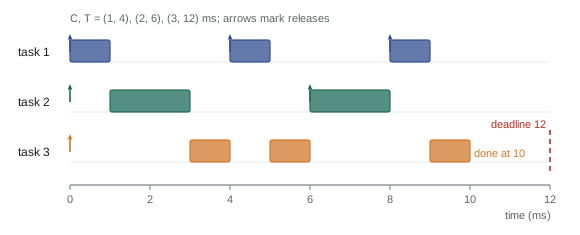
For the tasks (1, 4), (2, 6) and (3, 12) ms under RM priorities, find the worst-case response time of each.
Show solution
- Task 1 (highest): \( R_1 = 1 \) ms ≤ 4.
- Task 2: start at 2; \( 2 + \lceil 2/4 \rceil \cdot 1 = 3 \); then \( 2 + \lceil 3/4 \rceil \cdot 1 = 3 \). \( R_2 = 3 \) ms ≤ 6.
- Task 3: start at 3; \( 3 + \lceil 3/4 \rceil + 2\lceil 3/6 \rceil = 6 \); \( 3 + \lceil 6/4 \rceil + 2\lceil 6/6 \rceil = 7 \); \( 3 + 2 + 2 \cdot 2 = 9 \); \( 3 + 3 + 4 = 10 \); \( 3 + 3 + 4 = 10 \). \( R_3 = 10 \) ms ≤ 12.
Answer: All three meet their deadlines, with task 3 finishing at worst 10 ms into its 12 ms period. The set is schedulable even though its utilization of 0.833 exceeds the Liu and Layland bound.
import math

def rta(tasks):
    """tasks: list of (name, C, T, D), highest priority first. Returns response times."""
    out = []
    for i, (name, C, T, D) in enumerate(tasks):
        R = C
        while True:
            nxt = C + sum(math.ceil(R / Tj) * Cj for _, Cj, Tj, _ in tasks[:i])
            if nxt == R or nxt > D:
                R = nxt
                break
            R = nxt
        out.append((name, R, D, R <= D))
    return out

def ll_bound(n):
    return n * (2 ** (1 / n) - 1)

sets = {
    "example": [("t1", 1, 4, 4), ("t2", 2, 6, 6), ("t3", 3, 12, 12)],
    "tight":   [("t1", 2, 5, 5), ("t2", 4, 7, 7)],
}
for label, ts in sets.items():
    U = sum(C / T for _, C, T, _ in ts)
    print("%s: U = %.3f, LL bound = %.3f" % (label, U, ll_bound(len(ts))))
    for name, R, D, ok in rta(ts):
print(" %s: R = %d, D = %d, %s" % (name, R, D, "meets" if ok else "MISSES"))example: U = 0.833, LL bound = 0.780 t1: R = 1, D = 4, meets t2: R = 3, D = 6, meets t3: R = 10, D = 12, meets tight: U = 0.971, LL bound = 0.828 t1: R = 2, D = 5, meets t2: R = 8, D = 7, MISSES
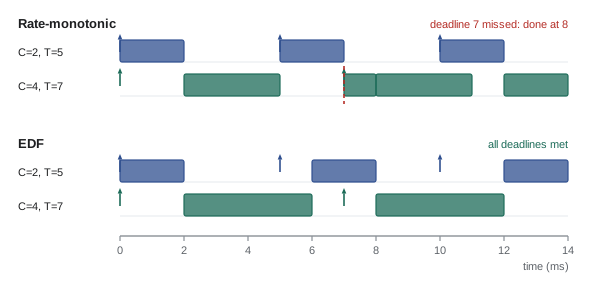
The second task set has utilization 0.971. Under fixed priorities its lower-priority task needs 8 ms but has only 7, so no fixed-priority assignment works (the other order fails too). The next section shows a scheduler that handles it.
Earliest deadline first
Earliest deadline first (EDF) is a dynamic-priority policy: at each moment, the ready job whose absolute deadline is soonest runs. Liu and Layland showed that for independent preemptible tasks with deadlines equal to periods, EDF meets every deadline if and only if \( U \le 1 \). It is optimal on one processor: if any scheduler can meet all deadlines, EDF can. The 'tight' task set above, with U = 0.971, is schedulable under EDF.
If EDF is so good, why do most RTOSes use fixed priorities? Several reasons. Fixed priorities map directly onto interrupt controllers and simple kernels. Their overload behavior is predictable: when the system is overloaded, the lowest-priority tasks miss deadlines and the important high-rate tasks keep running, whereas under EDF an overload can cause a cascade of misses across many tasks. And fixed-priority systems are easier to reason about during debugging. EDF is available in some kernels, including Linux's SCHED_DEADLINE policy (lesson 9), and is attractive when utilization must be pushed close to 100 %.
Worked problem
Utilization headroom
A controller runs four tasks with harmonic periods of 1, 2, 4 and 8 ms and execution times of 0.25, 0.4, 0.6 and 1.2 ms. Is it schedulable under RM, and how much processor capacity is left?
Show solution
- U = 0.25 + 0.20 + 0.15 + 0.15 = 0.75.
- With harmonic periods, RM schedules any set with \( U \le 1 \).
Answer: Yes. The set is schedulable with 25 % of the processor spare. With non-harmonic periods the four-task bound would be 0.757, so the set would still pass, but only just.
Making the model realistic
Real systems break the textbook assumptions in predictable ways, and RTA extends to cover each of them.
- Kernel overheads: add the cost of two context switches (and any scheduler work) to each task's C, or model the tick interrupt as an extra highest-priority task.
- Interrupts: interrupt routines effectively run above every task. Include each one in the interference sum with its own C and minimum inter-arrival time.
- Blocking: when a task waits for a resource held by a lower-priority task, its response time grows by a blocking term \( B_i \). With the priority ceiling or inheritance protocols of lesson 6, \( B_i \) is bounded by the longest critical section of a lower-priority task that can block it.
- Release jitter: if a task's release can be delayed by up to \( J_j \) after its nominal time, more of its releases can fall inside a window. The interference term uses \( \lceil (R_i + J_j)/T_j \rceil \), and the response time measured from the nominal release becomes \( R_i + J_i \).
Putting these together gives the response-time equation most practitioners use:
Worked problem
Adding blocking and an interrupt
Task 2 from the earlier example (C = 2, T = D = 6 ms) can be blocked for up to 0.5 ms by a lower-priority task holding a mutex, and a CAN receive interrupt of 0.2 ms can arrive at most every 1 ms. Task 1 still has C = 1, T = 4. Find task 2's response time.
Show solution
- Start: \( R = 2 + 0.5 = 2.5 \).
- Iterate: \( 2.5 + \lceil 2.5/4 \rceil \cdot 1 + \lceil 2.5/1 \rceil \cdot 0.2 = 2.5 + 1 + 0.6 = 4.1 \).
- Next: \( 2.5 + \lceil 4.1/4 \rceil + \lceil 4.1/1 \rceil \cdot 0.2 = 2.5 + 2 + 1.0 = 5.5 \).
- Next: \( 2.5 + 2 + \lceil 5.5/1 \rceil \cdot 0.2 = 2.5 + 2 + 1.2 = 5.7 \); then \( 2.5 + 2 + 1.2 = 5.7 \).
Answer: Task 2's worst-case response time rises from 3 ms to 5.7 ms, still within its 6 ms deadline but with very little margin. Interrupts and blocking, ignored in the textbook model, nearly doubled it.
Multicore scheduling
Modern robot computers have several cores, and multicore scheduling is considerably harder. In partitioned scheduling, each task is assigned to one core and each core is scheduled independently, so the single-core tests apply per core; the difficulty moves to the bin-packing problem of assigning tasks to cores. In global scheduling, any task can run on any core, which can use capacity better but brings timing anomalies and much weaker tests, and makes WCET harder to bound because tasks migrate between caches. Most hard real-time robot software uses partitioning: the control tasks are pinned to dedicated cores, and lesson 9 shows how Linux supports this with CPU affinity and isolation.
Common mistakes
MistakeGiving the highest priority to the task that seems most important
InsteadAssign rate-monotonic or deadline-monotonic priorities.
MistakeConcluding a set is unschedulable because it exceeds the Liu and Layland bound
InsteadUse response-time analysis; the bound is only sufficient.
MistakeRunning RTA with execution times that exclude kernel overhead
InsteadAdd context-switch and scheduler costs to each task's C.
MistakeIgnoring interrupts and blocking in the analysis
InsteadInclude interrupts in the interference sum and add a blocking term.
MistakeAssuming EDF behaves gracefully under overload
InsteadExpect cascading misses and protect critical tasks if overload is possible.
Summary and key terms
- Each task is modeled by its worst-case execution time, period and deadline; total utilization above 1 is never schedulable on one core.
- Rate-monotonic priorities are optimal among fixed-priority schemes when deadlines equal periods.
- The Liu and Layland bound \( n(2^{1/n} - 1) \) is a quick sufficient test, and harmonic periods allow utilization up to 1.
- Response-time analysis iterates \( R_i = C_i + \sum \lceil R_i/T_j \rceil C_j \) for an exact fixed-priority test.
- EDF meets all deadlines whenever \( U \le 1 \) but behaves less predictably under overload.
- Realistic analysis adds kernel overhead, interrupts, blocking terms and release jitter.
- Multicore hard real-time systems usually partition tasks onto cores and analyze each core separately.
- Utilization
- A task's execution time divided by its period; summed over tasks for the whole set.
- Rate-monotonic
- Fixed priorities assigned so that shorter periods get higher priority.
- Deadline-monotonic
- Fixed priorities assigned so that shorter deadlines get higher priority.
- Critical instant
- The release pattern that produces a task's worst-case response time.
- Response-time analysis
- An iterative exact test of fixed-priority schedulability.
- Liu and Layland bound
- The utilization below which rate-monotonic scheduling is guaranteed to work.
- Harmonic periods
- Periods that each divide every longer period in the set.
- EDF
- Earliest deadline first: the job with the soonest absolute deadline runs.
- Blocking term
- Extra response time caused by lower-priority tasks holding shared resources.
- Partitioned scheduling
- Assigning each task permanently to one core.
Practice problems
Work each problem on paper first, then reveal the answer to check.
What is the Liu and Layland bound for two tasks?
Show answer
About 0.828.
Tasks (2, 10) and (3, 15): what is U?
Show answer
0.4.
Under RM, which runs first: a 2 ms period task or a 5 ms one?
Show answer
The 2 ms task.
Are periods 2, 4 and 10 ms harmonic?
Show answer
No; 4 does not divide 10.
Compute R for C = 1, with one higher task (1, 3).
Show answer
R = 2.
Under EDF, what is the schedulability condition for D = T?
Show answer
\( U \le 1 \).
What extra term models a task held up by a lower-priority mutex holder?
Show answer
The blocking term \( B_i \).
How are interrupts treated in RTA?
Show answer
As highest-priority tasks in the interference sum.
Name the Linux policy that implements EDF.
Show answer
SCHED_DEADLINE.
What is the main difficulty of partitioned multicore scheduling?
Show answer
Assigning tasks to cores, a bin-packing problem.
Lesson quiz · 5 questions
Score 60% or more to complete this lesson.
Create a free account to save your progress, take quizzes and earn a certificate.