
ROB-450 · Lesson 12 of 12 · 27 min
Capstone: a safety case and compliance review
This capstone brings the course together by building the core of a safety case and a compliance review for an invented service robot deployment. A safety case is a structured argument, supported by evidence, that a system is acceptably safe for a specific use in a specific environment. Unlike a compliance checklist, which shows that listed requirements were met, a safety case explains why the system is safe, which matters most for novel systems where no checklist is complete. Safety cases have long been required for nuclear plants, offshore installations and railways, are central to the new global regulation for automated driving systems described in lesson 7, and are the organizing idea of UL 4600 for autonomous products. Robot companies increasingly use them for deployments in public and care settings. Everything in the scenario is invented, and the compliance points illustrate the method rather than giving legal advice.
The scenario
Harbourview Health Center, an invented 400-bed hospital, plans to deploy twelve autonomous delivery robots made by an invented company, Ferro Robotics. Each robot weighs 90 kg loaded, travels at up to 1.2 m/s, carries medications, specimens and supplies in locked compartments opened by staff badges, rides elevators through an integration with the elevator controller, and navigates corridors used by staff, patients, visitors and children. It uses safety-rated laser scanners and bumpers for protective stopping, cameras with a learned person-detection model for path planning, and a voice interface that answers simple questions. A cloud-hosted fleet manager assigns tasks, and Ferro updates software remotely. The hospital wants to start with two wards and expand.
| Element | Decision for the capstone |
|---|---|
| Operational domain | Indoor corridors, elevators and ward entrances of two wards and the pharmacy; 24 hours; no outdoor travel; no use in emergency department |
| People present | Staff, patients including frail and confused patients, visitors including children, people using wheelchairs, walkers and canes, people with visual or hearing impairments |
| Foreseeable misuse | Children riding or climbing, people blocking robots, staff overloading compartments, patients following robots into restricted areas |
| Interfaces | Elevators, automatic and fire doors, badge system, hospital network, fleet manager in the cloud |
| Out of scope | Clinical decisions; robots do not interact physically with patients |
Structuring the argument
A safety case has three parts: claims (what is asserted, such as the robots are acceptably safe for use in the defined wards), arguments (why the evidence supports the claims, such as by addressing every identified hazard) and evidence (test reports, analyses, certificates, procedures). Goal Structuring Notation (GSN), developed in the 1990s and maintained as a community standard, draws the argument as a tree: goals are claims, strategies explain how a goal is broken down, solutions are evidence, and context and assumption nodes record the conditions. A good safety case also records defeaters, reasons the argument might be wrong, and shows how they were addressed, which guards against confirmation bias.
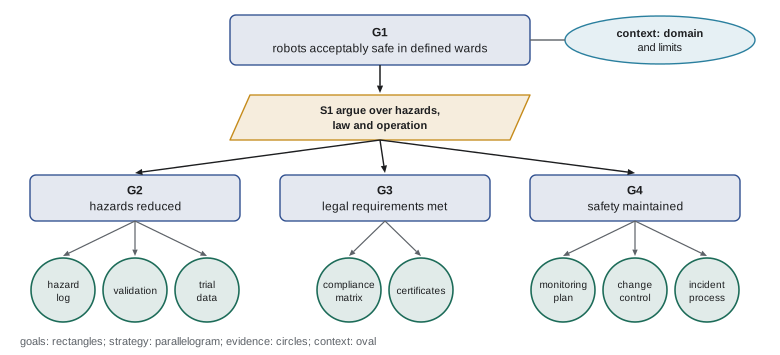
UL 4600 sets out what a safety case for an autonomous product should cover, including hazards from the autonomy itself, the operational design domain, perception and machine learning limitations, data and testing, human interaction, cybersecurity and field monitoring, and it requires independent assessment. For this capstone, the safety case has three branches under the top claim: hazards are reduced to acceptable levels; legal requirements are met; and safety is maintained in operation.
Branch 1: hazards and safety functions
The hazard log uses task-based analysis and STPA, as in lesson 2. Each hazard is assessed, and safety functions are specified with required performance levels using the ISO 13849-1 risk graph, as in lesson 3.
| Hazard | Main measures | Safety function and PLr |
|---|---|---|
| Collision with a pedestrian in a corridor | Speed 1.2 m/s in open corridors, 0.5 m/s near wards, 0.3 m/s at corners; soft bumpers; low height lights | Speed-dependent protective field stop; safely limited speed; PL d (S2, F2, P1) |
| Collision with a person lying on the floor | Lower scanner plane, 3D camera for obstacle detection, bumper | Protective stop on low obstacle; PL d |
| Trapping in an elevator with a patient on a stretcher | Robot rides only empty cars or yields; doors monitored; staff override | Elevator interlock and yield function; PL d |
| Blocking a fire exit or fire door | No-stop zones; fire alarm integration sends robots to safe parking | Fire alarm response function; PL c |
| Pinching fingers in a compartment lid | Low closing force, edge sensor | Lid force limitation; PL b |
| Tipping on a ramp | Static stability check; ramp speed limit; route restrictions | Inherent design, no control function claimed |
| Battery fire | Certified packs, battery management system, charging room with detection | Battery management; PL c for over-temperature shutdown |
| Wrong delivery of medications | Badge-controlled compartments, audit logs; clinical checks remain with staff | Outside machinery safety; covered by hospital medication processes |
Worked problem
Checking the evidence from trials
Ferro reports 40,000 km of hospital trials elsewhere with zero contacts between robots and people that caused injury. The Harbourview fleet will travel about 110,000 km a year. What does the trial evidence show on its own?
Show solution
- With zero events, the 95 percent upper confidence bound on the rate is about \( 3/40\,000 = 7.5 \times 10^{-5} \) per km.
- Applied to 110,000 km, the upper bound is about \( 8.3 \) injurious contacts a year.
- The trials are consistent with a very low rate but cannot rule out a rate that would be unacceptable.
- The safety case therefore rests mainly on design and validation evidence for safety functions, with field data as supporting and monitoring evidence.
Answer: The trial data alone allow up to about eight injurious contacts a year at 95 percent confidence, so the argument must rely on validated safety functions rather than mileage, as lesson 7 showed for automated vehicles.
# Residual-risk tally for the hazard log and a check of what field data can show (illustrative)
import math
hazards = {   # name: (annual frequency of hazardous event after measures, prob. of serious injury given event)
    "corridor collision":       (0.40, 0.02),
    "low obstacle collision":   (0.05, 0.05),
    "elevator trapping":        (0.02, 0.05),
    "fire exit blocked":        (0.01, 0.10),
    "lid pinch":                (2.00, 0.001),
    "battery fire":             (0.002, 0.30),
}
total = 0.0
for name, (f, p) in sorted(hazards.items(), key=lambda kv: -kv[1][0] * kv[1][1]):
    r = f * p
    total += r
    print(f"{name:24s} serious injuries per year {r:.4f}")
print(f"total {total:.4f} per year, about one per {1 / total:.0f} years")
# how many fleet-km without injury would show a rate below the total, at 95% confidence?
km_per_year = 12 * 25 * 365
rate_per_km = total / km_per_year
print(f"fleet km per year: {km_per_year:,}; km needed with zero events: {-math.log(0.05) / rate_per_km:,.0f}")corridor collision serious injuries per year 0.0080 low obstacle collision serious injuries per year 0.0025 lid pinch serious injuries per year 0.0020 elevator trapping serious injuries per year 0.0010 fire exit blocked serious injuries per year 0.0010 battery fire serious injuries per year 0.0006 total 0.0151 per year, about one per 66 years fleet km per year: 109,500; km needed with zero events: 21,724,019
The tally identifies the corridor collision as the dominant residual risk, which directs attention to speed limits and field design in busy areas. It also shows that years of operation would be needed to confirm the estimate from field data, so monitoring near misses, not only injuries, is essential: the fleet's safety-rated stops, close passes and bumper activations provide far more data than injuries ever will.
Branch 2: legal compliance
The compliance review lists every legal requirement, the evidence that it is met and the owner responsible. The robot is not a medical device, because it has no medical intended use, but the hospital setting brings health privacy, accessibility and elevator rules into play.
For a hospital in a US state, the main items are these. Workplace safety: the hospital's duties under OSHA standards and the General Duty Clause, or the state plan, with Ferro's risk assessment, validation records and training. Electrical approval: NRTL listing of robots and chargers. Elevators: the integration with elevator controls must comply with ASME A17.1 and be accepted by the state or local elevator authority. Fire safety: the Life Safety Code (NFPA 101) as applied by the authority having jurisdiction and by accreditation bodies, including keeping egress clear. Accessibility: the Americans with Disabilities Act requires that robots do not block accessible routes. Privacy: cameras will capture images of patients, which can be protected health information, so the hospital as a HIPAA covered entity needs a risk analysis under the Security Rule, a business associate agreement with Ferro if Ferro handles protected health information, and limits on collection, use and retention. State privacy and biometric laws may also apply. Product liability, insurance and the contract allocate the remaining risk.
| Area | Requirement source | Evidence | Owner |
|---|---|---|---|
| Machinery safety | Type-C standards ISO 3691-4 and ISO 13482 by analogy; ISO 13849-1 | Risk assessment, validation report, PL calculations | Ferro |
| Electrical safety | Certification or listing | Certificates for robot and charger | Ferro |
| Elevator integration | Elevator code and regulator acceptance | Approved integration design, acceptance test | Hospital and elevator contractor |
| Fire and egress | Fire code and life safety requirements | Fire alarm integration test, no-stop zone map | Hospital |
| Accessibility | Accessibility and human rights law | Route review with accessibility experts, complaint process | Hospital |
| Health privacy | Health privacy law | Privacy impact assessment, agreement with Ferro, retention settings | Hospital and Ferro |
| Cybersecurity | IEC 62443 practices; hospital security policy | Zone design, penetration test, update process, SBOM | Ferro and hospital IT |
| AI transparency | Honest claims, consumer and human rights law | Voice interface discloses it is automated; performance limits documented | Ferro |
Branch 3: safety in operation and ethics
A safety case is not finished at go-live. The third branch argues that safety is maintained: staff are trained; routes and speed zones are reviewed after the first month; near misses and safety stops are monitored weekly; software updates follow a change control procedure with Ferro, including regression testing of safety functions and notice to the hospital before deployment; incidents are investigated and reported as the law requires; and the safety case is reviewed when the deployment expands to new wards, when the robots or their software change significantly and at least annually.
The ethics review, which lessons 9 and 11 support, asks questions the law may not. Will robots shift workload in unexpected ways, for example by making nurses wait at doors to receive deliveries? Are patients and visitors told about cameras in plain language? Could confused patients be frightened, and how will staff respond? Will the robots be used to monitor staff performance? Who decides, and how are workers and their unions involved? Recording these questions and the decisions made strengthens the safety case and builds trust.
Worked problem
Writing a defeater and its rebuttal
A reviewer challenges the claim that collisions with people lying on the floor are adequately controlled, noting that the lower scanner plane may not detect a person lying parallel to the robot's path in a dark corner. Write the defeater and a rebuttal with evidence.
Show solution
- Defeater: the low-obstacle protective function may fail to detect a person lying parallel to the path in a dark area.
- Analysis: the 3D camera is not safety rated, so it cannot be claimed as the protective function; the scanner's lower plane detects objects above 50 mm.
- Rebuttal evidence: tests with a mannequin lying at several angles, including parallel, in lighting from 0 to 500 lux, showing detection at all positions by the scanner plane; bumper activation tests as a backup.
- Residual measure: reduced speed at night in ward corridors, and staff procedures for patients known to be at risk of falls.
Answer: The defeater is recorded with test evidence that the safety-rated scanner detects the mannequin in all tested positions and lighting, plus additional night speed limits, and the reviewer's acceptance is recorded.
Deliverables
The capstone deliverable is a concise safety case report of perhaps 20 to 40 pages for a real project, with appendices of evidence. It contains the limits of the deployment, the GSN argument, the hazard log, the safety requirements specification with PLr and achieved PL for each function, the validation summary, the compliance matrix, the operational safety plan, the ethics review and the list of defeaters with their resolution. It is signed by the people responsible, reviewed independently and kept under version control. For the course project, produce the top two levels of the GSN argument, a hazard log with at least eight hazards, safety function specifications for three of them, a compliance matrix for your chosen jurisdiction, an operational safety plan and three defeaters with rebuttals.
| Section | Key question it answers | Course lesson |
|---|---|---|
| Limits and hazards | What could go wrong, for whom, in what conditions? | Lessons 1, 2 and 6 |
| Safety functions | How reliable must each safeguard be, and is it? | Lessons 3 and 4 |
| Regulatory route | Which laws and standards apply, and who must comply? | Lessons 5, 7 and 9 |
| Liability and insurance | Who bears the cost if harm occurs? | Lesson 8 |
| Security | Could an attacker defeat the safety argument? | Lesson 10 |
| Ethics and work | Is the deployment right, and who is affected? | Lesson 11 |
| Operation | How will safety be maintained and the case kept current? | Lessons 2, 4 and 12 |
Common mistakes
MistakePresenting a compliance checklist as a safety case.
InsteadExplain why the system is safe through claims, arguments and evidence, including hazards no checklist covers.
MistakeRelying on trial mileage as the main evidence.
InsteadUse validated safety functions as primary evidence and field data for confirmation and monitoring.
MistakeClaiming a non-safety-rated camera as a protective function.
InsteadOnly safety-rated devices can carry safety function claims; learned perception supports planning.
MistakeIgnoring privacy law because the robot is not a medical device.
InsteadCameras in hospitals capture health information, bringing PHIPA or HIPAA into play.
MistakeTreating the safety case as finished at go-live.
InsteadMaintain it through monitoring, change control, incident review and periodic updates.
Summary and key terms
- A safety case argues through claims, arguments and evidence that a system is acceptably safe for a defined use.
- GSN structures the argument; UL 4600 sets out what an autonomous product safety case should cover; defeaters guard against confirmation bias.
- The hazard log and safety functions with PLr form the core engineering branch.
- Field trial data rarely prove safety alone; validated safety functions and near-miss monitoring carry the argument.
- In a US hospital, compliance covers OSHA, NRTL listing, ASME A17.1 for elevators, NFPA 101, the ADA and HIPAA.
- Operational safety and ethics reviews keep the case current and address questions the law does not.
- Safety case
- A structured argument, supported by evidence, that a system is acceptably safe for a specific use.
- Claim
- A statement in a safety case that the argument must support.
- Goal Structuring Notation
- A graphical notation for safety case arguments using goals, strategies, solutions and context.
- Defeater
- A reason an argument might be wrong, recorded with its resolution.
- UL 4600
- A standard for the safety evaluation of autonomous products using safety cases.
- Compliance matrix
- A table linking legal requirements to evidence and owners.
- Near miss
- An event that could have caused harm but did not.
- Health information custodian
- Under PHIPA, an organization such as a hospital responsible for personal health information.
Practice problems
Work each problem on paper first, then reveal the answer to check.
What three parts does a safety case contain?
Show answer
Claims, arguments and evidence.
In GSN, what does a strategy node do?
Show answer
It explains how a goal is broken down into sub-goals.
Zero injuries were seen in 60,000 km. What is the approximate 95 percent upper bound on the rate?
Show answer
\( 3/60\,000 = 5 \times 10^{-5} \) per km.
Why are near misses valuable evidence?
Show answer
They are far more frequent than injuries and reveal weaknesses before harm occurs.
Give the PLr found for corridor collisions in the hazard log and the parameters.
Show answer
PL d from S2, F2, P1.
Which US law governs protected health information captured by hospital robot cameras?
Show answer
HIPAA, through its Privacy and Security Rules.
List three triggers for reviewing the safety case.
Show answer
Expansion to new areas, significant robot or software changes, incidents, and periodic annual review.
Write one ethics question for a hospital robot deployment.
Show answer
For example: will robots shift workload onto nurses waiting to receive deliveries?
Lesson quiz · 5 questions
Score 60% or more to complete this lesson.
Create a free account to save your progress, take quizzes and earn a certificate.