
ROB-450 · Lesson 5 of 12 · 25 min
Machinery law, standards and conformity
An engineer can design an excellent safety system and still put a robot into service illegally, because machinery is governed by a web of laws, regulations, standards and approval schemes that differ by country, province or state and by whether the machine is used at work or sold to consumers. This lesson maps that web for robots used in Canada and the United States and explains the European Union's approach, which matters because many robots are made in or exported to Europe and because EU rules often shape international standards. The key ideas are who has the legal duty, what makes a standard binding, how conformity is shown and what happens when a machine is modified. ROB-440 lesson 8 summarized the main robot safety standards; here the focus is on the legal machinery around them.
How law and standards fit together
Statutes passed by legislatures set general duties and create regulators. Regulations made under statutes set specific rules, sometimes by incorporating standards by reference. Standards are documents produced by recognized bodies through a consensus process; on their own they are voluntary, but they become binding when a regulation incorporates them, when a contract requires them, or in practice when inspectors and courts treat them as evidence of what a reasonable employer or manufacturer would do. Guidance documents from regulators explain how they interpret the law. A professional must know which layer a requirement comes from, because the consequences of not meeting it differ.
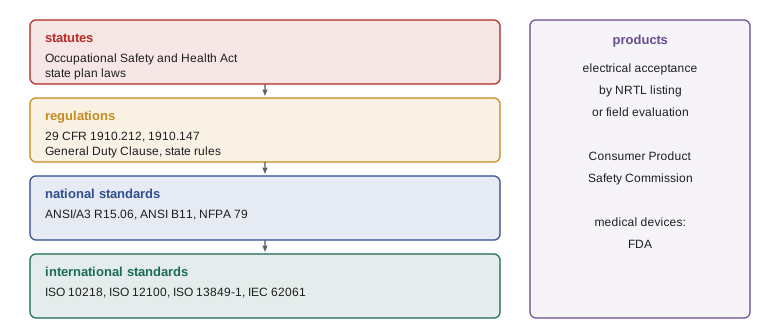
In the United States, the federal Occupational Safety and Health Administration (OSHA) sets and enforces workplace standards for most private employers, and about half the states operate OSHA-approved state plans that must be at least as effective and may be stricter, as in California, Michigan and Washington. OSHA has no robot-specific standard. Robot installations are judged against general requirements: 29 CFR 1910.212 on general machine guarding, 1910.147 on the control of hazardous energy, 1910.303 and Subpart S on electrical safety, and the General Duty Clause for recognized hazards not covered by a specific standard. OSHA's Technical Manual has a chapter on industrial robot safety, and inspectors and courts look to consensus standards, chiefly ANSI/A3 R15.06-2025, the ANSI B11 series and NFPA 79, as evidence of recognized hazards and feasible means of protection.
Workplace duties for robot installations
Workplace law puts the main legal duty on the employer, but it also places duties on suppliers, owners and workers. The practical requirements for a robot installation are broadly similar across jurisdictions: assess hazards, guard dangerous parts, control hazardous energy during maintenance, train and supervise, keep records and report serious incidents.
Some US states and many employers add to OSHA's general requirements. Michigan's state plan, for instance, has its own general industry rules on machine guarding. Employers often require integrators to supply a documented risk assessment to ANSI/A3 R15.06 and the task-based method in A3's technical report R15.306, together with validation records for safety functions. OSHA's 1910.147 requires written energy control procedures, periodic inspections of those procedures and training, which for robots must address gravity-loaded axes, stored pneumatic energy and capacitors in drives, as well as the limited exceptions for minor servicing that use alternative measures providing effective protection.
Workers have duties too: to use safeguards, report hazards and not remove or defeat protective devices. Defeating interlocks, by taping switches or using spare actuators, is a persistent cause of robot injuries. Good design reduces the motivation to defeat safeguards, for example by providing safe ways to clear jams and observe processes, and both ISO 14119 and the type-C robot standards require designers to consider the incentive to defeat interlocks.
Product requirements: approval and certification
Separately from workplace duties, products must meet requirements before they are sold or installed. For robots used at work, the most important of these concern electrical safety.
In the United States, OSHA's electrical standard at 1910.303 requires electrical equipment used in workplaces to be acceptable, which in practice means listed, labeled or certified by a nationally recognized testing laboratory (NRTL) such as UL Solutions, CSA Group, Intertek or TÜV, or otherwise evaluated as the regulation allows. Industrial control panels are commonly built to UL 508A, and industrial machinery wiring follows NFPA 79 and Article 670 of the National Electrical Code. Local electrical inspectors enforce the NEC and may require field evaluation of unlisted machines. Consumer robots fall under the Consumer Product Safety Act and the Consumer Product Safety Commission (CPSC), which can set mandatory standards, require reports of defects and order recalls, as lesson 8 explains.
Neither Canada nor the United States has a general legal requirement that machinery carry a conformity mark showing compliance with safety standards, comparable to European CE marking. Compliance with robot safety standards is demonstrated through the documentation that customers, inspectors and courts expect: risk assessments, validation reports, declarations by the integrator, certificates for components, and manuals. Many buyers make conformity to CSA Z434 or ANSI/A3 R15.06 a contract requirement, which turns the standard into a legal obligation between the parties.
The European approach
The European Union regulates machinery through product law that applies before a machine is placed on the market. The Machinery Directive 2006/42/EC has governed machinery since 2009. It is being replaced by the Machinery Regulation (EU) 2023/1230, which applies from 20 January 2027 and, as a regulation, applies directly in every member state without national transposition. Manufacturers, including any company that builds an assembly of machines such as a robot cell, must meet essential health and safety requirements, compile a technical file, carry out a conformity assessment procedure, issue an EU declaration of conformity and affix CE marking.
| Feature | What it means for robot makers |
|---|---|
| Essential health and safety requirements | Legally binding objectives for safe design, such as guarding, control systems and stopping, written in general terms |
| Harmonised standards | Standards cited in the Official Journal, such as EN ISO 10218 and EN ISO 13849-1, give a presumption of conformity with the requirements they cover |
| Conformity assessment | Self-assessment for most machinery; third-party assessment by a notified body for categories listed as higher risk |
| Technical file and declaration | Risk assessment, drawings, calculations, test reports and instructions kept for ten years; a signed declaration of conformity |
| Substantial modification | Anyone who modifies machinery in a way not foreseen by the manufacturer that affects safety becomes its manufacturer for compliance purposes |
The new regulation contains changes aimed at modern robots. Its essential requirements address autonomous mobile machinery, human-machine interaction including psychological stress, protection against corruption of control systems by malicious third-party action, which links safety to cybersecurity, and machinery whose behavior evolves after it is placed on the market. Its list of higher-risk categories includes safety components and machinery with embedded systems that have fully or partially self-evolving behavior using machine learning approaches to ensure safety functions; these require assessment by a notified body unless future harmonized standards provide another route. It allows instructions to be supplied digitally, with a paper copy on request. And it clarifies when a modification, including a software update, is substantial enough to make the modifier the manufacturer. Canadian and American companies exporting robots or robot cells to Europe must follow these rules, and many apply EU-style documentation to all their markets to keep one design.
Worked problem
Which rules apply to one robot cell sold in three places?
An integrator in Ontario builds identical palletizing cells for customers in Ontario, Ohio and Germany. Summarize the main compliance steps for each destination.
Show solution
- Ontario: design to CSA Z434:26 and CSA Z432; electrical certification by an SCC-accredited body or field evaluation; a pre-start health and safety review if light curtains replace guards; the customer's OHS duties under the OHSA and Regulation 851.
- Ohio: design to ANSI/A3 R15.06-2025, NFPA 79 and the B11 series; NRTL listing or field evaluation for electrical acceptance; the customer's duties under OSHA 1910.212 and 1910.147.
- Germany: compliance with the EU Machinery Directive until 19 January 2027 and the Machinery Regulation after; harmonized EN ISO standards; technical file, declaration of conformity and CE marking for the assembly; German workplace rules for the user.
- Common core: one ISO 12100 risk assessment and ISO 13849-1 safety design, extended with each destination's documents.
Answer: The safety engineering can be shared, but each destination needs its own legal deliverables: CSA-based design and a PSR in Ontario, NRTL-acceptable electrics and OSHA compliance in Ohio, and CE marking under EU law in Germany.
Modifications, retrofits and used machines
Robots are frequently moved, reprogrammed and given new tools. Each change can alter hazards, and the law treats modification as a point where duties revive. A risk assessment review under management of change should ask whether the modification introduces new hazards, increases risk, or changes the performance required of safety functions. In Europe, a substantial modification makes the modifier responsible as a manufacturer, with a full conformity assessment for the affected parts. In Canada and the United States, the duty to provide a safe workplace continues, and in Ontario a modification may trigger a new pre-start health and safety review where the regulation requires it.
Used robots raise similar issues. A second-hand robot may have been built to an older edition of the standards, may have lost documentation, and may have safety functions disabled or changed by its previous owner. Buyers should obtain the manufacturer's manuals, check the controller's safety configuration and its checksum, and treat the integration as a new installation needing a full risk assessment. Older robots often lack modern safety-rated monitoring, which may require additional external safeguards to reach the current level of protection.
Worked problem
Is this change substantial?
A food plant replaces a robot's two-finger gripper with a vacuum gripper of similar mass, and separately increases the robot's maximum speed in automatic mode by 30 percent to raise throughput. Assess both changes.
Show solution
- Gripper change: similar mass and inside the robot's payload rating; new hazards include dropped products on vacuum loss and suction hazards; review the risk assessment and add measures such as vacuum monitoring.
- Speed increase: stopping distances grow with speed, so the minimum distances of light curtains and scanners computed with ISO 13855 may no longer be adequate.
- Re-measure stopping time at the new speed and check every protective device distance; revise the risk assessment and validation records.
- In Europe, the speed change could be a substantial modification if it affects safety in a way not foreseen by the manufacturer; in Ontario, the change could require a new pre-start review if a listed protective element is involved.
Answer: Both changes need review; the speed increase is the more significant because it can invalidate safety distances and may count as a substantial modification.
Common mistakes
MistakeAssuming that because a standard is voluntary, it does not need to be followed.
InsteadRegulations, contracts, inspectors and courts often make standards effectively binding.
MistakeShipping a robot cell to Europe with North American documentation only.
InsteadPrepare a technical file, declaration of conformity and CE marking under EU machinery law.
MistakeEnergizing an imported machine that lacks electrical certification.
InsteadObtain certification by an accredited body or NRTL, or a field evaluation, before connection.
MistakeTreating software changes as outside safety review.
InsteadAssess software updates under management of change; they can change hazards and may count as substantial modifications.
MistakeInstalling a used robot as if its old safety configuration were still valid.
InsteadTreat it as a new installation, verify the safety configuration and perform a full risk assessment.
Summary and key terms
- Statutes set duties, regulations set rules, and standards become binding through incorporation, contracts and expectations of inspectors and courts.
- In the United States, OSHA enforces 1910.212, 1910.147, electrical rules and the General Duty Clause, with ANSI/A3 R15.06, B11 and NFPA 79 as key standards.
- Workplace electrical equipment must be acceptable, usually NRTL listed; consumer robots fall under the CPSC.
- The EU Machinery Regulation 2023/1230 applies from 20 January 2027, with CE marking, harmonized standards and new requirements for autonomy, cybersecurity and machine learning.
- Modifications and used robots require renewed risk assessment, and substantial modifications can make the modifier the legal manufacturer in Europe.
- Incorporation by reference
- A regulation making a standard legally binding by citing it.
- Pre-start health and safety review
- An Ontario requirement for a documented engineering review before certain equipment is used.
- NRTL
- Nationally recognized testing laboratory accepted by OSHA for product certification.
- Field evaluation
- On-site electrical evaluation of equipment that is not certified as a whole.
- Harmonised standard
- A European standard cited in the Official Journal that gives a presumption of conformity.
- CE marking
- The mark by which a manufacturer declares conformity with EU product law.
- Technical file
- Documentation proving that a machine meets EU essential requirements.
- Substantial modification
- A change that affects safety in a way not foreseen by the original manufacturer.
Practice problems
Work each problem on paper first, then reveal the answer to check.
What makes a voluntary standard legally binding? Give two routes.
Show answer
Incorporation by reference in a regulation, or a contract requirement; courts and inspectors also treat it as evidence of reasonable care.
Which OSHA standard covers general machine guarding?
Show answer
29 CFR 1910.212.
What does NRTL stand for and why does it matter?
Show answer
Nationally recognized testing laboratory; OSHA accepts their listings as evidence that workplace electrical equipment is acceptable.
From what date does the EU Machinery Regulation apply?
Show answer
20 January 2027.
Name two new topics addressed by the EU Machinery Regulation.
Show answer
Autonomous mobile machinery, protection against corruption by malicious action, self-evolving machine learning safety functions, digital instructions.
Why can a speed increase invalidate a safety design?
Show answer
Stopping distances grow, so protective device distances based on the old stopping time may no longer be adequate.
List three steps when installing a used robot.
Show answer
Obtain manuals, verify safety configuration and checksum, perform a full risk assessment and add safeguards as needed.
Why do workers defeat interlocks, and how can design help?
Show answer
To save time clearing jams or watching processes; provide safe access and observation methods.
Lesson quiz · 5 questions
Score 60% or more to complete this lesson.
Create a free account to save your progress, take quizzes and earn a certificate.