
SLS-101 · Lesson 4 of 12 · 18 min
Value: what customers actually buy
▶ Video coming soon A video version of this lesson is on the way.
On the Juniper & Pine floor one Saturday, Aiden watched Carl Jensen sell a refrigerator to a couple who had walked in intending to buy the cheapest model in the store. Carl did not argue with them about price. He asked how many people lived in the house (five, including three teenagers), how often they shopped (once a week, at the big-box store across town), and what annoyed them about their current fridge ("we can never find anything, and the milk goes off"). Twenty minutes later they left with a model that cost 400 dollars more than they had planned. At the door the husband shook Carl's hand and said, "Thanks. That's the first time anyone's asked how we actually use it."
Afterwards Aiden asked Carl how he had done it. "I didn't sell them a fridge," Carl said. "I sold them fewer wasted groceries and fewer arguments about the milk. The fridge is just how they get it." That is the subject of this lesson. Customers do not buy products for their own sake; they buy what the product will do for them. A seller's job is to understand that value from the customer's point of view and to make it visible.
Value is in the customer's eyes
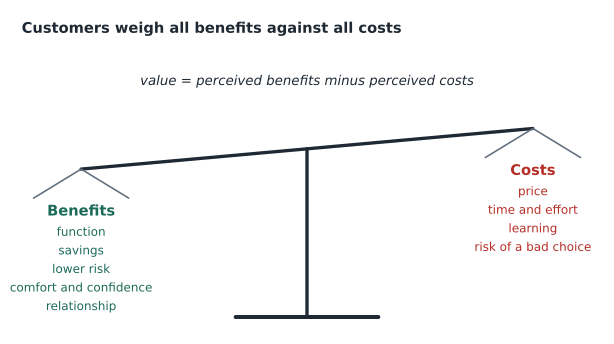
Customer value is the difference between what a customer believes they gain from a purchase and what they believe it costs them, all things considered. Both halves of that idea are wider than they first appear. The gains include the product's function, but also convenience, reliability, status, peace of mind, and in business the effect on the organization's results. The costs include the price, but also the time spent choosing and installing, the effort of learning something new, and the risk that the decision turns out badly.
The word that matters in that equation is perceived. Two customers can look at the same product and reach different values, because they have different needs, different alternatives and different worries. The cheapest fridge was poor value for Carl's family of five; it might be excellent value for a student living alone. Value is not a property of the product. It belongs to the combination of a product and a particular customer.
This explains why discovery matters so much. A seller cannot show value they have not understood. Carl's three questions told him what the family needed, what their current situation cost them, and what would count as better. Without them he would have been reduced to comparing shelves and cubic feet, and the cheaper model would have won.
Features, advantages and benefits
Sellers often confuse three things that sound alike.
| Term | Meaning | Example: a multifunction printer |
|---|---|---|
| Feature | A fact about the product | Prints 45 pages a minute; has a secure-release card reader |
| Advantage | What the feature lets the product do | Large jobs finish quickly; documents only print when the owner is at the machine |
| Benefit | What that means to this customer | Reception stops queuing at the printer; patient letters are never left in the tray for others to read |
The test of a benefit is whether it answers the customer's question "so what?" A feature never does. "Secure release" means nothing to Janet at Northfield Family Clinic. "Patient letters will never sit in the output tray where another patient could read them" answers a concern she had raised herself, because it touches the clinic's privacy obligations. The same feature might offer a different benefit to a law firm (confidential documents) or a school (fewer forgotten printouts wasting paper).
Benefits are only persuasive when they connect to something the customer said. A seller who lists ten benefits the customer never mentioned sounds like a brochure. A seller who says "you mentioned the waiting room gets crowded when the printers jam; here is how this changes that" sounds like someone who listened.
Kinds of value
It helps to think about value in several categories, because different customers weigh them differently.
- Functional value: the product does the job better, faster or more reliably.
- Economic value: the purchase saves money, earns money or costs less over its life than the alternative.
- Risk reduction: the purchase lowers the chance of a bad outcome, such as a breakdown, a privacy breach or a missed deadline.
- Emotional value: the purchase brings comfort, pride, confidence or relief.
- Social and relationship value: the purchase helps the buyer look good to others, or comes with a supplier relationship the buyer trusts.
Business buyers are often assumed to care only about economic value. In practice the person signing a purchase order also worries about looking foolish if a new system fails, and values a supplier who will answer the phone. Household buyers are often assumed to buy on emotion, yet many will spend an evening comparing energy ratings and warranty terms. Good sellers listen for all five.
Making economic value visible
In B2B selling especially, buyers need to justify a purchase to someone else, so sellers help by putting numbers on value. The simplest tool compares the total cost of the customer's current situation with the total cost of the proposed solution over the same period. Price is only one line in that comparison.
Different people value different things
In a household or an organization, several people may weigh the same purchase differently. At Northfield Family Clinic, Janet valued an end to daily printer frustration and a simpler way to book the shared rooms. Dr. Anand valued patient privacy, low disruption and a predictable cost. The bookkeeper valued a monthly payment that fitted the budget and contract terms that did not lock the clinic in unreasonably. The front-desk staff valued not having to stand at a jammed printer while patients waited. One proposal had to show value to all of them, which meant Maya needed to know what each one cared about.
Households work the same way. When a couple shops for a fridge, one may care most about capacity and the other about energy use or the finish matching the dishwasher. A teenager may care only about the ice maker. Aiden learned to ask, "Who else will be using it?" and "Is there anything the others at home would want me to know?" Those questions often explain why a customer hesitates: they are representing someone who is not in the store.
Stating value in one sentence
A value proposition is a short statement of why a particular customer should choose an offer: who it is for, what problem it solves, and what makes it better than the alternatives. Companies write value propositions for whole markets; good sellers adapt them to each customer. A general statement such as "Ridgeline managed print reduces printing costs" is weak, because it may not be true for every customer and it says nothing about this one. A tailored statement is stronger: "For a busy clinic like yours, a managed print contract means the printers simply work, patient letters stay private, and you have one predictable monthly bill instead of surprise repairs."
A useful test of a value proposition is whether the customer would recognize their own words in it. Maya builds hers from her discovery notes, using the customer's own phrases where she can. Aiden does the same in a few seconds on the floor: "So you want something the dog can't wreck, that seats all five of you for movie night, and that will fit through the side door. Let me show you two that do all three."
Value must also be compared with the customer's real alternatives. The alternative is not always a competitor. It may be doing nothing, repairing the old product, building something in-house, or spending the money on something else entirely. A clinic could keep its old printers for another year; a family could put the fridge money toward a holiday. Sellers who understand the alternative can explain value in terms that matter: "Compared with keeping the old printers, here is what changes."
Value changes over time
The value a customer sees in a purchase is not fixed. It can rise when the customer learns more about their problem, as when Janet realized how many staff hours the printers consumed, and fall when circumstances change, as when a budget is cut or a competitor offers a new option. It can also fall after the sale if the product does not deliver what was promised. This is why sellers revisit value at each stage: confirming in discovery what matters, showing it in the presentation, checking it in the close, and proving it in follow-up. A seller who demonstrates value only once, in a single presentation, leaves the customer to remember it alone, and memory fades quickly when an invoice arrives.
Retail customers revisit value too, often within days. A couple who bought a recliner on Saturday may see it advertised for less elsewhere on Monday. If they understood what they bought and why, such as the better frame, the longer warranty and free delivery, they are far less likely to regret the decision.
Worked problem
The real cost of the old printers
Northfield Family Clinic owns two old printers. Janet estimates staff lose 6 hours a month to jams and reprints, at an average loaded wage of 32 dollars an hour, and the clinic spends about 110 dollars a month on emergency service calls and 260 dollars a month on toner and paper. Ridgeline proposes a managed print contract at 395 dollars a month covering two new machines, all toner, service and repairs, with paper still bought separately at about 180 dollars a month; Maya expects lost staff time to fall to 1 hour a month. Compare the monthly cost of the two options.
Show solution
- Current monthly cost: staff time plus service plus supplies.
- \[6 \times 32 = 192 \text{ dollars of staff time}\]
- \[192 + 110 + 260 = 562 \text{ dollars a month}\]
- Proposed monthly cost: contract plus paper plus remaining staff time.
- \[1 \times 32 = 32 \text{ dollars of staff time}\]
- \[395 + 180 + 32 = 607 \text{ dollars a month}\]
- Difference.
- \[607 - 562 = 45 \text{ dollars a month more}\]
Answer: The managed print contract costs about 45 dollars a month more than the current situation, or 540 dollars a year. Maya cannot honestly claim it saves money. She can show that for about 45 dollars a month the clinic gets reliable printing, secure release for patient documents and no surprise repair bills. Whether that is good value depends on how much Janet and Dr. Anand care about those benefits, and Maya's job is to ask.
The example illustrates a rule Darnell insists on: never invent savings. Many sellers would have inflated the staff time lost, or ignored the cost of paper, to make the contract look cheaper. That might win the first meeting, but the clinic's bookkeeper would check the numbers, and Maya's credibility would be gone. An honest comparison that shows a small extra cost for real benefits is far more persuasive than a doubtful saving.
Value in retail
Retail customers rarely build spreadsheets, but they make the same comparison in their heads. A mattress customer weighs 1,800 dollars against years of sleep, back pain, a 90-night comfort exchange, and the hassle of delivery. A furniture customer weighs a sofa's price against how long it will last with children and a dog. Aiden's job is the same as Maya's: find out what matters to this customer, then show clearly how the product delivers it. Lifetime cost helps in retail too. A sofa at 1,600 dollars that lasts ten years costs 160 dollars a year; one at 900 dollars that lasts four years costs 225 dollars a year.
Common mistakes
MistakeDescribing features and expecting the customer to work out the benefits.
InsteadTranslate each relevant feature into what it means for this customer, using their own words where possible.
MistakeListing every benefit the product offers.
InsteadChoose the benefits that connect to needs the customer has expressed.
MistakeAssuming business buyers care only about price.
InsteadBusiness buyers weigh function, economics, risk, emotion and relationship too; the person signing also has a reputation to protect.
MistakeInflating savings to make the numbers work.
InsteadUse honest, checkable figures; if a solution costs more, show what the extra buys.
Summary and key terms
- Customer value is what a customer believes they gain from a purchase minus what they believe it costs, including time, effort and risk as well as price.
- Value is perceived, so it differs between customers and must be uncovered in discovery.
- Features are facts about a product, advantages are what features allow, and benefits are what that means to a particular customer.
- Value comes in functional, economic, risk-reduction, emotional and social forms.
- In B2B selling, economic value is often shown by comparing the total cost of the current situation with the total cost of the proposal; the comparison must be honest.
- Lifetime cost per year helps retail customers compare products with different prices and lives.
- Customer value
- Perceived benefits minus perceived costs, from the customer's point of view.
- Feature
- A fact about a product.
- Advantage
- What a feature allows the product to do.
- Benefit
- What a feature or advantage means to a particular customer.
- Economic value
- Value measured in money saved, earned or avoided.
- Total cost comparison
- Comparing all the costs of the current situation and a proposed solution over the same period.
Practice problems
Work each problem on paper first, then reveal the answer to check.
Turn this feature into a benefit for a family with toddlers: "stain-resistant fabric."
Show answer
For example: "Spills from juice cups and snacks wipe off, so the sofa still looks good in a few years and you don't have to worry every time the kids sit on it."
A dishwasher costs 1,100 dollars and lasts 11 years; another costs 700 dollars and lasts 7 years. Which costs less per year?
Show answer
1,100 ÷ 11 = 100 dollars a year; 700 ÷ 7 = 100 dollars a year. They cost the same per year, so other benefits decide.
Why did Maya not claim the managed print contract saves money?
Show answer
Because the honest comparison showed it costs about 45 dollars a month more; she instead showed what the extra money buys.
Lesson quiz · 5 questions
Score 60% or more to complete this lesson.
Create a free account to save your progress, take quizzes and earn a certificate.