
SLS-101 · Lesson 5 of 12 · 18 min
Trust and credibility
▶ Video coming soon A video version of this lesson is on the way.
In her third week Maya lost a deal she thought she had won. Halverson Law LLP, a twelve-lawyer firm downtown, had liked her proposal for new meeting-room video equipment and RoomFlow booking software. Then the managing partner, Ruth Halverson, called to say they were going with a competitor. Maya asked why, and Ruth was candid. "Your price was fine. But you told us the installation would take a day, and when our office manager asked your technician, he said three. I don't know which of you to believe, and I can't have my boardroom out for a week." Maya had guessed at the installation time rather than checking. The competitor's quote was higher, but its rep had brought the installer to the second meeting.
Darnell did not scold her. "Every buyer is really asking two questions," he said. "Is this the right solution, and can I trust the people selling it? You answered the first one well. You didn't answer the second." This lesson is about that second question: what trust is, how buyers judge it, and how sellers earn and lose it.
Why trust decides sales
Buyers face uncertainty in almost every purchase. They cannot test a three-year printer contract before signing, cannot know whether the sofa will still look good in five years, and cannot see inside the supplier's service department. Trust is what lets them decide anyway. When a buyer trusts a seller, they accept the seller's claims, share honest information about their needs and budget, and forgive small mistakes. When they do not, they demand proof for everything, hide information, and drift toward the safest-looking option, which is often the biggest brand or the cheapest price.
Trust matters more as the stakes rise. Nobody needs to trust a cashier to buy a coffee. A school business officer committing to furniture for a new building, or a couple spending a month's pay on a sectional, is taking a risk, and will buy from the person who makes that risk feel smaller. This is why experienced sellers say that in complex sales, the salesperson is part of the product.
The parts of trust
A widely used way to break trust into parts comes from David Maister, Charles Green and Robert Galford's book *The Trusted Advisor*. They describe trustworthiness with four elements, often written as a "trust equation".
| Element | What the buyer is judging | How a seller builds it |
|---|---|---|
| Credibility | Does this person know what they are talking about, and are they honest about it? | Accurate knowledge, admitting what you do not know, never exaggerating |
| Reliability | Does this person do what they say they will? | Keeping small promises, being on time, following up when you said you would |
| Intimacy | Do I feel safe telling this person about my real situation? | Listening, discretion, treating confidences carefully |
| Self-orientation (divides) | Is this person focused on me or on themselves? | Asking about the customer, not rushing to close, recommending what fits even if it earns less |
The equation is a way of thinking rather than a formula to calculate, but its structure carries a lesson. The three elements on top add together, so strength in one can partly make up for weakness in another. Self-orientation sits underneath and divides, so a seller who seems to be thinking about their own quota undermines credibility, reliability and intimacy all at once. Maya's mistake at Halverson Law was a credibility and reliability failure: she stated something she had not checked, and the buyer found the contradiction.
Trust in a single retail visit
Retail sellers have only minutes to earn trust, so small signals carry great weight. Customers notice whether an associate gives straight answers about delivery times, whether they mention a cheaper option that would also suit, whether they explain the protection plan honestly or push it, and whether the price on the tag matches the price at the till. They also notice how associates treat each other and other customers. Bev tells new associates that every customer is watching the whole store, not just the person serving them.
Honesty about limitations is especially powerful in retail because customers expect the opposite. When a woman asked Aiden whether a pale linen sofa would be fine with two young children and a cat, he said, "Honestly, it will show marks quickly. This performance fabric looks almost the same and wipes clean." She bought the performance fabric version, which cost a little more, and later told Bev that Aiden was the first salesperson who had ever talked her out of something.
The company earns trust too
Trust attaches to the business as well as the individual seller. Policies such as clear return terms, comfort trials, price matching, written warranties and reliable delivery tell customers the company will stand behind its products. Published reviews, years in business, membership of industry associations and well-known customers all serve as evidence. A seller can draw on that trust, but can also damage it: a single broken promise by one associate can generate an online review that thousands of shoppers read.
For B2B sellers, company trust often decides who gets onto the shortlist at all. School divisions, clinics and municipalities usually want proof that a supplier is financially stable, carries appropriate insurance, protects customer data and has served similar customers. Ridgeline keeps a short document with this information so that Maya can answer such questions immediately. Being able to say "here is our certificate of insurance and three references from other clinics" in the first week builds more credibility than any presentation.
Trust in digital and remote selling
More selling now happens by email, video call and online chat, where customers cannot read body language as easily and have more reason to be cautious. Trust signals online include a complete, professional profile with a real photograph, prompt and accurate replies, clear identification of who the seller works for, and messages that are clearly written for the recipient rather than copied to hundreds of people. Mass messages that pretend to be personal damage trust quickly, because recipients recognize them. Maya's rule is never to send a message she would be embarrassed to have the customer forward to her manager.
How long trust takes
Trust builds slowly and falls quickly. A customer may need many good experiences before they trust a seller completely, but a single serious breach, such as a hidden fee, a broken delivery promise or a misleading claim, can undo all of them. This imbalance is one reason experienced sellers are careful even with small statements. It also means that trust is an asset that grows with time in a territory or a store. Carl's customers trust him partly because he has been at Juniper & Pine for nine years and they can see he will still be there next year to answer for what he sold. New sellers cannot borrow that history, but they can start building it from the first day by keeping every promise, however small, and being honest when honesty is inconvenient.
Trust is also personal and specific. A customer may trust Maya's product knowledge but not yet her company's delivery record, or trust Juniper & Pine's return policy but not a particular associate. Sellers should notice which part of trust is weak and address that part directly.
Worked problem
Comparing two sellers on the trust equation
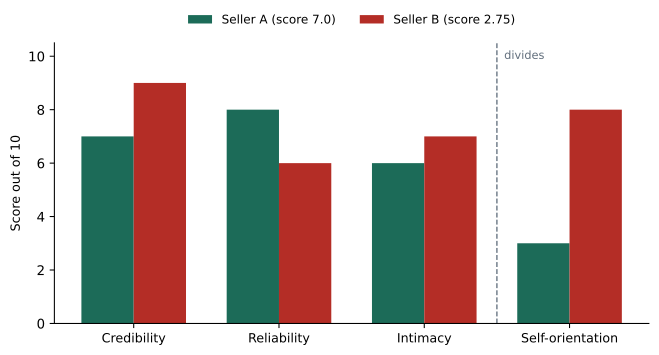
Darnell asks Maya to score two imaginary sellers from 1 to 10 on each element. Seller A: credibility 7, reliability 8, intimacy 6, self-orientation 3. Seller B: credibility 9, reliability 6, intimacy 7, self-orientation 8. Which seems more trustworthy by the equation?
Show solution
- Add the three elements on top for each seller.
- \[A: 7 + 8 + 6 = 21 \qquad B: 9 + 6 + 7 = 22\]
- Divide each total by self-orientation.
- \[A: 21 \div 3 = 7.0 \qquad B: 22 \div 8 = 2.75\]
Answer: Seller A scores 7.0 and Seller B 2.75. B knows more, but B's obvious focus on their own interests cuts their trustworthiness to well under half of A's. The numbers are only illustrations; the lesson is that reducing self-orientation does more for trust than adding a little more knowledge.
How buyers judge credibility
Credibility comes partly from expertise and partly from honesty, and buyers test both quickly. They notice whether a seller answers questions directly or deflects. They notice claims that sound too good, such as "zero downtime" or "the best on the market", and discount everything else the seller says. They notice whether the seller admits limits. Paradoxically, saying "that model isn't the right fit for you" or "I don't know, but I'll find out by Thursday" raises credibility, because it shows the seller will tell the truth when it costs them.
Sellers can borrow credibility from evidence: references from similar customers, case studies, test results, certifications and trial periods. A clinic manager is more convinced by a call with another clinic manager than by any brochure. At Juniper & Pine, Bev encourages associates to mention the store's comfort trial and price-match policy, not as sales tricks but because they move risk from the customer to the store, which is itself a signal that the store stands behind what it sells.
Reliability is built from small promises
Reliability is the element sellers control most directly, and it is built from very small things: replying when you said you would, arriving on time, sending the summary after the meeting, correcting an error before the customer finds it. Each kept promise is a piece of evidence that the larger promises, such as installation dates and service response times, will be kept too. Each broken promise, however small, makes the buyer wonder.
For this reason Darnell asks his team to make promises they can keep and then keep them early. "I'll send it by Friday" followed by sending it on Thursday builds more trust than "I'll send it tomorrow" followed by sending it on Friday. It sounds trivial. Over months, it separates the sellers customers recommend from the ones they avoid.
Intimacy and self-orientation
In the trust equation, intimacy means the buyer feels safe sharing sensitive information: the real budget, the internal politics, the worry that their job depends on this project going well. Buyers share those things with sellers who listen without judging, keep confidences and use the information to help rather than to pressure. A seller who repeats one customer's problems to another, or uses a disclosed budget to push the price up, will never be told the truth again.
Self-orientation is the hardest element to fake because buyers see it in small behaviors: interrupting, steering every conversation back to the product, pushing for a decision before the buyer is ready, recommending the most expensive option every time. The cure is genuine attention to the customer's interests, including the willingness to walk away from a sale that is wrong for them. Carl at Juniper & Pine is the store's top earner partly because he sometimes tells customers to buy the cheaper model, and they remember it.
Recovering when trust is damaged
Every seller eventually makes a mistake. What matters is the response. A good recovery has four parts: acknowledge the mistake plainly without excuses, explain what happened if it helps, fix it, and say what will be different next time. Maya called Ruth Halverson back the following week. She did not try to reopen the deal. She said she had given an installation estimate without checking it, that it was her error, and that she now confirmed all timelines with the installation team before quoting. Ruth thanked her. Two months later, when the law firm's printers came up for renewal, Ruth called Maya first.
Common mistakes
MistakeGuessing at facts such as installation times or delivery dates to keep the conversation moving.
InsteadSay you will confirm, then confirm, then reply when you said you would.
MistakeMaking big claims to impress the buyer.
InsteadExaggeration lowers credibility for everything else you say; precise, modest claims are more believable.
MistakeRecommending the most expensive option every time.
InsteadHigh self-orientation divides away trust; recommend what fits the customer.
MistakeHiding a mistake and hoping the customer will not notice.
InsteadAcknowledge it, fix it and explain what will change; a good recovery can strengthen trust.
Summary and key terms
- Buyers ask whether a solution is right and whether they can trust the people selling it.
- Trust lets buyers act despite uncertainty and matters more as the stakes rise.
- The trust equation from The Trusted Advisor describes trustworthiness as credibility plus reliability plus intimacy, divided by self-orientation.
- Credibility comes from accurate knowledge and honesty, including admitting limits; sellers can add evidence such as references and trials.
- Reliability is built from many small kept promises.
- Intimacy means the buyer feels safe sharing sensitive information.
- Self-orientation divides everything else, so focus on the customer matters most.
- When trust is damaged, acknowledge the mistake, fix it and explain what will change.
- Trust
- A buyer's willingness to rely on a seller's words and actions despite uncertainty.
- Credibility
- Being knowledgeable and honest about what you know.
- Reliability
- Consistently doing what you said you would.
- Intimacy
- In the trust equation, the buyer's sense that it is safe to share sensitive information.
- Self-orientation
- The degree to which a seller seems focused on their own interests rather than the customer's.
- Reference
- An existing customer willing to speak to a prospect about their experience.
Practice problems
Work each problem on paper first, then reveal the answer to check.
Using the trust equation, why does high self-orientation do so much damage?
Show answer
It sits underneath the line and divides the sum of credibility, reliability and intimacy, so it reduces all three at once.
Give two ways a seller can borrow credibility.
Show answer
References from similar customers, case studies, test results, certifications or trial periods.
Seller C scores credibility 6, reliability 9, intimacy 6 and self-orientation 2. What is the score?
Show answer
(6 + 9 + 6) ÷ 2 = 21 ÷ 2 = 10.5.
Lesson quiz · 5 questions
Score 60% or more to complete this lesson.
Create a free account to save your progress, take quizzes and earn a certificate.