
SLS-101 · Lesson 9 of 12 · 18 min
Handling objections: a first look
▶ Video coming soon A video version of this lesson is on the way.
"It's more than we wanted to spend." Aiden heard that sentence six times in his first two weeks, and each time he responded the same way: he walked the customer to a cheaper model. Twice they bought it; four times they left. Carl overheard one of the conversations and took him aside. "You answered the wrong question," he said. "When someone says it's more than they wanted to spend, they might mean they can't afford it. Or they might mean they don't yet see why it's worth more. Or they might mean they want to think about it. You have to find out which before you answer."
An objection is any concern, question or reason a customer gives for not buying, or not buying yet. Objections are a normal part of almost every sale, and they are not the enemy. A customer who raises an objection is still engaged; they are telling the seller what stands between them and a decision. The silent customer who smiles, says thanks and leaves is far harder to help. This lesson introduces the main kinds of objection and a simple process for handling them. Course SLS-213, Negotiation and Closing, develops the subject further.
Why customers object
Objections come from a handful of underlying sources. Recognizing the source helps the seller respond to the real concern rather than the words.
| Kind of objection | What the customer may say | What may lie underneath |
|---|---|---|
| Price or budget | "It costs too much." "We don't have the budget." | Cannot afford it; does not yet see the value; is comparing with a cheaper option; wants a better deal |
| Need | "We're fine with what we have." | Does not see the problem as serious; has not connected the product to their situation |
| Timing | "Not right now." "Maybe next year." | Other priorities; budget cycle; wants to delay a risky decision |
| Trust in the seller or company | "We've heard your service is slow." | A past bad experience; a competitor's claim; lack of evidence |
| Product fit | "It won't fit through our door." "It doesn't integrate with our system." | A genuine limitation, or a misunderstanding |
| Authority | "I need to check with my partner / my boss." | Genuinely shared decision; or a polite way of saying no |
Some objections are real barriers that no answer will remove: the sofa really will not fit, or the clinic really has no budget until April. Others are misunderstandings that a fact will clear up. Many are requests for reassurance. And some are smoke screens, polite reasons that hide the real one. A seller cannot tell which is which without asking.
A process for handling objections
Most sales training teaches a short sequence for handling objections. The labels vary; the steps are nearly always the same.
| Step | What to do | Example: "It's more than we wanted to spend." |
|---|---|---|
| 1. Listen | Let the customer finish without interrupting | Stay quiet and attentive until they stop |
| 2. Acknowledge | Show you heard and take the concern seriously, without agreeing that the objection is correct | "That's fair, it's a big purchase." |
| 3. Explore | Ask a question to understand what lies behind it | "Can I ask whether it's the total, or the monthly cost, or how it compares with what you'd expected?" |
| 4. Respond | Answer the real concern with facts, options or evidence | Explain what the extra cost buys, show financing, or suggest a model that fits the budget |
| 5. Confirm | Check whether the response addressed the concern | "Does that help, or is there something else on your mind?" |
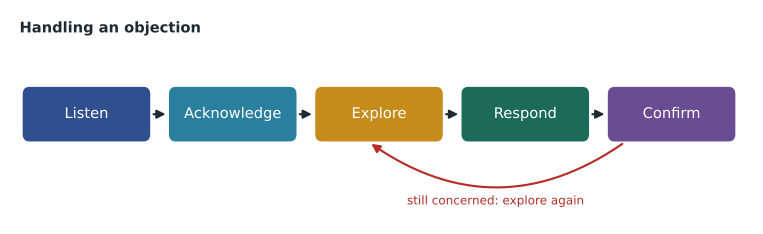
The step most sellers skip is the third. They hear an objection and immediately answer it, as Aiden did, so they answer the wrong concern. Asking first has two benefits. It tells the seller what to address, and it often lets the customer think the concern through aloud and partly resolve it themselves. A customer asked "what were you expecting to spend?" may say "about 1,500," which tells Aiden the gap is 300 dollars, not 1,000.
Responding to price objections
Price objections are the most common and deserve particular care, because the easy response, a discount, is often the worst one. As lesson 1 showed, discounts come straight out of gross margin. A seller who discounts at the first sign of resistance also teaches the customer that the first price was not real.
Better responses depend on what lies underneath.
- The customer does not yet see the value. Return to the needs they described and show how the product meets them. Compare like with like: the cheaper option may lack features the customer said they wanted.
- The total feels large. Express the cost in smaller or more meaningful units, such as per month, per use or per year of life, but only if that is genuinely how the customer will experience it.
- The customer genuinely cannot afford it. Respect that. Show a model that fits the budget, or explain financing honestly, including its cost.
- The customer is comparing with a competitor. Ask what the other offer includes. Many price gaps disappear when delivery, installation, warranty or service are added in.
- The customer wants a better deal. Some customers always ask. A small, planned concession, such as free delivery, may be appropriate; give it in exchange for a decision, not as a reflex.
Building an objection bank
Most sellers hear the same dozen objections again and again. Experienced teams collect them, together with good responses, in a shared objection bank. Ridgeline's bank, kept in the CRM, lists each common objection, the concerns that usually lie behind it, the questions that help uncover which one is real, and evidence that answers each: references, short case studies, contract clauses, service statistics. Juniper & Pine keeps a simpler version on a single page in the break room, covering the most common floor objections: price, delivery time, fit, "I'll think about it" and "I need to ask my partner."
An objection bank is not a set of scripts to recite. Customers recognize canned answers immediately and trust them less. Its value is in preparation: a seller who has thought in advance about why customers say "we're fine with what we have" can ask a better question in the moment. New sellers should add to the bank as they learn, and teams should review it every few months as products, prices and competitors change.
Role-play is the best way to practice. Darnell runs short sessions at the Friday team meeting in which one person raises a real objection from the week and another handles it, with the group suggesting improvements. The goal is not to win the argument but to practice the five steps until exploring the concern becomes a habit.
Feel, felt, found and its limits
One of the best-known objection techniques is called feel, felt, found: "I understand how you feel. Other customers have felt the same way. What they found was..." It works when it is sincere and the evidence is real. It expresses empathy, shows the customer is not alone, and offers proof from people like them. Carl uses a version of it naturally: "A lot of people worry that a firm mattress will be uncomfortable at first. Most of our customers find it takes about two weeks to adjust, and that's why we give you ninety nights to exchange it if it isn't right."
The technique fails when it is used mechanically or when the "others" are invented. Customers who have heard "I understand how you feel" many times hear it as a signal that a sales routine is starting. And claiming that other customers found something they did not is simply dishonest. The safer habit is to borrow the idea, empathy plus real evidence from similar customers, without the formula.
When to stop handling
Not every objection should be overcome. If exploring reveals that the product genuinely does not fit, the right response is to say so and, where possible, suggest what would. Maya once found that a small accounting office needed only one simple printer, not a managed print contract; she told them so, recommended a basic model, and earned a customer who later bought furniture when the firm grew. Pushing on after an objection has proved real turns a seller from helper into obstacle.
After the objection
Once an objection has been handled, the seller should return to the sale rather than leave the conversation hanging. A simple confirming question, such as "Does that answer it?", followed by a trial close or the next step, keeps momentum. If the same objection keeps returning, it has not really been resolved and needs more exploring.
Worked problem
Reframing a price objection
A couple likes a mattress priced at 1,800 dollars but says it is more than they wanted to spend; on questioning, they had hoped to spend about 1,400 dollars. The mattress has a 10-year warranty and the store's experience is that this model lasts at least 8 years. The cheaper model they are considering, at 1,400 dollars, typically lasts about 6 years. Compare the cost per year and per night of each.
Show solution
- Cost per year for each mattress.
- \[1{,}800 \div 8 = 225 \text{ dollars a year}\]
- \[1{,}400 \div 6 \approx 233 \text{ dollars a year}\]
- Cost per night, using 365 nights a year.
- \[225 \div 365 \approx 0.62 \text{ dollars a night}\]
- \[233.33 \div 365 \approx 0.64 \text{ dollars a night}\]
- The price gap at the till is:
- \[1{,}800 - 1{,}400 = 400 \text{ dollars}\]
Answer: The more expensive mattress costs about 225 dollars a year, or about 62 cents a night, against about 233 dollars a year, or about 64 cents a night, for the cheaper one. Spread over its expected life, it is slightly cheaper to own. Aiden can share that honestly, but if the couple's budget really is 1,400 dollars today, the right answer is to respect it, mention financing if they ask, and help them choose the best mattress they can afford.
The reframing only works because the lifetimes are realistic. Claiming a mattress will last 15 years to make the numbers look good would be dishonest, and the customer would remember it when it sagged after seven.
Objections in business sales
In B2B, objections often come from people the seller has not met. Janet at Northfield liked Maya's managed print proposal, but the bookkeeper objected that a five-year contract tied the clinic down, and Dr. Anand worried that a privacy problem with a printer could put patient information at risk. The same five steps apply, but the seller may need to explore objections through the contact ("What exactly concerns the bookkeeper about the term?") and respond with material the contact can pass on, such as a one-page answer or a call with a reference customer.
Some business objections are also process steps. "We need three quotes" is not really a concern about the seller; it is a purchasing rule. The right response is to ask about the process ("What will the committee compare?") and make sure the proposal stands out on the criteria that matter.
Preventing objections
The best way to handle a predictable objection is to address it before it is raised. Maya knew Northfield had complained about Ridgeline's late delivery five years earlier, so she raised it herself in the first meeting, explained what had changed in Ridgeline's delivery process, and offered the contact details of two recent clinic customers. By the time the bookkeeper heard about it, the concern had already been answered. Bev teaches the same habit on the floor: if a sofa is deep, say so before the customer sits down, and mention the shallow-seat version.
Common mistakes
MistakeAnswering an objection immediately.
InsteadListen, acknowledge and ask a question to find the real concern before responding.
MistakeReaching for a discount at the first price objection.
InsteadExplore what lies behind it; show value, compare like with like, or offer a planned concession in exchange for a decision.
MistakeTreating every objection as a trick to overcome.
InsteadSome objections are real barriers; respect them and help the customer find a better fit.
MistakeWaiting for predictable objections to come up.
InsteadRaise known concerns early, with evidence, so they are resolved before they block the sale.
Summary and key terms
- An objection is any concern or reason a customer gives for not buying, or not buying yet; it shows the customer is still engaged.
- Objections arise from price or budget, need, timing, trust, product fit and authority, and the stated objection may hide a different concern.
- A five-step process helps: listen, acknowledge, explore, respond and confirm.
- The explore step is the one most often skipped and the most important.
- Price objections need care because discounts reduce margin; responses include showing value, expressing cost in meaningful units honestly, respecting real budgets, comparing complete offers and making planned concessions in exchange for decisions.
- In B2B, objections may come from people the seller has not met.
- Predictable objections are best raised early.
- Objection
- A concern, question or reason a customer gives for not buying, or not buying yet.
- Smoke screen
- A polite stated objection that hides the real reason.
- Acknowledge
- Show that the concern has been heard and taken seriously.
- Concession
- Something a seller gives up, such as a discount or free delivery.
- Reframing
- Presenting a cost or benefit in different units or terms to make it clearer.
Practice problems
Work each problem on paper first, then reveal the answer to check.
A customer says, "We're fine with what we have." What kind of objection is this, and what question might you ask?
Show answer
A need objection; for example, "How often does the current system cause problems, and what happens when it does?"
A 1,200-dollar sofa lasts 8 years and a 900-dollar sofa lasts 5 years. Which costs less per year?
Show answer
1,200 ÷ 8 = 150 dollars a year; 900 ÷ 5 = 180 dollars a year. The 1,200-dollar sofa costs less per year.
Why should a seller ask a question before answering a price objection?
Show answer
Because the same words can mean the customer cannot afford it, does not see the value, is comparing a competitor or wants a deal, and each needs a different answer.
Lesson quiz · 5 questions
Score 60% or more to complete this lesson.
Create a free account to save your progress, take quizzes and earn a certificate.