
SLS-110 · Lesson 12 of 12 · 19 min
Case study: one purchase seen from both sides
▶ Video coming soon A video version of this lesson is on the way.
This final lesson follows one purchase from start to finish, twice: once as the buyers lived it and once as the sellers saw it. The buyers are Hannah and Luis Moreno, the couple expecting a baby who appeared in lesson 1. The sellers are Aiden Laroque and Carl Jensen at Juniper & Pine. Hannah and Luis agreed to be interviewed for Juniper & Pine's customer research in October 2026, after the purchase was complete, and Bev Halvorsen added the store's own records and the associates' notes. The account below combines both. The lesson then applies the same lens to a business purchase still in progress: Eastgate Physiotherapy's decision about Ridgeline's print contract.
As you read, look for the ideas from the course: the trigger, needs and jobs, the decision process, perception and memory, biases and shortcuts, social influence, emotion and risk, and trust. The questions at the end ask you to identify them.
The buyers' story
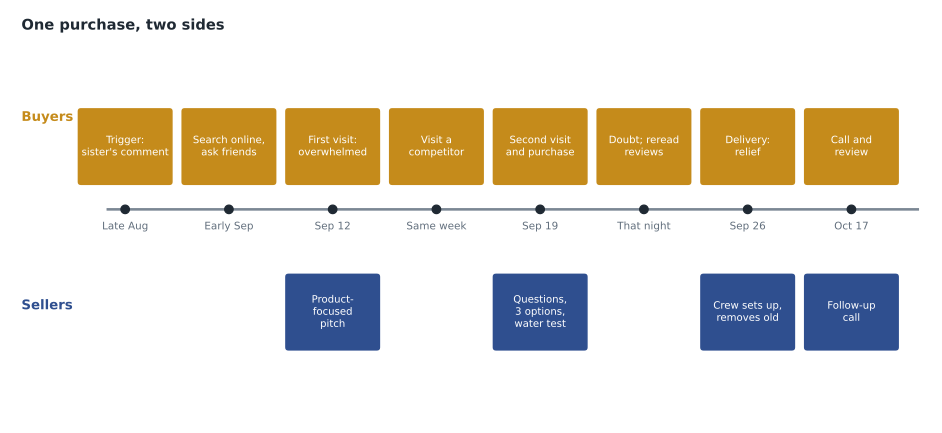
Hannah and Luis had owned their small house in central Sioux Falls for three years. Their old sofa had come from Luis's brother and was sagging, but it had never seemed urgent to replace. In late August 2026, with the baby due in mid-October, Hannah's sister visited, sat on the sofa and said, 'You're not going to want to get up from that thing at three in the morning.' That evening they started looking.
Their first search was online. They looked at furniture sites, read reviews and saved photos of light gray sofas they liked. They also asked friends with young children what had survived. Two themes came back repeatedly: get fabric you can clean, and make sure the cushions are firm enough to get up from easily while holding a baby. Their list of stores was short: Juniper & Pine, because a friend had bought a mattress there and liked the delivery, a large national chain and an online brand that sold sofas in boxes.
On Saturday, September 12, they visited Juniper & Pine. A young associate greeted them warmly and told them about every sofa in the gallery. 'He was nice,' Hannah said later, 'but it was like a lecture. We'd mentioned the baby and he talked about kiln-dried frames.' They tried several sofas, liked a light gray sectional, but felt overwhelmed and left to visit the national chain. There, they found a similar sectional for about 300 dollars less, but the salesperson could not say when it would arrive and the fabric felt thin. They looked at the online brand's sofa in a showroom photo and read reviews complaining that the cushions flattened.
A week later, on Saturday, September 19, they returned to Juniper & Pine. This time Carl Jensen greeted them. 'He asked when the baby was due before he asked anything about sofas,' Luis said. Carl asked what their days looked like, who would use the sofa, whether they had pets and what had gone wrong with the old one. He showed them three sectionals instead of ten, explained the difference between the fabrics by spilling a little water on a sample of each, and suggested they try getting up from each one with a heavy cushion in their arms. They chose the same light gray sectional they had liked the first time, in a performance fabric with removable cushion covers.
The price was 2,480 dollars, plus 79 dollars for delivery. Carl mentioned the five-year stain protection plan for 199 dollars once, explained what it covered and what it did not, and said many customers with young children chose it but that the fabric was already easy to clean. They bought the plan. They also asked whether the store would match the national chain's price; Carl explained that the chain's model used a different frame and fabric, showed them both specifications side by side, and offered to check if they found the same model cheaper elsewhere. They were satisfied with that. Carl confirmed that the sectional was in stock and booked delivery for Saturday, September 26, well before the due date.
The evening after buying, Hannah woke up wondering whether they had spent too much. She reread the reviews of the sectional, found mostly good ones and a few complaints about delivery windows, and felt better. Delivery was on time. The crew set up the sectional, removed the old sofa and took the packaging away. 'That was the moment I stopped worrying,' Hannah said. Three weeks later, on Saturday, October 17, the baby, a girl named Sofia, was a week old, and Carl called to ask how the sectional was working. Luis said it was the most-used thing in the house. Hannah later posted a four-star review: five stars for the sofa and the salesman, one star off because the delivery text gave a four-hour window.
The sellers' story
From Juniper & Pine's side, the story began on September 12 with a missed opportunity. Aiden's notes from that day read: 'Couple, gray sectional, interested, said they'd think about it.' He had not recorded the baby, the due date or what the couple were worried about. When Bev reviewed the day with him, she pointed out that the couple had told him the trigger in their first sentence and the main concern in their second, and that he had answered neither.
When the Morenos returned, Carl recognized the signs of a couple in the evaluation stage: they went straight to the sectional they had seen before and asked how it differed from two others. He saw his job as helping them finish a decision they had mostly made. His questions were aimed at their situation rather than the product, and his three-sectional short list reduced the choice to something they could compare. The water test turned a fabric claim into something they could see and feel. Asking them to stand up holding a cushion tested a criterion their friends had raised but no store had addressed.
Carl's handling of the price question was deliberate. He knew that the national chain's sectional set a reference price for the couple, and he could have argued that it was inferior. Instead, he showed the specifications side by side and offered to check any genuine price match. 'If I talk down the other store,' he told Aiden afterward, 'they wonder what I'm hiding. If I show them the facts, they decide for themselves.' His single, balanced mention of the protection plan reflected Juniper & Pine's rule against pressure on add-ons.
After the sale, the store's process took over. The delivery team's standards, the old-furniture removal and the three-week follow-up call are part of every furniture sale, because Bev knows from experience, and from the research in lesson 4, that the end of the experience shapes how it is remembered. The four-star review stung a little. Bev passed the comment about the four-hour window to Marcus Dube, the operations lead. The two-hour delivery windows he began piloting for appliances on October 5 are planned for furniture next.
| Lesson | Idea | Where it appears |
|---|---|---|
| 1 | Doing nothing is an option | The old sofa had been "fine" for three years |
| 2 | Needs behind the request; functional, emotional and social jobs | A gray sofa (request); cleanable seating, peace of mind and a welcoming family home |
| 3 | Trigger, search, consideration set, evaluation, post-purchase | The sister's comment; three stores; returning to compare; doubt after buying |
| 4 | Need for touch; peak-end rule | The water test; delivery as the moment worry ended |
| 5 | Reference price; narrowing choices | The national chain's lower price; three sectionals instead of ten |
| 6 | Social influence and reviews | The sister, friends with children, the friend who liked delivery, online reviews |
| 7 | Perceived risk and trust | Performance and time risk; trust earned by honest comparison |
Worked problem
Checking what the Morenos actually paid
The Morenos paid 2,480 dollars for the sectional, 79 dollars for delivery and 199 dollars for the protection plan, before tax. They chose Juniper & Pine's 12-month equal-payment plan through its partner lender, with no interest if each payment is made on time. What was their total before tax, what was the monthly payment, and how did the total compare with the national chain's sectional at 300 dollars less with the same delivery charge and no protection plan?
Show solution
- Total before tax: 2,480 + 79 + 199 = 2,758 dollars.
- Monthly payment: 2,758 ÷ 12 ≈ 229.83 dollars.
- National chain: (2,480 − 300) + 79 = 2,259 dollars.
- Difference: 2,758 − 2,259 = 499 dollars, of which 199 dollars is the protection plan and 300 dollars is the price difference.
Answer: The Morenos spent 499 dollars more than the cheapest option they considered, about 230 dollars a month for a year, or 300 dollars more for the sectional itself. Their interview made clear what they bought with the difference: a better fabric, a firm delivery date before the baby and a store they trusted. A seller should help buyers see exactly this kind of trade-off, and should also explain plainly that interest-free payment plans usually depend on paying on time and can carry charges if a payment is missed.
The same lens on a business purchase
Ridgeline's proposal to Eastgate Physiotherapy, followed through lessons 1, 5 and 8, is still in progress as this course ends in mid-November 2026. Looking at it from both sides shows how the same ideas take a different shape in an organization. The trigger was a slow build-up of jams and invoice arguments rather than a single comment, and it was Carla Bennett, the office manager, not a family member, who first said it out loud. The needs include the organization's, reliable printing at a predictable cost, and the office manager's personal win: no more being the person who clears the jams.
The decision process is longer and more formal. The office manager can approve up to 5,000 dollars, so the two owner physiotherapists must approve the 14,400-dollar, three-year contract at their December 2 meeting. The buying group is small: the office manager as initiator, gatekeeper and influencer, a physiotherapy assistant who uses the main printer most as a user, and the two owner physiotherapists as deciders. The perceived risks are performance, financial and time risk: will the new machines work, will there be hidden charges and will installation disrupt patient care? Carla adds a fourth concern from experience: the clinic once paid to leave a five-year lease early, so she wants a contract it can end if service fails. Maya's one-page summary for the owners, her fixed per-page price with no minimum volume, her installation plan for a weekend and a termination clause tied to service levels are each aimed at one of those risks. Whatever the owners decide on December 2, Maya will ask for a debrief from the office manager, so that she learns from the decision either way.
| Element | The Morenos | Eastgate Physiotherapy |
|---|---|---|
| Trigger | A comment from a sister, a baby on the way | Months of jams and invoice disputes |
| Who decides | The couple together | Two owner physiotherapists, on the office manager's recommendation |
| Timeline | Four weeks from trigger to delivery | About four months from first meeting to planned installation |
| Main risks | Performance and time | Performance, financial and time |
| What built trust | Honest comparison, a short list, on-time delivery | Agreed numbers, a fixed price, a clear plan and summary |
What the case teaches
Both stories end where the course began. The sellers who succeeded were the ones who asked who the buyer was and what the buyer was trying to get done. Aiden's first conversation with the Morenos failed not because he lacked knowledge but because he directed it at the product. Carl's succeeded because he directed the same knowledge at their situation, concerns and decision. Maya's work with Eastgate follows the same pattern in a more complex setting, with more people, more rules and more time.
Aiden asked Carl afterward what he would have done differently on September 12. Carl thought about it. 'I'd have asked about the baby,' he said, 'and then I'd have stopped talking.' The courses that follow in the Sales programs, beginning with the conversation skills of SLS-120, build on that answer.
Common mistakes
MistakeA customer who leaves to "think about it" has rejected the store.
InsteadThey may be early in evaluation; a good impression and a reason to return matter.
MistakeTalking down a competitor's product builds confidence in yours.
InsteadAn honest side-by-side comparison lets buyers decide for themselves and builds trust.
MistakeThe sale ends at payment.
InsteadDelivery, follow-up and handling doubts shape how the purchase is remembered and reviewed.
MistakeHousehold and business buying have nothing in common.
InsteadThe same ideas apply, though organizations add more people, rules, approvals and time.
Summary and key terms
- The Morenos' purchase shows every stage of the decision process, including doubt after buying.
- Aiden's first conversation failed because it focused on the product rather than the buyers' situation.
- Carl helped by asking about the situation, narrowing the choice, letting the buyers test the fabric and comparing honestly.
- Delivery and the follow-up call shaped the buyers' final memory of the purchase.
- Eastgate's purchase shows the same ideas in an organization, with approval limits, a buying group and formal risks.
- In both settings, sellers succeed by understanding who the buyer is and what the buyer is trying to get done.
- Win-loss interview
- A conversation with a buyer after a decision to learn how and why they chose.
- Equal-payment plan
- A financing arrangement that spreads a purchase into equal installments, often interest-free if paid on time.
- Short list
- A small set of options chosen to match the buyer's needs.
- Debrief
- A review after a decision to learn what influenced it.
Practice problems
Work each problem on paper first, then reveal the answer to check.
What was the trigger for the Morenos' purchase?
Show answer
Hannah's sister's comment about getting up from the old sofa at three in the morning, with the baby due in October.
Which three ideas from lesson 5 did Carl use, and how?
Show answer
He respected the reference price by comparing honestly, he narrowed ten options to three, and he presented the protection plan once without pressure.
A customer pays 1,800 dollars over 12 equal interest-free payments. What is each payment?
Show answer
1,800 ÷ 12 = 150 dollars.
What would Carl have done differently on September 12?
Show answer
Asked about the baby and then stopped talking.
Lesson quiz · 5 questions
Score 60% or more to complete this lesson.
Create a free account to save your progress, take quizzes and earn a certificate.