
SLS-110 · Lesson 8 of 12 · 19 min
Organizational buying: how businesses decide
▶ Video coming soon A video version of this lesson is on the way.
When Maya was selling appliances at Juniper & Pine, a customer who liked a sofa could usually buy it that afternoon. In her first months at Ridgeline she learned that organizations do not work that way. Eastgate Physiotherapy liked Ridgeline's print proposal in September 2026, but the office manager could approve purchases only up to 5,000 dollars; anything larger went to the clinic's two owner physiotherapists, who met monthly. Prairie Valley School District needed the purchase in its budget for the fiscal year, a formal procurement process if the value was high enough and, for some contracts, approval by the board. Keystone Grain Equipment's owners reviewed every capital purchase above 20,000 dollars at a quarterly meeting.
Organizational buying is the process by which organizations establish the need for products and services and identify, evaluate and choose among suppliers. BUS-220 introduced how business markets differ from consumer markets and outlined the business buying process. This lesson looks at the same ground through a salesperson's eyes: how organizations actually move from a problem to a signed contract, and what a seller needs to understand about budgets, approvals and buying situations to help them get there.
Why organizational buying is different
Business markets differ from consumer markets in ways that shape every sale. There are fewer, larger buyers; demand is derived from the demand for the buyer's own products or services; purchases often involve many people; decisions follow written policies; and relationships last for years. For a salesperson, the most important differences are three. Several people decide, so the seller must understand a group, which is the subject of lesson 9. The money belongs to the organization and is controlled by budgets and approval limits, which this lesson covers. And formal rules govern how suppliers are chosen, especially in public bodies, which lesson 10 covers.
Organizational buyers are often described as rational, and they do use more formal criteria than most households. But lesson 2 showed that every organizational purchase also involves people with personal motives, and lesson 7 showed that perceived risk and fear of blame can matter more than price. The best description is that organizational buying is a formal process carried out by people with ordinary human concerns.
Buying situations
In 1967 Patrick Robinson, Charles Faris and Yoram Wind classified organizational purchases into three buy classes, a framework still used in sales training. In a straight rebuy, the organization reorders something it has bought before from an approved supplier, often with little thought. In a modified rebuy, the organization wants to change something about a past purchase, such as the specifications, price or supplier. In a new task purchase, the organization buys something for the first time, with high uncertainty, a long search and many people involved.
| Buy class | Example | If you are the current supplier | If you are a challenger |
|---|---|---|---|
| Straight rebuy | Eastgate reorders toner from its current supplier | Keep service flawless and reordering easy | Hard to enter; wait for a problem or a contract renewal |
| Modified rebuy | Prairie Valley seeks a new print contract when the old one ends | Expect competitors; show results and improvements | Present a clear reason to change and lower the risk of switching |
| New task | Keystone equips meeting rooms for video calls for the first time | Not applicable | Help the buyer understand the problem and build the requirements |
The buy class tells a seller how much help the buyer needs and how open the decision is. Maya's biggest opportunities came from new task purchases, such as Keystone's meeting rooms, where she could help the buyer define the requirements, and from modified rebuys, such as Prairie Valley's print contract, where the incumbent supplier had let service slip. Straight rebuys were mostly closed to her unless something went wrong for the current supplier.
The buying process
Robinson, Faris and Wind also described eight stages that organizations move through in a new task purchase, which they called buyphases. BUS-220 listed them: problem recognition, general need description, product specification, supplier search, proposal solicitation, supplier selection, order-routine specification and performance review. In straight rebuys, several stages are skipped. The model is useful, but research by Gartner published in 2019 found that real business buying is far less tidy. Gartner described six jobs that buyers must complete: problem identification, solution exploration, requirements building, supplier selection, validation and consensus creation. Buyers revisit these jobs repeatedly and in no fixed order, a pattern Gartner compared to a tangle of loops rather than a funnel.
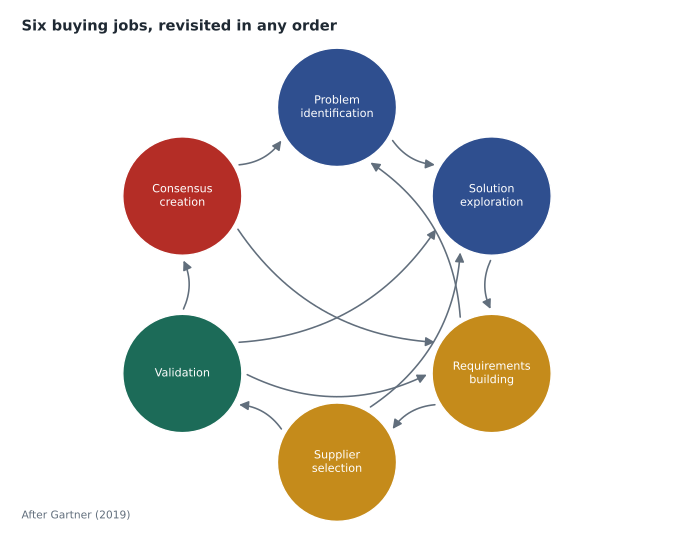
The practical message for sellers is that buyers need help with each job, and that the jobs where buyers struggle most, especially validation and consensus creation, are often where a seller adds the most value. Validation means checking that the chosen solution will really work, through references, pilots and evidence. Consensus creation means getting the people involved to agree. A seller who provides materials that help one stakeholder explain the purchase to another, as lesson 4 described, is helping with consensus creation.
Derived demand and the buyer's own business
Because business demand is derived from the buyer's own sales, a seller needs to understand how the customer's business is doing. Keystone Grain Equipment makes augers and grain-handling equipment, and its sales follow farm incomes, which rise and fall with crop prices and harvests. In a year when farmers are cautious, Keystone's owners delay capital spending of every kind, including meeting rooms. A school division's spending follows its operating grant and enrollment; a clinic's follows patient volumes and the fees it can bill. Reading a customer's annual report, local news and industry publications before a meeting tells the seller whether the buyer is likely to be expanding, holding steady or cutting back, and therefore which arguments will matter. In a cutting year, savings and risk reduction matter most; in a growth year, capacity and speed.
This understanding also helps a seller avoid wasted effort. Darnell keeps a short note in the CRM for each major account on what drives the customer's own revenue and when its busy and quiet seasons fall. Keystone, for example, cannot install anything during harvest, when its service technicians are in the field and the plant runs extra shifts. A proposal that ignores the customer's own calendar tells the buyer that the seller has not been paying attention.
Budgets and fiscal years
Organizations spend according to budgets, and budgets follow fiscal years. South Dakota school districts use a fiscal year that runs from July 1 to June 30, as does the State of South Dakota. Many businesses use the calendar year, and the federal government's fiscal year runs from October 1 to September 30. A purchase that is not in this year's budget may have to wait for next year's, and the budget for next year is usually set months before it begins.
This has two consequences. The first is timing: the best time to influence a large public purchase is often during budget planning, long before any formal request for proposals. The second is the end-of-year effect: departments with unspent funds near the end of a fiscal year sometimes want to buy quickly, while departments that have spent their budgets cannot buy anything until the new year. Neither is a reason to pressure buyers, but both are reasons to ask early, 'When does your budget year start, and when is next year's budget set?'
Capital and operating spending
Organizations often treat two kinds of spending differently. Capital expenditure buys assets that last several years, such as furniture or equipment, and usually needs higher-level approval. Operating expenditure covers ongoing costs, such as subscriptions, services, leases and supplies, and is often easier to approve within a department's budget. Ridgeline's managed print contracts and RoomFlow subscriptions are operating costs, while buying printers outright would be capital. Which is better depends on the customer's accounting, tax situation and cash, and the customer's finance team decides. A seller should understand the difference, ask which the customer prefers and avoid giving accounting or tax advice.
Approval limits and signing authority
Most organizations set dollar limits on who can approve a purchase. A typical pattern is that a department head can approve small purchases, a director or vice-president approves larger ones, and the chief executive or board approves the largest. Public bodies publish their limits in purchasing policies. The limits matter because the person who must sign may be someone the seller has never met, and the approval may happen at a meeting with its own schedule.
Worked problem
Planning backward from the approval meeting
Eastgate Physiotherapy's proposal from Ridgeline totals 14,400 dollars over three years. The office manager can approve up to 5,000 dollars, so the two owner physiotherapists must approve it. They meet on the first Wednesday of each month and want papers one week before. The clinic's current print lease ends on January 31, 2027, and Ridgeline needs three weeks to order, configure and install new machines. Today is November 2, 2026. Which meeting must approve the purchase, and by when must the papers be ready?
Show solution
- The work must finish by January 31, 2027, so ordering and setup must start by about January 10, three weeks earlier.
- An approval at the January meeting, on Wednesday, January 6, 2027, would leave only four days before the work must begin, which is too tight.
- The December meeting falls on Wednesday, December 2, 2026.
- Papers are due one week earlier, on Wednesday, November 25, 2026.
Answer: Aim for approval at the December 2 meeting, with the proposal and a one-page summary for the owners delivered to the office manager by November 25. That gives 23 days from today to answer the office manager's remaining questions. Maya should share the timeline with the office manager and agree on it, not impose it.
Planning backward like this is one of the most useful habits in business selling. Many deals that sellers think are lost are really late: the paperwork reached the approver after the meeting that mattered. Asking early about approval limits, meeting dates and paperwork requirements is not pushy; buyers appreciate a seller who understands how their organization works.
Influences on organizational buyers
Frederick Webster and Yoram Wind proposed in 1972 that organizational buying is shaped by four groups of influences: environmental factors, such as the economy, regulation and technology; organizational factors, such as goals, policies, structure and systems; interpersonal factors, such as authority, status and persuasiveness within the buying group; and individual factors, such as each person's age, experience, personality and attitude to risk. BUS-220 described each group. For a salesperson, the framework is a reminder to look beyond the specifications. A clinic's purchase may be shaped by new privacy rules for patient information, by the owners' preference for familiar suppliers and by the office manager's workload as much as by print speed.
How organizations choose suppliers
Organizations usually compare suppliers on a mix of criteria: price and total cost, quality and reliability, delivery and service, technical capability, financial stability, reputation, ease of working together and, increasingly, environmental and social practices. Larger organizations and public bodies often score suppliers formally, with weights for each criterion, as lesson 10 shows. Smaller organizations decide less formally, but the same criteria are present in the conversation.
A seller's job is to learn the criteria and their weights early, ideally before the buyer has written them down, and to make sure the buyer has the information needed to judge each one fairly. When the criteria favor a competitor, an honest seller either shows evidence that changes the buyer's view of a criterion, suggests a criterion the buyer has missed that genuinely matters, or accepts that this is not the right customer. Trying to win on criteria the buyer does not care about rarely works.
Common mistakes
MistakeThe person you meet can approve the purchase.
InsteadAsk about approval limits; larger purchases often need someone you have not met, at a scheduled meeting.
MistakeBusiness buying follows eight neat stages in order.
InsteadBuyers loop among buying jobs; help most with validation and consensus creation.
MistakeA purchase can happen whenever the buyer likes the proposal.
InsteadBudgets, fiscal years and approval meetings set the timing; plan backward from them.
MistakeSellers should advise whether to lease or buy.
InsteadExplain the options, ask what the customer prefers and leave accounting and tax decisions to the customer.
Summary and key terms
- Organizational buying is a formal process carried out by people with ordinary human concerns.
- The buy classes are straight rebuy, modified rebuy and new task, and each calls for a different seller strategy.
- Gartner describes six buying jobs that buyers revisit in no fixed order.
- Budgets, fiscal years, capital and operating spending and approval limits shape when and how organizations buy.
- Planning backward from approval meetings prevents deals from arriving too late.
- Webster and Wind grouped influences on organizational buyers into environmental, organizational, interpersonal and individual factors.
- Straight rebuy
- Reordering a familiar product from an approved supplier.
- Modified rebuy
- A repeat purchase in which specifications, price or supplier may change.
- New task
- A first-time purchase with high uncertainty and a long search.
- Fiscal year
- The twelve-month period an organization uses for its budget and accounts.
- Approval limit
- The largest purchase a person is authorized to approve.
- Consensus creation
- The buying job of getting the people involved to agree.
Practice problems
Work each problem on paper first, then reveal the answer to check.
Prairie Valley's print contract is ending and it is inviting new suppliers. Which buy class is this?
Show answer
A modified rebuy.
Name Gartner's six B2B buying jobs.
Show answer
Problem identification, solution exploration, requirements building, supplier selection, validation and consensus creation.
An approval meeting is on March 3 and papers are due one week before. When are papers due?
Show answer
February 24.
Why is the budget planning period a good time to influence a public purchase?
Show answer
Because the money for next year is decided then, long before any formal request for proposals.
Lesson quiz · 5 questions
Score 60% or more to complete this lesson.
Create a free account to save your progress, take quizzes and earn a certificate.