
SLS-110 · Lesson 5 of 12 · 20 min
Biases and shortcuts in buying
▶ Video coming soon A video version of this lesson is on the way.
Carl Jensen has sold appliances at Juniper & Pine for nine years, and he has noticed patterns that he cannot fully explain. Customers who see a 3,800-dollar refrigerator first are more comfortable with a 2,400-dollar one than customers who start at the 1,200-dollar end of the aisle. Customers offered nine dishwashers often leave to 'think about it', while customers shown three usually choose one. And customers who take a mattress home under the store's 90-night comfort exchange almost never exchange it, even when they had doubts in the store. None of this is in the product training. All of it is in the research on how people make decisions.
This lesson introduces the mental shortcuts and systematic biases that shape buying. Psychologists and behavioral economists have studied them for more than fifty years. Some findings are among the most robust in social science; others have weakened or failed when researchers tried to repeat them. A professional seller needs to know both which effects are real and which are doubtful, and to use the real ones only in ways that help buyers decide well.
Heuristics: useful shortcuts
A heuristic is a mental shortcut that produces a quick judgment without working through every detail. People rely on heuristics constantly, and usually they work well enough. In a famous 1974 paper in the journal Science, Amos Tversky and Daniel Kahneman described three heuristics that also produce predictable errors: availability, representativeness and anchoring. Daniel Kahneman's 2011 book Thinking, Fast and Slow popularized the related idea of two modes of thinking, a fast, automatic and intuitive System 1 and a slow, effortful and deliberate System 2. Many psychologists treat the two systems as a helpful metaphor rather than a literal description of the brain, but the metaphor captures something every salesperson sees: most buying judgments are fast, and careful analysis is the exception.
The availability heuristic is the tendency to judge how likely something is by how easily examples come to mind. A customer whose neighbor's front-load washer grew mold will see that risk as larger than the statistics suggest. A business manager who remembers one failed software rollout will overestimate the risk of the next. The representativeness heuristic is the tendency to judge by resemblance to a stereotype: a heavy sofa 'looks' well built, a supplier with a polished website 'seems' reliable. Neither judgment is necessarily wrong, but both can be.
Anchoring
Anchoring is the tendency for an initial number to pull later estimates toward it, even when the first number is arbitrary. In Tversky and Kahneman's original experiment, people who saw a wheel of fortune stop at a high number gave higher estimates of the share of African countries in the United Nations than people who saw a low number. Anchoring is one of the most replicated effects in the field. It shows up in price judgments, salary negotiations and estimates by experts as well as novices.
Carl's refrigerator observation is an anchoring effect. Seeing the expensive model first sets a reference that makes the middle model look reasonable. Anchoring also shapes business negotiation, as SLS-213 explains: the first number put on the table, whether a price, a discount or a budget, tends to frame the rest of the discussion. The ethical use of anchoring is to show genuine options in a sensible order, for example starting a tour of the range with the model that best fits the customer's stated needs. Inventing an inflated 'regular price' so that a sale price looks like a bargain is deceptive, and it can break the FTC's guides against deceptive pricing and state laws on former-price comparisons.
Losses loom larger than gains
Prospect theory, published by Kahneman and Tversky in 1979, describes how people evaluate risky choices. Its central idea is that people judge outcomes as gains or losses relative to a reference point, usually the current situation, and that losses hurt more than equal gains please. This asymmetry is called loss aversion. Early estimates suggested losses weigh about twice as much as gains. Large reviews of many studies since then have found an average close to that figure, with wide variation across people and situations, and some researchers argue that the effect is smaller for everyday amounts of money than for large ones.
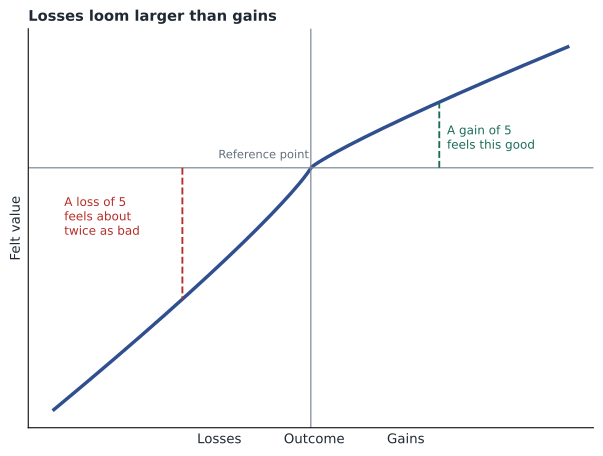
Loss aversion explains several things sellers meet daily. It is part of why doing nothing feels safe: changing suppliers means giving up the known current arrangement, and the possible loss looms larger than the possible gain. It explains why a free trial is persuasive: once a customer owns something, giving it up feels like a loss. And it explains why the same fact can feel different depending on how it is framed.
Framing
Framing means presenting the same information in different ways, for example as a gain or a loss, or as a share that succeeds or a share that fails. In a 1981 study, Tversky and Kahneman showed that people's choices between two disease programs reversed depending on whether outcomes were described as lives saved or lives lost, even though the numbers were identical. Framing effects are well established, although their size varies.
Worked problem
Framing the same saving two ways
Ridgeline's proposal to Eastgate Physiotherapy would cut the clinic's printing costs from about 7,500 dollars a year to about 4,800 dollars, with the same number of pages. How can Maya state this as a gain and as a loss, and which is honest?
Show solution
- Saving per year: 7,500 − 4,800 = 2,700 dollars.
- Saving per month: 2,700 ÷ 12 = 225 dollars.
- Gain frame: "The new contract saves the clinic about 2,700 dollars a year."
- Loss frame: "Under the current arrangement, the clinic is paying about 225 dollars a month more than it needs to."
Answer: Both statements are true and use the same numbers, so both are honest. The loss frame is likely to feel more urgent because of loss aversion. Maya may use either, as long as the underlying figures are ones the clinic agreed with and the comparison covers the same pages and service. What she must not do is mix units to exaggerate, for example comparing a monthly saving against a yearly cost.
The status quo and the endowment effect
William Samuelson and Richard Zeckhauser coined the term status quo bias in 1988 after finding that people disproportionately stick with an existing option, even when alternatives are equally or more attractive. A closely related effect is the endowment effect, demonstrated by Daniel Kahneman, Jack Knetsch and Richard Thaler in 1990: people who were given a coffee mug asked for about twice as much money to sell it as other people were willing to pay to buy one. Owning something, even briefly, increases its value to the owner. Some later researchers argue that the size of the endowment effect depends on how experiments are run, but the basic pattern has been found many times.
These effects explain Carl's third observation. Customers who take a mattress home under the 90-night comfort exchange begin to think of it as their mattress, and giving it up feels like a loss. A trial or exchange period is ethical when the product genuinely suits the customer and using the exchange is simple, with its fee and conditions explained before the sale. It becomes manipulative when the process is deliberately made difficult. Juniper & Pine's policy is that an exchange takes one phone call and a pickup date, and Bev reminds associates that a customer who keeps a mattress they dislike will not come back for a sofa.
Too many choices
In a well-known 2000 study, Sheena Iyengar and Mark Lepper set up a tasting table of jams in a supermarket. When 24 jams were displayed, more shoppers stopped, but far fewer bought than when only 6 were displayed. The finding, often called choice overload, became famous. Later research has made it more complicated. A 2010 review of 50 experiments by Benjamin Scheibehenne and colleagues found that, on average, the effect of the number of options on choice was close to zero, with some studies finding overload and others finding that more choice helped. A 2015 review by Alexander Chernev and colleagues concluded that overload is most likely when the options are complex, hard to compare, the buyer has no clear preferences and the decision is difficult.
This is exactly the situation of a customer facing nine dishwashers with similar prices and dozens of features. The practical response is not to hide the range but to help the customer narrow it: ask two or three questions about needs, then show the three models that fit, while making it clear the others are available. Customers usually welcome a short list from a seller they trust.
Decoys and defaults
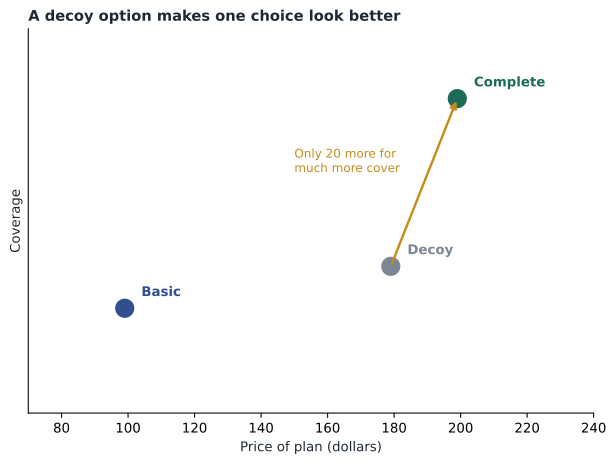
The attraction or decoy effect, first shown by Joel Huber, John Payne and Christopher Puto in 1982, occurs when adding a third option that is clearly worse than one of the existing options makes that option more attractive. A protection plan offered in three tiers, where the middle tier is only slightly cheaper than the top tier but covers much less, can make the top tier look like the obvious choice. Later research has found that the decoy effect is often weaker with real products and meaningful descriptions than in early laboratory studies, so it should not be treated as a reliable lever.
Defaults are much more powerful. When one option is chosen automatically unless people opt out, most people keep it. Eric Johnson and Daniel Goldstein's 2003 study of organ donation found much higher consent rates in countries where consent was the default. In selling, defaults appear in order forms, contracts and online checkouts. A pre-ticked box for a protection plan is a default. Setting defaults that most customers would choose anyway, such as standard delivery, helps them. Setting defaults that add charges most customers do not want is a dark pattern, and the FTC and state regulators have taken action against pre-selected add-ons and hidden charges.
Findings that did not hold up
Not every famous result in this field has survived. Since about 2011, psychology has gone through what is often called a replication crisis, in which many published findings could not be reproduced by other researchers. Some priming effects are a well-known example. A 1996 study reported that people who unscrambled sentences containing words associated with old age walked more slowly afterwards; a 2012 attempt by Stéphane Doyen and colleagues to repeat it with more careful controls did not find the effect. Claims that subtle cues such as a word on a poster or a particular scent reliably change what people buy should be treated with caution unless they have been repeated in large, careful studies.
For a salesperson, the replication crisis offers two lessons. First, be skeptical of sales training that promises secret psychological triggers. The effects that have held up, such as anchoring, loss aversion, framing, the status quo and defaults, are real but modest, and they work alongside the buyer's actual needs, not instead of them. Second, the most reliable way to influence a buyer remains the simplest: understand what they need and show them honestly how to get it.
Helping buyers decide well
Biases cut both ways. They can lead a buyer into a poor decision, and a good seller can help a buyer avoid them. A seller can counter availability bias by giving real figures alongside vivid stories, counter status quo bias by laying out the cost of doing nothing, counter choice overload by narrowing the options, and counter post-purchase regret by making returns easy. Richard Thaler and Cass Sunstein's 2008 book Nudge argued that the people who design choices have a responsibility to design them in ways that help people make the choices they would make with full information and attention. That is a good standard for salespeople, too.
Common mistakes
MistakeBehavioral science gives sellers secret triggers that work on everyone.
InsteadRobust effects such as anchoring and loss aversion are real but modest, and some famous effects have failed to replicate.
MistakeMore choice always helps the customer.
InsteadWith complex, hard-to-compare options, a short list based on the customer's needs often helps more.
MistakeFraming a saving as a loss is dishonest.
InsteadUsing the same true numbers in a different frame is honest; inventing or mixing numbers is not.
MistakePre-selecting add-ons is a smart default.
InsteadDefaults should be what most customers would choose; pre-ticked charges are a dark pattern regulators act against.
Summary and key terms
- Heuristics are mental shortcuts that are usually useful but produce predictable errors.
- Anchoring, loss aversion, framing, the status quo bias, the endowment effect and defaults are well-supported effects.
- Choice overload and the decoy effect depend strongly on the situation and are weaker than early studies suggested.
- Some priming findings failed to replicate; treat claims of subtle triggers with caution.
- Sellers can use these effects to help buyers decide well, for example by showing the cost of inaction and narrowing options.
- Inflated regular prices, false scarcity and pre-ticked charges are deceptive and can break the law.
- Heuristic
- A mental shortcut that produces a quick judgment.
- Anchoring
- The pull of an initial number on later estimates.
- Loss aversion
- The tendency for losses to be felt more strongly than equal gains.
- Framing
- Presenting the same information in different ways, such as gains or losses.
- Endowment effect
- Valuing something more once you own it.
- Default
- The option that applies unless the buyer chooses otherwise.
- Replication
- Repeating a study to see whether its findings hold.
Practice problems
Work each problem on paper first, then reveal the answer to check.
Why are customers more comfortable with a 2,400-dollar refrigerator after seeing a 3,800-dollar one?
Show answer
Anchoring: the first price sets a reference that makes the second look reasonable.
A contract saves 3,600 dollars a year. State the loss frame per month.
Show answer
The current arrangement costs about 300 dollars a month more than it needs to.
What did Scheibehenne and colleagues find about choice overload?
Show answer
Across 50 experiments, the average effect of the number of options was close to zero, with results varying by situation.
When is a free trial ethical?
Show answer
When the product genuinely suits the customer and returning or exchanging it is simple, with the conditions explained up front.
Lesson quiz · 5 questions
Score 60% or more to complete this lesson.
Create a free account to save your progress, take quizzes and earn a certificate.