
SLS-120 · Lesson 11 of 12 · 21 min
Difficult emotions and conflict
▶ Video coming soon A video version of this lesson is on the way.
The customer was already angry when he reached Aiden. His new refrigerator had been delivered on Tuesday, the delivery team had scratched the hardwood floor on the way in, and the store had promised a call back about the repair that never came. Now it was Saturday, the showroom was full, and he was speaking loudly enough for other customers to turn around. Aiden's first instinct was to explain that the delivery team was a separate company and that the person who had promised the call worked on weekdays. Bev, walking over, caught his eye and shook her head slightly. Later she explained: 'Everything you were about to say was true. None of it was what he needed to hear first.'
Strong emotions are part of selling. Buyers get frustrated, anxious, disappointed and sometimes angry: about a delivery, a price increase, a product that failed, or simply a bad day. Sellers feel emotions too, including defensiveness, embarrassment and frustration of their own. This lesson covers how emotions affect conversations, how to respond to an upset buyer, how to de-escalate a tense situation, how to handle conflict and disagreement constructively, and how sellers look after themselves.
What happens when emotions run high
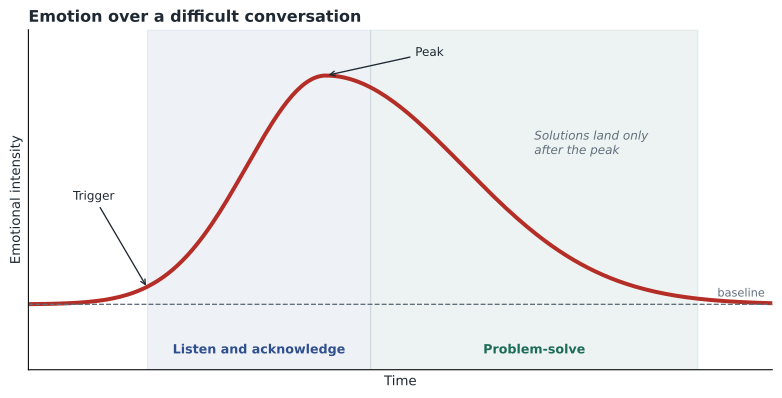
When people feel threatened or very upset, their capacity to process information falls. They focus narrowly on the source of the threat, hear less, remember less accurately and tend to interpret neutral statements as hostile. Popular writing often describes this as the emotional part of the brain taking over from the reasoning part. Neuroscientists consider that a simplification, but the practical point is well supported: a person in a heightened emotional state is not ready for explanations, facts or solutions. They first need to feel heard and to calm down.
This is why Aiden's instinct was the wrong place to start. The facts about the delivery company and the weekday staff were accurate, but to an angry customer they would sound like excuses. They might be useful later, once the customer felt that someone was taking responsibility.
Responding to an upset buyer
Bev teaches a sequence she calls listen, acknowledge, own, solve, follow up. It resembles many service recovery models taught in retail and customer service, and SLS-130 Customer Service and Customer Experience covers service recovery in depth. Here the focus is on the conversation itself.
| Step | What the seller does | What it sounds like |
|---|---|---|
| Listen | Let the buyer say everything without interrupting | Nodding, "Go on", silence |
| Acknowledge | Show that you understand what happened and how they feel | "You were promised a call and nobody called. And the floor is damaged. That's really frustrating." |
| Own | Take responsibility on behalf of the business, without blaming others | "That's on us. I'm sorry." |
| Solve | Agree on what happens next, specifically | "I'm going to book the floor repair with you right now, and I'll give you my direct number." |
| Follow up | Do what you said, and check back | A call on Monday to confirm the repair date |
Acknowledging feelings is not the same as agreeing with everything the buyer says. If the buyer says the store is run by incompetents, the seller does not need to agree, but can acknowledge the frustration behind the words: 'I can hear how frustrating this has been.' Acknowledgment is about the experience, which is real, not the accusation.
Apologies matter, and they work best when they are specific and sincere. 'I'm sorry you feel that way' sounds like an apology but blames the buyer's feelings. 'I'm sorry we didn't call you back as promised' names the failure. Sellers sometimes worry that apologizing admits legal liability. Many US states have apology laws, though most are limited to health care, that limit the use of an apology as evidence of fault in some legal proceedings, but the protection varies by place and type of case. In everyday sales and service, the practical guidance is to follow company policy, apologize sincerely for the experience and the specific service failure, and avoid speculating about legal responsibility for something like an injury or major damage.
Worked problem
Rewriting a response
Here is what Aiden almost said to the customer with the scratched floor: "Actually, the delivery is done by a contractor, not us, and the person who promised you the call only works weekdays, so there's nothing I can do until Monday." Rewrite the response using the sequence.
Show solution
- Listen first: let the customer finish, without interrupting.
- Acknowledge: "You had your new fridge delivered, the floor got scratched, and then the call you were promised never came. I'd be upset too."
- Own: "That's our responsibility. The delivery team works for us, and we should have called. I'm sorry."
- Solve: "I can't book the floor repair company until they open on Monday, but I can do two things now. I'll write up the claim with you here, with photos if you have them, and I'll call you myself by 10 a.m. Monday with a repair date."
- Follow up: Aiden adds a task in the store system and calls on Monday at 9:40 a.m.
Answer: The facts are the same, including that the repair cannot be booked until Monday. The difference is that the customer hears first that he has been heard and that someone is responsible, and he leaves with a specific promise and a name.
De-escalation
Sometimes a buyer's anger rises beyond ordinary frustration. Sellers are not security staff and should never put themselves or others at risk, but they can often calm a situation before it gets worse. Many workplace de-escalation programs teach similar basics.
| Do | Avoid |
|---|---|
| Keep your own voice calm, slow and a little lower | Raising your voice to match theirs |
| Give the person space and stay at an angle, not head on | Moving closer, pointing or touching |
| Move the conversation somewhere quieter if it is safe to do so | Arguing in front of other customers |
| Use the person's name and simple, short sentences | Long explanations or policy language |
| Offer choices: "Would you prefer to sit down here or talk by the desk?" | Ultimatums: "Calm down or leave" |
| Know when to bring in a manager, and when to get help | Trying to handle a threatening situation alone |
Saying 'calm down' rarely calms anyone. It tells the person their feelings are the problem. Acknowledging the feeling and lowering your own voice usually works better.
Every seller should know their workplace's policy for threatening behavior. If a customer threatens violence, damages property or will not stop shouting at staff, the seller's job is to step away, get a manager and, if necessary, call for help. Retail stores and many offices have procedures for this, and occupational health and safety law in both countries expects employers to address workplace violence and harassment, including from customers.
Conflict and disagreement in sales conversations
Not every difficult moment is an emotional outburst. Much more often, sellers face disagreement: a buyer who thinks the price is too high, who prefers a competitor, who doubts a claim, or who disagrees with a colleague on the buying team. Disagreement is normal and often useful, because it shows what the buyer really cares about. Handling objections and negotiation are the subject of SLS-213 Negotiation and Closing; this section covers the conversational skills behind them.
Stay curious rather than defensive. When a buyer pushes back, the instinct is to defend. A better first response is to understand: 'Tell me more about what's behind that.' Many objections turn out to be different from what they first sounded like. A buyer who says 'your price is too high' may mean 'I can't justify this to my manager', 'the competitor is cheaper' or 'I don't see the value yet', and each needs a different response.
Separate the person from the problem. A principle from Roger Fisher and William Ury's 1981 book Getting to Yes, developed at the Harvard Negotiation Project, is to treat disagreements as shared problems to solve rather than contests between people. In sales, that means talking about the issue, such as the budget or the timeline, rather than about whether the buyer is being reasonable.
Use I-statements for your own position. When a seller must disagree, such as when a buyer asks for a commitment the seller cannot make, saying what the seller can and cannot do is clearer and less confrontational than criticizing the request: 'I can't promise delivery by Friday, because the warehouse can't confirm it. I can promise Monday, and I'll call you Thursday if anything changes.'
Handle disagreement within the buying group carefully. When two people on the buyer's side disagree, as Dale and Linda at Keystone sometimes did, the seller should not take sides. Acknowledge both views, look for what each person needs, and suggest a way forward that addresses both: 'It sounds like the timeline matters most to you, Dale, and how staff experience the change matters most to you, Linda. Would a two-room start that finishes by the 22nd work for both?'
The seller's own emotions
Selling involves a lot of rejection. Inside sales reps may hear no dozens of times a day, and account executives lose deals they spent months on. Retail associates deal with rude customers on busy days. Sellers who take every rejection personally burn out. Sellers who stop caring stop selling well.
Darnell talks openly in the clinic about this. He suggests a few habits that research on stress and emotional regulation broadly supports. Name the feeling to yourself, which tends to reduce its intensity. Pause before responding when you feel defensive; a breath or a sip of water is enough. Reframe rejection as information about fit and timing rather than as a verdict on you. Talk to colleagues after hard calls. And protect the basics: sleep, breaks and time away from the phone. If stress becomes overwhelming, most employers offer an employee assistance program, and talking to a manager or a health professional is a sign of good judgment, not weakness.
Worked problem
Reframing a lost deal
Maya lost a deal with a small law firm after three meetings, when the firm chose a competitor that was 15 in 100 cheaper. She feels she failed. How might she reframe it, and what can she learn?
Show solution
- Name the feeling: disappointment, and some embarrassment because she had told Darnell the deal was likely.
- Separate what she controlled from what she did not: she could not change the competitor's price, but she could have learned earlier that price was the deciding factor.
- Look for information: the firm's office manager had mentioned budget in the first meeting, and Maya had not asked a follow-up question.
- Decide one change: in future discovery calls, she will ask how the decision will be made and what would make a cheaper option win.
- Close the loop: she sends the firm a short, gracious note and asks if she may check back in a year.
Answer: The deal is still lost, but Maya leaves with one specific improvement and a relationship that is still open. Fourteen months later, the firm called her back when the competitor's service fell short.
Aiden's customer with the scratched floor came back three weeks after the repair to buy a range. He asked for Aiden by name. 'You were the only person who didn't make excuses,' he said. Bev pointed out afterwards that Aiden had not changed a single fact. He had changed the order in which he said things.
One last point about conflict: it is not always a bad sign. A buyer who argues with a proposal is still engaged. The buyer to worry about is the one who goes quiet, stops replying and buys elsewhere without a word.
Darnell puts it simply to the clinic: an argument is a buyer telling you what matters to them. Listen to it.
Common mistakes
MistakeExplaining the facts first calms an angry customer.
InsteadListen and acknowledge first; explanations land only after the emotion has peaked.
MistakeAcknowledging feelings means agreeing with the buyer.
InsteadAcknowledge the experience and feeling, not every accusation.
Mistake"I'm sorry you feel that way" is an apology.
InsteadName the specific failure: "I'm sorry we didn't call you back."
MistakeTelling someone to calm down helps them calm down.
InsteadLower your own voice, give space, offer choices and acknowledge the feeling.
MistakeSellers should handle threatening customers themselves.
InsteadStep away, get a manager and call for help if needed; follow workplace policy.
Summary and key terms
- Strong emotions reduce people's capacity to process information, so listening and acknowledging come before explaining and solving.
- A useful sequence for upset buyers is listen, acknowledge, own, solve and follow up.
- Specific, sincere apologies work best; follow company policy on legal matters.
- De-escalation relies on a calm voice, space, short sentences, choices and knowing when to get help.
- Disagreement is normal; stay curious, separate the person from the problem and use I-statements.
- Sellers manage their own emotions by naming feelings, pausing, reframing rejection, talking to colleagues and protecting the basics.
- Acknowledgment
- Showing that you understand what happened and how the other person feels, without necessarily agreeing.
- De-escalation
- Calming a tense situation through voice, space, language and choices.
- I-statement
- A statement of your own position or limits, rather than a criticism of the other person.
- Reframing
- Seeing an event, such as a lost deal, from a different and more useful angle.
Practice problems
Work each problem on paper first, then reveal the answer to check.
List the five steps Bev teaches for responding to an upset buyer.
Show answer
Listen, acknowledge, own, solve and follow up.
Why was Aiden's first instinct the wrong place to start?
Show answer
Accurate facts sound like excuses to someone at the peak of anger; they need to feel heard first.
Rewrite "Calm down, sir" into a more helpful response.
Show answer
For example: "I can see this has been really frustrating. Would you like to sit down here and go through it with me?"
What principle from Getting to Yes helps in sales disagreements?
Show answer
Separate the person from the problem and treat the disagreement as a shared problem to solve.
Lesson quiz · 5 questions
Score 60% or more to complete this lesson.
Create a free account to save your progress, take quizzes and earn a certificate.