
SLS-120 · Lesson 2 of 12 · 19 min
Active listening
▶ Video coming soon A video version of this lesson is on the way.
At the second Tuesday clinic, Darnell played the first five minutes of a call without telling anyone who the seller was. A facilities manager at Keystone Grain Equipment described a problem: the plant's meeting room was booked twice for the same morning, twice in one month, and both times a visiting dealer group ended up standing in the hallway. The seller on the recording said, 'That's frustrating,' and then moved straight to describing RoomFlow, Ridgeline's booking software. Darnell stopped the recording. 'What did the manager actually say was the problem?' he asked. Someone said double bookings. Maya, who had made the call, said quietly, 'He said visitors were embarrassed in front of the dealers. I didn't hear that part.'
Hearing is the physical act of sound reaching the ear. Listening is the mental work of attending to, understanding, remembering and responding to what someone says. Active listening is a deliberate way of listening that shows the speaker they have been understood and helps the listener understand them accurately. The term comes from the psychologists Carl Rogers and Richard Farson, who described it in a 1957 paper on listening in counseling and the workplace. In sales, it is the skill that makes every other conversation skill work.
Why listening is harder than it looks
Most people believe they are better listeners than they are. Several things get in the way, and salespeople face all of them.
People think faster than others speak. Conversational speech runs at roughly 120 to 160 words per minute, while people can process language much faster than that. The spare capacity tends to fill with other thoughts: what to say next, an email that needs an answer, a judgment about the speaker. A seller who is planning the next pitch is not fully listening to the buyer.
Sellers listen for openings. Because salespeople know their products well, they are tempted to listen only for a cue that a product fits, as Maya did with the word 'booked'. This is sometimes called listening to reply rather than listening to understand.
Assumptions fill the gaps. When a buyer says something familiar, the seller's mind completes the story from past customers. Sometimes the assumption is right. Often the details that make this buyer different are exactly the details the seller skipped.
Emotion narrows attention. When a buyer criticizes the company, mentions a competitor or pushes back on price, the seller may become defensive and stop listening to what is actually being said. Lesson 11 returns to this.
Levels of listening
Trainers use several ladders to describe listening. One common version, adapted from Stephen Covey's work on empathic listening, has five levels. It is a teaching device rather than a research finding, but it gives sellers a useful way to check themselves.
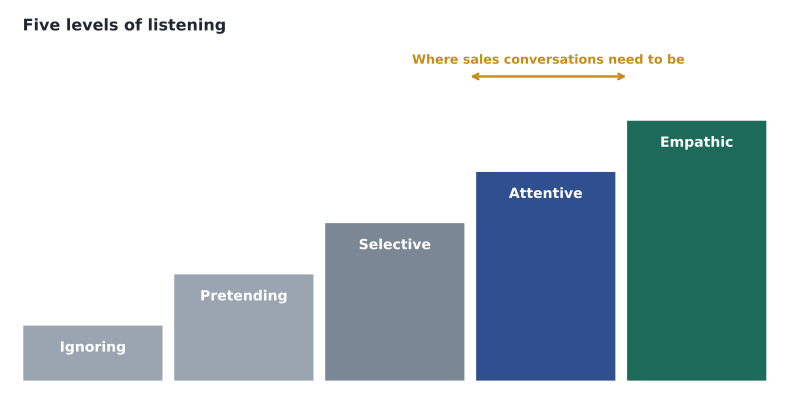
| Level | What the listener does | What it sounds like in a sales conversation |
|---|---|---|
| Ignoring | Does not attend at all | Checking a phone while the buyer talks |
| Pretending | Gives signs of listening without attending | 'Right, right, sure' with no follow-up |
| Selective | Attends only to parts that interest the listener | Hearing the product cue and skipping the rest |
| Attentive | Attends to the words and can repeat them accurately | An accurate summary of the facts the buyer gave |
| Empathic | Attends to the meaning and feeling behind the words | Noticing that the real concern is embarrassment in front of dealers |
The core techniques of active listening
Active listening is often taught as a set of techniques. They are worth learning separately, but in a good conversation they blend together, and none of them works if the listener is not genuinely trying to understand.
Attending. Give the speaker your full attention and show it. In person, that means facing the speaker, keeping a relaxed and open posture, keeping your phone away and making natural eye contact. On a call, it means closing other windows and silencing notifications. Attending also means letting the speaker finish. Interrupting, even to agree, tells the buyer that your thought matters more than theirs.
Encouraging. Small signals tell the speaker to keep going: a nod, 'mm-hm', 'go on', 'tell me more'. Silence is also an encourager. Many people feel uncomfortable with a pause of more than a second or two and rush to fill it. A seller who waits three or four seconds after the buyer stops talking will often hear the most important sentence of the conversation, because the buyer fills the silence with something they had not planned to say.
Paraphrasing. Restate the content of what the speaker said in your own words: 'So the room has been double booked twice this month, and both times it was for visiting dealers.' A paraphrase shows that you heard the facts and gives the speaker a chance to correct you. It should be shorter than the original and should not add anything the speaker did not say.
Reflecting feelings. Name the emotion you are hearing, tentatively: 'It sounds like that was embarrassing for the team.' Reflecting a feeling shows empathy and often opens the conversation to what really matters to the buyer. The word 'sounds' matters. It invites correction, while 'You feel embarrassed' tells the buyer what they feel.
Clarifying. Ask about anything vague: 'When you say the system is unreliable, what happens?' Clarifying questions are covered more fully in lesson 3.
Summarizing. At natural break points, pull together several points: 'Let me make sure I have this. Bookings are made by email to the receptionist, two dealer visits were double booked this month, the plant manager was upset both times, and you'd like something that shows the calendar to everyone. Did I miss anything?' Summaries organize the conversation, confirm understanding and often prompt the buyer to add something important.
Worked problem
Paraphrase, reflect or summarize?
A Juniper & Pine customer tells Aiden: "Our old mattress is twelve years old. My husband's back is sore every morning and I'm tired of him tossing all night. We looked online but there are too many choices and every review contradicts the last one." Write a paraphrase, a reflection and a summary that Aiden could use.
Show solution
- A paraphrase restates the content briefly: "So the mattress is twelve years old and your husband wakes up sore."
- A reflection names the feeling tentatively: "It sounds like the online research has been more confusing than helpful."
- A summary pulls the points together and checks: "Let me make sure I understand. The old mattress is twelve years old, he wakes up with a sore back, his tossing keeps you awake, and you want help cutting through all the choices. Is that right?"
- Aiden should not add a claim the customer did not make, such as "so you need a firm mattress", until he has asked more.
Answer: Each response does a different job. Aiden uses the reflection first, because the customer's frustration with the research is what she most wants acknowledged, and then the summary before asking his next question.
Listening to the whole message
Active listening attends to three things at once: what is said, how it is said and what is not said. The content is the facts and requests. The delivery is the tone, pace, hesitations and emphasis. A buyer who says 'the price is fine' while hesitating and looking away is sending a mixed message, and the hesitation deserves a gentle question. Lesson 5 covers nonverbal signals more fully, with an important caution about how easily they are misread.
What is not said can matter most. A buyer who describes a problem in detail but never mentions who decides, or who talks about features but never about budget, may be avoiding a sensitive subject. An attentive seller notices the gap and, at the right moment, asks about it.
Notes: listening that lasts
In business selling, listening has to survive beyond the conversation. Maya will pass what she learns to a sales engineer, a proposal writer and possibly a delivery team, and she will need to remember details weeks later. Notes are part of listening. Darnell teaches three habits.
Ask permission and explain why: 'Do you mind if I take notes, so I get the details right?' Buyers almost always agree, and asking signals care.
Capture the buyer's own words for the important points. If the buyer says the problem is 'embarrassing in front of dealers', write that, not 'scheduling issue'. Using the buyer's words later, in a summary email or a proposal, shows they were heard.
Enter the notes in the CRM the same day. Memory fades quickly, and a note entered a week later is often a reconstruction rather than a record. SLS-140 Sales Technology: CRM and Digital Tools covers how notes, activities and opportunities are recorded.
Recording calls is one way to capture everything, but the rules differ between the two countries, and a seller must know them before pressing record.
In the United States, federal law allows a call to be recorded when one party to it consents, and South Dakota, where Ridgeline is based, also follows a one-party consent rule. Several states, including California, Washington, Florida, Illinois and Pennsylvania, require the consent of everyone on the call, and when a call crosses state lines the stricter rule is the safe one to follow. Ridgeline's policy is that sellers tell every buyer at the start of a recorded call, ask for agreement and stop recording if the buyer objects, whatever state the buyer is in.
Listening in a busy store
Retail listening has its own challenges. Aiden often talks with customers in a noisy showroom, with other customers waiting and children pulling at their parents. He has minutes rather than an hour. Bev's advice is to listen in short, focused bursts and to use the environment. When a couple is talking to each other about a sofa, Aiden stays close enough to be available but far enough to give them privacy, and he listens to the conversation between them, which often reveals more than anything they would say to a salesperson. When he does step in, he refers to what he heard naturally rather than awkwardly: 'I couldn't help noticing you both sat on the deeper one first.'
Retail customers also signal how much help they want. A customer who answers a greeting with 'just looking' may truly want to browse. Active listening includes respecting that, staying available and coming back later with a light, specific offer: 'If you want to compare the two you keep looking at, I can show you the difference in the cushions.'
Checking your own listening
Darnell asks clinic members to rate themselves after a call by answering four questions honestly.
| Question | A good sign | A warning sign |
|---|---|---|
| Could I repeat the buyer's main problem in their own words? | Yes, with details | Only in my product's terms |
| Did I learn something I did not expect? | At least one surprise | The call went exactly as planned |
| How often did I interrupt? | Rarely or never | Several times, even to agree |
| Did I summarize and ask what I missed? | At least once, near the end | No summary at all |
Maya's Keystone call failed three of the four. She called the facilities manager back the next week, apologized for jumping ahead and asked to hear more about the dealer visits. The conversation that followed was about the plant's reputation with its dealer network, and it led to a meeting with the plant manager. 'Listening,' Darnell told the clinic, 'is the one sales skill that always pays.'
Common mistakes
MistakeListening means keeping quiet until it is your turn to talk.
InsteadActive listening means working to understand and showing that you have, through attending, paraphrasing, reflecting and summarizing.
MistakeA good paraphrase repeats the buyer's words exactly.
InsteadA paraphrase restates the content briefly in your own words and adds nothing new.
MistakeTelling the buyer what they feel shows empathy.
InsteadReflect feelings tentatively, as in "It sounds like", so the buyer can correct you.
MistakeNotes can be written up at the end of the week.
InsteadEnter notes the same day, using the buyer's own words for the important points.
MistakeAny participant can record a sales call without saying so.
InsteadRecording rules differ by country and, in the US, by state; tell the buyer and get agreement before recording.
Summary and key terms
- Active listening, described by Rogers and Farson in 1957, means working to understand the speaker and showing that you have.
- Listening is hard because people think faster than others speak, sellers listen for openings, assumptions fill gaps and emotion narrows attention.
- Sales conversations need attentive and empathic listening, not just hearing the words.
- The core techniques are attending, encouraging, paraphrasing, reflecting feelings, clarifying and summarizing.
- Listening includes what is said, how it is said and what is left out.
- Notes in the buyer's own words, entered the same day, make listening last; recording calls requires knowing the consent rules.
- Active listening
- Deliberate listening that aims to understand the speaker and shows them they have been understood.
- Paraphrase
- A brief restatement of what the speaker said, in the listener's own words.
- Reflecting
- Naming, tentatively, the feeling the listener hears behind the words.
- Summary
- A restatement of several points at a break in the conversation, followed by a check.
Practice problems
Work each problem on paper first, then reveal the answer to check.
What did Maya miss on the Keystone call?
Show answer
That the real concern was visitors being embarrassed in front of the dealers, not just double bookings.
Why does a pause of three or four seconds after the buyer stops talking help?
Show answer
Buyers often fill the silence with information they had not planned to share.
Turn this into a tentative reflection: "You're angry about the late delivery."
Show answer
For example: "It sounds like the late delivery really let you down."
Name the four questions in Darnell's after-call listening check.
Show answer
Could I repeat the problem in the buyer's words, did I learn something unexpected, how often did I interrupt, and did I summarize and ask what I missed.
Lesson quiz · 5 questions
Score 60% or more to complete this lesson.
Create a free account to save your progress, take quizzes and earn a certificate.