
SLS-210 · Lesson 11 of 12 · 21 min
Building a prospecting cadence
▶ Video coming soon A video version of this lesson is on the way.
By the end of October, Maya had learned to make good cold calls, write short emails, use the professional network well and follow up events quickly. Her results were still uneven. Some weeks she booked six meetings, others one. At the Thursday session on October 29, Owen Pelletier asked to see her calendar. It showed bursts of activity followed by gaps: a busy day of calls on a Tuesday, then nothing for that account for two weeks, then an email that referred to a call the prospect had long forgotten. "You've got all the instruments," Owen said. "Now you need sheet music."
A prospecting cadence, also called a sequence, is a planned series of contacts with a prospect across several channels and days, designed to start a conversation. It answers three questions in advance: how many times to try, through which channels and with what spacing. A cadence turns individual skills into a repeatable system, makes sure no good prospect is dropped after one attempt and stops the seller from contacting someone too often. This lesson covers how cadences are designed, how Ridgeline's standard cadence works, how to match cadences to account tiers and how to fit them into a working week.
Why one attempt is not enough
Most prospects do not respond to the first contact. They are busy, the call came at a bad time, the email arrived in a crowded inbox. Many sales teams report that a large share of meetings are booked after the third or fourth contact, although the exact figures vary widely by market and are usually published by vendors of sales tools. Ridgeline's own data supports the general pattern: of the 41 first meetings its account executives booked from outbound cadences in the third quarter of 2026, only 9 came from the first touch.
At the same time, there is a point where more contact stops helping and starts annoying. A prospect who has received eight messages in a week is more likely to complain than to reply. A good cadence balances persistence with respect: enough attempts across different channels to reach a busy person, spread out so that each one feels reasonable, and ending politely if there is no response.
Elements of a cadence
| Choice | Question | Typical range in B2B |
|---|---|---|
| Number of touches | How many attempts before pausing? | 6 to 12 |
| Length | Over how many days? | 2 to 4 weeks |
| Channels | Which mix of call, email, network and other? | Usually three channels |
| Spacing | How many days between touches? | 1 to 4 business days, wider later |
| Content | What does each touch add? | A new angle, example or resource each time |
| Exit rules | When does the cadence stop? | Reply, meeting booked, opt-out, bounce or end of cadence |
Each touch should add something. A cadence of eight messages that all say "just following up" gives a prospect eight reasons to ignore the seller. A cadence in which the first touch names a trigger, the second shares a short customer example, the third offers a useful checklist and the fourth asks a different question gives the prospect several different reasons to respond, any one of which might match what they care about.
Ridgeline's standard cadence
Owen's team designed Ridgeline's standard cadence for tier B accounts in 2025 and adjusted it after measuring results. It has eight touches over fifteen business days, across three channels.
| Day | Channel | Touch | Content |
|---|---|---|---|
| 1 | Network + call | View profile; call; no voicemail | Reason based on trigger; one question |
| 1 | First email | Short note naming the trigger and one problem | |
| 3 | Call | Second call; leave voicemail | Same reason; mention the email |
| 5 | Second email in the same thread | Short customer example from a similar organization | |
| 8 | Network | Connection request with note, or comment on a post | Personal, no pitch |
| 10 | Call | Third call; no voicemail | A different question |
| 12 | Third email | Useful resource, such as the office-move checklist | |
| 15 | Breakup email | Polite close, door left open |
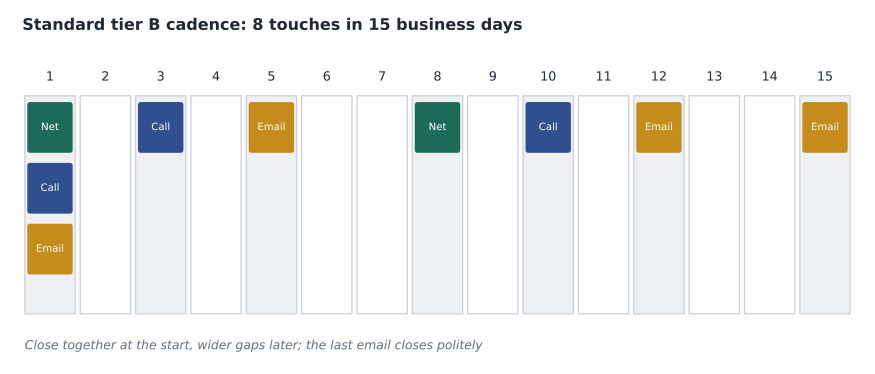
The pattern has several features worth noticing. Touches are close together at the start, when a prospect who is interested is most likely to respond, and wider apart later. Channels alternate, so a prospect who ignores email might pick up the phone, and vice versa. Voicemails are left only twice, because more feels like pressure. The network touch comes in the middle, after the prospect has seen Maya's name a couple of times, so the connection request is less likely to feel like a stranger's. And the cadence ends with a breakup email, which often gets more replies than any other message, perhaps because it removes pressure and makes it easy to say "not now, try me in spring".
Every email touch must follow CAN-SPAM, including a working opt-out, and once a contact opts out, the platform removes them from every email step automatically. Calls to cell phones are dialed manually, as lesson 5 explained, and contacts at Canadian offices are moved to a calls-and-network-only version of the cadence unless they have given consent.
Matching cadences to tiers
Not every account deserves the same cadence. Ridgeline uses three versions. Tier A accounts get a highly personalized cadence of ten to twelve touches over four weeks, with individually written emails, research before every call and sometimes a mailed item, such as a printed office-move checklist with a handwritten note. Tier B accounts get the standard cadence above. Tier C accounts get a light cadence of three or four touches, mostly email with segment-level personalization where consent allows, and a single call. Inbound leads that score highly get a fast cadence that starts within an hour, as lesson 8 described.
What happens at the end
A prospect who finishes a cadence without responding is not lost. They move to a nurture status, where they receive occasional useful contact, such as a quarterly email newsletter if they have consented, and are put back into a new cadence when a new trigger appears or after a set period, often three to six months. Ridgeline's CRM reopens these accounts automatically after 120 days. When Maya reached Deb Wiens at Sandstone on the third call of her second cadence, in November, Deb said, "I remember your emails from September. The timing wasn't right then."
Capacity: how much can one seller run?
Cadences are easy to start and hard to keep up. If a seller adds too many accounts, she cannot make every call on the right day, emails go out late and the cadence loses its rhythm. A seller needs to work out how many new accounts she can add each week given the time each touch takes.
Worked problem
How many new accounts per week?
In Maya's standard cadence, each account gets 3 calls (about 3 minutes each, including notes), 4 emails (about 4 minutes each, since they are personalized at trigger level) and 1 network touch (about 2 minutes). She has 180 minutes a week for outbound contact in her two blocks, plus 60 minutes of Monday research time. Research takes about 5 minutes per tier B account. How many new tier B accounts can she add to the cadence each week, if the cadence runs for three weeks and she keeps a steady flow?
Show solution
- Contact time per account over the whole cadence: 3 × 3 + 4 × 4 + 1 × 2 = 9 + 16 + 2 = 27 minutes.
- Because the cadence runs three weeks, in a steady state she is working three weekly groups at once, so each week's contact load is 27 minutes per account added each week (spread across the three weeks).
- Contact capacity: 180 ÷ 27 ≈ 6.7 accounts per week.
- Research capacity: 60 ÷ 5 = 12 accounts per week, which is not the limit.
Answer: Maya can add about 6 or 7 new tier B accounts a week. That is fewer than she had been trying to work, which explains the gaps in her calendar. Owen suggested 6 a week, plus 2 tier A accounts using time borrowed from email, and using the inside team's help for tier C.
The calculation in the example uses a useful idea: in a steady flow, the total weekly load equals the time for one account's full cadence multiplied by the number of accounts added each week, because at any time the seller is working accounts that started this week, last week and the week before. This makes capacity easy to estimate for any cadence.
Worked problem
What should the cadence produce?
Grace's data shows that 100 tier B accounts in the standard cadence produce, on average, 31 conversations with the right person and 11 first meetings. If Maya adds 6 tier B accounts a week for 12 weeks, how many first meetings should the cadence produce over the quarter, and how does that compare with her target of about 4 or 5 outbound meetings a week from lesson 1?
Show solution
- Accounts added: 6 × 12 = 72.
- Expected first meetings: 72 × 11 ÷ 100 ≈ 7.9.
- Target: about 4.2 meetings a week × 12 weeks ≈ 50 meetings.
Answer: About 8 meetings from tier B cadences, far below the 50 she needs. The tier B cadence alone cannot fill her pipeline. The rest must come from tier A accounts, which convert better, from referrals, events and inbound leads, and from the inside sales team booking meetings for her. Lesson 12 builds the full plan.
The second example is sobering, and it is meant to be. Many new sellers assume that a cadence alone will fill a pipeline. In most B2B markets, it is one source among several, and its output depends on targeting as much as effort. Improving the meeting rate from 11 to 15 in every 100 accounts, through better triggers and messages, would add nearly 3 meetings a quarter from the same effort.
Fitting cadences into the week
A cadence only works if the seller does the tasks on the right days. Sales engagement platforms, which SLS-140 covers, help by creating a task list each morning: these calls to make, these emails to send, these profiles to view. Even so, the seller needs a weekly rhythm that protects the time. Maya settled on this pattern: Monday afternoon for research and loading new accounts; Tuesday and Thursday mornings for calls and personalized emails; Wednesday for meetings; Friday for follow-up, proposals and a 15-minute review of the week's numbers.
| Day | Prospecting work | Time |
|---|---|---|
| Monday | Research new accounts; check triggers; load cadences | 1:00 to 2:00 p.m. |
| Tuesday | Calls and emails due today | 8:30 to 10:00 a.m. |
| Wednesday | First meetings; network touches between meetings | As booked |
| Thursday | Calls and emails due today | 8:30 to 10:00 a.m. |
| Friday | Review numbers; move non-responders to nurture | 3:30 to 3:45 p.m. |
Measuring and improving a cadence
Because a cadence is a system, it can be tested and improved. Useful measures include the reply rate for each email, the connect rate for each call, which touch produced each meeting, the opt-out rate and the share of accounts that finish without any response. Owen's team tests one change at a time, such as a new subject line on the second email or moving the network touch from day 8 to day 4, and compares results over a few weeks. Because the numbers are small, they look for large, consistent differences rather than reacting to a single week.
Opt-outs and complaints deserve special attention. A sudden rise in opt-outs after a particular email suggests it is irrelevant or annoying. Ridgeline's rule is that any email step with more than 2 opt-outs in every 100 sends is rewritten, and any complaint about frequency triggers a review of the whole cadence.
Common mistakes
MistakeGiving up after one or two attempts.
InsteadUse a planned cadence of several touches across channels.
MistakeSending the same "just following up" message repeatedly.
InsteadMake each touch add a new angle, example or resource.
MistakeAdding more accounts than you can work on schedule.
InsteadCalculate weekly capacity from the time per account and add only that many.
MistakeUsing one cadence for every account.
InsteadMatch the cadence to the tier: personalized for A, standard for B, light for C.
MistakeContinuing a cadence after a reply or opt-out.
InsteadUse exit rules, and let the platform stop the sequence automatically.
Summary and key terms
- A prospecting cadence is a planned series of multi-channel contacts over several days, designed to start a conversation.
- Most meetings come after several touches, but too many touches annoy prospects; cadences balance persistence and respect.
- Cadences set the number of touches, length, channels, spacing, content and exit rules.
- Ridgeline's standard tier B cadence has eight touches over fifteen business days across calls, email and the professional network.
- Tier A accounts get longer, more personal cadences; tier C accounts get light ones.
- Weekly capacity equals available time divided by the time for one account's full cadence.
- Cadences are one source among several; measure, test one change at a time and watch opt-outs.
- Prospecting cadence
- A planned series of contacts with a prospect across channels and days.
- Touch
- A single contact attempt, such as a call, email or network interaction.
- Exit rule
- A condition that ends a cadence, such as a reply or opt-out.
- Breakup email
- The polite final email in a cadence.
- Nurture
- Occasional, useful contact with prospects who are not ready, until a new trigger appears.
- Capacity
- The number of new accounts a seller can add to a cadence each week.
Practice problems
Work each problem on paper first, then reveal the answer to check.
A cadence takes 30 minutes per account and a seller has 150 minutes a week. How many new accounts can she add each week?
Show answer
150 ÷ 30 = 5 accounts.
If 100 accounts produce 9 meetings, how many meetings will 80 accounts produce on average?
Show answer
80 × 9 ÷ 100 = 7.2 meetings.
Why are touches closer together at the start of a cadence?
Show answer
Interested prospects are most likely to respond early, and wider gaps later avoid pressure.
What should happen to a prospect who finishes a cadence without replying?
Show answer
Move them to nurture and restart a cadence when a new trigger appears or after a set period.
Lesson quiz · 5 questions
Score 60% or more to complete this lesson.
Create a free account to save your progress, take quizzes and earn a certificate.