
SLS-210 · Lesson 2 of 12 · 20 min
The ideal customer profile
▶ Video coming soon A video version of this lesson is on the way.
At the second Thursday session, on September 17, Darnell asked Maya which of her 640 accounts she planned to call first. She had sorted the list alphabetically and was planning to start at the top. Darnell laughed, then asked Grace Liu to join them. Grace had spent part of the summer analyzing every customer Ridgeline had won between 2023 and 2025, 118 accounts in all, to find out what the best ones had in common. "Before you knock on 640 doors," she told Maya, "let's work out which 60 are most likely to open."
This lesson is about that question. An ideal customer profile, or ICP, is a description of the kind of organization that gets the most value from what a company sells and that the company can serve profitably. It describes organizations, not people. A good ICP lets a seller rank a long list of accounts, spend her time where the odds are best and explain to a buyer why she called them in particular. A poor ICP, or none at all, leaves a seller working through lists in whatever order they happen to be in.
ICP and buyer persona
Two ideas are often confused. The ICP describes the organization: its industry, size, location, setup and situation. A buyer persona describes a person inside that organization: their role, goals, worries, habits and the way they make decisions. Maya studied personas in SLS-110, where Grace's personas included the busy clinic office manager and the cautious finance lead. In prospecting, the ICP comes first, because it tells a seller which organizations to research; the persona comes second, because it tells her whom to contact there and what to say. A seller who uses personas without an ICP may write a perfect message to an office manager at an organization that is far too small to buy.
| Ideal customer profile | Buyer persona | |
|---|---|---|
| Describes | An organization | A person or role inside an organization |
| Typical contents | Industry, size, location, setup, triggers, fit for the offering | Role, goals, problems, decision style, preferred channels |
| Main use in prospecting | Choosing and ranking accounts | Choosing contacts and shaping the message |
| Example at Ridgeline | Clinics and professional firms with 20 to 250 staff and several meeting rooms | The office manager who runs the printers and books the rooms |
What goes into an ICP
An ICP is built from a few kinds of information. Firmographics are the basic facts about an organization: industry, number of employees, revenue, number of locations and where it is. They are the easiest to find and the most commonly used. Industries are usually described with the North American Industry Classification System (NAICS), which Canada, the United States and Mexico share, so a family medical clinic has the same kind of code in both countries.
Setup or technographic information describes how the organization works today: what equipment and software it uses, how its offices are laid out and who supplies it. For Ridgeline, the number of meeting rooms, the age of the printers and whether the office already uses a room-booking system all matter. Some of this can be found online; much of it only emerges in conversation.
Situational triggers are events that make an organization more likely to buy soon: a move to a new office, an expansion, a merger, new leadership, the end of an equipment lease or a change in regulation. Triggers are often more useful than firmographics, because they tell a seller not only whether an organization fits, but when. Lesson 3 covers how to spot them.
Fit for the offering describes the needs that the company's products solve well. Ridgeline's managed print service is strongest for offices that print a lot of confidential paper, such as clinics and law firms, and RoomFlow is strongest for offices with several shared rooms. An ICP that ignores fit tends to produce meetings with organizations that are the right size but have no reason to change.
Negative criteria describe organizations to avoid: those that are too small to justify a visit, those tied into long contracts with a competitor, those outside the service area or those whose needs Ridgeline cannot meet. A short list of negatives saves as much time as the positives.
Building an ICP from customer data
The most reliable way to build an ICP is to study the customers a company already has. Grace's method was straightforward. She took the 118 accounts won from 2023 to 2025 and split them into three groups using data in the CRM and the finance system: the best customers, who had bought more than once, renewed and paid on time; the average customers; and the poor ones, who had canceled early, disputed invoices or needed far more service than expected. Then she compared the groups on firmographics, setup and the trigger that had started each deal.
| Characteristic | Best customers (38) | Average customers (55) | Poor customers (25) |
|---|---|---|---|
| 20 to 250 employees | 34 of 38 | 41 of 55 | 9 of 25 |
| Two or more shared meeting rooms | 33 of 38 | 30 of 55 | 6 of 25 |
| Regulated records (health, legal, financial) | 27 of 38 | 22 of 55 | 5 of 25 |
| Deal started by an ending lease or contract | 24 of 38 | 19 of 55 | 4 of 25 |
| Within the core service area | 37 of 38 | 50 of 55 | 15 of 25 |
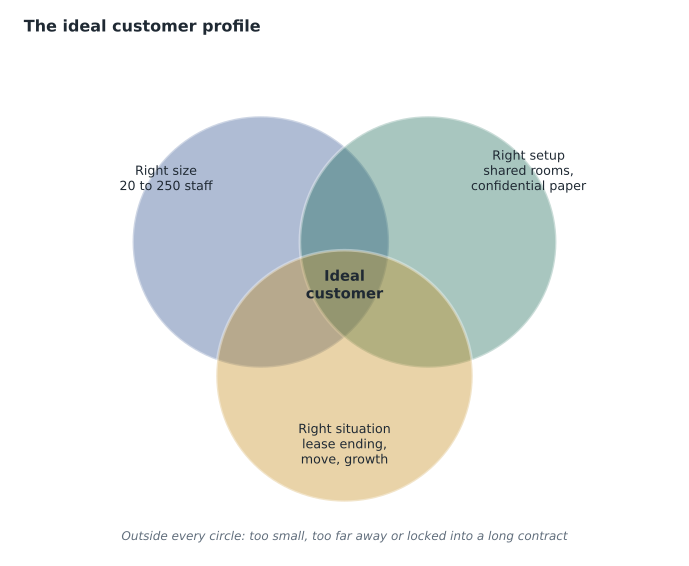
The pattern was clear. Most of the best customers had 20 to 250 employees, several meeting rooms and regulated paperwork, and many of their deals had started when an old lease was ending. Most of the poor customers were very small offices or organizations far outside the service area, where travel time made service expensive. Grace turned the findings into a short ICP statement: **organizations with 20 to 250 staff in the core service area, with two or more shared meeting rooms, handling regulated or confidential records, ideally with a print or room-booking contract ending within twelve months.**
Two cautions come with this method. First, a company's past customers reflect where its sellers happened to look, not every place good customers might be; if nobody ever called accounting firms, the data will not show that accounting firms buy. Grace flagged accounting firms and insurance brokers as worth testing for this reason. Second, small groups can mislead. A pattern based on five customers is a hint, not a rule. The ICP should be reviewed each year against new results.
Scoring and tiering accounts
Once an ICP exists, a seller can score her accounts against it and sort them into tiers. A common approach gives points for each ICP characteristic, adds them up and divides the list into groups: tier A accounts get careful research and personal outreach; tier B accounts get lighter research and a standard sequence; tier C accounts get occasional low-effort contact or are set aside. This is sometimes called account tiering, and it is one of the simplest ways to use limited prospecting time well. Lesson 9 shows a more detailed version that also scores engagement, such as a prospect opening emails or visiting the website.
Worked problem
Scoring three accounts against Ridgeline's ICP
Grace's simple fit score gives 25 points for 20 to 250 employees, 20 points for two or more shared meeting rooms, 20 points for regulated records, 25 points for a known lease or contract ending within twelve months and 10 points for being in the core service area. Tier A is 70 points or more, tier B is 40 to 69 and tier C is below 40. Score these accounts: Lakeview Veterinary Hospital (34 staff, 2 meeting rooms, medical records, lease end unknown, in the core area); Sandstone Accounting Group (61 staff, 4 meeting rooms, financial records, print lease ends in May 2027, in the core area); and a two-person insurance office 140 kilometers away with one room.
Show solution
- Lakeview: size 25 + rooms 20 + regulated records 20 + core area 10 = 75 points; tier A.
- Sandstone: size 25 + rooms 20 + records 20 + lease ending 25 + core area 10 = 100 points; tier A.
- Two-person office: no size points, no rooms points, regulated records 20 (insurance files), outside the core area = 20 points; tier C.
Answer: Sandstone and Lakeview both go into tier A, with Sandstone first because of the known lease date. The small distant office is tier C: Maya might add it to an occasional email but should not spend an hour researching it.
When Maya scored all 640 accounts this way, using what she could find in the CRM and online, she ended up with 63 tier A accounts, 149 tier B and 428 tier C or unknown. The 428 were not worthless; many simply had missing data. But the first 63 gave her a starting list that was small enough to research properly, and she could explain to each one why Ridgeline had contacted them.
The ICP in a seller's own words
An ICP that lives only in a spreadsheet does little good. Darnell asked Maya to be able to describe it in two sentences, the way she would explain it to a referral source or a new colleague: "We work best with clinics and professional offices of about 20 to 250 people that have several meeting rooms and a lot of confidential paper. They usually call us when their printer lease is ending or they are moving or expanding." When Maya used this description at a networking breakfast in October, two people immediately suggested organizations that fitted it, which is the subject of lesson 4.
The ICP also shapes the first thing a seller says. If Maya calls Sandstone Accounting Group, she can say honestly that Ridgeline works with many firms that handle confidential financial records in shared offices, which is a reason for the call that relates to Sandstone rather than to Ridgeline's catalog. Lessons 5 and 6 show how this becomes the opening of a call or an email.
Where to find firmographic data
Basic firmographic data comes from several places. Company websites and professional profiles give staff counts, locations and leadership. Industry associations and licensing bodies list members; in Maya's territory, for example, health professions are licensed by state licensing boards, and many publish searchable directories of clinics or practitioners. Commercial data providers sell lists with estimated employee counts and industry codes, although their estimates for small organizations can be far off. Government statistics show how many businesses of each size and industry exist in an area: the US Census Bureau publishes County Business Patterns, with counts of establishments by industry and employee size for each county, which helps a seller estimate how many ICP accounts a territory should contain. Maya used this to check her list: if the official counts suggested about 80 medical clinics of the right size in her area and her CRM held only 45, she was missing accounts.
Any data about people must be handled within privacy law. Collecting a business's address and staff count is one thing; collecting personal details about the people who work there is another. In the United States there is no single federal privacy law for this kind of data. Several states have broad privacy laws, and some of them, such as California's, cover business contacts, so companies usually follow a common standard: collect only what is needed, keep it accurate and honor requests to stop contact. SLS-150 covers privacy law in more detail.
Keeping the ICP honest
An ICP is a hypothesis about where good customers are, and it should be tested. Grace reviews Ridgeline's ICP each January by comparing win rates, deal sizes and service costs for tier A, B and C accounts closed in the previous year. If tier A accounts do not win more often or stay longer than tier B, the scoring is not working. She also watches for drift: sellers sometimes start calling every organization tier A because they like it, which makes the tiers meaningless. Darnell's rule is that no seller can promote an account to tier A without a written reason that matches the ICP.
Finally, an ICP is not a reason to be rude to buyers who fall outside it. When the two-person insurance office called Ridgeline in October asking about a printer, Owen's team answered the question, suggested a simpler option from Ridgeline's online store and moved on politely. Not every buyer is a fit, and a seller who says so honestly earns a good reputation in a territory where people talk.
Common mistakes
MistakeWorking through a prospect list alphabetically or in random order.
InsteadScore accounts against the ICP and start with tier A.
MistakeConfusing the ICP with a buyer persona.
InsteadUse the ICP to choose organizations and personas to choose people and messages within them.
MistakeBuilding the ICP from opinions or from a few memorable customers.
InsteadBase it on data from many won and lost accounts, and treat small samples as hints.
MistakeLeaving out negative criteria.
InsteadList the kinds of organizations to avoid so that sellers do not waste time on poor fits.
MistakeNever revisiting the ICP.
InsteadReview it at least once a year against win rates, deal sizes and service costs.
Summary and key terms
- An ideal customer profile describes the organizations that get the most value from an offering and can be served profitably.
- The ICP describes organizations; a buyer persona describes people within them.
- ICPs combine firmographics, setup or technographics, situational triggers, fit for the offering and negative criteria.
- The best ICPs come from analyzing good, average and poor customers in the company's own data.
- Scoring accounts against the ICP and sorting them into tiers focuses research and outreach on the best odds.
- Sellers should be able to state the ICP in two sentences and use it to explain why they called.
- ICPs should be tested and reviewed each year, and data about people must be handled within privacy law.
- Ideal customer profile (ICP)
- A description of the organizations most likely to benefit from an offering and to be served profitably.
- Buyer persona
- A description of a type of person within a buying organization.
- Firmographics
- Basic facts about an organization, such as industry, size and location.
- Situational trigger
- An event that makes an organization more likely to buy soon.
- Account tiering
- Sorting accounts into groups such as A, B and C by fit, to decide how much effort each gets.
- NAICS
- The North American Industry Classification System, used in Canada, the United States and Mexico to classify industries.
Practice problems
Work each problem on paper first, then reveal the answer to check.
Using Grace's scoring in the lesson, score a 45-person law firm with three meeting rooms, client files, no known contract end date, in the core area.
Show answer
25 + 20 + 20 + 10 = 75 points, tier A.
Why might an ICP built only from past customers miss good prospects?
Show answer
Past customers reflect where sellers happened to look; industries nobody called will not appear in the data.
Give two examples of situational triggers for Ridgeline.
Show answer
Any two of: an ending printer lease, an office move, an expansion, a merger, new leadership, a new records regulation.
What is the risk of letting sellers promote accounts to tier A freely?
Show answer
The tiers lose meaning, because sellers rate accounts by preference rather than fit.
Lesson quiz · 5 questions
Score 60% or more to complete this lesson.
Create a free account to save your progress, take quizzes and earn a certificate.