
SLS-210 · Lesson 3 of 12 · 19 min
Researching accounts and contacts
▶ Video coming soon A video version of this lesson is on the way.
With 63 tier A accounts on her list, Maya spent the morning of September 22 researching the first one, Sandstone Accounting Group. By lunch she had read the firm's website, its partners' professional profiles, three news stories about its merger with a smaller practice in 2025, its job postings and a long review thread about its parking. She had also learned the managing partner's favorite hockey team. At the Thursday session, Darnell asked what she had found that would help her start a conversation. She thought about it and picked out two things: the merger had brought two offices under one roof, and the firm was hiring an operations coordinator. Everything else, including the hockey team, was interesting but not useful.
Research is the bridge between a list of accounts and a good first contact. Done well, it lets a seller reach the right person with a reason to talk that is about the buyer's situation. Done badly, it either takes so long that the seller never actually contacts anyone, or it produces trivia that makes the first contact feel creepy rather than relevant. This lesson covers what to look for, where to look, how long to spend and how to record what you find.
What research is for
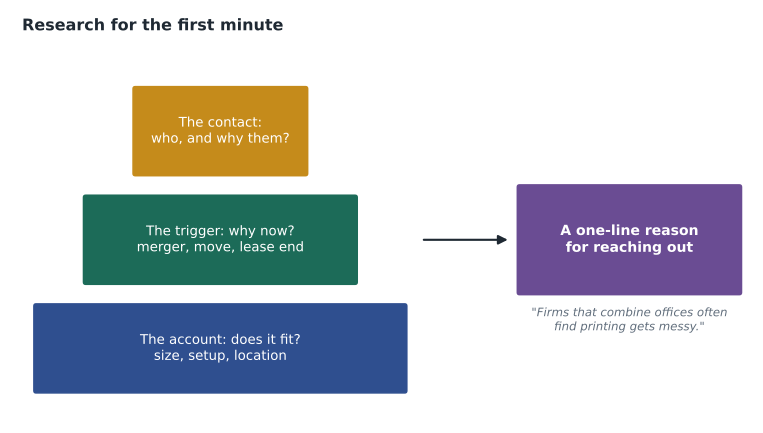
Before a first contact, a seller is trying to answer four questions about an account. Does it fit? Research confirms or corrects what the ICP score assumed: staff numbers, number of locations, kind of work. Is something happening? A trigger such as a move, merger, expansion, new leader or ending contract makes a conversation more timely. Who should I talk to? Research identifies the people likely to be involved in a decision and the one to contact first. What is my reason for reaching out? The answers to the first three questions combine into a short, honest reason that the buyer might care about. If research does not help answer one of these four questions, it can usually wait until after the first conversation.
Darnell called this "research for the first minute, not the whole meeting". Deeper research into the buyer's business, goals and problems belongs in preparation for discovery, which SLS-211 covers. At the prospecting stage, the aim is enough knowledge to earn a conversation, not a full account plan.
Sources of account information
| Source | What it often shows | Watch out for |
|---|---|---|
| The organization's website | Services, locations, leadership, news, careers page | Pages that are years out of date |
| Professional networking profiles | Who works there, job titles, recent moves, posts | Titles that do not reflect who actually decides |
| News and press releases | Mergers, expansions, new leaders, awards | Old stories presented as new |
| Job postings | Growth, new roles, systems they use, office plans | Postings that stay up after the job is filled |
| Industry and licensing directories | Practitioners, clinic size, specialties | Listings for people, not organizations |
| Public procurement portals | Tenders for schools, health authorities and municipalities | Strict rules on contacting buyers during a tender |
| Building permits and leasing news | Office moves, renovations, new sites | Delays between a permit and a move |
| Your own CRM | Past contact, quotes, purchases, service calls | Notes from years ago about people who have left |
The CRM is the most overlooked source. Before researching anything else, a seller should check what her own company already knows: whether the account has bought before, who called them last and what happened. When Maya checked Sandstone in the CRM, she found that another account executive had quoted a printer to the firm in 2023 and lost to a competitor on price, with a note that the lease was for 48 months. That one note was worth more than the rest of the morning: a 48-month lease from mid-2023 would end in 2027, matching the May 2027 date in Grace's data.
Public procurement deserves a special note. Schools, school districts, hospitals and city governments usually buy through formal tenders or requests for proposals, and they publish them on public portals. Once a tender is open, most buyers forbid sellers from contacting anyone except the named procurement contact, and breaking that rule can disqualify a bid. Maya's territory includes Prairie Valley School District, whose request for proposals was published on November 3. From that date, all of Maya's questions have to go through the procurement contact in writing. Before a tender opens, it is generally fine to have ordinary conversations about needs, as long as the seller does not try to shape the tender unfairly.
Spotting triggers
Triggers are the most valuable thing research can find, because they answer the question "why now?". Common triggers in B2B selling fall into a few groups. Change of people: a new executive, office manager or owner often reviews suppliers in their first months. Change of place: a move, a renovation, a new location or a merger of two offices into one. Change of size: rapid hiring, a new service line or a contract win. Change of contract: an expiring lease or service agreement. Change of rules: new regulations, such as stricter requirements for handling health or financial records.
Many triggers show up in public information. A job posting for an "operations coordinator to support our growing team after a recent merger" tells Maya about a merger, growth and a new person who will probably handle suppliers. A news story about a clinic adding four physicians tells her the clinic needs more space and more printing. Darnell asked Maya to keep a "trigger list" for her territory and check it every Monday morning for ten minutes, using saved searches and alerts where her tools allowed.
Researching contacts
In B2B selling, decisions are rarely made by one person. SLS-110 introduced the buying center: the users, influencers, gatekeepers, buyers and decision makers involved in a purchase. At the prospecting stage, a seller wants to identify a few likely members and decide whom to contact first. For a mid-sized clinic, Ridgeline's experience is that the office or practice manager is usually the best first contact, because she runs the printers and the rooms and feels the problems daily, while a managing physician or partner signs off on larger spending. In an accounting firm, an operations manager often plays the office manager's role.
A seller does not need to start at the very top. Contacting the senior partner first can work for large, strategic deals, but for most of Ridgeline's offerings it is better to start with the person who owns the problem and then involve the decision maker once the need is clear. The opposite mistake is to talk only to a junior user who likes the product but has no budget or authority. A simple contact map, with two or three names, their roles and a note on how each might care about the offering, helps a seller choose.
| Name and role | Likely interest | Plan |
|---|---|---|
| Deb Wiens, operations manager | Printer problems, room bookings after the merger, supplier costs | First contact |
| Paul Rehman, managing partner | Cost, client confidentiality, the merged office running smoothly | Involve once the need is clear |
| New operations coordinator (role being hired) | Daily running of the office | Note for later |
| IT contractor (name unknown) | Network and security for printers and room panels | Ask Deb who it is |
How long to spend
Research time should match the value and fit of the account. A popular rule of thumb among sales trainers is "three by three": find three useful things in three minutes. That is too little for a tier A account worth tens of thousands of dollars, and too much for a tier C account that may never respond. Ridgeline uses a simple budget instead.
Worked problem
Budgeting research time for the week
Darnell asks account executives to spend about 15 minutes on each tier A account, 5 minutes on each tier B account and 1 minute (a quick check that the organization still exists and fits) on each tier C account. This week Maya plans to contact 12 tier A, 25 tier B and 30 tier C accounts. How much research time is that, and how does it compare with her two 90-minute prospecting blocks?
Show solution
- Tier A: 12 × 15 = 180 minutes.
- Tier B: 25 × 5 = 125 minutes.
- Tier C: 30 × 1 = 30 minutes.
- Total: 180 + 125 + 30 = 335 minutes, or about 5.6 hours.
- Her two prospecting blocks are 2 × 90 = 180 minutes.
Answer: Research alone would take nearly twice her prospecting blocks, leaving no time for actual calls and emails. Maya can either do the research in separate planning time, as Darnell suggests on Monday afternoons, or reduce the number of accounts she contacts this week.
The exercise shows a common trap. Research feels productive and safe, so it expands to fill the available time, and the uncomfortable part, actually contacting people, gets pushed to later. Darnell's fix was to separate the two: research on Monday afternoon, contact on Tuesday and Thursday mornings. When Maya sat down on Tuesday, every account on her list already had a reason for the call written beside it.
Recording what you find
Research that stays in a seller's head, or in a browser tab, is lost. Ridgeline asks sellers to record three things in the CRM for each researched account: the trigger or reason to contact, if any, with the date and source; the first contact and why; and the planned first message in one sentence. These notes make it possible for someone else to pick up the account, for Grace to measure which triggers lead to deals, and for Maya herself to remember, two months later, why she called. SLS-140 covers CRM records in detail.
Notes should be factual and professional. A CRM record can be requested by the person it describes under privacy law and may be read by colleagues, customers or, in a dispute, a court. "Deb Wiens, operations manager, joined 2024, posted about the merger move in June" is fine. Speculation about people's personal lives, health or character does not belong there.
Finding contact details ethically
Once a seller knows whom to contact, she needs a way to reach them. Main switchboard numbers, published business email addresses, professional networking messages and introductions are the usual routes. Commercial data providers sell direct phone numbers and email addresses, of varying accuracy. Some tools guess email addresses from name patterns and test them. Sellers should be careful with all of these. Using personal phone numbers or personal email addresses for business prospecting is risky under anti-spam and telemarketing rules and usually unwelcome. Collecting data in ways that break a website's terms of use, such as automated scraping, can expose the company to legal claims. And outdated data leads to messages to people who have left, which annoys everyone.
In the United States, CAN-SPAM does not require consent before a first commercial email, but it does require honest headers and subject lines and a working opt-out, and some states have their own rules. Messages to personal cell phones raise separate TCPA issues, covered in lesson 5. When in doubt, Maya uses published business channels and introductions.
Using AI tools for research
Many sales tools now include AI assistants that summarize a company's website, news and profiles, suggest triggers and draft a first message. They can save time, especially on tier B accounts. They also make mistakes. An assistant may confuse two organizations with similar names, present old news as recent or invent a detail that sounds plausible. In October, a summary told Maya that Lakeview Veterinary Hospital had "recently opened a second clinic". It had not; a different practice with a similar name had. Darnell's rule is that any fact used in outreach must be checked against an original source, and that the seller, not the tool, is responsible for what is sent. Customer data should only be entered into tools the company has approved, because some tools use what they are given to improve their models.
Common mistakes
MistakeResearching for an hour and contacting no one.
InsteadUse a time budget by tier, and separate research time from contact time.
MistakeCollecting interesting trivia about people.
InsteadLook for fit, triggers, the right contact and a reason to reach out.
MistakeIgnoring your own CRM.
InsteadCheck past contact, quotes and purchases before researching elsewhere.
MistakeContacting buyers directly during an open public tender.
InsteadFollow the tender rules and use only the named procurement contact.
MistakeTrusting AI research summaries without checking.
InsteadVerify every fact used in outreach against an original source.
Summary and key terms
- Prospect research answers four questions: does it fit, is something happening, who should I talk to and what is my reason for reaching out.
- Research for the first minute, not the whole meeting; deeper research belongs to discovery.
- Useful sources include websites, profiles, news, job postings, directories, procurement portals, permits and the CRM.
- Triggers such as changes of people, place, size, contract or rules answer "why now?".
- A contact map identifies likely buying-center members and the best first contact, usually the person who owns the problem.
- A research time budget by tier prevents research from crowding out contact.
- Record triggers, contacts and planned messages in the CRM, factually, and find contact details through ethical, lawful channels.
- Trigger
- An event that makes a conversation timely, such as a move, merger, new leader or ending contract.
- Buying center
- The group of people involved in an organizational purchase.
- Contact map
- A short list of likely decision participants, their interests and the plan for each.
- Research budget
- A planned amount of research time per account, set by tier.
- Public tender
- A formal, published competition through which public bodies buy goods and services.
Practice problems
Work each problem on paper first, then reveal the answer to check.
Maya plans 10 tier A, 20 tier B and 40 tier C accounts. Using Ridgeline's budget, how much research time is that?
Show answer
150 + 100 + 40 = 290 minutes, about 4.8 hours.
Name the five groups of triggers in the lesson.
Show answer
Changes of people, place, size, contract and rules.
Why is the office manager often a better first contact than the managing partner at a mid-sized clinic?
Show answer
She owns the daily problem and can confirm the need before the decision maker is involved.
What should a seller do if an AI summary reports a new clinic opening?
Show answer
Check the fact against an original source before using it in outreach.
Lesson quiz · 5 questions
Score 60% or more to complete this lesson.
Create a free account to save your progress, take quizzes and earn a certificate.