
SLS-212 · Lesson 10 of 12 · 20 min
Presenting price
▶ Video coming soon A video version of this lesson is on the way.
Tom Ostrowski, the finance manager at Halverson Law, had a habit that every seller who met him remembered. Whatever the presentation, he turned to the last page first. When Maya Chen gave him her managed print proposal on Friday, November 6, 2026, he did exactly that, read the price, and said, "Four hundred and twelve a month. What are we paying now?" Maya had expected the question, and the answer was on the facing page: the firm's current lease cost 1,180 dollars a quarter, and toner and service added about 95 dollars a month. "So you're cheaper," Tom said, after a moment with his calculator. "Why didn't you say that on the first page?"
Presenting price is one of the most uncomfortable moments in selling, and one of the most important. Done badly, a fair price sounds expensive, a seller sounds apologetic, and the conversation turns into haggling. Done well, the price arrives as the natural conclusion of everything the customer has heard: the cost of the problem, the value of the solution and the comparison with what they pay today. This lesson covers when to present price, how to frame it, how to present options and how to keep price presentations honest and legal. SLS-213 covers what happens next, when the customer pushes back.
When to present price
Sellers often want to delay price until the customer is convinced of the value. That instinct is sound in principle: a price heard before the customer understands the solution is judged against nothing. But delaying too long, or dodging a direct question, makes the seller look evasive. Customers like Tom, who turn to the price page first, are common, especially in finance and procurement roles.
| Situation | Good approach |
|---|---|
| Customer asks for a price before discovery | Give a realistic range and explain what it depends on, then ask the questions that would narrow it |
| Customer asks for price early in a presentation | Give it, briefly, with the comparison to today, then say you will show what it includes |
| Normal presentation sequence | Present price after the solution and evidence, and before the next step |
| Written proposal | State price clearly in the executive summary and in full in the investment section |
| Formal RFP | Follow the RFP's price form exactly; do not hide or bundle fees |
Giving a range early, when the customer insists, is usually better than refusing. "Most clinics your size spend between 300 and 500 dollars a month on managed print, depending on how many printers and pages you need" answers the question honestly, sets expectations and opens the door to discovery. The range must be real, not a low number used to hook the customer.
Price in context: the comparison with today
A price on its own means little. A price compared with what the customer pays today, or with the cost of the problem, means a great deal. Tom's question, "What are we paying now?", is the question every buyer asks, aloud or silently. A good price presentation answers it before it is asked.
Worked problem
Comparing Halverson Law's current cost with the proposal
Halverson Law's current lease costs 1,180 dollars a quarter, and toner and service add about 95 dollars a month. Ridgeline proposes 412 dollars a month, all inclusive. Compare the two monthly and annually.
Show solution
- Current lease per month: 1,180 ÷ 3 = 393.33 dollars.
- Current total per month: 393.33 + 95 = 488.33 dollars.
- Monthly difference: 488.33 − 412 = 76.33 dollars.
- Annual: current 488.33 × 12 = 5,860 dollars; proposal 412 × 12 = 4,944 dollars; difference 5,860 − 4,944 = 916 dollars a year.
Answer: The proposal costs about 76 dollars a month, or about 916 dollars a year, less than the firm pays today, and it includes toner and service that are billed separately now.
Tom's comment about the first page was fair. The comparison was the strongest part of the proposal, and it belonged in the executive summary, not on page four. Maya rewrote her proposal template that weekend so that every managed print proposal opened with a one-line comparison: what the customer pays today, what they would pay, and what is included.
Framing the price
The same price can be expressed in different units: per month, per year, over the whole contract, per user, per page, per room. The choice of unit, called framing, affects how the price feels. Behavioral research, beginning with Amos Tversky and Daniel Kahneman's work on framing effects in 1981, has found that people respond differently to the same information presented in different but equivalent ways.
| Frame | Halverson example | When it helps |
|---|---|---|
| Monthly | 412 dollars a month | When the customer budgets monthly or compares with a monthly bill |
| Annual | 4,944 dollars a year | When the customer budgets annually |
| Contract total | 24,720 dollars over five years | When the decision maker approves by total commitment |
| Per person | About 21 dollars a month per staff member for 20 staff | When cost is shared across people |
| Compared with today | 916 dollars a year less than now | Almost always |
Framing is legitimate when it helps the customer understand the price and its value. It becomes manipulative when it hides the real commitment. Presenting a five-year contract only as "412 a month" to a decision maker who approves by total commitment would be misleading, because it keeps the 24,720-dollar total out of view. Good practice is to choose the frame that matches how the customer budgets and decides, and always to show the total commitment somewhere clear.
The contract total in the table comes from 412 × 60 = 24,720 dollars. The per-person figure assumes 20 staff: 412 ÷ 20 = 20.60 dollars a month, about 21. Both figures should be checked before they are shown, because a wrong number in a price presentation does more damage than a wrong number anywhere else.
Presenting price with confidence
How price is said matters as much as what it is. Sellers who are nervous about price tend to apologize for it, surround it with qualifiers, or offer a discount before the customer has reacted. "The price is, um, about 412 a month, but we can probably look at that" invites negotiation. "The all-inclusive price is 412 dollars a month, which is about 76 dollars a month less than you pay today" does not.
| Weak | Strong |
|---|---|
| "It's a bit more than you might expect, but..." | "The investment is 66,000 dollars a year, which is 12,000 dollars less than the division spends today." |
| "We could probably do something on that." | State the price and stop talking. |
| Burying the price in the middle of a paragraph | Putting the price on its own line, with what it includes |
| Rounding down ("about 400") | Stating the exact price (412 dollars) |
| Rushing past it | Pausing after stating it, and letting the customer respond |
The pause after stating the price is the hardest habit to learn. Silence feels uncomfortable, and nervous sellers fill it, often with a concession. Farida's advice at the Friday lab was blunt: "Say the price, say what it includes, and then close your mouth. The next person to speak should be the customer."
Presenting options
Offering two or three options at different prices can help customers choose and can move the conversation from whether to buy to which option to buy. Options are often called good, better, best, though the labels need not be so obvious. Options work best when each one is a genuine choice suited to a different need, when the differences are clear, and when the seller makes a recommendation.
Worked problem
Building three options for Westgate & Rowe
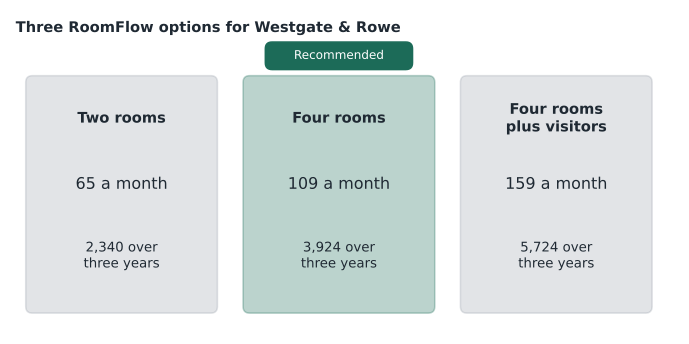
Westgate & Rowe's new office will have four meeting rooms. RoomFlow costs 109 dollars a month for four rooms on a three-year term. Ridgeline could also offer two rooms at 65 dollars a month, or four rooms with visitor sign-in and a lobby screen at 159 dollars a month. What are the three-year totals, and how should Maya present them?
Show solution
- Two rooms: 65 × 36 = 2,340 dollars over three years.
- Four rooms (recommended): 109 × 36 = 3,924 dollars.
- Four rooms with visitor sign-in and lobby screen: 159 × 36 = 5,724 dollars.
- Presentation: three columns, each showing what it includes, the monthly price and the three-year total, with the four-room option marked "recommended" and one sentence explaining why it fits the firm's plan.
Answer: The options total 2,340, 3,924 and 5,724 dollars over three years. Maya recommends the four-room option because the firm will have four bookable rooms, and she explains what each option includes rather than leaving the customer to work it out.
Options can also be used manipulatively. SLS-110 described the decoy effect: adding an option that nobody would choose, designed only to make another option look better. The evidence on decoy effects is mixed, with some studies finding them weaker than early research suggested, but the ethical point is clear. Every option a seller presents should be one they would be willing to sell and stand behind. An option included only to manipulate is a form of deception, even if each price is technically real.
Showing the full price
A price presentation must show the full price the customer will pay. That means including all mandatory fees, stating whether taxes are included, and making clear any charges that depend on use, such as pages above an included volume.
In the United States, the FTC's rule on unfair or deceptive fees, in force since May 2025, applies only to live-event tickets and short-term lodging, but the FTC Act's general ban on deceptive practices and many state laws still make it risky to hide mandatory fees. Sellers should present a price that includes all mandatory fees and state clearly whether sales tax is extra. SLS-150 covers these rules in detail.
| Include in the presented price | State clearly alongside it |
|---|---|
| All fixed, mandatory charges, such as installation or setup if it is required | Whether taxes are included or extra |
| Delivery, if it is not optional | Usage-based charges, such as pages above the included volume |
| Any monthly platform or service fee | Price changes during the term, if any |
| Removal of old equipment, if the proposal requires it | Early termination fees and end-of-term options |
For public-sector customers, price presentation follows the RFP's price form exactly. Prairie Valley's Form C required every fee to be listed, including any charge for extra pages, delivery, installation and end-of-contract removal. A supplier who left a fee off the form could not charge it later without risking a dispute, and evaluators compared the forms line by line.
When price is presented by someone else
In many B2B sales, the seller presents price to one person who then presents it to others: Carla to Eastgate's owners, Dale Petrie to Keystone's board, the business manager to Prairie Valley's superintendent. The seller cannot control that second presentation, but can make it easier. A one-page summary with the comparison to today, the total commitment and what is included gives the champion everything they need. So does asking, "How will you present this to the owners, and what questions do you think they will ask?"
Price is also easier to accept when the customer can see what is not included as clearly as what is. A short line such as "not included: paper, and pages above 3,000 a month" prevents the most common source of later disputes, a customer who believed something was covered when it was not. Ridgeline's sellers were told that if they found themselves hoping a customer would not ask about an exclusion, that exclusion belonged on the price page.
Common mistakes
MistakeLeaving the comparison with today's cost until late in the proposal.
InsteadPut the comparison with what the customer pays now in the executive summary.
MistakeDodging a direct question about price.
InsteadAnswer briefly, with a real range or the price and a comparison, then explain what it includes.
MistakeApologizing for the price or offering a discount before the customer reacts.
InsteadState the price, what it includes and the comparison, then pause.
MistakeFraming a long contract only as a small monthly figure.
InsteadUse the frame that matches how the customer budgets, and always show the total commitment.
MistakeLeaving mandatory fees out of the presented price.
InsteadInclude all mandatory fees and state clearly whether taxes and usage charges are extra.
Summary and key terms
- Present price after the solution and evidence in the normal sequence, but answer early price questions honestly with a real range or the price and a comparison.
- Always compare the price with what the customer pays today or the cost of the problem; that comparison often belongs on the first page.
- Framing the price per month, per year, over the contract or per person affects how it feels; choose the frame that matches how the customer budgets, and always show the total commitment.
- State price confidently, exactly and on its own, then pause.
- Options can help customers choose if each is genuine, the differences are clear and the seller recommends one; decoy options are a form of deception.
- Present the full price, including all mandatory fees, and state clearly whether taxes and usage charges are extra.
- Help champions present price to others with a one-page summary.
- Framing
- Expressing the same price or information in different but equivalent ways, such as per month or per year.
- Total commitment
- The full amount a customer agrees to pay over the life of a contract.
- Good, better, best
- A set of three options at increasing levels of scope and price.
- Decoy option
- An option included only to make another look better, not because anyone should choose it.
- Drip pricing
- Presenting a price that is later raised by fixed, mandatory charges not included in it.
- All-inclusive price
- A price that covers all mandatory charges for the service described.
Practice problems
Work each problem on paper first, then reveal the answer to check.
A lease costs 1,050 dollars a quarter plus 70 dollars a month for toner. A proposal costs 380 dollars a month. What is the annual difference?
Show answer
Current: 350 + 70 = 420 a month, or 5,040 a year; proposal 4,560 a year; difference 480 dollars a year.
A five-year contract costs 295 dollars a month. What is the total commitment?
Show answer
295 × 60 = 17,700 dollars.
A customer asks for a price in the first five minutes of a discovery call. What do you say?
Show answer
Give an honest range and explain what it depends on, then ask the questions that would narrow it.
Lesson quiz · 5 questions
Score 60% or more to complete this lesson.
Create a free account to save your progress, take quizzes and earn a certificate.