
SLS-212 · Lesson 12 of 12 · 19 min
Lab: a full presentation and proposal
▶ Video coming soon A video version of this lesson is on the way.
The last session of the Friday presentation lab, on November 13, 2026, was a full rehearsal. Each account executive brought a real opportunity, a written proposal and a presentation, and presented to colleagues playing the customer. Maya Chen brought Eastgate Physiotherapy. Carla Bennett had asked Maya to join the first twenty minutes of the owners' meeting on Wednesday, December 2, to present the proposal and answer questions, before the owners made their decision in private. Darnell Brooks agreed to play Mark Olafson, the careful owner. Farida Haddad played Jenna Fraser, the owner who cared most about patients and staff. Grace Liu played Carla. Owen Pelletier, the inside sales lead, kept time and scored.
This lesson walks through Maya's lab from preparation to debrief. It brings together every earlier lesson: discovery and the bridge statement (lesson 1), structure (lesson 2), tailoring (lesson 3), a short demonstration (lesson 4), visuals and data (lesson 6), the written proposal (lesson 7), the business case (lesson 9), price (lesson 10) and questions (lesson 11). The online and RFP lessons do not apply directly to this opportunity, but the habits from them, such as interaction points and answering first, appear throughout.
The brief
Each lab participant received a brief from Farida, modeled on what the real customer had said. Maya's brief summarized the facts she had gathered over the fall.
| Item | Detail |
|---|---|
| Customer | Eastgate Physiotherapy: eleven staff, three printers, lease ending January 31, 2027 |
| Decision makers | Owners Jenna Fraser and Mark Olafson, who decide together at their monthly meeting |
| Champion | Carla Bennett, office manager, who can approve up to 5,000 dollars alone |
| Proposal | Two printers on a three-year managed print agreement, 400 dollars a month, all inclusive up to 3,000 pages a month |
| Business case | Hard savings about 8,100 dollars over three years; soft savings in staff time about 12,000 dollars |
| Known concerns | Mark: cost and the early termination terms. Jenna: disruption to patients and staff time |
| Time | 20 minutes in the owners' meeting, December 2 |
Planning
Maya's one-page plan followed lesson 1. Her purpose was to help the owners decide on December 2 whether to approve the agreement so installation could happen on Saturday, January 30, the day before the lease ended. Her key message was: "Two new printers will cost the clinic less than it pays today and give staff back the time they lose to jams." Her evidence was the business case Carla had built with her, a reference from Northfield Family Clinic, Ridgeline's written service promise and a two-minute look at how a staff member would release a print job at the printer with a badge.
Using the rule of thirds from lesson 2, she planned 13 minutes of prepared material and kept 7 for questions.
Worked problem
Planning a 20-minute owners' presentation
Maya has 20 minutes. She plans to finish prepared material at about two-thirds of the time, rounded to the nearest minute, and to split it: bridge and purpose 2 minutes, business case 4, solution and demonstration 3, implementation 1.5, price and terms 1.5, next step 1. Does the plan fit, and how much time is left for questions?
Show solution
- Two-thirds of 20 minutes is 20 × 2 ÷ 3 = 13.3 minutes, which rounds to 13.
- Planned material: 2 + 4 + 3 + 1.5 + 1.5 + 1 = 13 minutes.
- Time for questions and discussion: 20 − 13 = 7 minutes.
Answer: The plan uses 13 minutes of prepared material and leaves 7 minutes for questions, which fits the rule of thirds.
Her audience plan, from lesson 3, gave the business case the most time because Mark would judge the proposal mainly on cost, and put the implementation section straight after the demonstration because Jenna's main worry was disruption. She dropped a slide about Ridgeline's other services entirely.
Building the materials
Maya prepared four slides and a one-page leave-behind; the full proposal was already in the owners' papers. Following lesson 6, each slide had a headline that stated its point.
| Slide | Headline | Visual |
|---|---|---|
| 1 | "Today's printers cost the clinic about 12,300 dollars a year" | A bar split into direct costs, 7,500, and staff time, 4,800 |
| 2 | "Over three years, two new printers save about 20,100 dollars" | Two bars, status quo and proposal, with hard and soft savings labeled separately |
| 3 | "Installed on a Saturday, ready on Monday" | A three-step timeline: install January 30, fifteen-minute training February 1, old printers removed by the leasing company |
| 4 | "400 dollars a month, all inclusive, fixed for three years" | What is included and what is not, and the early termination terms in plain language |
Before the lab, Grace checked every number on the slides against the business case. Slide 1's total was 7,500 + 4,800 = 12,300 dollars. Slide 2's figure of about 20,100 dollars came from lesson 9's three-year comparison: status quo 36,900 dollars, proposal 16,800, difference 20,100, of which 8,100 was hard savings and 12,000 soft. Grace also checked that the bars on slide 2 started at zero.
The presentation
Maya opened with a bridge statement. "When Carla and I first spoke in October, she told me the clinic's three printers jam about four times a week each, and that it's usually a physiotherapist or a receptionist who ends up clearing them between patients. Your lease ends on January 31, so you're deciding now whether to renew it or change. My goal today is to help you decide whether our proposal is the better option, and if it is, to agree to approve it today so we can install on January 30. Is that a fair starting point?"
Darnell, playing Mark, said it was, but added a question straight away: "Before you go on, what's this going to cost us?" Following lesson 10, Maya answered at once rather than asking him to wait: "Four hundred dollars a month, all inclusive, which is less than the clinic pays today. I'll show you exactly how on the next slide." Darnell nodded and let her continue.
The business case took four minutes. Maya walked through the direct costs, then the staff time, then the three-year comparison, and pointed out that the hard savings alone made the case even if no staff time was counted. Farida, as Jenna, asked how the staff-time figure was calculated, and Maya explained that the jam counts and minutes had come from Carla's own two-week tally.
The demonstration took two minutes and used a printer from Ridgeline's showroom set up in the lab room. Maya printed a two-page patient exercise sheet from a laptop and asked Farida to walk to the printer, tap a badge and collect it. Farida, still in role, said: "So nobody's exercise sheet sits on the printer for the next patient to see." Maya had not planned that point, but it was a good one, and she confirmed it: print jobs were held until released, which helped protect patient information.
The questions
The question period ran seven minutes and brought four questions, three of which were in Maya's question bank.
| Question | Asker | Maya's answer | Assessment |
|---|---|---|---|
| What if we want to leave after a year? | Mark | Allowed after the first year with 90 days' notice and a fee set out in the agreement; she showed the plain-language summary on slide 4 | Clear, honest, matched the agreement |
| What if we print more than 3,000 pages? | Mark | Extra pages are billed at the rate in the agreement; the clinic's last year averaged about 2,100 pages a month | Good: used the customer's own data |
| Who do staff call when it breaks? | Jenna | One number, a technician within four business hours, a loaner if the fix takes longer than a day | Good, but could have mentioned the Northfield reference here |
| Can you do it for 350 a month? | Mark | Explained that 400 was the price for this level of service and pages, and that Ridgeline could look at a lower page allowance if the owners wanted to reduce the price, but recommended against it given current volumes | Good trade rather than a discount, as in SLS-213 |
The price question was the one Maya had not prepared for, and her answer showed the habit SLS-213 teaches: she did not discount, but she offered a trade, a lower page allowance for a lower price, and explained honestly why she did not recommend it. Darnell, stepping out of role during the debrief, said that was exactly what he would want an account executive to do.
Maya closed by summarizing. "You've seen that the proposal costs less than today, saves staff time, can be installed on a Saturday and has a clear exit after the first year. If you approve it today, Carla and I will confirm the Saturday installation and the training on Monday morning. Is there anything else you'd need to make that decision?" Darnell, as Mark, said he was satisfied. Farida, as Jenna, said she would want to hear from Northfield first. Maya offered to have Janet Morrow call her before the meeting.
The scorecard
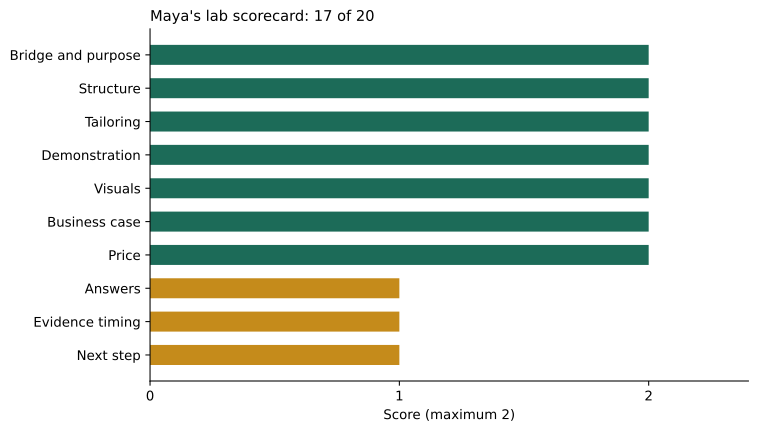
Owen scored each presentation on a ten-item scorecard, each item worth up to 2 points, for a total of 20. The scorecard drew directly on the lessons of this course.
| Item | Score (0–2) | Note |
|---|---|---|
| Bridge statement and purpose | 2 | Clear, in the customer's words, ended with a check |
| Structure followed the buyer's questions | 2 | Case for change, solution, evidence, implementation, price, next step |
| Tailored to each owner | 2 | Cost for Mark, disruption and patients for Jenna |
| Demonstration used a real scenario | 2 | Releasing a patient sheet with a badge |
| Visuals honest and readable | 2 | Headlines stated the point; bars started at zero |
| Business case used customer numbers, hard and soft separated | 2 | Carla's tally; hard savings stated first |
| Price presented confidently with comparison | 2 | Answered early, exact figure, compared with today |
| Questions answered directly and briefly | 1 | Good answers, but two ran long |
| Evidence offered at the right moment | 1 | Northfield reference not mentioned until Jenna asked |
| Clear next step agreed | 1 | Approval asked for, but Jenna's condition not fully resolved |
Maya's total was 2 × 7 + 1 × 3 = 17 out of 20.
The debrief
Farida ran each debrief the same way: the presenter spoke first about what went well and what they would change, then the role players, then Owen with the scores. Maya said the business case had worked better than she expected, because it was Carla's numbers rather than hers, and that she should have offered the Northfield reference as soon as Jenna asked about service rather than waiting to be asked for it. Farida agreed and added one more point: two of Maya's answers had run to nearly two minutes, and in a twenty-minute meeting with owners who wanted to talk privately afterward, every minute counted.
Darnell's comment was about the close. Jenna's condition, hearing from Northfield, was reasonable and could not be resolved in the room. But Maya could have turned it into a specific next step with a date: Janet to call Jenna by Monday, November 30, so the owners had the reference before their meeting. Maya wrote that down as her first action.
Maya's action plan
By the end of the session, Maya had a short list of actions for the real meeting on December 2. Everything on it was a plan, because the meeting had not yet happened.
| Action | By when |
|---|---|
| Ask Janet Morrow at Northfield whether she will call Jenna Fraser | November 20 |
| Confirm the reference call has happened | November 30 |
| Shorten answers: write a one-sentence answer for each question in the bank | November 25 |
| Send Carla the final one-page leave-behind for the owners' papers | November 25 |
| Rehearse the 13-minute presentation twice with a timer | December 1 |
| Confirm installation crew is held for Saturday, January 30 | December 2, after the decision |
What the lab showed
Across the session, Farida noted a few patterns that applied to every presenter, not just Maya. The presentations that scored best were the ones built on the strongest discovery, not the ones with the best slides. The most common weakness was length: answers and sections that ran long because the presenter knew a lot and wanted to show it. And the moments that persuaded the role players most were the unplanned ones that came from the customer's own words and concerns, such as Jenna's point about patient privacy at the printer. Those moments happen only when the seller has left room for them.
Farida closed the term of the presentation lab with the same slide she had used to open it in September: discovery notes on the left, the opening slide of a presentation on the right. This time the right-hand slide was Maya's first slide for Eastgate, and every point on the left had found its way across.
Common mistakes
MistakePreparing slides but not a question bank for a short decision meeting.
InsteadPrepare likely questions and one-sentence answers, especially on price and terms.
MistakeHolding back a strong reference until asked.
InsteadOffer the reference at the moment the related concern comes up.
MistakeLeaving a customer's condition open at the close.
InsteadTurn the condition into a specific next step with a date.
MistakeTreating a request for a lower price as a request for a discount.
InsteadOffer a trade, such as a lower page allowance, and explain your recommendation honestly.
MistakeLetting answers run long in a short meeting.
InsteadGive the direct answer in one sentence and stop unless asked for more.
Summary and key terms
- The lab brought the course together in one rehearsal: a brief, a one-page plan, an audience plan, honest visuals, a business case built on the customer's numbers, a short demonstration, a confident price, prepared answers and a clear next step.
- Maya's 20-minute plan used 13 minutes of material and kept 7 for questions.
- She answered an early price question directly, kept hard and soft savings separate and offered a trade rather than a discount when asked for a lower price.
- Her scorecard total was 17 of 20; her main improvements were offering evidence at the right moment, shortening answers and turning a customer's condition into a dated next step.
- Presentations that score best are built on strong discovery and leave room for the customer's own concerns to shape the conversation.
- Lab brief
- A summary of a real opportunity used to set up a role-play presentation.
- Role player
- A colleague who acts as a customer in a practice presentation.
- Scorecard
- A list of criteria used to score a practice presentation and guide the debrief.
- Debrief
- A structured discussion after a practice presentation of what worked and what to change.
- Action plan
- A list of specific actions, with dates, to prepare for the real meeting.
- Leave-behind
- A short written summary given to the customer during or after a presentation.
Practice problems
Work each problem on paper first, then reveal the answer to check.
A 30-minute owners' meeting is planned with the rule of thirds. How many minutes of prepared material should there be?
Show answer
30 × 2 ÷ 3 = 20 minutes, leaving 10 for questions.
A ten-item scorecard scores 2 on six items, 1 on three and 0 on one. What is the total out of 20?
Show answer
12 + 3 + 0 = 15 out of 20.
A decision maker says they want to hear from a reference first. How should you close?
Show answer
Turn the condition into a specific next step: arrange the reference call by a set date before the decision meeting.
Lesson quiz · 5 questions
Score 60% or more to complete this lesson.
Create a free account to save your progress, take quizzes and earn a certificate.