
SLS-212 · Lesson 8 of 12 · 21 min
Responding to RFPs
▶ Video coming soon A video version of this lesson is on the way.
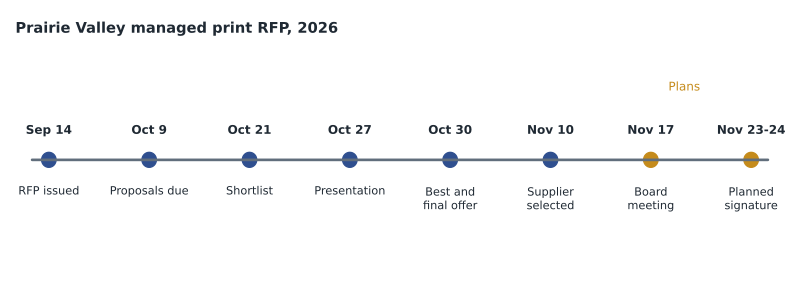
On Monday, September 14, 2026, Prairie Valley School District published a request for proposals for managed print services as a legal notice in its official newspaper and on the district's website. Proposals were due by 2:00 p.m. on Friday, October 9. The document ran to thirty-one pages and asked 84 questions. Darnell Brooks assigned Maya Chen to the response team alongside Farida Haddad, Grace Liu and Leah Marchand, and he said the same thing he said before every public bid: "We don't get to choose the rules. We get to be the easiest proposal to score."
A request for proposals (RFP) is a formal invitation from an organization to suppliers to submit proposals for a defined need, which the organization then evaluates against published criteria. RFPs are common in the public sector, where purchasing rules require open competition above certain values, and in large private organizations with procurement departments. Responding to them well is a distinct skill. The structure, content and even the format of the response are set by the customer, and a proposal that is excellent but ignores the rules can be rejected without being read.
Types of procurement documents
Organizations use several kinds of documents to buy, and the names vary. The differences matter because they decide how suppliers are evaluated.
| Document | Purpose | How suppliers are chosen |
|---|---|---|
| Request for information (RFI) | Learn about the market before buying | No award; used to plan a later RFP |
| Request for quotation (RFQ) | Buy a clearly specified item at the best price | Usually lowest compliant price |
| Invitation to tender or bid | Buy a clearly specified item or service, often construction | Usually lowest compliant price from a responsible bidder |
| Request for proposals (RFP) | Buy a solution where suppliers may propose different approaches | Best overall value against weighted criteria |
| Request for qualifications (RFQual) | Shortlist qualified suppliers before an RFP | Qualifications only; no price |
Prairie Valley's document was an RFP because the division did not want to specify every printer model. It wanted suppliers to propose a fleet and service model that met its needs, and it would weigh price against quality. Its evaluation criteria were published in the RFP: price 40 points, technical solution 25, service and support 15, implementation 10 and references 10, for a total of 100.
The rules behind public RFPs
Public bodies buy under rules designed to make spending fair, open and accountable. Sellers need to understand them, both to compete and to avoid mistakes that disqualify them.
In South Dakota, state law in chapter 5-18A of the South Dakota Codified Laws sets the purchasing rules for public bodies, including school districts. Under section 5-18A-14, a contract for supplies or services, other than professional services, of 50,000 dollars or more must be advertised for bids or proposals as a legal notice, printed at least twice, with the first notice at least ten days before the deadline, and the notice must reserve the right to reject any or all bids. Section 5-18A-22 exempts some purchases, including computer hardware, software and peripherals, so whether a particular print contract must be advertised can depend on what it covers. Many districts, like Prairie Valley, set board policies that require a formal RFP for multi-year service contracts above 50,000 dollars whatever the exemptions, and post the RFP on their websites as well as in the newspaper.
Beyond the thresholds, public RFPs usually share several rules. All suppliers must receive the same information, so questions are asked in writing and answered for everyone in an addendum. Contact with evaluators outside the official process is forbidden during the competition; a supplier who lobbies a committee member can be disqualified. Proposals must arrive by the deadline, and late proposals are generally rejected however good they are. Evaluation must follow the published criteria. And unsuccessful suppliers can usually ask for a debriefing.
| Rule | What it means for the seller |
|---|---|
| Single point of contact | All questions go to the named procurement officer, in writing, before the question deadline |
| Addenda | Answers and changes are published to all suppliers; read every addendum |
| Blackout or no-lobbying period | No contact with evaluators about the RFP outside the process |
| Mandatory requirements | Pass or fail conditions; missing one can disqualify the proposal |
| Deadline | Late proposals are generally rejected |
| Published criteria | Write to the criteria; evaluators can score only what is in the proposal |
| Debriefing | Unsuccessful suppliers may ask why they lost and how to improve |
The no-lobbying rule caught Ridgeline's attention because of an episode SLS-150 describes. During a separate Prairie Valley furniture competition earlier in the fall, Maya's cousin, who worked in the division's purchasing department, had been named to the evaluation committee. Both disclosed the relationship and her cousin was replaced. For the print RFP, Leah reminded the team in writing that all contact with the division about the RFP went through Colleen Sawatzky, the procurement officer named in the document.
Bid or no bid
Responding to an RFP takes a great deal of work. Ridgeline estimated about 120 hours across five people for the Prairie Valley response. Before committing that time, a sales team should decide whether to bid at all. A bid/no-bid decision weighs the chance of winning against the cost of responding and the value of the contract.
Worked problem
Scoring a bid/no-bid decision
Darnell uses a simple scorecard: each factor is rated from 1 (poor) to 5 (strong) and multiplied by its weight. Ridgeline bids if the total is at least 70 of a possible 100. For Prairie Valley the ratings were: fit with our solution 5 (weight 5), relationship with the customer 3 (weight 4), ability to meet all mandatory requirements 5 (weight 4), price competitiveness 3 (weight 4), strategic value 4 (weight 3). Should Ridgeline bid?
Show solution
- Weights total 5 + 4 + 4 + 4 + 3 = 20, so the maximum score is 20 × 5 = 100.
- Fit: 5 × 5 = 25. Relationship: 3 × 4 = 12. Mandatory requirements: 5 × 4 = 20.
- Price competitiveness: 3 × 4 = 12. Strategic value: 4 × 3 = 12.
- Total: 25 + 12 + 20 + 12 + 12 = 81.
Answer: The score is 81 of 100, above the threshold of 70, so Ridgeline should bid. The weakest factors, relationship and price, show where the response needs most work.
Teams that bid on everything waste effort and often lose to competitors who were working with the customer before the RFP was written. A frequent sign that an RFP is a poor prospect is a set of requirements that seem written around a particular competitor's product. In Prairie Valley's case, the requirements were neutral, Ridgeline had met the division's staff during discovery months before, and the audit work had given it an understanding of the fleet that competitors lacked.
Reading the RFP
The first task after deciding to bid is to read the whole RFP carefully and build a compliance matrix: a table listing every requirement and question, where it is answered in the response, who is writing the answer, and whether the requirement is mandatory. The matrix makes sure nothing is missed, and it helps evaluators if it is included in the response.
| RFP ref. | Requirement | Mandatory? | Response section | Owner | Status |
|---|---|---|---|---|---|
| 2.1 | Proposal received by 2:00 p.m., October 9 | Yes | Submission | Grace | Booked for October 8 |
| 2.4 | Signed acknowledgment of all addenda | Yes | Form B | Leah | Addenda 1 and 2 signed |
| 3.2 | Proof of commercial general liability insurance of at least 2 million dollars | Yes | Appendix C | Leah | Certificate requested |
| 4.1 | Proposed fleet by school with device types and counts | No (scored) | Section 3.1 | Maya | Draft |
| 4.6 | Service response and repair times | No (scored) | Section 4.2 | Farida | Done |
| 5.3 | Three references from public-sector customers | Yes | Section 6 | Maya | Two confirmed |
| 6.1 | Price schedule using Form C, with all fees | Yes | Form C | Grace | Draft |
Reading the RFP also means reading between the lines. The questions an organization asks reveal what it worries about. Prairie Valley asked six separate questions about service response in rural schools, which told the team that service outside the city was a sore point with the current supplier. It asked how data on stored print jobs was protected, which told them that privacy was a concern. Those insights shaped how the team wrote, even where the answers were factual.
Asking questions
Most RFPs allow suppliers to submit written questions by a deadline, with answers published to all suppliers in an addendum. Good questions clarify genuine uncertainties: how many devices are in each school, whether page volumes include color, whether the division wants a single invoice. Asking questions also shows engagement, but sellers should remember that every answer is shared with competitors, so questions should not reveal the seller's strategy.
Ridgeline asked four questions. One of them, whether the division wanted suppliers to propose a reduced fleet or a like-for-like replacement, produced an addendum confirming that reduced fleets were welcome. That answer helped every bidder, but Ridgeline had already done the audit that showed how much the fleet could shrink, so it benefited most.
Writing the response
An RFP response should be easy to evaluate. Evaluators often score dozens of proposals against a sheet of criteria, and they reward responses that answer each question clearly, in the order asked, with the answer first and the evidence after.
| Practice | Why it helps |
|---|---|
| Follow the RFP's structure and numbering exactly | Evaluators can find each answer and score it |
| Answer first, then explain | The evaluator sees immediately whether the requirement is met |
| Use the customer's words | Evaluators look for the terms in the criteria |
| Give specific evidence: numbers, names, examples | Specific claims score higher than general ones |
| Keep marketing language out | "Industry-leading" and "best-in-class" score nothing |
| Include a compliance matrix | It shows nothing is missing |
| Respect page limits and formats | Some RFPs reject or ignore pages beyond the limit |
Within those rules, a response can still be persuasive. The executive summary, which most RFPs allow, is the place to tell the division what it is getting in its own terms: one standard fleet reduced from 61 models to 44 devices, automatic toner, one service desk with four-hour response in every school including rural ones, reporting by school, and total cost below the division's savings target.
How evaluators score price
Public RFPs often score price with a formula, so suppliers can work out how their price will translate into points. A common formula awards the full price points to the lowest price and gives other suppliers points in proportion: points = maximum price points × (lowest price ÷ this supplier's price).
Worked problem
Calculating price points
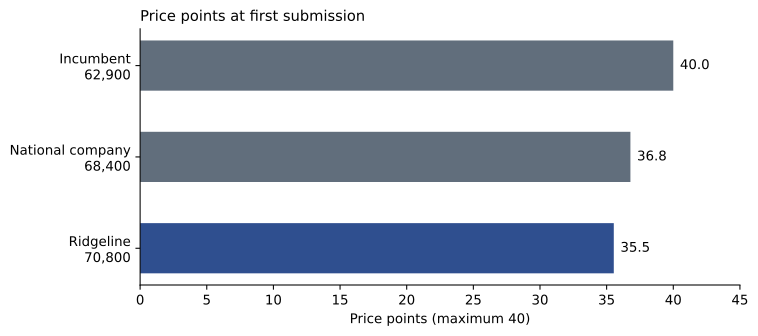
Prairie Valley awards up to 40 points for price using the formula above. At the first submission, the three shortlisted prices were: the incumbent supplier 62,900 dollars a year, a national office-products company 68,400 dollars and Ridgeline 70,800 dollars. How many price points did each receive?
Show solution
- The lowest price is 62,900 dollars, so the incumbent receives the full 40 points.
- National company: 40 × 62,900 ÷ 68,400 = 40 × 0.9196 = 36.78 points.
- Ridgeline: 40 × 62,900 ÷ 70,800 = 40 × 0.8884 = 35.54 points.
- Ridgeline is 40 − 35.54 = 4.46 points behind on price, so it must win by more than that on the other 60 points.
Answer: The incumbent scores 40, the national company about 36.8 and Ridgeline about 35.5. Ridgeline needs at least about 4.5 more points than the incumbent from the technical, service, implementation and reference criteria to win.
This kind of calculation is useful in two ways. It tells the team where it must win: here, on the technical solution and service, where the audit and the four-hour rural response were strong. And it shows how much a price change would matter. As SLS-213 describes, Ridgeline's best and final offer of 66,000 dollars a year later raised its price score to 40 × 62,900 ÷ 66,000 = about 38.1 points.
Submitting, presenting and waiting
Submission is where avoidable mistakes lose bids: a missing signature, an unacknowledged addendum, a file uploaded to the wrong place, a courier who arrives at 2:05. Ridgeline's rule was to submit a full day before the deadline and to have a second person check every mandatory item against the matrix. Grace submitted the response on October 8.
Many RFPs include a shortlist stage, in which the top-scoring suppliers present to the evaluation committee or answer clarification questions. Prairie Valley shortlisted three suppliers on October 21 and invited each to a 60-minute presentation and clarification meeting; Ridgeline's was on October 27. Lessons 3 and 11 describe how the team prepared. After that came the best and final offer and the selection on November 10, subject to approval by the division's board on November 17 and to a signed contract.
If a supplier loses, a debriefing is valuable. Most public bodies will explain how the proposal scored and where it fell short. Sellers who ask for debriefings, accept them gracefully and act on them improve their chances in the next competition.
Common mistakes
MistakeBidding on every RFP.
InsteadUse a bid/no-bid scorecard, and bid where you have a real chance and the work is justified.
MistakeContacting evaluators during the competition.
InsteadSend all questions to the named contact in writing, and respect the blackout period.
MistakeMissing a mandatory requirement.
InsteadBuild a compliance matrix and have a second person check every mandatory item before submitting.
MistakeAnswering in your own structure and marketing language.
InsteadFollow the RFP's structure, answer first, use the customer's words and give specific evidence.
MistakeSubmitting at the last minute.
InsteadSubmit at least a day early and confirm receipt.
Summary and key terms
- An RFP invites suppliers to propose a solution that the buyer evaluates against published, weighted criteria; it differs from RFIs, RFQs and tenders.
- In South Dakota, SDCL 5-18A-14 requires supplies and services contracts of 50,000 dollars or more to be advertised twice, the first notice at least ten days before the deadline, subject to the exemptions in 5-18A-22.
- Public RFPs use a single point of contact, addenda, no-lobbying rules, mandatory requirements, strict deadlines and debriefings.
- Decide whether to bid with a weighted scorecard.
- Build a compliance matrix, read between the lines, ask clarifying questions, follow the RFP's structure and answer first.
- Price is often scored as maximum points × lowest price ÷ your price.
- Submit early, check every mandatory item and ask for a debriefing if you lose.
- Request for proposals (RFP)
- A formal invitation to suppliers to propose a solution, evaluated against published criteria.
- Compliance matrix
- A table listing every RFP requirement, where it is answered, who owns it and whether it is mandatory.
- Mandatory requirement
- A pass-or-fail condition in an RFP; missing one can disqualify a proposal.
- Addendum
- A published change or answer to suppliers' questions that applies to all bidders.
- Bid/no-bid decision
- The decision whether to respond to an RFP, based on fit, chances and cost.
- Debriefing
- A meeting in which a buyer explains to an unsuccessful supplier how its proposal was scored.
Practice problems
Work each problem on paper first, then reveal the answer to check.
The lowest price in an RFP is 45,000 dollars and price is worth 30 points. Your price is 50,000. How many price points do you get?
Show answer
30 × 45,000 ÷ 50,000 = 27 points.
Why should RFP questions avoid revealing your strategy?
Show answer
Answers are published to all suppliers, so competitors see the questions and answers too.
Name two items that belong in a compliance matrix row.
Show answer
For example, the RFP reference and requirement, whether it is mandatory, the response section, the owner and status.
Lesson quiz · 5 questions
Score 60% or more to complete this lesson.
Create a free account to save your progress, take quizzes and earn a certificate.