
SLS-222 · Lesson 12 of 12 · 20 min
Case study: a value-based deal
▶ Video coming soon A video version of this lesson is on the way.
This final lesson follows the Keystone Grain Equipment training-center deal from the first value desk session on September 22 to the rehearsal on Friday, November 13, 2026, when Maya prepared the package that Marlene Toews would take to Keystone's owners' board in January. It brings together every lesson in the course. The board's decision and the installation are still ahead, so everything after November 13 is written as a plan.
Where the deal stood in September
In September, Maya had a quote and a problem. The quote was a list of equipment for six rooms with a total of 48,000 dollars at the bottom. The problem was that Dale Petrie liked it and could not approve it, and nobody else at Keystone had seen a reason to. Rob's three questions in lesson 1, how Keystone makes money, what its finance director worries about at this time of year and how many dollars of sales the purchase represents, showed how little Maya knew about the customer's business. Each later session filled in part of the picture.
| Date (2026) | What Maya learned or did | Lesson |
|---|---|---|
| September 22 | Keystone sells through about 70 dealers; cash is tight in spring; 48,000 dollars equals about 800,000 dollars of sales at a 6 in 100 operating margin | 1 |
| September 29 | The next best alternative is to keep renting hotel rooms and sending trainers to dealers | 2 |
| Early October | Marlene shares summary statements; Keystone judges projects on payback within three years; anything over 20,000 dollars goes to the board | 3 |
| October 13 | Benefits of 27,800 dollars a year from Keystone's records; payback about 23.5 months; NPV about 50,000 dollars at 8 in 100 | 4 |
| Early November | A five-year lease at about 962 dollars a month as an option; tax treatment left to Keystone's accountant | 5 |
| November 3 | An integrator quotes 41,500 dollars; Ridgeline's differences are worth about 18,200 dollars; EVC about 59,700 dollars | 8 |
| November 9 and 10 | Price held to January 31 instead of pressing for a year-end signature; value case with sensitivity and break-even | 8, 10 |
| November 11 | Twenty-five minutes with Raymond Wiebe and Marlene; a new dealer group raises the value of video training | 9 |
Three options
Rob's review of the draft package on November 12 began with a question: "Why should Keystone's board have only one choice?" Offering a single proposal turns the board's decision into yes or no. Offering well-designed options turns it into which one, and lets the customer choose the level of value it wants. It also gives the board a way to say yes if it is nervous about the full amount. Maya built three options.
| Option A: four rooms | Option B: six rooms | Option C: six rooms with managed support | |
|---|---|---|---|
| What is included | Video and displays in four rooms; RoomFlow in four rooms | Video and displays in six rooms; RoomFlow in six rooms | Option B plus quarterly checks, priority parts and a session-ready guarantee |
| Price | 34,500 dollars | 48,000 dollars | 48,000 dollars plus 1,800 dollars a year |
| RoomFlow per year | 2,160 dollars | 3,240 dollars | 3,240 dollars |
| Hotel days replaced per year (estimate) | 9 | 16 | 16 |
| Trainer trips replaced per year | 12 | 12 | 12 |
| Lease option over 60 months | About 691 dollars a month | About 962 dollars a month | About 962 dollars a month plus support |
Option A was smaller because four rooms could not host Keystone's larger dealer sessions, so it would replace only about 9 of the 16 hotel days. Option C added a managed support service that some customers value as insurance; it would save Keystone's IT contractor some work, which Northgate IT estimated at about 1,500 dollars a year.
Worked problem
Comparing the three options
Using 1,100 dollars per hotel day, 850 dollars per trip and Keystone's discount rate of 8 in 100 over five years (annuity factor 3.9927), calculate each option's net annual benefit, payback in months and five-year NPV. For option C, include the 1,800-dollar support fee and the 1,500 dollars of IT time saved.
Show solution
- Option A: benefits 9 × 1,100 + 12 × 850 = 9,900 + 10,200 = 20,100; net 20,100 − 2,160 = 17,940 dollars.
- Option B: net 24,560 dollars, as in lesson 4.
- Option C: net 24,560 − 1,800 + 1,500 = 24,260 dollars.
- \[\text{Payback: } \frac{34{,}500}{17{,}940} \times 12 \approx 23.1,\quad \frac{48{,}000}{24{,}560} \times 12 \approx 23.5,\quad \frac{48{,}000}{24{,}260} \times 12 \approx 23.7\]
- \[\text{NPV A} = 17{,}940 \times 3.9927 - 34{,}500 \approx 37{,}129\]
- \[\text{NPV B} = 24{,}560 \times 3.9927 - 48{,}000 \approx 50{,}061\]
- \[\text{NPV C} = 24{,}260 \times 3.9927 - 48{,}000 \approx 48{,}863\]
Answer: All three pay back in about 23 months. Option B has the highest NPV, about 50,100 dollars, against about 37,100 for A and 48,900 for C. On Keystone's own numbers, B creates the most value.
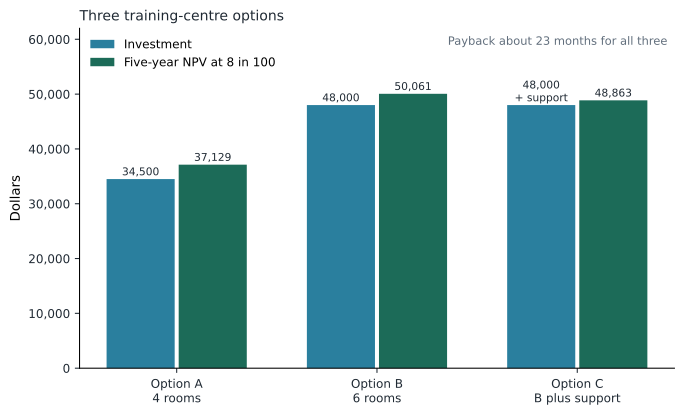
The comparison showed why options need honest design. All three paid back at almost the same rate, so payback alone could not separate them. NPV could: the extra 13,500 dollars for option B over option A bought 6,620 dollars a year more net benefit, paying back the difference in about two years and adding about 13,000 dollars of NPV. Option C cost slightly more than it saved; it was there for a board that valued guaranteed uptime over a small amount of money, not to make option B look good by comparison.
Worked problem
Is the step from A to B worth it?
Option B costs 13,500 dollars more than option A and produces 24,560 − 17,940 = 6,620 dollars a year more net benefit. What is the payback on the extra amount?
Show solution
- \[\frac{13{,}500}{6{,}620} \approx 2.04 \text{ years}\]
Answer: About two years, inside Keystone's three-year test. The extra rooms pay for themselves on their own.
The price and Ridgeline's margin
Before the package went out, Grace checked it from Ridgeline's side, as lesson 7 required. Ridgeline needed every option to earn an acceptable margin at the quoted price, and needed to know what each option was worth to Ridgeline as well as to Keystone.
| Ridgeline's view | Option A | Option B |
|---|---|---|
| Equipment and installation price | 34,500 dollars | 48,000 dollars |
| Gross profit at about 30 in 100 | 10,350 dollars | 14,400 dollars |
| RoomFlow gross profit per year at about 78 in 100 | About 1,685 dollars | About 2,527 dollars |
| Share of the differentiation value captured (lesson 8) | — | About 36 in 100 |
The price of option B had been set by value, not by cost plus, and it left Keystone with about two-thirds of the value of Ridgeline's differences over the integrator's offer. There was no discount in the package. The concessions Ridgeline had made were structural: the lease option, the price hold to January 31 and the installation in Keystone's quiet weeks. Each answered a real concern of Marlene's without lowering the price.
The package
The package Marlene would take to the board had four parts, each designed so that it could stand on its own if a director read only that page.
- A one-page executive brief, as in lesson 9, with the situation, the recommendation (option B), the investment, the return, the risks and the decision needed.
- A two-page value case, as in lesson 10, in Keystone's capital request format, with the assumptions register, the three cases and the break-even: "Even if we replace only half our hotel training days, the rooms pay back within three years."
- The three options with their figures, and the lease and purchase prices side by side, with tax treatment left to Keystone's accountant.
- Ridgeline's commitments: completion by February 15, 2027 with loaners for any room not ready, four-business-hour service, the price held to January 31, and a review of 2027 results against the 2025 baseline in early 2028.
The rehearsal
On Friday, November 13, Darnell Brooks played Raymond Wiebe and Grace played Marlene in a twenty-minute rehearsal of a possible board-preparation call. They had agreed in advance to ask the hardest questions they could think of.
| Question in the rehearsal | Maya's answer | Lesson |
|---|---|---|
| "Why not just take the integrator's rooms and save 6,500 dollars?" | The booking system and four-hour service are worth about 4,500 dollars a year to you after RoomFlow; the difference pays back in about 17 months. Without the coordinator's time it is close, and then it's about whether those two things matter to you. | 8, 11 |
| "Your numbers assume 2025 was typical. What if training drops?" | In the low case, 12 hotel days and 8 trips, payback is about 34 months, still inside three years. You need to replace only about half your hotel days to pass your test. | 10 |
| "Why shouldn't we wait a year?" | Each month of delay costs about 2,000 dollars of savings on your figures, and the new dealer group makes video training more useful next year, not less. | 9 |
| "Can you do it for 40,000?" | Option A is 34,500 for four rooms. For six rooms, 48,000 is the price; what we can change is how you pay, through the lease, and when, through the January hold. | 7, 11 |
| "What happens if the installation runs into April?" | We commit in writing to February 15 with loaners for any room not ready, and the installation is planned for your quiet weeks. | 9 |
Darnell scored the rehearsal 18 of 20. He took off one point because Maya had answered the price question a little too quickly, before asking what lay behind it, and another because she had used the word "ROI" once without saying over what period. Grace said the answer to the waiting question was the strongest moment, because it used Keystone's own figure and Raymond's own news.
What happens next
The plan from here was simple and mostly in Keystone's hands. Marlene would put the proposal on the agenda for the board's January meeting. Maya would be available by phone. If the board approved option B, installation would follow in early February, the first video training sessions for the new dealer group would be scheduled for March and the 2027 results would be reviewed against the 2025 baseline early in 2028. If the board chose option A, the extra two rooms could be added later at the same per-room price. If it chose neither, Maya would ask Marlene what the board had needed and had not seen.
Rob closed the last value desk session of the year by asking Maya what she would do differently on the next deal. Her answer was the course in one sentence: "Ask the money questions in the first meeting, not the tenth."
A checklist for the next value-based deal
After the rehearsal, Grace turned the fall's work into a checklist that Ridgeline's account executives could use on any deal above about 20,000 dollars. It is short on purpose. Each line points back to a lesson in this course.
| Stage of the sale | Business acumen question | Lesson |
|---|---|---|
| First meeting | How does this customer make money or deliver its service, and what is its busy season? | 1 |
| Discovery | What is the next best alternative, and what does it cost the customer today? | 2 |
| Discovery | How will the decision be evaluated, by whom and against what test? | 3, 4 |
| Building the offer | Which numbers in the customer's own records support each benefit? | 4, 10 |
| Building the offer | What will the customer pay over the whole period, and would a lease or subscription suit it better? | 5, 6 |
| Pricing | What are the differences worth, and what share of that value will the customer keep at this price? | 8 |
| Pricing | What margin does the price earn Ridgeline, and what is the walk-away price? | 7, 11 |
| Presenting | Can the case fit on one page in the executive's terms? | 9 |
| Presenting | Does the decision still make sense in the low case, and what is the break-even? | 10 |
| Negotiating | If the customer raises a lower price, what does it mean, and which structural moves could answer it? | 11 |
| After the sale | How and when will the value be measured against the baseline? | 10 |
Maya noticed that most of the questions belonged early in the sale, before a quote existed. That was the lesson of the fall. The Keystone deal had stalled in September not because the price was wrong but because nobody at Keystone had been given a reason, in Keystone's own numbers, to spend 48,000 dollars. By November the price was the same and the conversation was completely different.
The checklist also had a note at the bottom, in Rob's handwriting on the printed copy he pinned in the value-desk room: "Every number must be one the customer can check and one we believe."
Common mistakes
MistakeA single proposal gives the customer the clearest choice.
InsteadWell-designed options turn yes-or-no into which one, and give a nervous board a way to say yes.
MistakeA deliberately poor option makes the recommended one look better.
InsteadEach option should be honest; option C was there for a board that valued guaranteed uptime.
MistakeWhen options pay back at the same rate, they are equally good.
InsteadNPV and the payback on the step between options show which creates the most value.
MistakeConcessions in a value-based deal mean discounts.
InsteadStructural concessions such as a lease, a price hold or scheduling can answer real concerns without lowering the price.
Summary and key terms
- The Keystone case brought the course together: understanding the customer's business, finding the next best alternative, reading its financial statements, calculating payback, ROI and NPV, comparing a lease with a purchase, setting a value-based price against a competitor, checking the seller's own margins, preparing for executives and building a value case with sensitivity and break-even.
- Three honest options let the board choose the level of value it wanted.
- All three paid back in about 23 months, so NPV and the payback on the step between options showed that the six-room option created the most value.
- Concessions were structural rather than discounts.
- The package was designed to stand on its own when someone else presented it.
- Good, better, best
- A set of honest options at increasing levels of value and price.
- Incremental payback
- The payback on the extra cost of a larger option, from its extra benefit.
- Structural concession
- A change to payment, timing or terms that answers a customer concern without lowering the price.
- Board package
- The documents a champion takes to a board, each able to stand on its own.
Practice problems
Work each problem on paper first, then reveal the answer to check.
Option X costs 20,000 dollars with a net benefit of 9,000 a year; option Y costs 30,000 with 13,000 a year. What is the payback on the step from X to Y?
Show answer
10,000 ÷ 4,000 = 2.5 years.
Why did Maya include option C if it had a lower NPV than option B?
Show answer
For a board that valued guaranteed uptime and support over a small amount of money; it was an honest choice, not a decoy.
Name two structural concessions in the Keystone package.
Show answer
The five-year lease option, the price hold to January 31 and installation in Keystone's quiet weeks.
Lesson quiz · 5 questions
Score 60% or more to complete this lesson.
Create a free account to save your progress, take quizzes and earn a certificate.