
SLS-222 · Lesson 2 of 12 · 20 min
Value propositions
▶ Video coming soon A video version of this lesson is on the way.
At the second value desk session, on September 29, Rob asked each account executive to write Ridgeline's value proposition on an index card. Five people wrote five different sentences. Three of them included the words "quality" and "service". One said "one-stop shop for the modern workplace". Maya wrote "We make offices work better." Rob collected the cards, read them aloud and asked the room which of the sentences a customer could test. Nobody answered.
"A value proposition isn't a slogan," he said. "It's a promise about what a particular customer will get, specific enough that they could hold us to it." This lesson is about writing that kind of promise.
What a value proposition is
A value proposition is a clear statement of the benefits a customer will receive from an offer, compared with the alternatives, and of what those benefits are worth to that customer. It answers the buyer's unspoken question: "Why should we buy this, from you, rather than do something else or nothing?" A company can have a general value proposition for its market, but in business-to-business selling the most useful ones are written for a segment or a single account.
The word value has a specific meaning here. To the customer, value is the difference between the benefits it receives and the total costs it bears to get them, including the price, the time, the effort and the risk. A customer can see great value in an expensive product if the benefits are large, and little value in a cheap one if it causes problems. Price is only one of the costs.
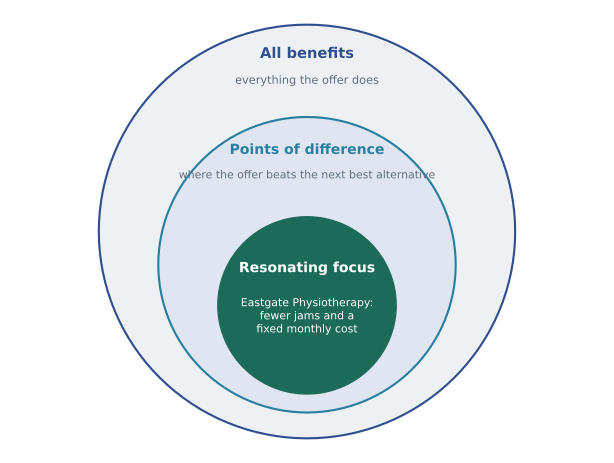
James Anderson, James Narus and Wouter van Rossum, writing in the Harvard Business Review in 2006, described three common kinds of value proposition in business markets. The first lists all benefits: everything good the offer does. It is easy to write and rarely persuasive, because many of the benefits are ones every competitor offers. The second lists favorable points of difference: the ways the offer is better than the next best alternative. That is more useful, but the points of difference may not matter to this customer. The third, which they recommended, is a resonating focus: the one or two points of difference that matter most to this customer, stated in terms of what they are worth. Their article was based on work with suppliers rather than a controlled study, but the distinction has become a standard one in business-to-business marketing.
Start from the next best alternative
A value proposition only makes sense against an alternative. The customer is never choosing between the seller's offer and nothing; it is choosing between the offer, a competitor's offer, doing the work in another way, or carrying on as it is. The status quo is often the strongest competitor. Before writing a value proposition, the seller has to know what the customer would do instead, and what that costs.
At Eastgate Physiotherapy, the alternative was to renew the clinic's printer lease, which ended on January 31, 2027, with its current supplier, or simply to keep the old machines going. At Prairie Valley, the alternatives were the incumbent's bid and a national office-products company's bid. At Keystone Grain Equipment, for the training center, the alternative was to keep renting hotel meeting rooms for dealer training and sending trainers to dealers.
| Customer | Next best alternative | What the alternative costs or risks |
|---|---|---|
| Eastgate Physiotherapy | Renew the current lease for three old printers | Direct costs of about 7,500 dollars a year plus staff time lost to jams |
| Prairie Valley School Division | The incumbent supplier's bid | A lower price, but next-day rather than four-hour service |
| Keystone Grain Equipment | Keep renting hotel rooms and traveling to dealers | About 27,800 dollars a year in room rental and trainer travel |
| Westgate & Rowe | An online furniture seller | A lower price, curbside delivery, self-assembly and a short warranty |
From features to benefits to value
Sellers learn early to translate features into benefits. A feature is what a product has or does; a benefit is what that does for the customer. Business acumen adds a third step: the value, which is what the benefit is worth, preferably in money. The step from benefit to value is where most proposals stop short.
| Feature | Benefit | Value to the customer |
|---|---|---|
| Two new multifunction printers with automatic toner ordering | Fewer jams and no running out of toner | Eastgate recovers about 4,800 dollars a year of lost staff time |
| Fixed monthly price for up to 3,000 pages | Predictable cost, no surprise repair bills | Eastgate's owners can budget printing exactly: 400 dollars a month |
| Four-business-hour service response | Problems fixed the same day | Prairie Valley schools avoid a lost teaching day when a printer fails before exams |
| Room booking panels linked to the calendar | No double-booked rooms during dealer visits | Keystone protects meetings with its largest dealer group |
Not every benefit can be turned into money, and a seller should not force it. Some value is about risk, reputation or how people feel. Dale Petrie's comment in discovery, "It would mean I'd stop apologizing," was about embarrassment in front of dealers. It mattered to him and to the deal. It went into the proposal in his words, not as an invented dollar figure.
Hard value and soft value
Finance directors distinguish between two kinds of value. Hard value shows up as a change in the customer's actual spending or income: a lower invoice, a canceled contract, a reduced hotel bill. Soft value is real but does not change a line in the bank account directly, most often staff time saved. If a receptionist saves two hours a week, the clinic does not pay her less; it gets two hours of other work. Soft value is still value, but a careful buyer discounts it, and a careful seller labels it.
The Eastgate business case Maya had built in Farida's presentation lab showed both kinds separately, which was one of the reasons Farida had scored it well.
Worked problem
Hard and soft value in the Eastgate proposal
Over three years, Eastgate's current arrangement would cost about 7,500 dollars a year in lease, service and toner (22,500 dollars in total) plus about 4,800 dollars a year of staff time lost to jams (14,400 dollars in total). Ridgeline's proposal costs 400 dollars a month for 36 months. Carla Bennett, the office manager, estimates that some jams will continue even with new machines, costing about 2,400 dollars of staff time over the three years. What are the hard savings, the soft savings and the total?
Show solution
- Proposal fees: 400 × 36 = 14,400 dollars.
- \[\text{Hard savings} = 22{,}500 - 14{,}400 = 8{,}100\]
- \[\text{Soft savings} = 14{,}400 - 2{,}400 = 12{,}000\]
- Total: 8,100 + 12,000 = 20,100 dollars over three years.
Answer: Hard savings of 8,100 dollars and soft savings of 12,000 dollars, for 20,100 dollars over three years. Shown separately, the owners can decide how much weight to give the staff time, and the hard savings alone already justify the change.
Maya noticed something about the numbers. If the owners ignored the soft savings entirely, the proposal still saved them money. That made it a much stronger case than one where the decision depended on believing the soft figure.
Writing a value proposition
Rob gave the team a fill-in-the-blanks structure to start from. It is not the only way to write a value proposition, but it forces the writer to include the parts that matter.
- For [this customer or segment], who [the problem or goal, in their words],
- our [offer] [the main outcome],
- unlike [the next best alternative], which [its main shortfall],
- so that [what it is worth, in money, time or risk], as shown by [evidence].
Maya's first attempt for Eastgate read: "For Eastgate Physiotherapy, whose front desk loses about two hours a week to printer jams and whose lease ends in January, our managed print service gives the clinic two reliable printers and a fixed monthly cost, unlike renewing the current lease, which keeps the old machines and the jams, so that the clinic saves about 8,100 dollars in direct costs over three years plus most of the staff time it now loses, as shown by Carla's two-week jam tally and the clinic's current invoices." It was long, but every part of it could be checked.
Rob's comment was that the sentence was for Maya, not for the customer. In a proposal or a conversation, she would say it in pieces, in plain language, and lead with whatever Carla or the owners cared about most. The structure was a test of whether she had all the parts.
Making it resonate
The resonating focus is the part of the value proposition this particular customer cares about most. Finding it is a job for discovery (SLS-211), not for the marketing department. Two customers buying the same product can care about completely different things.
| Customer | What resonated | What did not |
|---|---|---|
| Eastgate Physiotherapy | Fixed monthly cost and fewer interruptions at the front desk | Print speed, color quality |
| Prairie Valley School Division | Same-day service across 15 sites and one point of contact | The newest device models |
| Keystone Grain Equipment | Professional dealer visits and training without hotel bills | Room analytics and reports |
| Halverson Law | Security of client documents and a competent, quick supplier | Low price |
A useful check is to read the value proposition to someone at the customer and watch the reaction. If they nod politely, it is probably a list of benefits. If they say "yes, that's exactly our problem" or start adding numbers of their own, it has found the focus.
Evidence
A value proposition is a claim, and claims need evidence. The best evidence comes from the customer's own data: invoices, logs, counts and the customer's own estimates. The next best is evidence from similar customers, such as references and case results, stated honestly. Ridgeline's RoomFlow claim, after the legal review described in SLS-150, read: "Across our first six RoomFlow customers, double bookings fell by about four-fifths in the first three months." It was less dramatic than the marketing team's first draft, but it was true and Grace had the file to prove it.
Evidence should match the claim. A claim about staff time needs a count of time; a claim about cost needs invoices; a claim about reliability needs service records. Where the seller has to assume something, the assumption should be written down so the buyer can change it. Lesson 10 shows how a value case keeps assumptions visible.
One offer, several value propositions
In a complex sale, one value proposition rarely fits every person involved. Lesson 1 showed that owners, finance, operations, HR, IT and procurement each watch different numbers. The underlying offer stays the same, but the seller emphasizes different parts of it for each audience, while keeping every version consistent with the others. A finance director who compares notes with the operations director should find that they were told the same facts.
For the Keystone training center, Maya drafted four short versions on one page before the January board meeting.
| Audience at Keystone | Value emphasized | Evidence offered |
|---|---|---|
| Raymond Wiebe, president | Dealer training that keeps Keystone's products in front of dealers' staff, without hotel bills | Training-day counts and dealer feedback from Linda |
| Marlene Toews, finance director | About 27,800 dollars a year of hotel and travel costs replaced; payback in about two years | Keystone's own hotel invoices and travel claims for 2025 |
| Dale Petrie, operations director | No double-booked rooms during dealer visits; one supplier for rooms, video and service | Results from the two-room pilot after January installation |
| Linda Sorensen, HR manager | Easier booking and recorded sessions for new staff and dealer staff | Booking logs and attendance records |
Phrases that weaken a value proposition
Some words appear in so many proposals that buyers no longer read them. Rob kept a list on the meeting-room whiteboard and asked sellers to replace each one with something the customer could check.
| Weak phrase | Why it fails | Stronger replacement |
|---|---|---|
| World-class, best-in-class, industry-leading | Every supplier says it, and nobody can test it | A specific result with a source, such as a service response time |
| Seamless, hassle-free | Promises the absence of problems, which no buyer believes | What happens when something does go wrong |
| Solutions | Hides what is actually being sold | Name the product or service |
| Save money | Says nothing about how much, when or how | The amount, the period and the basis for the figure |
| Partner | Claims a relationship the customer has not yet agreed to | What the seller will do after the sale, with names and dates |
None of these words is forbidden, and in conversation they can be harmless. The problem is when they carry the weight of the argument. A proposal that is still persuasive after every one of them has been deleted is usually a good one.
Common mistakes
MistakeA value proposition is a short slogan about the company.
InsteadIt is a specific, testable statement of what a particular customer will get and what it is worth, compared with its alternatives.
MistakeListing every benefit makes the strongest case.
InsteadMost benefits are shared with competitors; focus on the one or two differences that matter most to this customer.
MistakeThe competitor is the only alternative to consider.
InsteadThe status quo, doing nothing or doing it another way, is often the strongest alternative.
MistakeSoft savings such as staff time should be presented as cash savings.
InsteadLabel them as soft value; a careful buyer discounts them, and the case is stronger if hard savings justify it alone.
Summary and key terms
- A value proposition states what a particular customer will get, compared with its next best alternative, and what that is worth.
- Customer value is benefits minus total costs, of which price is only one.
- Anderson, Narus and van Rossum distinguish all benefits, favorable points of difference and a resonating focus; the last is usually strongest.
- The step from benefit to value, what the benefit is worth, is where many proposals stop short.
- Hard value changes the customer's spending or income; soft value, such as staff time, is real but should be labeled.
- A good value proposition can be checked and is supported by evidence, preferably the customer's own data.
- Value proposition
- A statement of the benefits a customer will receive from an offer, compared with alternatives, and what they are worth.
- Customer value
- The benefits a customer receives minus the total costs it bears to get them.
- Next best alternative
- What the customer would do if it did not buy the seller's offer, including doing nothing.
- Resonating focus
- The one or two points of difference that matter most to a particular customer.
- Hard value
- Value that changes the customer's actual spending or income.
- Soft value
- Real value, such as time saved, that does not directly change spending or income.
Practice problems
Work each problem on paper first, then reveal the answer to check.
A proposal saves a customer 6,000 dollars in invoices and 9,000 dollars of staff time over three years. Which is hard value and which is soft?
Show answer
The 6,000 dollars of invoices is hard value; the 9,000 dollars of staff time is soft value.
Rewrite "Our printers are the best on the market" as a value statement for a clinic.
Show answer
For example: "Two reliable printers at a fixed 400 dollars a month, so your front desk stops losing about two hours a week to jams."
Why should a seller identify the next best alternative before writing a value proposition?
Show answer
Because value is only meaningful compared with what the customer would otherwise do, and the status quo is often the strongest alternative.
Lesson quiz · 5 questions
Score 60% or more to complete this lesson.
Create a free account to save your progress, take quizzes and earn a certificate.