
SLS-230 · Lesson 1 of 12 · 20 min
From seller to sales leader
▶ Video coming soon A video version of this lesson is on the way.
On Thursday, October 15, 2026, Bev Halvorsen asked Carl Jensen to stay behind after her pre-shift huddle at Juniper & Pine Home. The store's commissioned floor team had grown to nine sellers over the past two years, and the owners had approved a new role for 2027: an assistant sales manager who would schedule the floor, coach new sellers, approve price adjustments and run the floor on Bev's days off. Bev wanted Carl in the job. He had been at the store nine years, he was its best seller, and the newer associates, including Aiden Laroque, already went to him with questions.
Carl did not say yes. "I like selling," he told her. "I know how to do it. I don't know whether I'd like making other people do it." Bev gave him until Monday, November 30, to decide, and offered to walk him through what the job really involved before then.
Across town, at Ridgeline Workplace Solutions, Darnell Brooks was having a version of the same conversation with himself. Three years earlier he had been Ridgeline's top account executive. When the regional sales manager's job opened, the vice-president of sales, Rob Kowalski, offered it to him. The first six months, Darnell said later, were the worst of his working life. He kept trying to win deals himself, his team stopped bringing him problems because he took them over, and the team's results fell before they rose. Rob had asked Darnell to share that story with the leadership group as Ridgeline prepared its plans for the fiscal year starting December 1, 2026.
This course follows both companies through the fall of 2026 as their sales leaders plan for the next year. It covers how a sales organization is set up, how leaders hire, onboard and coach sellers, how territories, quotas and pay plans are designed, how pipeline and forecast reviews are run, and how motivation and culture are built. The final lesson is a case study of a team that has fallen behind. This first lesson is about the move itself: what changes when a seller becomes a leader, and why the best seller is not always the best choice.
What a sales manager actually does
A sales manager is paid for the results of other people. That single change explains most of what is hard about the job. A seller's day is organized around their own customers and deals. A manager's day is organized around the sellers: whether they have the right accounts, the right skills, enough good opportunities, and the support to close them. The manager still cares about deals, but mostly as evidence of how each seller is doing.
Most sales management jobs combine six kinds of work. The balance changes with the size of the team and the type of selling, but every lesson in this course connects to one of them.
| Area of work | What it involves | Where this course covers it |
|---|---|---|
| Building the team | Defining roles, hiring, onboarding and, when needed, letting people go | Lessons 2, 3 and 4 |
| Developing people | Coaching skills, reviewing calls and deals, career conversations | Lesson 5 |
| Planning the work | Territories, account assignments, quotas and pay plans | Lessons 6, 7 and 8 |
| Running the business | Pipeline reviews, forecasts, reports to senior managers | Lesson 9 |
| Keeping people engaged | Recognition, contests, workload and fairness | Lesson 10 |
| Setting standards | Ethics, compliance with employment and sales law, culture | Lesson 11 |
Darnell kept a simple log of how he spent a typical fortnight in October 2026. About a third of his time went to coaching and joint calls with his six field account executives, about a fifth to pipeline and forecast work, and the rest was split between hiring for an open position, planning for the new fiscal year, internal meetings, and his own two house accounts, which he was gradually handing to his sellers. The log surprised him: the coaching share was higher than in his first year, when he had spent most of his time on deals he should have left to others.
Why the best seller is not always the best manager
Promoting the top seller feels fair and safe. The top seller knows the products, the customers and the selling process, and their success seems to prove they have what it takes. But the skills that make a great seller overlap only partly with the skills that make a great manager. A great seller is good at building trust with customers, persisting through rejection and closing. A manager also needs to diagnose why someone else is struggling, teach without taking over, give hard feedback, plan for a whole team and stay calm when results depend on other people.
Research supports the concern. In a study published in 2019 in the Quarterly Journal of Economics, economists Alan Benson, Danielle Li and Kelly Shue examined sales workers and managers across more than 200 United States firms. Firms were much more likely to promote their best sellers into management, but stronger sales performance before promotion was associated with weaker team performance after promotion. The researchers described this as evidence of the Peter principle, the old idea that people are promoted until they reach a job they cannot do well. The study has limits: it covers one kind of data from one country, measures team results rather than every part of a manager's job, and cannot capture every reason a team's results change. But it gives companies a reason to judge candidates on management potential, not just sales results.
None of this means top sellers make poor managers. Darnell turned out to be a good one, after a hard start. It means the decision should rest on evidence about the management skills the job needs, and that a top seller who does not want to manage should not be pushed into it. Many companies now offer a senior seller path, with larger accounts, mentoring duties and higher earning potential, so that great sellers can grow without leaving selling.
The shifts a new leader has to make
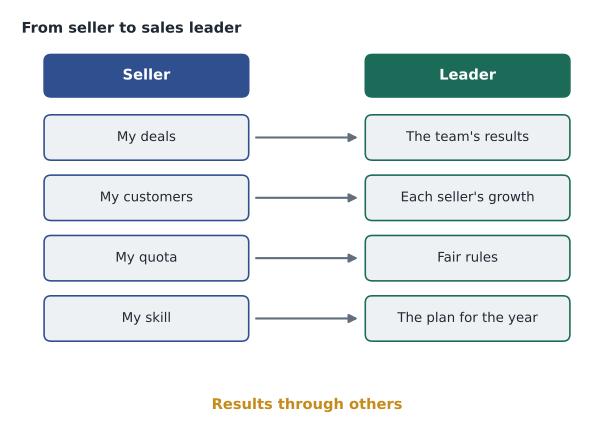
Bev described the move from seller to manager as a set of shifts. She had made them herself fourteen years earlier, when she moved from the appliance floor to running the store's sales team. Each shift sounds simple, but each one means giving up something that made the person successful as a seller.
| As a seller | As a leader |
|---|---|
| Success means my sales | Success means the team's sales and the growth of each person |
| I solve the customer's problem | I help the seller solve it, and step in only when needed |
| I protect my time for my customers | My time belongs first to my team |
| I compete with my colleagues | I am responsible for fairness among them |
| I can speak freely about company decisions | I explain and carry out decisions, even ones I argued against |
| Friends at work are peers | Former peers now report to me, and fairness has to come first |
The hardest shift for Darnell was the second. When one of his account executives was struggling with a negotiation, his instinct was to join the call and take it over. He usually won the deal, but the seller learned nothing and the team learned that the way to get help was to wait for Darnell to rescue them. Rob's advice was to ask one question before every intervention: "Will stepping in here help this person sell the next deal on their own?" If the answer was no, Darnell coached before the call and debriefed after it instead.
The last shift worried Carl most. He had worked beside the other sellers for years, eaten lunch with them and argued with them about who got the customer who walked in at closing time. As assistant sales manager he would be deciding schedules and settling those arguments. Bev told him the answer was not to stop being friendly, but to be visibly fair: publish the rules for sharing walk-in customers, apply them the same way to everyone, and never use the role to steer good customers to friends.
Player-coaches and full-time managers
Small sales teams often use a player-coach: a leader who carries their own accounts or quota while also managing others. The arrangement saves money and keeps the leader close to customers, but it pulls in two directions. When a big deal is at stake, the leader's own quota tends to win, and coaching gets squeezed. The assistant sales manager role at Juniper & Pine was planned as a player-coach role: Carl would still sell on the floor for about half of his hours.
A common guide is that a full-time first-line sales manager can lead roughly six to ten sellers, depending on how complex the selling is, how experienced the sellers are and how much the manager must travel. This range is a rule of thumb from practice rather than a fixed law. Darnell's six field account executives were at the low end because the deals were complex and two of his people were new. Bev, with nine floor sellers on overlapping shifts and simpler sales, needed help mainly because the store was open seven days a week and she could not be on the floor for every shift.
Worked problem
Comparing Carl's pay as a seller and as assistant manager
In 2025, Carl closed 610 sales at an average of 2,120 dollars, for net sales of 1,293,200 dollars. The gross margin on his sales averaged 40 in 100, and Juniper & Pine pays floor sellers 8 in 100 of the gross margin on their sales. The assistant manager offer is a salary of 52,000 dollars plus commission at the same rate on his own sales, which Bev expects to fall by half because he will sell only half of his hours. Will Carl earn more or less?
Show solution
- \[\text{Gross margin} = 1{,}293{,}200 \times 0.40 = 517{,}280 \text{ dollars}\]
- \[\text{Commission as a seller} = 517{,}280 \times 0.08 = 41{,}382.40 \text{ dollars}\]
- As assistant manager, his own sales fall by half, so his commission falls by half:
- \[41{,}382.40 \div 2 = 20{,}691.20 \text{ dollars}\]
- \[\text{Total as assistant manager} = 52{,}000 + 20{,}691.20 = 72{,}691.20 \text{ dollars}\]
- \[72{,}691.20 - 41{,}382.40 = 31{,}308.80 \text{ dollars more}\]
Answer: On these figures Carl would earn about 31,300 dollars more as assistant manager, mostly because of the salary. Bev pointed out that the comparison leaves out what matters most to him: whether he would enjoy the work, and whether the role would let him keep the customers who ask for him by name.
The example also shows why managers' pay is usually built differently from sellers' pay. A manager's main value is the results of the team, so manager pay plans usually tie at least part of the variable pay to team results. Bev's offer did not do that yet. Lesson 8 returns to manager pay when Ridgeline designs its plans for fiscal 2027.
What a leader owes the team
Leaders also take on duties that sellers do not have. A manager who sets schedules is responsible for following the rules on hours, breaks and overtime. A manager who interviews is responsible for hiring fairly and lawfully. A manager who hears a complaint of harassment must act on it under the employer's policy and the law. These duties are not optional extras: in South Dakota, as everywhere in the United States, an employer can be held responsible for what its managers do and fail to do. Later lessons cover the specific rules where they apply, such as minimum wage and overtime for commissioned sellers in lesson 8 and fair hiring in lesson 3.
Leaders also owe their teams honesty. Rob's rule for his managers was that a seller should never be surprised by a performance conversation. If a seller is falling short, they should hear it early, with specifics, and with a plan to improve. A manager who avoids hard conversations to stay liked is not being kind; they are letting the seller fail without a chance to fix it.
Deciding whether to lead
Bev suggested Carl test the role before deciding. For three weeks in November he would run the Tuesday and Wednesday floor schedules, sit in on her coaching sessions with Aiden and another new seller, and handle the price-adjustment approvals on those days. They would meet on Friday, November 27, to talk about what he had learned. Carl agreed, partly because it meant he could decide with evidence rather than guesswork.
Darnell, asked by Rob what he would tell someone in Carl's position, gave three suggestions. First, ask what the job is really for, not what it is called: if the role exists mainly to cover shifts, it will feel very different from one built around developing people. Second, talk to someone who has done it, about the bad weeks as well as the good. Third, decide what success would look like in a year, and whether you would be proud of that. The rest of this course is about what doing the job well involves.
Common mistakes
MistakePromoting the top seller automatically because they have the best results.
InsteadAssess candidates on the skills the management job needs, such as coaching, planning and fairness, and offer a senior seller path for those who want to keep selling.
MistakeTaking over a struggling seller's deals to save them.
InsteadCoach before and debrief after; step in only when doing so will help the seller succeed next time.
MistakeTreating a player-coach role as a full-time sales job with management added on.
InsteadSet aside protected time for coaching and planning, or the manager's own quota will crowd it out.
MistakeAvoiding hard conversations to stay liked by former peers.
InsteadBe visibly fair, give feedback early and specifically, and apply the same rules to everyone.
MistakeAssuming management is simply the next step up.
InsteadDecide whether you want the work itself, ideally after testing the role and talking to people who have done it.
Summary and key terms
- A sales manager is paid for the results of other people.
- The job combines building the team, developing people, planning territories, quotas and pay, running pipeline and forecast reviews, keeping people engaged and setting standards.
- The best seller is not always the best manager; research by Benson, Li and Shue found that stronger sellers were more likely to be promoted but tended to lead weaker teams, though the study has limits.
- New leaders must shift from personal success to team success, from solving problems to helping others solve them, and from competing with peers to being fair to them.
- Player-coaches carry their own quota while managing, which saves money but can squeeze coaching.
- A common rule of thumb is six to ten sellers per full-time manager.
- Leaders take on legal duties for hours, pay, hiring and workplace conduct, and owe their teams honest, early feedback.
- Sales manager
- A leader responsible for the results of a group of sellers.
- First-line manager
- A manager who leads sellers directly, rather than other managers.
- Player-coach
- A leader who manages others while also carrying their own accounts or quota.
- Span of control
- The number of people who report directly to one manager.
- Peter principle
- The idea that people are promoted until they reach a job they cannot do well.
- Senior seller path
- A career track that lets strong sellers grow in responsibility and pay without becoming managers.
Practice problems
Work each problem on paper first, then reveal the answer to check.
A seller earns 8 in 100 of a gross margin of 400,000 dollars. A manager offer pays 55,000 dollars plus half that commission. Which pays more, and by how much?
Show answer
As a seller: 400,000 × 0.08 = 32,000 dollars. As manager: 55,000 + 16,000 = 71,000 dollars, which is 39,000 dollars more.
Why did Rob ask Darnell to ask himself one question before stepping into a seller's deal?
Show answer
To make sure he stepped in only when it would help the seller succeed on their own next time, rather than rescuing deals and teaching the team to wait for him.
Give two reasons a top seller might be a poor choice for a management role.
Show answer
The job needs different skills, such as diagnosing and coaching others, planning and giving hard feedback; and the person may not want to manage, so they would be pushed out of work they do well.
Lesson quiz · 5 questions
Score 60% or more to complete this lesson.
Create a free account to save your progress, take quizzes and earn a certificate.