
SLS-230 · Lesson 8 of 12 · 25 min
Compensation and commission plans
▶ Video coming soon A video version of this lesson is on the way.
Rob Kowalski's fourth planning session, on Tuesday, November 10, 2026, was about pay. Ridgeline's fiscal 2027 pay plans had to be signed off by the owners before December 1, and they had to fit everything decided in the first three sessions: the new structure with segment specialists and inside-sales pods, the redrawn territories and the new quotas. Grace Liu had modeled each plan in a spreadsheet so that the group could see what a seller would earn at different levels of results. At Juniper & Pine Home the same week, Bev Halvorsen was checking that her floor sellers' commission plan met South Dakota and federal pay rules before the long holiday hours began.
Pay plans get more attention from sellers than almost anything else a company does, and they shape behavior in ways the designers do not always intend. This lesson covers the parts of a sales pay plan, how to calculate payouts, the legal rules that apply to commissioned employees in each country, and how to check a plan before it goes live.
The parts of a sales pay plan
Most sales pay plans combine a fixed base salary with variable pay that depends on results. The total a seller is expected to earn at 100 in 100 of quota is called on-target earnings (OTE), and the split between base and variable at target is the pay mix. A mix with more variable pay suits jobs where the seller's own effort clearly drives the sale and results can be measured quickly; a mix with more base suits jobs with long cycles, team selling or a large share of account care.
| Role | Typical pay mix (base / variable) | Main measure | Ridgeline or Juniper & Pine plan for fiscal 2027 |
|---|---|---|---|
| Field account executive | About 50/50 to 70/30 | First-year revenue against quota | OTE 96,000 dollars, mix 60/40 |
| Inside sales rep | About 65/35 to 80/20 | Accepted meetings and sourced revenue | Hourly base plus 75 dollars per accepted meeting and 1 in 100 of first-year revenue |
| Account manager | About 70/30 to 85/15 | Retention and expansion revenue | Base plus bonus on renewal and expansion targets |
| Sales manager | About 65/35 to 75/25 | Team results | Base plus bonus on team attainment |
| Retail floor seller | Often mostly or all commission, with a guaranteed minimum | Gross margin on own sales | 8 in 100 of gross margin, with a guaranteed hourly minimum |
Within the variable part, the main design choices are the commission rate, any accelerators that raise the rate above quota, any decelerators that lower it below a threshold, whether earnings are capped, and what happens when a sale is reversed. A clawback recovers commission already paid if a customer cancels or fails to pay within a set period. A draw is an advance paid against future commission, usually to a new seller who has not yet built a pipeline; a recoverable draw is repaid from later commission, while a non-recoverable draw is a guarantee that does not have to be repaid.
Ridgeline's account executive plan
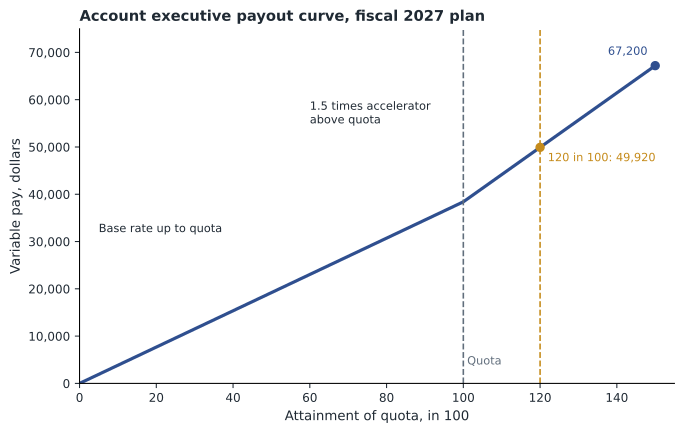
For fiscal 2027, Ridgeline's field account executives would have on-target earnings of 96,000 dollars, with a base salary of 57,600 dollars (60 in 100) and target variable pay of 38,400 dollars (40 in 100). Commission would be paid on first-year revenue. Each seller's commission rate is their target variable pay divided by their quota, so that every seller earns their full target variable at exactly 100 in 100 of quota, whatever the size of their quota. Above quota, the rate rises by half, an accelerator of 1.5 times, with no cap. Commission on a new customer would be clawed back if the customer canceled within 90 days of installation.
Worked problem
Calculating Maya's fiscal 2027 commission
Maya's quota is 534,500 dollars and her target variable pay is 38,400 dollars. Suppose she closes 641,400 dollars of first-year revenue in fiscal 2027, which is 120 in 100 of quota. What is her commission rate, her variable pay and her total pay?
Show solution
- \[\text{Commission rate} = \frac{38{,}400}{534{,}500} = 0.071843 \approx 7.18 \text{ in } 100\]
- \[\text{Up to quota} = 534{,}500 \times 0.071843 = 38{,}400 \text{ dollars}\]
- \[\text{Above quota} = (641{,}400 - 534{,}500) \times 0.071843 \times 1.5 = 106{,}900 \times 0.107764 \approx 11{,}520 \text{ dollars}\]
- \[\text{Variable pay} = 38{,}400 + 11{,}520 = 49{,}920 \text{ dollars}\]
- \[\text{Total pay} = 57{,}600 + 49{,}920 = 107{,}520 \text{ dollars}\]
Answer: At 120 in 100 of quota, Maya would earn about 107,520 dollars, compared with on-target earnings of 96,000. The accelerator means that each dollar above quota pays half as much again as a dollar below it, which rewards strong results without a cap.
The group spent most of the session on the second-order effects. Rob asked what the plan would make sellers do in the last two weeks of a quarter. Grace showed that because quotas were quarterly and accelerators applied only to revenue above each quarter's quota, a seller just short of quota had a strong reason to push deals into the current quarter, while a seller well above it might hold a deal for the next one. To reduce that, the accelerator would be calculated on year-to-date attainment, so moving a deal across a quarter boundary would not change its total pay.
Lesson 2's specialists raised a different question: who gets credit when Lisa, as clinics specialist, closes a clinic deal in Andrew's territory? The plan gave both full quota credit, a practice called double crediting, because Rob wanted the territory seller to bring the specialist in rather than keep the deal to themselves. Double crediting costs money, since two people earn commission on one sale, and Grace budgeted for about 300,000 dollars of specialist deals a year to be double credited.
Pay for inside sellers, account managers and managers
The inside-sales plan from earlier in the fall stayed: an hourly base, 75 dollars per meeting accepted by a field seller, and 1 in 100 of first-year revenue from opportunities the rep sourced. Account managers' bonuses were tied to two measures, the share of renewing revenue kept and expansion revenue, so that they were rewarded for keeping customers as well as growing them. Darnell's own plan, as a manager, tied his variable pay to the team's total attainment, with a smaller part tied to the number of his sellers who reached quota, so that he gained more from developing the whole team than from carrying one star.
Pay on the sales floor
Juniper & Pine paid its floor sellers a base of 13.00 dollars an hour plus 8 in 100 of the gross margin on furniture and mattress sales and 6 in 100 on appliances, rather than a share of the price. Paying on margin discourages sellers from giving away discounts to close a sale, because a discount cuts their own commission as well as the store's profit. In its planning for 2027, the owners asked Bev whether the store should save money by dropping the base and paying commission only, with the pay of any seller whose commission fell short topped up to the minimum wage. Bev tested the idea on a real slow week.
Worked problem
Checking pay against the minimum wage
In a slow week in early November, Aiden works 40 hours and earns 440 dollars of commission. South Dakota's minimum wage in 2026 is 11.85 dollars an hour. Under a commission-only plan, would Juniper & Pine need to top up his pay, and by how much? What does he earn under the current plan?
Show solution
- Commission per hour: 440 ÷ 40 = 11.00 dollars, which is below 11.85.
- Minimum pay for the week: 40 × 11.85 = 474.00 dollars.
- Top-up: 474.00 − 440.00 = 34.00 dollars.
Answer: Under commission only, the store would have to top Aiden up by 34 dollars, to 474 dollars, so he earns at least the minimum wage for every hour worked. Under the current plan he earns 40 × 13.00 + 440 = 960 dollars. Bev recommended keeping the base: commission only would pay newer sellers little more than the minimum wage in quiet weeks, and the store would lose them to employers with steadier pay.
Employment law for commissioned sellers
In the United States, the federal Fair Labor Standards Act (FLSA) sets the main rules, and South Dakota has no separate state overtime law. Three FLSA provisions matter for sales teams. First, the outside sales exemption in section 13(a)(1) exempts employees whose primary duty is making sales and who are customarily and regularly away from the employer's place of business; they are not owed minimum wage or overtime under the FLSA, and no salary test applies. Ridgeline's field account executives, who spend much of their time at customers' sites, fit this exemption. Second, inside sales employees who sell mainly by phone, video and email from the office are not outside sellers, so Ridgeline's inside reps must be paid at least the minimum wage and overtime at one and a half times their regular rate for hours over 40 in a week, with commissions included in the regular rate. Third, the retail commission exemption in section 7(i) exempts from overtime employees of a retail or service establishment whose regular rate exceeds one and a half times the minimum wage in any week they work overtime and more than half of whose earnings over a representative period of one month to one year are commissions. South Dakota's minimum wage of 11.85 dollars an hour in 2026 must be paid for all hours to employees it covers.
Worked problem
Overtime for an inside sales rep
Tyler Greyeyes, an inside sales rep in Sioux Falls, is paid 18.00 dollars an hour plus commission. In one week he works 44 hours and earns 300 dollars of commission for the week. Under the FLSA, what is his pay for the week?
Show solution
- Straight-time pay: 44 × 18.00 = 792.00 dollars, plus 300.00 commission = 1,092.00 dollars.
- \[\text{Regular rate} = 1{,}092 \div 44 \approx 24.82 \text{ dollars}\]
- \[\text{Overtime premium} = 4 \times 0.5 \times 24.82 \approx 49.64 \text{ dollars}\]
- \[\text{Total} = 1{,}092.00 + 49.64 = 1{,}141.64 \text{ dollars}\]
Answer: Tyler is owed about 1,141.64 dollars. Because his commission is included in the regular rate, his overtime premium is based on 24.82 dollars rather than his 18.00 dollar base.
Juniper & Pine's commissioned floor sellers in Sioux Falls can qualify for the 7(i) exemption. In a 46-hour week in December, Carl Jensen earns 46 × 13.00 = 598 dollars of base pay and 1,150 dollars of commission, 1,748 dollars in all. His regular rate is 1,748 ÷ 46 = 38.00 dollars an hour, well above one and a half times the federal minimum wage of 7.25 dollars (10.875 dollars), and commission is 1,150 ÷ 1,748, about 66 in 100 of his pay. As long as more than half of his earnings over the store's chosen representative period, of at least one month, are commission, the store is not required to pay him overtime. Newer sellers such as Aiden, whose commission can be smaller than their base pay, may fail the more-than-half test, so Bev checks every overtime week, not just the plan.
Two further points matter in South Dakota. State law requires wages due to be paid by the regular payday for the pay period in which an employee is discharged, so a commission plan should say clearly when commission is earned and when it is paid, especially after someone leaves. And deductions such as clawbacks should be agreed in writing and must not take a non-exempt employee below the minimum wage; employers should get advice before relying on one.
Checking a plan before it goes live
Grace ran each plan through four tests before the owners signed off. Cost: what would the company pay in total at 80, 100 and 120 in 100 of quota, and was the cost of sales reasonable compared with the margin earned? Behavior: what would the plan make sellers do, especially near period ends, on discounts and with customers who might cancel? Simplicity: could each seller explain how they were paid in two sentences? And law: did the plan meet minimum wage, overtime, deduction and payment-timing rules for every role in each location?
Worked problem
What the field plan costs the company
Ridgeline has seven field account executives with total quotas of 3,628,000 dollars and total target variable pay of 7 × 38,400 = 268,800 dollars. If the team as a whole reaches exactly 100 in 100 of quota, what is the variable cost as a share of first-year revenue? Ridgeline's gross margin on new revenue averages 35 in 100. What share of that margin goes to field commission?
Show solution
- \[\text{Variable cost} = \frac{268{,}800}{3{,}628{,}000} \approx 0.0741 = 7.41 \text{ in } 100 \text{ of revenue}\]
- \[\text{Gross margin} = 3{,}628{,}000 \times 0.35 = 1{,}269{,}800 \text{ dollars}\]
- \[\text{Share of margin} = \frac{268{,}800}{1{,}269{,}800} \approx 0.2117 \approx 21.2 \text{ in } 100\]
Answer: At target, field commission would cost about 7.4 in 100 of first-year revenue, or about 21 in 100 of the gross margin it generates, before base salaries and the cost of double crediting. The owners accepted the figure because first-year revenue understates the value of multi-year contracts, which bring margin for years after the commission is paid.
Common mistakes
MistakeSetting one commission rate for all sellers regardless of quota.
InsteadDivide each seller's target variable pay by their quota so that everyone earns target pay at 100 in 100.
MistakeDesigning a plan without asking what it will make sellers do near period ends.
InsteadModel behavior as well as cost, for example by calculating accelerators on year-to-date attainment.
MistakeAssuming commissioned sellers are never owed minimum wage or overtime.
InsteadCheck whether each role meets the outside sales or retail commission exemption; inside sellers are generally owed both.
MistakeTaking clawbacks from wages without a clear written agreement.
InsteadPut clawback and payment-timing rules in the written plan and get advice before deducting.
MistakePaying floor sellers on price rather than margin.
InsteadPay on margin so that discounting costs the seller as well as the store.
Summary and key terms
- A sales pay plan usually combines base salary with variable pay; on-target earnings are total pay at 100 in 100 of quota, and the pay mix is the split between base and variable.
- Design choices include commission rates, accelerators, decelerators, caps, clawbacks and draws.
- Setting each seller's rate as target variable divided by quota pays everyone their target at quota.
- Plans should be modeled for cost and for the behavior they encourage, such as pushing or holding deals near period ends.
- Commission on margin discourages discounting. Employment law applies to commissioned sellers: the FLSA's outside sales and retail commission exemptions, overtime for inside sellers with commission in the regular rate, and South Dakota's minimum wage and payment-timing rules.
- On-target earnings (OTE)
- Total pay a seller is expected to earn at 100 in 100 of quota.
- Pay mix
- The split between base salary and target variable pay.
- Accelerator
- A higher commission rate on results above quota.
- Clawback
- Recovery of commission already paid when a sale is reversed.
- Draw
- An advance against future commission; recoverable if repaid from later commission, non-recoverable if not.
- Double crediting
- Giving two sellers full quota credit for the same sale.
Practice problems
Work each problem on paper first, then reveal the answer to check.
Target variable pay is 30,000 dollars and quota is 400,000. What is the commission rate, and what is the variable pay at 110 in 100 of quota with a 1.5 times accelerator?
Show answer
Rate is 30,000 ÷ 400,000 = 0.075. Up to quota 30,000; above quota 40,000 × 0.075 × 1.5 = 4,500; total 34,500 dollars.
A commission-only seller covered by South Dakota's minimum wage works 35 hours and earns 350 dollars. What top-up is needed to meet the 11.85 dollar minimum wage?
Show answer
35 × 11.85 = 414.75 dollars; 414.75 − 350 = 64.75 dollars.
Why does paying floor sellers on margin rather than price discourage discounting?
Show answer
A discount lowers the margin, so it lowers the seller's own commission as well as the store's profit.
Lesson quiz · 5 questions
Score 60% or more to complete this lesson.
Create a free account to save your progress, take quizzes and earn a certificate.