
SLS-256 · Lesson 10 of 12 · 22 min
Following up after the sale
▶ Video coming soon A video version of this lesson is on the way.
Carl Jensen made 610 sales in 2025. Of those, 340 came from customers who had bought from him before or had been sent by someone who had. Aiden did the division on his phone: more than half. "That's not luck," Carl said. "It's nine years of phone calls three days after delivery." The clinic that week was about what happens after the delivery truck leaves, and why it decides a seller's next ten years.
Following up after a big-ticket sale serves the customer and the store at once. The customer gets help using the product, a quick fix if something is wrong, and reassurance that they chose well. The store gets early warning of problems, honest reviews, referrals and repeat business. This lesson covers why follow-up matters, when and how to do it, the rules that apply, and how to ask for reviews and referrals honestly.
Why follow-up matters
Lesson 2 described the fifth stage of a considered purchase, living with it. Customers often feel uneasy after a big purchase, a reaction psychologists call post-purchase dissonance, a form of the cognitive dissonance Leon Festinger described in the 1950s: they wonder whether they paid too much or chose the wrong model, and they notice every small flaw. A short, helpful contact at the right moment eases that worry. It also catches the problems customers would otherwise put up with quietly, or mention only in a review.
Follow-up has a long-term value as well. Big-ticket purchases come again: the couple who bought a sectional will need a mattress, a dining table and, in time, appliances. Each household that returns or refers a friend is worth many times a single sale.
Worked problem
What a returning household is worth
Carl estimates that a household that trusts him buys about four more big-ticket items over the next fifteen years and refers at least one other household that buys once. If the average main-floor sale is 2,400 dollars at a gross margin of about 40 in 100, what gross margin does that relationship produce beyond the first sale?
Show solution
- Margin on an average sale:
- \[2{,}400 \times 0.40 = 960 \text{ dollars}\]
- Four repeat purchases plus one referral sale is five more sales:
- \[5 \times 960 = 4{,}800 \text{ dollars}\]
Answer: On these illustrative assumptions, the relationship produces about 4,800 dollars of further gross margin, five times the first sale's. A follow-up call that makes it more likely is one of the most valuable things a seller does.
Worked problem
How much of Carl's business is repeat or referred
Carl made 610 sales in 2025, and 340 came from returning or referred customers. What share is that?
Show solution
- \[\frac{340}{610} \approx 0.557 \text{, or about 56 in 100}\]
Answer: About 56 in 100 of Carl's sales came from customers he had served before or their referrals.
A follow-up calendar
Carl's follow-up followed a simple calendar, which Juniper & Pine later built into the clienteling app as automatic tasks.
| When | What | Purpose |
|---|---|---|
| The day of the sale | A short thank-you, with the order summary and delivery window | Confirms the details and gives the customer one person to contact |
| Within three days of delivery | A phone call or message: is everything in place, working and as expected? | Catches problems early and eases post-purchase worry |
| About 30 nights after a mattress delivery | A check on comfort, with tips on adjustment | Helps the customer settle in before the 90-night comfort exchange deadline |
| Around the first anniversary | A care reminder, such as cleaning a fridge coil or rotating cushions | Helps the product last and keeps the relationship warm |
| When something relevant happens | A message about a recall, a matching piece arriving, or a delivery slot before a holiday | Useful news, never routine promotion |
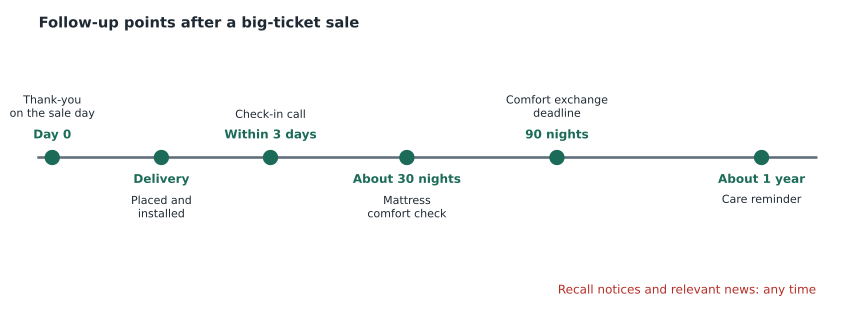
The three-day call was the one Carl never missed. It usually took two minutes. Most customers said everything was fine, and many mentioned something small: a wobbly leg, a door that needed adjusting, a question about the oven's self-clean. Each one fixed early saved a complaint later.
Worked problem
The 30-night mattress check
Juniper & Pine sells about 50 mattresses a month. Before sellers made a 30-night comfort call with adjustment tips, about 12 in 100 customers used the 90-night comfort exchange; afterward, about 8 in 100. Each exchange costs the store about 180 dollars in pickup, delivery and disposal. How many exchanges a month does the call avoid, and what does it save?
Show solution
- Exchanges before:
- \[50 \times 0.12 = 6\]
- Exchanges after:
- \[50 \times 0.08 = 4\]
- Saving:
- \[(6 - 4) \times 180 = 360 \text{ dollars a month}\]
Answer: The call avoids about two exchanges a month, saving about 360 dollars, and many customers who would have exchanged end up content with the mattress they chose, often after simple advice such as giving a new mattress a few weeks or adding a topper. The exchange remains available to anyone who needs it.
What to say
Good follow-up sounds like help, not sales. Carl's three-day call followed the same pattern every time: who he was, why he was calling, an open question, and an offer.
| Step | Carl's words |
|---|---|
| Who and why | "Hi Denise, it's Carl from Juniper & Pine. Your recliner went in on Thursday and I wanted to check how it's settling in." |
| Open question | "How is it working in the room? Anything not quite right?" |
| Listen and act | If there is a problem: "Let me get that sorted. I'll call you by tomorrow afternoon with a time." Then do it. |
| Offer | "If you have any questions about the care card or the fabric, I'm the person to call." |
| Close | "Thanks again. Enjoy it." |
He did not use the call to sell. If the customer mentioned a future project, such as a bedroom they were planning, he noted it and asked whether they would like him to let them know when the new beds arrived. If they said no, he left it.
The rules on follow-up messages
Under CAN-SPAM, transactional or relationship messages, such as confirming a purchase, giving warranty, recall or safety information, or updating an order, are largely exempt from the commercial-message rules, though they must not be misleading. A message that promotes a product is commercial and must include an opt-out. Marketing texts need prior express written consent under the TCPA. A three-day check-in about the delivered sofa is transactional. A text suggesting a matching ottoman is marketing and needs written consent. Calls to existing customers are generally allowed under the Telemarketing Sales Rule's established business relationship exception for 18 months after a purchase, unless the customer asks not to be called.
Asking for reviews
Satisfied customers rarely write reviews unless they are asked, and unhappy ones often do without being asked. Asking every customer for an honest review gives a fairer picture. The asking must be fair too.
- Ask every customer, not only the ones you expect to be happy. Selecting only happy customers distorts the store's reviews.
- Ask for an honest review of their experience, not a positive one.
- Do not offer a reward for a review. The FTC's rule on consumer reviews prohibits incentives conditioned, explicitly or implicitly, on a review expressing a particular sentiment, and the FTC's endorsement guides require any incentive to be disclosed.
- Never write a review yourself, ask family to write one, or respond to criticism with anything but a helpful reply.
Carl asked for reviews at the end of the three-day call, once he knew the customer was satisfied or the problem was fixed: "If you have a minute, an honest review would help other people shopping for a sectional. Here's the link." Customers who had just had a problem fixed often wrote the most generous reviews.
Referrals
Referrals work best when they are earned rather than asked for. A customer who had a good experience will mention it to friends without prompting; the seller's part is to make it easy, with a business card, a name to ask for, and a thank-you when a referred friend buys. Juniper & Pine's referral program gave both the referring customer and the new customer a 50-dollar credit on a future purchase, disclosed on the card. Carl sent a handwritten note to anyone who referred a friend, whether or not the friend bought.
Keeping the client book
Lesson 10 of SLS-250 described how Carl's paper binder of about 900 households moved into the clienteling app in November 2026. Follow-up depends on that record: what each household bought, when it was delivered, the rooms and projects they mentioned, their preferences and how they agreed to be contacted. Good records let a seller follow up at the right moment with the right message. They also carry privacy obligations: customer information must be accurate, kept only as long as needed, used for the purposes the customer expects, and protected, as SLS-150 explained.
Follow-up in other categories
Vehicle dealers follow up after delivery and around service intervals, and their service department is often where the next sale begins. Jewelry stores offer free cleaning and inspection, which brings customers back regularly. Electronics retailers follow up on installations and protection plans. In each category, the principle is the same as Carl's: help first, sell later, and only if the customer wants it.
Handling a concern on the follow-up call
Most follow-up calls are short and pleasant, but some uncover a problem. Carl taught a simple sequence for those moments: listen, acknowledge, check the facts, offer what the store can do, and confirm what happens next.
- Listen fully. Let the customer finish before explaining anything.
- Acknowledge. "That's frustrating, especially after waiting for it." Acknowledging is not the same as admitting fault.
- Check the facts. Ask for details or a photo and look up the order before promising anything.
- Offer what the store can actually do. A technician visit, a cleaning kit, an exchange under the comfort policy or a manager's review.
- Confirm next steps and a date. Then call back on that date, even if there is no news yet.
| Concern | Usual cause | Typical response |
|---|---|---|
| "The mattress feels firmer than in the store." | New foam and a body used to the old mattress | Explain the adjustment period; book the 30-night check; remind them of the comfort exchange |
| "The sofa color looks different at home." | Different lighting from the showroom | Compare with the swatch in daylight; check the order code; involve a manager if the fabric is wrong |
| "The fridge makes a humming noise." | Normal compressor and fan sounds, or a leveling problem | Explain normal sounds; offer a technician if it is loud or new |
| "There's a scratch on the dresser." | Damage in transit or at assembly | Ask for a photo; arrange a touch-up or replacement under the delivery-damage guarantee |
A concern handled well is one of the strongest reasons customers return. Carl had several clients who first trusted him because of how he fixed a problem rather than how he made the sale. The key, he told Aiden, was never to let a customer chase the store: the seller calls back on the promised date, and the customer should never have to repeat the whole story to a second person.
Some concerns should go straight to a manager: anything involving safety, such as a gas smell, an electrical fault or a tall item that was not anchored; a customer who is angry enough to mention a complaint to a regulator or a lawyer; and any request the seller is not allowed to approve. Passing these on quickly is not a failure. The seller stays in touch, tells the customer who will call them and when, and checks afterward that the call happened.
Common mistakes
MistakeTreating follow-up as a sales call.
InsteadCall to help: check, fix, answer questions, and sell only if the customer raises a need.
MistakeCalling only when there is something to sell.
InsteadFollow a calendar of useful contacts: thank-you, three-day check, care reminders.
MistakeAsking only happy customers for reviews.
InsteadAsk every customer for an honest review, without rewards tied to the rating.
MistakeSending promotional messages without consent.
InsteadSeparate transactional messages from commercial ones and check consent for the latter.
MistakeLeaving problems mentioned in follow-up unresolved.
InsteadGive a time for the fix, do it, and confirm afterward.
Summary and key terms
- Follow-up eases post-purchase worry, catches problems early, and builds the repeat and referral business that makes up a large share of an experienced seller's sales.
- A calendar of useful contacts, such as a thank-you, a three-day check, a 30-night mattress check and an anniversary care reminder, turns follow-up into a habit.
- The call should sound like help: who and why, an open question, action on any problem and an offer.
- Transactional messages generally do not need consent; promotional ones do.
- Reviews should be requested from every customer, honestly and without rewards tied to the rating.
- Referrals are earned by good service and made easy with a name and a thank-you.
- Accurate, protected client records make good follow-up possible.
- Post-purchase dissonance
- Unease after a big purchase about whether it was the right choice.
- Transactional message
- A message that completes, confirms or gives information about a purchase, warranty, recall or safety issue.
- Referral
- A new customer sent by an existing one.
- Client book
- A seller's record of customers, purchases, preferences and contact consent.
- Three-day call
- A check-in shortly after delivery to confirm the purchase is right and fix any problem.
- Incentivized review
- A review written in exchange for a reward; rules require disclosure and prohibit tying rewards to the rating.
Practice problems
Work each problem on paper first, then reveal the answer to check.
A seller made 480 sales, 210 from returning or referred customers. What share is repeat or referred?
Show answer
210 ÷ 480 = 0.4375, or about 44 in 100.
Is a message asking whether a delivered fridge is working properly transactional or commercial?
Show answer
Transactional: it gives information about the purchase.
Why ask every customer for a review, not only the happy ones?
Show answer
Selecting only happy customers distorts the reviews and can mislead other shoppers.
Lesson quiz · 5 questions
Score 60% or more to complete this lesson.
Create a free account to save your progress, take quizzes and earn a certificate.