
SLS-256 · Lesson 9 of 12 · 22 min
Delivery, installation and handover
▶ Video coming soon A video version of this lesson is on the way.
Hamid, the lead on Juniper & Pine's delivery crew, came to Carl's clinic one Wednesday in early November with a box of photographs. Each one showed a delivery that had gone wrong: a sectional wedged in a stairwell, a refrigerator that cleared the kitchen doorway by the width of a fingernail but would not open its doors against the wall, a dryer standing in a laundry room next to an outlet it could not plug into, a dresser delivered to a third-floor walk-up the customer had described as "no stairs". "Every one of these was decided on the sales floor," Hamid said. "By the time we see the problem, it's too late to fix it cheaply."
For a big-ticket customer, the purchase is not finished when they pay. It is finished when the item is in place, working and looking the way they imagined. Delivery, installation and handover are the moments when the customer finds out whether the store's promises were true. This lesson covers what the seller does to make them go well, and what happens when they do not.
Delivery starts at the sale
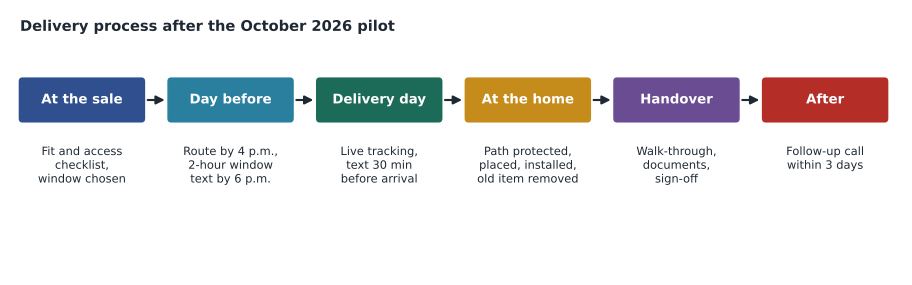
Most delivery problems come from information that was not gathered when the order was written. Since its October 2026 pilot, Juniper & Pine has required a fit and access checklist on every main-floor order, completed with the customer before payment. Its questions cover four areas.
- The path. Every doorway, hallway, stairwell and turn between the truck and the room, with widths and heights, plus elevators, building rules and parking for the truck.
- The space. The room measurements, where the item will stand, door swings for appliances, and clearance for recliners and drawers.
- The connections. For appliances: the type of electrical outlet, water supply and drain, gas supply, and venting. For electronics: wall type and mounting.
- The old item. Whether it needs to be disconnected, removed or hauled away, and whether it is in the way of the new one.
The checklist takes about ten minutes. Carl's advice was to treat it as part of the selling, not a form at the end. Customers who describe their home in detail are imagining the item in it, and the questions often reveal needed add-ons such as a dryer cord or a stacking kit.
Worked problem
What a failed delivery costs
A delivery fails when the crew arrives and cannot complete it: the item does not fit, a connection is missing, or nobody is home. At Juniper & Pine, a delivery stop takes two crew members about 1.5 hours including travel, at a loaded cost of about 34 dollars an hour each, plus about 45 dollars for the truck. What does one stop cost, and what does a failed delivery cost if the item has to be brought back and delivered again?
Show solution
- Cost of one stop:
- \[2 \times 1.5 \times 34 + 45 = 102 + 45 = 147 \text{ dollars}\]
- A failed delivery means a second stop:
- \[147 \times 2 = 294 \text{ dollars}\]
Answer: A failed delivery costs the store about 294 dollars in crew and truck time, before any damage, discount or lost goodwill. A ten-minute checklist at the sale is very cheap insurance.
Worked problem
The effect of the checklist
Juniper & Pine makes about 640 deliveries a month. Before the pilot, about 4 in 100 failed; after it, about 1.5 in 100. Using the 147-dollar cost of an extra stop, how many failures a month were avoided, and what did that save?
Show solution
- Failures before:
- \[640 \times 0.04 = 25.6\]
- Failures after:
- \[640 \times 0.015 = 9.6\]
- Failures avoided:
- \[25.6 - 9.6 = 16\]
- Monthly saving:
- \[16 \times 147 = 2{,}352 \text{ dollars}\]
Answer: About 16 failed deliveries a month were avoided, saving about 2,350 dollars a month in extra stops, or about 28,000 dollars a year, before counting happier customers.
Choosing the window and keeping the promise
Customers dread waiting at home for a delivery that might come at any time. Juniper & Pine's pilot replaced four-hour windows with a two-hour window chosen at the sale, routes confirmed by 4 p.m. the day before, a text with the window by 6 p.m., live tracking, and a text 30 minutes before arrival. The seller's part is to offer only windows the schedule can meet, to note anything that affects timing, such as an elevator that must be booked, and to tell the customer what they need to do: clear the path, move fragile items, and have the old appliance disconnected if the store is not doing it.
When the store cannot meet a promised window, the customer should hear it from the store first. Hamid's crew phoned ahead whenever they were running more than 20 minutes late. "People forgive late," he said. "They don't forgive finding out by waiting."
Installation and its limits
Many big-ticket items need installation, and the rules on who may do what matter for safety and for the warranty.
In South Dakota, gas appliance connections and electrical work beyond plugging an appliance into an existing outlet must be done by appropriately licensed trades under state and local codes, and some work needs a permit from the city. Juniper & Pine's installers level appliances, connect water lines and drains, install cords and vents, and plug in electric appliances; gas connections are booked with a licensed contractor the store works with, and the customer is told this at the sale. Some manufacturers' warranties require professional installation for gas or built-in appliances.
Furniture has its own safety step. Tall dressers and bookcases can tip over onto children, and Juniper & Pine includes an anchoring kit with every tall case piece and offers to install it at delivery.
In the United States, the STURDY Act led to a mandatory federal stability standard for clothing storage units such as dressers, in force since September 2023, and the Consumer Product Safety Commission still recommends anchoring furniture and televisions to the wall.
The handover
The handover is the moment the store passes the finished purchase to the customer. A good handover turns a delivery into a confident owner. Juniper & Pine's crews follow a short routine.
- Place and protect. Put the item exactly where the customer wants it, level it, and remove packaging. Protect floors and door frames on the way in and out.
- Inspect together. Walk around the item with the customer and look for damage before the crew leaves. Note anything on the delivery receipt.
- Demonstrate. Show the controls that matter: the recliner mechanism, the fridge temperature setting and filter, the washer cycles, the oven's first-use burn-off.
- Explain care. Leave the care card for the fabric or finish, and mention the first things to do, such as running the dishwasher empty or letting a mattress air out.
- Hand over the documents. The order, warranty information, the protection plan if bought, and how to register the product with the manufacturer.
- Remove the old item if haul-away was ordered, and confirm where it is going.
- Sign off. The customer signs the delivery receipt, and the crew tells them who to call if anything is wrong.
Sellers rarely attend deliveries, but they set them up. Carl's habit was to write a short note on the order for the crew: "Customer is nervous about the floors, new hardwood" or "Mrs. Thibault wants the dishwasher demo, she's never had one." Hamid said those notes were the most useful part of the order.
When something goes wrong
Even with good preparation, some deliveries go wrong: a damaged panel, a missing part, a fit problem nobody could have predicted. How the store responds decides whether the customer remembers the problem or the fix. Juniper & Pine's approach, built on the service recovery ideas in SLS-130, has four steps: acknowledge the problem and apologize at the door, offer a clear next step with a date, give the customer one person to call, and follow up when it is fixed. Crews can approve small fixes on the spot, such as touching up a scratch, and sellers can approve a goodwill credit within limits.
The customer also has rights. A product that arrives damaged or not as described does not meet the implied warranty of merchantability or any express warranty, and for orders placed by phone or online, the FTC's Mail, Internet or Telephone Order Merchandise Rule requires sellers to ship within the time stated, or 30 days if none was stated, and to offer the option to cancel when they cannot. The store's fix should never be less than what the law already requires.
Delivery in other categories
Vehicle sales have the most formal handover. Nadine's dealership booked a separate delivery appointment for every new vehicle: the car cleaned and fueled, the paperwork checked, the features demonstrated, a phone paired, and the customer's questions answered before they drove away. "If they leave confused about the touchscreen, the first service visit is a complaint," she said. Electronics retailers offer professional installation for wall-mounted televisions and home theater; jewelry stores make sizing and engraving part of the handover, along with appraisal documents.
Planning the day's routes
A delivery window is a promise the schedule has to keep, and the seller can only offer windows that the crews can actually meet. Understanding the arithmetic of a delivery day helps a seller see why some windows fill quickly and why the store limits how many deliveries it books.
Worked problem
How many stops can a crew make?
A two-person crew works a 9-hour shift. A typical stop, including travel, takes about 1.5 hours, and the crew needs about 1 hour for loading in the morning and a break. How many stops can the crew make in a day? If the store makes about 640 deliveries a month over 26 delivery days, how many crews does it need on an average day?
Show solution
- Hours available for stops:
- \[9 - 1 = 8 \text{ hours}\]
- Stops per crew:
- \[\frac{8}{1.5} \approx 5.3, \text{ so 5 stops}\]
- Deliveries per day:
- \[\frac{640}{26} \approx 24.6\]
- Crews needed:
- \[\frac{24.6}{5} \approx 4.9, \text{ so 5 crews}\]
Answer: Each crew can make about 5 stops a day, so the store needs about 5 crews on an average day and more on busy Saturdays and before holidays. A stop that takes twice as long, such as a sectional up three flights of stairs, uses up most of another stop's time, which is why the checklist notes stairs and assembly.
Apartments, condos and tight spaces
Deliveries to apartments and condos add rules the customer may not think to mention. Many buildings require an elevator booking, a certificate of insurance from the delivery company, delivery only during set hours, or protective pads in the elevator. Aiden learned to ask, "Is it a house, a townhouse or a building with an elevator?" on the first visit, and to note any booking times on the order.
- Elevator size. Measure the door and the inside, including the diagonal, for tall items such as refrigerators and headboards.
- Building paperwork. Ask whether the building needs a certificate of insurance and send the request to the delivery office at least three business days ahead.
- Parking. Note where the truck can stop and whether a permit is needed.
- Timing. Match the delivery window to the building's allowed hours.
These questions take a minute at the counter and can save a wasted trip. They also show the customer that the store has thought about their home, not only about the product.
Sellers should also be honest about what happens if the customer is not ready. If the building refuses the truck because the elevator was not booked, the crew cannot wait for hours, and the store will usually charge a redelivery fee. Telling the customer this at the counter, politely and in advance, is far better than surprising them with the fee afterward. Aiden added a line to his order notes for every building delivery, "Elevator booked: yes or no, and time", and checked it during the day-before call.
Common mistakes
MistakeWriting the order without asking about the path and connections.
InsteadComplete the fit and access checklist with the customer before payment.
MistakeOffering delivery windows the schedule cannot meet.
InsteadOffer only windows the route can keep, and note anything that affects timing.
MistakePromising installation work the crew is not licensed to do.
InsteadExplain what the crew installs and arrange licensed trades for gas and electrical work.
MistakeLeaving as soon as the item is in the room.
InsteadInspect, demonstrate, explain care and hand over documents.
MistakeLetting the customer discover a delay by waiting.
InsteadCall ahead when late, and tell the customer about problems before they have to ask.
Summary and key terms
- Most delivery problems are decided at the sale, so a fit and access checklist covering the path, the space, the connections and the old item is completed before payment.
- A failed delivery costs about two crew stops plus goodwill, so a short checklist pays for itself many times over.
- Two-hour windows, confirmed routes and texts make waiting easier, and the store should report delays first.
- Installation must respect licensing rules for gas and electrical work, and tall furniture should be anchored.
- A good handover places, inspects, demonstrates, explains care, hands over documents and signs off.
- When things go wrong, the store acknowledges, fixes with a date and follows up, and never offers less than the law requires.
- Fit and access checklist
- A record of the path, space, connections and old item, completed at the sale.
- Failed delivery
- A delivery the crew cannot complete on the first visit.
- Delivery window
- The period during which the customer is told the delivery will arrive.
- Handover
- Passing the finished, working purchase to the customer with a walk-through and documents.
- Loaded cost
- The hourly cost of a worker including wages, benefits and payroll costs.
- Anchoring kit
- Hardware that fastens tall furniture to the wall to prevent tip-overs.
Practice problems
Work each problem on paper first, then reveal the answer to check.
A delivery stop takes two people 2 hours at 30 dollars an hour each, plus 40 dollars for the truck. What does a failed delivery cost?
Show answer
One stop: 2 × 2 × 30 + 40 = 160 dollars; two stops: 320 dollars.
Name the four areas on Juniper & Pine's fit and access checklist.
Show answer
The path, the space, the connections and the old item.
Why should a crew inspect an item with the customer before leaving?
Show answer
So that any damage is found and recorded together, and the customer leaves confident or with a clear fix.
Lesson quiz · 5 questions
Score 60% or more to complete this lesson.
Create a free account to save your progress, take quizzes and earn a certificate.