
SLS-256 · Lesson 6 of 12 · 23 min
Financing options and disclosure
▶ Video coming soon A video version of this lesson is on the way.
Renée Thibault had a new kitchen, a renovation budget that was already spent, and no appliances. On a Saturday in early November she chose a refrigerator, range and dishwasher at Juniper & Pine for 3,600 dollars before taxes, and then asked the question Aiden had been half expecting: "Do you have one of those no-interest deals?" Juniper & Pine did, through its partner lender, and so did half the stores she had visited. What Renée did not know, and what Aiden had learned that Wednesday at the clinic, was that the plans with almost the same names could work very differently.
Financing is one of the most important and most regulated parts of big-ticket retail. It lets customers buy now and pay over time, and it lets stores sell more and larger items. It can also cost customers far more than they expect if they misunderstand the terms. This lesson explains the main kinds of retail financing, the disclosure rules, and the seller's role, which is narrower than many sellers think.
Who lends, and who sells
At Juniper & Pine, and at most furniture, appliance and electronics retailers, the store does not lend money itself. A partner lender, usually a bank or a specialist consumer finance company, offers credit to the store's customers. The customer applies through the store, the lender decides, and if the customer is approved, the lender pays the store and the customer repays the lender. The store pays the lender a merchant fee for promotional offers, which is how the lender can offer low or no interest.
This arrangement shapes the seller's job. The seller tells customers that financing is available, describes the store's current offers in the lender's own terms, helps the customer start the application, and makes sure the customer receives the lender's disclosure documents. The seller does not decide who is approved, does not promise approval or a rate, and does not explain credit terms beyond what the lender's materials say. Juniper & Pine's rule, which Bev wrote at the top of the financing binder, is: "Tell them it exists, tell them what it is, give them the papers, and let the lender do the lending."
Three common kinds of retail financing
Most retail financing falls into three kinds, and customers often confuse them.
- Equal-payment, no-interest plans. The purchase is divided into equal monthly payments over a set period, often 6 to 24 months, at 0 APR. If the customer makes every payment, they pay exactly the purchase price. The store pays the lender's merchant fee.
- Deferred-interest plans. The customer is told there is "no interest if paid in full" within a set period, such as 12 months. Interest builds up from the purchase date at the account's standard rate, often 25 to 30 APR, but it is not charged if the whole promotional balance is paid by the end. If even a small balance remains, all of the interest that built up over the whole period is charged at once.
- Installment loans. The customer borrows the purchase price and repays it in fixed monthly payments, with interest at a stated APR, over a term such as 24 to 60 months. Vehicle financing is usually an installment loan.
Juniper & Pine's partner lender offered all three in fall 2026: equal payments at 0 APR over 12 months on purchases over 1,000 dollars, a 12-month promotional plan of the second kind with a standard rate of 29.99 APR, and installment loans at rates that depended on the customer's credit. The figures in this lesson are the store's illustrative offers, not any real lender's.
Worked problem
An equal-payment plan
Renée finances 3,600 dollars of appliances on the equal-payment plan at 0 APR over 12 months. What is her monthly payment, and what does she pay in total if she makes every payment on time?
Show solution
- Monthly payment:
- \[\frac{3{,}600}{12} = 300 \text{ dollars}\]
- Total paid:
- \[300 \times 12 = 3{,}600 \text{ dollars}\]
Answer: Renée pays 300 dollars a month and 3,600 dollars in total, the same as the purchase price. The cost of the promotion is paid by the store through the merchant fee. If she misses a payment, the lender's terms may end the promotion and apply interest, which her agreement will explain.
The promotional-plan trap
The second kind of plan is where customers get hurt most often. A customer who makes payments but does not clear the whole balance by the end of the promotion can be charged a year's interest on the full original amount, even though they paid most of it off.
Worked problem
When a small balance costs a lot
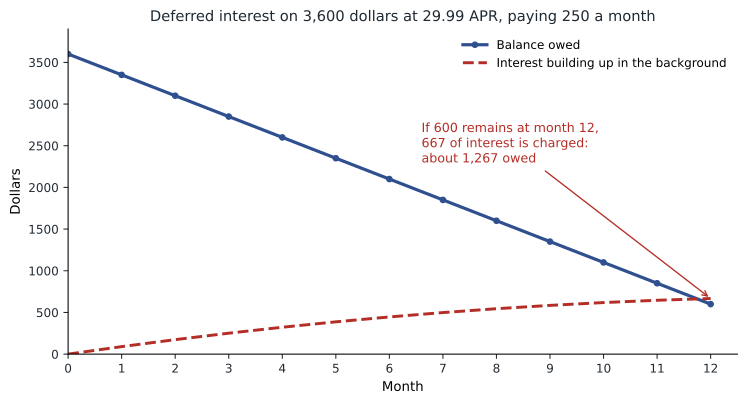
A customer finances 3,600 dollars on a 12-month promotional plan where interest builds up at 29.99 APR and is charged in full if any balance remains. They pay 250 dollars a month instead of 300. Using a simplified monthly calculation, how much interest builds up over the year, and what do they owe after 12 payments?
Show solution
- Monthly rate:
- \[\frac{0.2999}{12} \approx 0.0250\]
- Each month, interest builds up on the balance at the start of the month: 3,600 × 0.025 = 90 dollars in month 1, 3,350 × 0.025 ≈ 83.73 in month 2, and so on down to 850 × 0.025 ≈ 21.24 in month 12.
- Adding the twelve months gives about 667 dollars of interest.
- Balance after 12 payments of 250 dollars:
- \[3{,}600 - 12 \times 250 = 600 \text{ dollars}\]
- If the plan charges all the interest when a balance remains:
- \[600 + 667 = 1{,}267 \text{ dollars}\]
Answer: Paying 50 dollars a month less than the even amount leaves a 600-dollar balance, and the customer is charged about 667 dollars of interest, owing about 1,267 dollars. Paying 300 dollars a month would have cleared the balance and avoided all of it. Lenders calculate interest daily, so real figures differ slightly, but the effect is the same.
Carl's advice to Aiden was to make sure every customer who chose a promotional plan knew three things before leaving: the date the promotion ends, the monthly amount that clears the balance by that date, and what happens if they do not. "Write the monthly number on the receipt," he said. "Three hundred, not two-fifty."
Installment loans and the cost of credit
For larger purchases or customers who want longer terms, an installment loan spreads the cost over two to five years at a stated interest rate. The monthly payment is lower than on a short plan, but the total paid is higher.
Worked problem
Comparing two installment loans
A customer borrows 4,800 dollars for a bedroom set. The lender offers 36 months at 9.99 APR or, for a customer with a weaker credit history, 24 months at 19.99 APR. What are the monthly payments, totals and costs of credit? (The monthly payment on a loan of P at monthly rate r for n months is P × r ÷ (1 − (1 + r) to the power of −n).)
Show solution
- 36 months at 9.99 APR: monthly rate 0.0999 ÷ 12 ≈ 0.008325.
- \[4{,}800 \times \frac{0.008325}{1 - 1.008325^{-36}} \approx 154.86 \text{ dollars a month}\]
- Total paid:
- \[154.86 \times 36 \approx 5{,}574.96 \text{ dollars}\]
- Cost of credit:
- \[5{,}574.96 - 4{,}800 = 774.96 \text{ dollars}\]
- 24 months at 19.99 APR: monthly rate 0.1999 ÷ 12 ≈ 0.016658.
- \[4{,}800 \times \frac{0.016658}{1 - 1.016658^{-24}} \approx 244.28 \text{ dollars a month}\]
- Total paid and cost of credit:
- \[244.28 \times 24 \approx 5{,}862.63;\quad 5{,}862.63 - 4{,}800 = 1{,}062.63\]
Answer: The first loan costs about 155 dollars a month and 775 dollars of interest; the second about 244 dollars a month and 1,063 dollars of interest. The disclosure statement shows these figures, and the seller should make sure the customer sees them.
What the law requires
In the United States, the Truth in Lending Act and its Regulation Z require lenders to disclose the cost of credit in a standard form. For an installment loan, the disclosure shows the annual percentage rate, the finance charge, the amount financed and the total of payments. For a credit card account, it shows the rates, fees and how interest is calculated. Regulation Z also has a specific rule for deferred-interest advertising: an ad that says "no interest" or "same as cash" must say "if paid in full" and give the promotional period clearly and in immediate proximity, and must state prominently that interest will be charged from the date of purchase if the balance is not paid in full within the period. Footnotes do not satisfy the rule.
Two other federal rules matter at the counter. The FTC Holder Rule requires consumer credit contracts arranged through a seller to include a notice that anyone who holds the contract is subject to the claims and defenses the buyer has against the seller. If a financed sofa is never delivered, the customer can raise that against the lender. The Equal Credit Opportunity Act and Regulation B prohibit discrimination in credit on grounds including race, color, religion, national origin, sex, marital status, age and receipt of public assistance, and require lenders to give reasons when they deny credit.
Interest-rate limits differ by state and lender. South Dakota does not cap the rates banks can charge, which is why many credit card banks are based there, but since a 2016 ballot measure, non-bank lenders licensed as money lenders under state law are limited to 36 APR including fees. A seller must offer financing to every customer on the same basis and must never guess, from someone's appearance or accent, whether they will qualify.
The seller's part, step by step
| Do | Do not |
|---|---|
| Mention that financing is available to every customer, in the same words | Decide who looks like they need or will qualify for financing |
| Describe the current offers using the lender's materials | Explain rates, fees or terms beyond the lender's materials |
| Show how much a month clears a promotional balance by the end date | Let the customer leave thinking a promotional plan has no conditions |
| Help the customer start the application and leave the answers to them | Fill in income or employment for the customer, or round numbers up |
| Give the customer every disclosure document and point to the key figures | Promise approval, a rate or a credit limit |
| Respect a customer who prefers to pay another way | Use financing to push a larger purchase than the customer planned |
Renée chose the equal-payment plan. Aiden wrote "300 dollars a month, 12 payments, last payment by November 2027" on her receipt, showed her the line in the lender's disclosure that confirmed the 0 APR and what would happen after a missed payment, and handed her the papers. "I've heard horror stories about these," she said. "Now I know which kind I've got."
Financing in other categories
Vehicle financing is the largest and most regulated retail credit. Dealers usually arrange loans with banks or the manufacturer's finance company, and the same disclosure rules apply. Nadine's dealership showed every customer the amount financed, the rate, the term and the total of payments before any add-on products were discussed. Electronics and jewelry stores often offer store-branded credit cards with promotional plans, where the same cautions apply as at Juniper & Pine.
Questions customers ask about financing
Customers often ask the seller questions that only the lender can answer for certain. Carl's rule was to answer what the seller knows, point to the document for the rest, and never guess.
| Customer asks | A good answer |
|---|---|
| "Will this affect my credit?" | "Applying involves a credit check, and the account will appear on your credit report. The lender's form explains how." |
| "Can I pay it off early?" | "Yes, there is no penalty on this plan. On the promotional plan, paying it off before the end date is how you avoid the interest." |
| "What happens if I miss a payment?" | "The disclosure explains the late fee and whether the promotion ends. Let's read that line together." |
| "Am I approved?" | "The lender decides, not the store. I can tell you as soon as they reply." |
| "Is 0 APR really free?" | "On this equal-payment plan, yes, if every payment is made on time. The store pays the lender a fee, which is part of our costs." |
Answers like these keep the seller inside what the store can promise. They also help the customer: someone who knows to read the late-payment line before signing is far less likely to be surprised later.
Common mistakes
MistakeCalling every promotional plan "no interest".
InsteadUse the lender's terms and explain what happens if the balance is not paid by the end.
MistakeLetting customers pay the minimum on a promotional plan.
InsteadShow the monthly amount that clears the balance by the end date and write it down.
MistakeExplaining rates and fees from memory.
InsteadDescribe offers from the lender's materials and point to the disclosure.
MistakeOffering financing to some customers and not others.
InsteadMention it to everyone in the same words, and let the lender decide.
MistakeHelping a customer fill in their income on the application.
InsteadLeave every answer to the customer; misstating income is fraud.
Summary and key terms
- Retail financing is usually provided by a partner lender, and the store pays a merchant fee for promotional offers.
- The three common kinds are equal-payment plans at 0 APR, promotional plans that defer payments or interest, and installment loans.
- On promotional plans, interest can build up in the background and be charged in full if any balance remains at the end, so customers must know the end date and the monthly amount that clears the balance.
- Installment loans cost more in total over longer terms; the disclosure shows the APR and total cost.
- Disclosure laws and interest limits differ between Canada and the US.
- The seller mentions financing to everyone, describes it from the lender's materials, hands over every disclosure and leaves lending decisions to the lender.
- Partner lender
- A bank or finance company that provides credit to a store's customers.
- Merchant fee
- The amount a store pays a lender to offer promotional financing.
- Annual percentage rate (APR)
- The yearly cost of credit expressed as a rate, including certain fees.
- Cost of credit
- The total paid minus the amount borrowed.
- Deferred-interest plan
- A promotion where interest builds up from the purchase date and is charged in full if the balance is not paid within the promotional period.
- Installment loan
- A loan repaid in fixed regular payments over a set term.
Practice problems
Work each problem on paper first, then reveal the answer to check.
A customer finances 2,400 dollars at 0 APR over 12 equal payments. What is the payment?
Show answer
2,400 ÷ 12 = 200 dollars a month.
What three things should a customer on a promotional plan know before leaving the store?
Show answer
The end date, the monthly amount that clears the balance by then, and what happens if it is not cleared.
A 36-month loan has payments of 150 dollars on 4,500 borrowed. What is the cost of credit?
Show answer
150 × 36 = 5,400; 5,400 − 4,500 = 900 dollars.
Lesson quiz · 5 questions
Score 60% or more to complete this lesson.
Create a free account to save your progress, take quizzes and earn a certificate.