
VIS-130 · Lesson 12 of 12 · 34 min
Capstone: a visual lineage essay
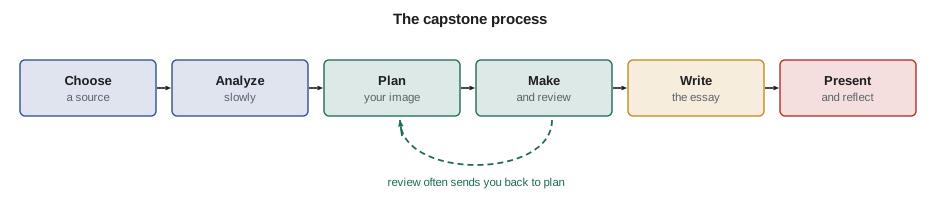
This final lesson brings the course together in a practical project. You will make an image, a photograph, a short film sequence or a still frame from a moving image, in conscious dialogue with a historical artwork, and write a visual lineage essay of about 1,200 to 1,500 words that analyzes the earlier work, explains what you borrowed, adapted or rejected, and reflects on what the comparison reveals. The project draws on every skill from the course: slow looking, formal vocabulary, context, lineage, color and light analysis, perspective, composition, and the legal and ethical awareness needed to borrow responsibly. This lesson walks through choosing a source, analyzing it, planning and making your image, writing the essay, citing sources and presenting the work.
What a visual lineage essay is
A visual lineage essay is a short piece of analytical writing that connects two or more images across time. It is not a list of similarities, and it is not a claim that one image copied another. Instead, it asks how a convention, technique or idea travels from one context to another and what changes along the way. In this capstone, one of the images is yours, which makes the essay part analysis and part artist's statement.
A strong lineage essay has five parts.
- A source analysis: a close formal and contextual reading of the historical work.
- A statement of intent: what you wanted your image to do and why you chose this source.
- A comparison: how specific elements, composition, light, color, perspective, subject, gesture, scale, were borrowed, adapted or rejected.
- A reflection: what the comparison reveals about the original, about your image and about how meanings change across media and time.
- Documentation: images or descriptions, production notes and full citations.
Choosing a source
Choose a historical artwork that genuinely interests you and that connects to an image you can realistically make. The source can come from any lesson in this course: a medieval panel, a Renaissance fresco, a Baroque painting, a Romantic landscape, an Impressionist street scene, an early photograph, a modernist poster, a Surrealist image or a contemporary work. Public-domain works are easiest to reproduce in your documentation; for modern and contemporary works, describe the image and link to a museum or authorized source rather than reproducing it.
| Criterion | Why it matters | Example question |
|---|---|---|
| Personal interest | you will look at it for many hours | Does it hold your attention on a second look? |
| Clear formal features | gives you specific elements to analyze and borrow | Can you name its composition, light and color precisely? |
| Feasibility | you need to make a related image | Do you have access to a similar subject, location or light? |
| Available information | context supports interpretation | Can you find reliable information in museum or scholarly sources? |
| Ethical fit | avoids appropriation harms | Does it involve sacred or community-owned imagery that requires permission? |
Avoid sources that would require you to copy a protected image closely, or to use Indigenous designs, regalia or sacred imagery without permission and collaboration. If you are drawn to a work by a living artist, your image should respond to its ideas or conventions rather than reproduce it.
Analyzing the source
Begin with at least thirty minutes of slow looking, ideally in front of the original in a gallery, otherwise with the best available reproduction. Use the routine from Lesson 1: describe, track the eye, ask how it was made, then interpret. Take notes under the headings of the formal elements and the relevant lessons.
| Area | Questions | Course lessons |
|---|---|---|
| Composition | Where is the main subject? What structure organizes the frame: thirds, pyramid, diagonal, symmetry, grid? | 2, 3, 8 |
| Space and perspective | Is there a vanishing point? Where is the horizon? Is space deep or flat? | 3, 8 |
| Light | What is the source, direction, quality and contrast? Can you estimate it in stops? | 4, 6 |
| Color | What is the palette and harmony? Where are accents? | 6, 10 |
| Subject and symbol | What is shown? Are there conventional symbols or attributes? | 1, 2 |
| Context | Who made it, when, for whom, and where was it seen? | all |
| Lineage | What earlier images does it draw on, and what later images borrow from it? | 1, 12 |
Worked problem
Analyzing a source for a capstone
A student chooses a Dutch Golden Age interior in which a woman reads a letter beside a window on the left, light falling across a table with a rug, a map on the back wall and a deep blue jacket. Produce a short analysis plan.
Show solution
- Composition: identify the figure's position, perhaps slightly off-center, the table and chair forming foreground barriers, and the map as a rectangle in the background.
- Light: soft, directional window light from the left, gentle falloff into a cooler shadow; estimate perhaps two to three stops between the lit face and the shadowed wall.
- Color: a restrained palette of ochres and grays with a saturated blue accent on the jacket drawing the eye.
- Subject and context: a private moment of reading in a prosperous Dutch home; the map may suggest distance, trade or an absent correspondent.
- Lineage: connect to Dutch window light as the model for studio photography, and to the long debate about optical aids discussed in Lesson 4.
Answer: The plan covers the off-center figure framed by foreground furniture, soft left-side window light with a modest two-to-three-stop range, an ochre palette with a single blue accent, the private, possibly distant correspondence suggested by the map, and the painting's place in the lineage of window light that photographers still use.
Planning your image
Your image should respond to the source, not replicate it. Decide what you will borrow, what you will adapt and what you will reject, and why. A useful framework is to choose one element to keep closely, one to transform and one to overturn.
Worked problem
Keep, transform, overturn
Continuing the previous example, plan a contemporary photograph responding to the Dutch interior.
Show solution
- Keep: soft side light from a single window on the left, with a modest contrast range.
- Transform: replace the letter with a phone screen, so the private act of reading becomes scrolling messages, and replace the map with a framed transit map or a screen showing a video call.
- Overturn: instead of a quiet, contained moment, include a hint of distraction or intrusion, such as notifications lighting the face in a cooler color, contrasting with warm daylight.
- Plan the light: aim for about 75 foot-candles on the lit side of the face from the window and about 19 on the shadowed wall, a 4:1 ratio or two stops; check with a light meter or false color.
Answer: The photograph keeps the soft left-window light, transforms the letter into a phone and the map into a transit map or video call, and overturns the original's calm by adding the cool glow of notifications, asking how private reading and distance have changed with digital communication.
Practical planning includes location scouting at the right time of day, permissions to photograph people and places, model releases if you will publish or exhibit the image, props, wardrobe and a shot list. Make test images, compare them side by side with the source, and adjust. If you are making a moving image, sketch a short storyboard and think about camera movement and sound as well as framing.
Making and reviewing the image
Shoot more than you think you need and review your images carefully against your plan and the source. Use the same analytical vocabulary on your own work. Is the composition doing what you intended? Is the light direction and quality right? Does the color accent draw the eye? Is the reference clear enough to be meaningful, without being a copy?
| Question | Look for |
|---|---|
| Does the image work on its own? | a viewer who does not know the source should still find it coherent and engaging |
| Is the dialogue with the source visible? | at least one clear, deliberate connection |
| Is it a response, not a copy? | meaningful transformation of subject, context or meaning |
| Are the formal choices controlled? | intentional light, color, composition and perspective |
| Are ethical and legal issues resolved? | consent, releases, no close copying of protected work, respect for cultural protocols |
Writing the essay
Structure your essay with an introduction, body paragraphs and a conclusion. The introduction names both works, gives the essential context and states a thesis: a clear claim about the relationship between them. A weak thesis says only that your photograph was inspired by the painting. A strong thesis makes an argument, for example that by translating the painting's window light and private act of reading into a contemporary scene of phone scrolling, your photograph reveals how the original's sense of absent connection persists, but is now fragmented by constant interruption.
Body paragraphs should each focus on one aspect: composition, light, color, subject or context. In each, describe the source precisely, describe your image precisely, and explain the significance of the similarity or difference. Use the formal vocabulary from the course and specific evidence. Conclude by reflecting on what the comparison reveals and what you learned as an image maker.
Worked problem
Writing a comparison paragraph
Write a model body paragraph comparing the light in the Dutch interior and the student's photograph.
Show solution
- Describe the source's light: soft daylight from a window at the left, falling across the woman's face and the table, with gentle falloff into cool shadow.
- Describe the photograph's light: matching soft window light from the left, about two stops of contrast, plus a cooler glow from the phone on the underside of the face.
- Explain the significance: the shared window light signals the reference and the quiet mood, while the second, cooler source introduces technology and divided attention.
- Connect to lineage: note that Dutch window light became the model for photographic portrait light.
Answer: In the painting, a soft daylight from the left falls across the woman's face and the letter, fading gently into the cooler shadows of the back wall; the single, even source makes reading a moment of absorption. My photograph keeps this window light, with about two stops between the lit face and the wall, a ratio photographers inherited from such interiors, but adds a second, cooler light from the phone screen beneath the face. The two sources divide the subject's attention, turning the painting's absorbed calm into a scene of competing claims, daylight and the screen, on her focus.
Citing sources and credits
Cite every artwork, book, article and website you use. Give the artist's name, title, date, medium, dimensions where available and current collection, and link to the museum page or authorized source. Use a consistent citation style recommended by your instructor, such as Chicago or MLA. Credit collaborators on your image: models, assistants, location owners and anyone who lent props or equipment.
In the United States, keep model releases and location permissions on file, particularly if the image may be used commercially, since state right-of-publicity laws restrict commercial use of a person's likeness. Remember that works published in 1930 or earlier are now in the public domain, while most later works remain protected.
Presenting the work
Present your image and essay together, in print, on a website or as a short slide presentation. Consider how the viewing conditions affect the work, as you have seen throughout the course: scale, screen versus print, lighting and sequence. If you present to a group, prepare a two-minute summary: the source, your thesis, two key comparisons and one insight. Invite questions, and listen to how others read your image; their interpretations may reveal connections you did not intend.
Assessment rubric
| Criterion | Weight | Excellent work |
|---|---|---|
| Source analysis | 25 percent | precise formal and contextual reading using course vocabulary |
| Image quality and intent | 25 percent | controlled, coherent image with a clear, transformative dialogue with the source |
| Comparison and argument | 25 percent | clear thesis supported by specific evidence from both images |
| Reflection | 15 percent | thoughtful insight into lineage, meaning and your own practice |
| Citation, ethics and presentation | 10 percent | complete citations, credits, permissions and clear presentation |
Worked problem
Calculating a weighted score
A project scores 85 on source analysis, 78 on image quality, 90 on comparison, 70 on reflection and 100 on citation, ethics and presentation, each out of 100. Using the rubric weights, what is the final score?
Show solution
- Multiply each score by its weight: \(85 \times 0.25 = 21.25\); \(78 \times 0.25 = 19.5\); \(90 \times 0.25 = 22.5\).
- Continue: \(70 \times 0.15 = 10.5\) and \(100 \times 0.10 = 10\).
- Add the results: \(21.25 + 19.5 + 22.5 + 10.5 + 10 = 83.75\).
- Round as your instructor specifies, usually to the nearest whole number.
Answer: The weighted final score is 83.75, or about 84 percent.
Looking ahead
This course has traced a long conversation, from Egyptian registers and Greek contrapposto to Renaissance perspective, Baroque light, Romantic landscape, Impressionist color, photography's invention, modernist design, Surrealist dreams, Pop seriality, Indigenous continuity and AI debates. Your capstone adds your own voice to that conversation. Keep a visual notebook of works that move you, visit galleries whenever you can, and keep asking the question that runs through every lesson: what can I learn from how earlier image makers solved the problems I face today? VIS-210 History and Theory of Photography continues this inquiry with a closer look at photography itself, and FILM-101 and the cinematography courses apply it to the moving image.
Common mistakes
MistakeWriting a thesis that only says your image was inspired by the source
InsteadState a clear argument about how the borrowing transforms meaning and what the comparison reveals
MistakeCopying a protected artwork closely and calling it a response
InsteadRespond to ideas and conventions, transform the image meaningfully, and use public-domain or licensed material for documentation
MistakeDescribing both images in general terms
InsteadUse precise formal vocabulary and specific evidence from each image
MistakeSkipping consent, releases and cultural protocols
InsteadObtain permissions and model releases and follow protocols for any community-owned imagery
MistakeTreating the essay as separate from the image-making
InsteadUse the analysis to plan the image and the review of the image to refine the essay
Summary and key terms
- A visual lineage essay connects a historical work to your own image through analysis, comparison and reflection.
- Choose a source that interests you, has clear formal features, is feasible to respond to and raises no unresolved ethical issues.
- Analyze the source slowly using composition, space, light, color, subject, context and lineage.
- Plan your image by deciding what to keep, transform and overturn, and test it against the source.
- Write a clear thesis and body paragraphs that compare specific elements with precise vocabulary.
- Cite artworks fully, credit collaborators and keep releases and permissions on file.
- The rubric weights source analysis, image, argument, reflection, and citation and ethics.
- Visual lineage essay
- An analytical essay connecting a historical artwork to a later image through comparison and reflection
- Thesis
- A clear, arguable claim that organizes an essay
- Source analysis
- A close formal and contextual reading of the work you respond to
- Keep, transform, overturn
- A planning framework for deciding how to respond to a source image
- Model release
- A signed permission from a person allowing use of their likeness
- Citation
- A formal reference giving full details of a source
- Artist's statement
- A short text explaining an artist's intentions and process
- Rubric
- A scoring guide listing criteria and their weights
- Lighting ratio
- The ratio between light on the lit and shadow sides of a subject
- Viewing conditions
- The scale, medium, lighting and setting in which an image is seen
Practice problems
Work each problem on paper first, then reveal the answer to check.
Name the five parts of a strong visual lineage essay.
Show answer
Source analysis, statement of intent, comparison, reflection and documentation.
Give two criteria for choosing a capstone source.
Show answer
Personal interest and clear formal features; also feasibility, available information and ethical fit.
Why should you avoid reproducing a contemporary artwork closely?
Show answer
It is likely protected by copyright, and a response should transform ideas rather than copy.
Explain the keep, transform, overturn framework.
Show answer
Keep one element closely, change one meaningfully and reverse one to create a new meaning.
What lighting ratio corresponds to two stops?
Show answer
4:1.
What makes a strong thesis for this essay?
Show answer
A clear argument about how the borrowing transforms meaning, not just a statement of inspiration.
What should each body paragraph do?
Show answer
Focus on one aspect, describe both images precisely and explain the significance of similarities and differences.
What details should an artwork citation include?
Show answer
Artist, title, date, medium, dimensions where available and current collection, with a link to an authorized source.
Calculate a weighted score with 80, 80, 80, 80 and 80 on the rubric.
Show answer
80, since all criteria have the same score.
Why present work with attention to viewing conditions?
Show answer
Scale, medium and setting change how viewers experience and interpret images.
Lesson quiz · 5 questions
Score 60% or more to complete this lesson.
Create a free account to save your progress, take quizzes and earn a certificate.