
VIS-130 · Lesson 7 of 12 · 27 min
Photography's invention and its dialogue with painting
When photography was announced to the world in 1839, the French painter Paul Delaroche is said to have declared that painting was dead. The story may be legend, but it captures the anxiety and excitement the new medium created. For the next century, photography and painting argued, borrowed and competed. Photographers imitated paintings to win acceptance as artists; painters used photographs and redefined their own purpose; and eventually photographers insisted that their medium had its own beauty, best seen in sharp, unmanipulated images. This lesson surveys the invention of photography, its early uses, the pictorialist movement, the turn to straight photography and the debates about whether photography is art. VIS-210 History and Theory of Photography covers this story in much greater depth; here the focus is on the conversation between photography and the older visual arts.
Before 1839: the dream of fixing the image
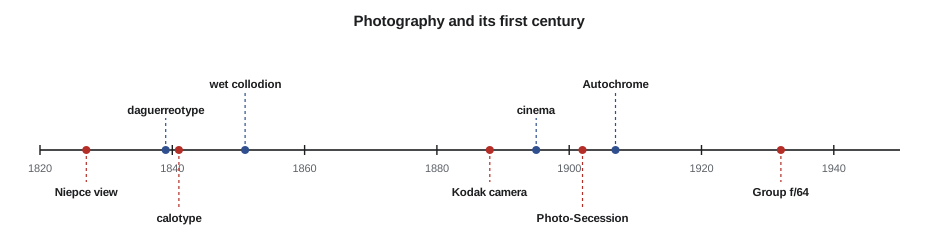
The camera obscura had been known for centuries, used by artists as a drawing aid and by scientists to observe eclipses. What was missing was a way to fix the projected image permanently. In the 1820s, the French inventor Nicéphore Niépce produced images using bitumen that hardened in light; a view from his window at Le Gras, made around 1826 to 1827 with an exposure of many hours, or possibly days, is usually described as the oldest surviving photograph made with a camera.
Niépce partnered with Louis Daguerre, a showman known for his Diorama, a theatrical display of large translucent paintings transformed by changing light. After Niépce's death, Daguerre developed a process that produced detailed images on silvered copper plates. The French government bought the rights and announced the daguerreotype to the public in August 1839, presenting it as a gift to the world, although Daguerre patented it in England.
Two processes: daguerreotype and calotype
In Britain, William Henry Fox Talbot had independently developed a paper-based process. His calotype, patented in 1841, produced a paper negative from which many positive prints could be made. The two processes had opposite strengths.
| Feature | Daguerreotype (1839) | Calotype (1841) |
|---|---|---|
| Support | silvered copper plate | paper negative, paper prints |
| Copies | unique image, no negative | unlimited prints from one negative |
| Detail | extremely sharp | softer, paper fibers visible |
| Appearance | mirror-like, must be tilted to view | matte, warm tones |
| Typical use | portraits in studios | landscapes, architecture, artistic studies |
| Legacy | precision and detail | the negative-positive principle behind film photography |
Talbot published The Pencil of Nature in installments between 1844 and 1846, the first commercially published book illustrated with photographs. Its title expressed a central idea: photography as nature drawing itself, without the artist's hand. That idea of the automatic, objective image would shape debates about photography's status for a century.
Photography's early tasks and painting's response
Within years, photography took over tasks that painters and printmakers had performed. Portrait studios offered affordable likenesses to middle-class customers, putting many miniature painters out of work. Photographers documented architecture, monuments, wars and expeditions. The wet collodion process, introduced in 1851, produced sharp negatives on glass with shorter exposures, and the cheap carte de visite, a small portrait mounted on card, became a craze in the 1860s.
Painters responded in several ways. Some used photographs as references for poses, drapery and landscapes, often secretly. Others stressed what photography could not do in its early decades: color, large scale, imaginative and historical subjects, and the personal mark of the hand. The Impressionists, as Lesson 6 showed, explored fleeting color and light, while borrowing photography's cropped framing.
Photographers imitating painting
Many early photographers wanted their work accepted as art, which in the nineteenth century meant resembling painting. In 1857, Oscar Rejlander made The Two Ways of Life, a large allegorical photograph combining more than thirty negatives into one image, modeled on Renaissance compositions. Henry Peach Robinson's Fading Away of 1858, a composite of several negatives showing a dying young woman surrounded by her family, was praised and criticized; some viewers found it too real for such a subject.
Julia Margaret Cameron, who began photographing in the 1860s on the Isle of Wight, made portraits and allegorical scenes with soft focus, close framing and dramatic light, often inspired by Renaissance religious painting and literature. She deliberately embraced slight blur and imperfections, which professional photographers criticized as technical faults, because she valued expression over precision. Her close-up portraits of famous Victorians are now among the most admired photographs of the century.
Worked problem
Recognizing painting conventions in an early photograph
A described 1860s photograph shows a young woman's head and shoulders, softly focused, lit from one side against a dark background, with her eyes cast down and a white veil framing her face. Identify the painting traditions it borrows from.
Show solution
- Note the lighting: strong side light against darkness recalls Baroque chiaroscuro.
- Note the framing and pose: downcast eyes and a veil recall Renaissance images of the Virgin Mary and saints.
- Note the soft focus: deliberately soft rendering echoes painterly softness, like sfumato, rather than photographic sharpness.
- Consider intention: the photographer is claiming artistic status by associating the image with revered painting traditions.
Answer: The photograph borrows Baroque side lighting against darkness, the downcast eyes and veil of Renaissance devotional images, and a soft, painterly focus. Together these conventions present the photograph as an artwork in the tradition of religious painting, much as Julia Margaret Cameron's portraits did.
Pictorialism
From the 1880s to about the First World War, an international movement called pictorialism promoted photography as a fine art through painterly effects. Pictorialists used soft-focus lenses, textured papers and hand-worked printing processes such as gum bichromate and platinum, which allowed them to manipulate tones, add brush marks and produce unique prints. They favored atmospheric subjects: misty landscapes, twilight streets, allegorical figures and tender portraits.
Camera clubs and exhibitions spread pictorialism across Europe and North America. In New York, Alfred Stieglitz founded the Photo-Secession in 1902 and published the lavish journal Camera Work from 1903 to 1917, presenting photographs alongside modern painting. His gallery at 291 Fifth Avenue, known simply as 291, exhibited photographers and avant-garde painters, including some of the first American shows of artists such as Henri Matisse and Pablo Picasso.
| Aspect | Pictorialism | Straight photography |
|---|---|---|
| Focus | soft, diffused | sharp throughout |
| Printing | manipulated, hand-worked processes | clean, unmanipulated prints |
| Model | painting and printmaking | photography's own qualities |
| Subjects | atmosphere, allegory, mood | form, texture, modern life, everyday objects |
| Key figures | early Stieglitz, Gertrude Käsebier, Edward Steichen | Paul Strand, Edward Weston, Ansel Adams, Imogen Cunningham |
Straight photography: the medium's own beauty
Around the First World War, a new generation, encouraged by Stieglitz himself, rejected painterly manipulation. Paul Strand's photographs of New York streets and abstract studies of bowls and fences, published in the final issues of Camera Work in 1916 and 1917, showed sharp, direct images that celebrated form, geometry and the texture of real things. Stieglitz championed this straight photography and himself turned to sharp images of clouds and city scenes.
In California in 1932, a group of photographers including Ansel Adams, Edward Weston and Imogen Cunningham formed Group f/64, named after a very small aperture that gives great depth of field. Their manifesto called for pure photography with sharp focus, full tonal range and no imitation of other media. Weston's close-up photographs of peppers, shells and nudes turned everyday forms into sculptural images. Adams later developed the zone system with Fred Archer, a method for controlling exposure and development to place tones precisely, which links directly to the measurement of light in stops covered in VIS-110.
Worked problem
Why f/64?
Group f/64 took its name from a very small aperture. With a large-format camera, why would f/64 suit their aims, and what is the trade-off in exposure compared with f/8?
Show solution
- A small aperture greatly increases depth of field, so near and far objects can both be sharp, matching the group's ideal of detailed, sharp images.
- Each full f-stop halves the light: f/8 to f/11, f/16, f/22, f/32, f/45 and f/64 is six stops.
- Six stops means \(2^6 = 64\) times less light reaches the film.
- Exposure time must therefore be 64 times longer at the same film speed, which suits still subjects and a tripod-mounted camera.
Answer: f/64 gives very deep focus, so whole landscapes or close-up objects can be sharp, the group's ideal. It lets in six stops, or 64 times, less light than f/8, so exposures must be 64 times longer, practical only for still subjects with the camera on a tripod.
Is photography art? The debate
The question of photography's artistic status ran through the nineteenth and twentieth centuries. In 1859, the poet and critic Charles Baudelaire attacked photography as the refuge of failed painters and argued it should remain a humble servant of science and the arts. Others saw photography as a mechanical process without creativity. Defenders pointed to the photographer's choices: subject, viewpoint, timing, light, lens and printing.
Legal decisions reflected the debate. In 1884, the US Supreme Court in Burrow-Giles Lithographic Co. v. Sarony held that a posed studio portrait of the writer Oscar Wilde was an original work entitled to copyright, because the photographer had made creative decisions about pose, costume, lighting and arrangement. Museums gradually began collecting photographs; the Museum of Modern Art in New York established a department of photography in 1940.
In the United States, after Burrow-Giles v. Sarony, photographs were firmly protected by copyright, and museums such as MoMA (from 1940) and later the George Eastman Museum in Rochester, founded in 1947, built major photography collections.
Photography and painting after the debate
By the twentieth century, the relationship had become a two-way exchange. Painters such as Edgar Degas, Thomas Eakins in Philadelphia and later Photorealists in the 1960s and 1970s used photographs as sources. Eadweard Muybridge's sequential photographs of a galloping horse, made in California in 1878, showed that all four hooves leave the ground at once, overturning centuries of painted horses with legs extended. His motion studies influenced painters and fed directly into the invention of cinema.
Photographers, meanwhile, influenced modern painting's interest in fragments, unusual angles and the everyday. Lesson 8 shows how modernist photographers in Europe, at the Bauhaus and in Soviet Russia, made photography central to avant-garde visual culture.
What image makers take from this history
The dialogue between photography and painting offers lessons that apply to every new medium, including AI imagery today. New tools often first imitate older art forms to gain acceptance, then discover their own strengths. The debate between manipulation and directness, pictorialism versus straight photography, recurs in arguments about retouching, filters, compositing and computational photography. Copyright law recognizes the creative choices behind images. And knowing that soft focus, sharp detail, chiaroscuro and allegory are all choices with histories lets you use them deliberately.
Common mistakes
MistakeStating that the daguerreotype produced negatives for multiple prints
InsteadRemember daguerreotypes were unique images; Talbot's calotype introduced the paper negative
MistakeAssuming all early photographers aimed for sharp, objective records
InsteadRecognize that pictorialists deliberately used soft focus and manipulation to claim artistic status
MistakeTreating straight photography as unedited snapshots
InsteadUnderstand it as a deliberate aesthetic of sharp focus, full tonal range and precise control
MistakeBelieving photography made painting obsolete
InsteadSee how painting redefined itself and how the two media exchanged ideas
MistakeAssuming copyright protects only paintings, not photographs
InsteadNote that courts recognized photographers' creative choices, as in Burrow-Giles v. Sarony in 1884
Summary and key terms
- Niépce made the oldest surviving camera photograph around 1826 to 1827, and the daguerreotype was announced in 1839.
- The daguerreotype produced unique, sharp images; Talbot's calotype introduced the paper negative and multiple prints.
- Photography took over portraiture and documentation, pushing painters to explore color, imagination and personal vision.
- Early art photographers such as Rejlander, Robinson and Cameron imitated painting conventions to claim artistic status.
- Pictorialism used soft focus and manipulated prints; Stieglitz's Photo-Secession and Camera Work promoted photography as art.
- Straight photography and Group f/64 celebrated sharp focus, full tonal range and the medium's own qualities.
- Legal and museum recognition, from Burrow-Giles v. Sarony to photography departments, confirmed photography's artistic status.
- Daguerreotype
- An early photographic process producing a unique, detailed image on a silvered copper plate
- Calotype
- Talbot's paper-negative process allowing multiple prints
- Wet collodion
- An 1851 process using glass plates coated and exposed while wet, giving sharp negatives
- Carte de visite
- A small, inexpensive photographic portrait on card, popular in the 1860s
- Composite photograph
- An image combined from several negatives
- Pictorialism
- A movement treating photography as fine art through soft focus and manipulated prints
- Photo-Secession
- A group founded by Alfred Stieglitz in 1902 to promote photography as art
- Straight photography
- Photography emphasizing sharp focus and unmanipulated images
- Group f/64
- A 1932 California group advocating pure, sharp, detailed photography
- Zone system
- A method developed by Ansel Adams and Fred Archer for precise control of tones through exposure and development
Practice problems
Work each problem on paper first, then reveal the answer to check.
What is usually considered the oldest surviving camera photograph?
Show answer
Niépce's view from the window at Le Gras, made around 1826 to 1827.
Name one advantage of the daguerreotype and one of the calotype.
Show answer
Daguerreotype: great sharpness; calotype: unlimited prints from one negative.
What was The Pencil of Nature?
Show answer
Talbot's book of photographs published 1844 to 1846, the first commercially published photographically illustrated book.
Why did Julia Margaret Cameron accept slight blur?
Show answer
She valued expression and feeling over technical precision.
Name two pictorialist printing processes.
Show answer
Gum bichromate and platinum printing.
What was 291?
Show answer
Alfred Stieglitz's New York gallery exhibiting photography and avant-garde art.
How many stops separate f/8 and f/64?
Show answer
Six stops, a factor of 64 in light.
What did Burrow-Giles v. Sarony decide?
Show answer
That a posed portrait photograph was an original work entitled to copyright protection.
What did Muybridge's horse photographs reveal?
Show answer
That all four hooves leave the ground at once during a gallop.
Name one modern debate that echoes pictorialism versus straight photography.
Show answer
Debates about retouching, filters, compositing or AI image generation.
Lesson quiz · 5 questions
Score 60% or more to complete this lesson.
Create a free account to save your progress, take quizzes and earn a certificate.