
VIS-210 · Lesson 1 of 12 · 29 min
Why history and theory matter to photographers
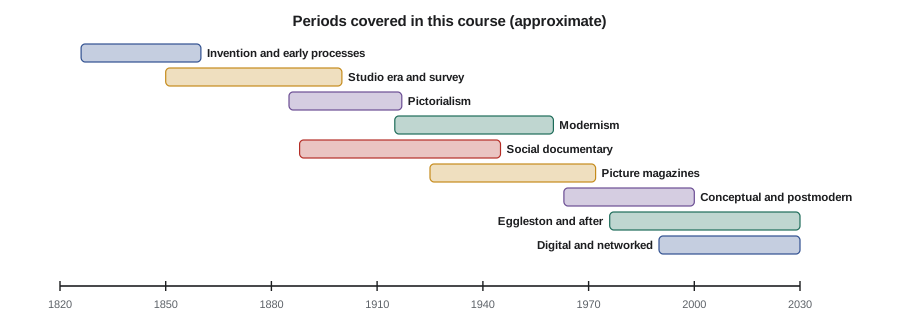
Every photograph you make enters a conversation that began in 1839. When you choose to shoot a portrait in sharp focus with a plain background, to photograph a street scene from the hip, to stage an elaborate tableau with lights and actors, or to post a quick phone picture without editing, you are taking a position in arguments that photographers, critics and audiences have been having for nearly two centuries. History and theory are the tools that let you hear that conversation and join it deliberately rather than by accident. This course traces photography from its invention to the networked, computational and AI-assisted images of today, and introduces the main ideas critics have used to explain what photographs are and what they do. VIS-130 Art History for Image Makers introduced photography's dialogue with painting; here we look at photography on its own terms, in much greater depth.
Three reasons history matters
The first reason is practical. Most of the visual choices available to you were invented, tested and argued over by earlier photographers. Soft focus, the decisive moment, the snapshot aesthetic, the deadpan typology, the staged tableau and the color street photograph each have a history, a set of masters and a set of criticisms. Knowing that history helps you choose a style for a reason, avoid clichés you did not know were clichés, and recognize when you are borrowing so that you can borrow well.
The second reason is professional. Clients, editors, curators, grant juries and teachers speak the language of photographic history. A curator who describes your work as "post-documentary", an editor who asks for something "more Evans than Arbus", or a grant jury that wants to know how your project relates to earlier work on the same community all expect you to understand the reference. An artist statement or a portfolio review often turns on whether you can place your work in context.
The third reason is ethical. Photography has been used to document injustice and to inflict it, to give people dignity and to strip it away. Colonial expedition photographs, police mug shots, ethnographic portraits and charity appeals all shaped how whole groups of people were seen. Understanding that history helps you think about consent, representation and power when you point a camera at someone today, and about how your images might be used long after you made them.
What theory adds
History tells us what happened; theory asks what photographs are and how they make meaning. Is a photograph a trace of reality, like a footprint, or a constructed image, like a painting? Does a photograph show us the world, or does it show us what the photographer, the camera company and the culture have taught us to see? Why do some photographs move us so strongly while others leave us cold? Who has the right to look, and who is looked at?
Photography theory is not a single system. It borrows from philosophy, semiotics, art history, psychoanalysis, Marxism, feminism, postcolonial studies and media studies. Some theorists celebrate photography's power to reveal; others are deeply suspicious of it. You do not have to agree with any of them. The value of theory lies in the questions it trains you to ask. A photographer who has read a little theory looks at an image and asks: what is shown, what is left out, who made this and for whom, how was it circulated, and what does it ask me to believe?
The main threads of this course
The course follows several threads that run through photographic history. Technology is one: each new process, from the daguerreotype to the smartphone sensor, changed what could be photographed, how quickly, by whom and at what cost. Purpose is another: photographs have served as art, evidence, commerce, memory, propaganda and entertainment, often all at once. Circulation is a third: a photograph seen as a unique daguerreotype in a velvet case means something different from the same subject printed in a magazine, hung in a museum or scrolled past on a phone. Power is the fourth: who owns cameras, who appears in front of them, and who decides which photographs are kept, published and remembered.
| Thread | Key question | Example in the course |
|---|---|---|
| Technology | What could the process record, and how fast? | Exposure times fall from minutes to milliseconds |
| Purpose | What was the photograph for? | Survey records, portraits, reform campaigns, art |
| Circulation | Where and how was it seen? | Albums, magazines, galleries, social feeds |
| Power | Who looked and who was looked at? | Colonial archives, police files, self-representation |
| Meaning | How does a photograph signify? | Index, studium and punctum, the gaze |
How historians of photography work
Historians of photography work much like other historians. They study primary sources: original photographs, negatives, albums, studio ledgers, letters, patents, catalogs of exhibitions and the pages of magazines. They pay attention to the object as well as the image. A daguerreotype is a mirror-like plate under glass, a carte de visite is a small card that was traded and collected, and a magazine photograph sits beside headlines and captions that shape how it is read. They also study secondary sources: books and articles by other historians and critics.
Photography history has its own problems of evidence. Many photographs are anonymous or undated. Captions were often added later and are sometimes wrong. Prints made decades after the negative may look very different from what the photographer intended. Famous images have been cropped, retouched and recaptioned many times. A careful historian traces an image back through its versions and asks which one is being discussed.
The canon, the short list of photographers and images treated as essential, is itself historical. For much of the twentieth century, the story of photography was told mainly through the eyes of a few museums, especially in New York, and it centered on American and European men working in an art context. Recent scholarship has widened the story to include vernacular photographs (snapshots, studio portraits and commercial images), women photographers, photographers of color, Indigenous photographers and image makers outside Europe and North America. This course follows that wider view while still covering the figures you will hear about in any gallery or classroom.
Archives and collections
Photographs survive because institutions collect, catalog and conserve them. Knowing where the major collections are helps you research a subject and see original prints rather than reproductions.
In the United States, the Library of Congress holds enormous photographic collections, including the Farm Security Administration and Office of War Information files, much of it digitized and in the public domain. The George Eastman Museum in Rochester, the Museum of Modern Art in New York, the International Center of Photography, the J. Paul Getty Museum and the Smithsonian Institution all hold major collections. University archives, state historical societies and local museums preserve regional and vernacular work.
Many collections now have searchable online catalogs. Use them, but remember that a digital file is a reproduction. Size, surface, tone and the physical form of the object are often lost on screen, and catalog descriptions may repeat old, inaccurate or offensive captions. Many archives now flag harmful historical language and invite communities to help correct records.
Reading a photograph: a first method
Before we turn to history, it helps to have a simple method for looking at any photograph. The method has four steps, adapted from the slow-looking routine you met in VIS-130.
- Describe: list what you can actually see, without interpreting. Subjects, setting, light, framing, focus, tonal range, color, format.
- Analyze: ask how the formal choices work. Where does the eye go first? What does the vantage point suggest? What is sharp and what is blurred? What has been cropped out?
- Contextualize: find out who made the photograph, when, for whom and how it was first seen. Read the original caption and the publication context if you can.
- Interpret: only now propose what the photograph means, and test your interpretation against the evidence from the first three steps.
Worked problem
Using the four-step method on a described photograph
A black-and-white photograph shows a woman seated on a porch step, holding a small child, looking slightly past the camera. The image is sharp, the light is soft and even, and the house behind her is weathered wood. The caption in a 1930s government report reads only "Farm tenant's wife." How would you apply the four steps?
Show solution
- Describe: a seated adult and a child, a weathered wooden house, soft light, sharp detail, a slightly averted gaze, a tight frame that excludes the wider landscape.
- Analyze: the frame isolates the figures, the averted gaze makes the viewer an observer rather than a participant, and the sharp detail of the worn wood emphasizes hardship.
- Contextualize: the caption tells us the photograph was made for a government agency that wanted public support for rural relief programs, so it was meant to persuade as well as record.
- Interpret: the photograph presents rural poverty sympathetically and with dignity, but it also turns an individual into a type ("farm tenant's wife") whose name is not recorded, which raises questions about whose story is being told.
Answer: The four steps move from evidence to meaning and reveal both the photograph's persuasive purpose and the ethical question of the unnamed subject.
History, theory and your own practice
This course asks you to make photographs as well as study them. Each lesson includes practice prompts that ask you to try a historical approach, such as making a long-exposure portrait that recalls the daguerreotype era, photographing a street in the manner of a survey photographer, or making a typology in the deadpan style of later conceptual artists. The goal is not imitation for its own sake. It is to feel, through your own work, why earlier photographers made the choices they did, and to discover which traditions you want to extend, question or reject.
Worked problem
Estimating how much of photographic history you have seen
Suppose estimates suggest that people now take well over a trillion photographs a year, while a typical survey history of photography reproduces about 500 images. If a student has studied the 500 images in a textbook, roughly what fraction of one year's photographs is that, assuming 1.5 trillion photographs a year?
Show solution
- Write the fraction: \( 500 / 1.5 \times 10^{12} \).
- Compute: \( 500 / 1.5 \times 10^{12} \approx 3.3 \times 10^{-10} \).
- Interpret: that is roughly one photograph in three billion from a single year, before counting the previous 185 years.
Answer: About \( 3 \times 10^{-10} \) of one year's output, which shows that any history of photography is a tiny, selected sample shaped by choices about what matters.
The calculation is deliberately rough, and estimates of yearly photo counts vary widely by source and method. The point stands: history is selection. Asking who did the selecting, and why, is one of the most useful habits you can build.
Ethics and copyright when you use historical photographs
When you study or reuse historical photographs, two questions come up quickly: who owns the rights, and what ethical duties do you have to the people shown?
In the United States, works published in 1930 or earlier are in the public domain as of 2026, and each January another year of works enters it. Many government photographs, such as those made by federal employees for the Farm Security Administration, are not protected by copyright at all, which is why they circulate so widely. Unpublished photographs and works published later follow more complex rules. Moral rights in the US are narrow and apply mainly to certain works of visual art under the Visual Artists Rights Act.
Legal permission is not the end of the question. A photograph of a person who did not consent, a photograph of a sacred ceremony, or a photograph taken in a context of colonial control may be legally free to use but ethically sensitive. Many archives and Indigenous communities now publish protocols for respectful use. When in doubt, ask, credit accurately, and consider whether the image needs context to avoid repeating harm.
Common mistakes
MistakeThinking photography history is just a list of famous names
InsteadHistory is a set of changing technologies, purposes, circulations and power relations, and famous names are only one entry point
MistakeTreating a caption as reliable fact
InsteadCaptions were often added later and can be wrong; trace an image back to its earliest publication
MistakeJudging a historical photograph from a screen reproduction alone
InsteadConsider the original object, its size, surface and format, which a digital file may not show
MistakeAssuming a photograph in the public domain can be used without any ethical thought
InsteadLegal status and ethical duties are separate; consider consent, context and community protocols
MistakeJumping straight to interpretation
InsteadDescribe and analyze first, then contextualize, then interpret
Summary and key terms
- Every photograph enters a conversation about style, purpose and meaning that began in 1839.
- History matters for practical, professional and ethical reasons.
- Theory asks what photographs are and how they make meaning, borrowing from many disciplines.
- Four threads run through the course: technology, purpose, circulation and power.
- The canon is itself historical and has widened to include vernacular, women, Indigenous and non-Western photography.
- The four-step method is describe, analyze, contextualize, interpret.
- Copyright terms and ethical duties are separate questions when using historical photographs.
- Canon
- The short list of works and makers treated as essential in a field at a given time
- Primary source
- An original object or document from the period studied, such as a print, negative or album
- Secondary source
- A later account or analysis written by a historian or critic
- Vernacular photography
- Everyday photographs such as snapshots, studio portraits and commercial images, often by unknown makers
- Circulation
- The ways an image is reproduced, distributed and seen
- Provenance
- The documented history of an object's ownership and location
- Context
- The circumstances of an image's making and first viewing
- Moral rights
- An author's rights to attribution and to the integrity of a work
- Public domain
- The status of works no longer protected by copyright
- Archive
- An organized collection of records, including photographs, kept for long-term use
Practice problems
Work each problem on paper first, then reveal the answer to check.
Name the four threads that run through this course.
Show answer
Technology, purpose, circulation and power.
Why should you be cautious about historical captions?
Show answer
They were often added later, may be inaccurate or offensive, and can change an image's meaning.
What are the four steps of the reading method?
Show answer
Describe, analyze, contextualize and interpret.
Give one reason the canon has changed in recent decades.
Show answer
Scholars widened the story to include vernacular photography, women, photographers of color, Indigenous photographers and non-Western traditions.
What does a primary source mean for a photo historian?
Show answer
An original print, negative, album, ledger, letter or publication from the period.
Why is a digital reproduction an incomplete source?
Show answer
It may lose the object's size, surface, tone and physical format.
What is the difference between copyright and moral rights?
Show answer
Copyright controls copying and use; moral rights protect attribution and the integrity of the work and stay with the author.
If a photograph is in the public domain, what else should you consider before using it?
Show answer
Consent, cultural sensitivity, community protocols and whether context is needed.
Using the estimate in the lesson, roughly what fraction of a year's photographs does a 500-image textbook represent?
Show answer
About \( 3 \times 10^{-10} \), or one in three billion.
Which step of the reading method uses the original publication?
Show answer
Contextualize.
Lesson quiz · 5 questions
Score 60% or more to complete this lesson.
Create a free account to save your progress, take quizzes and earn a certificate.