
VIS-210 · Lesson 5 of 12 · 29 min
Pictorialism and the Photo-Secession
By the 1880s photography was everywhere: in studios, in family albums, in science and in commerce. New technologies were making it faster and easier, and the Kodak camera of 1888 put it in the hands of anyone who could press a button. For photographers who wanted to be recognized as artists, this success was a problem. If anyone could take a photograph, how could photography be art? Pictorialism was their answer. From about 1885 to 1915, pictorialist photographers on both sides of the Atlantic made soft, atmospheric, carefully printed images that emphasized the photographer's hand, mood and taste. VIS-130 introduced pictorialism as part of photography's dialogue with painting; this lesson looks closely at its technologies, debates, organizations and legacy.
Faster plates and the amateur boom
The wet collodion process demanded skill, chemicals and a darkroom on the spot. In 1871 the English physician Richard Leach Maddox described a dry plate using a gelatin emulsion, and by the late 1870s factories were producing gelatin dry plates commercially. Photographers could now buy ready-made plates, expose them at leisure and develop them later. The plates were also much faster than wet collodion, allowing hand-held exposures of a fraction of a second.
Worked problem
How much faster were gelatin dry plates?
Suppose a wet collodion plate in good light needed about 4 seconds, and an early commercial gelatin dry plate in the same light needed about 1/15 second. How many stops faster was the dry plate?
Show solution
- Ratio of exposures: \( 4 \div (1/15) = 60 \).
- Convert to stops: \( \log_2 60 \approx 5.9 \).
Answer: About 6 stops faster, a factor of roughly 60, which made hand-held cameras and instantaneous photographs practical.
The numbers are illustrative; plate speeds varied widely by maker and were not standardized until later. The scale of the change is what matters. Faster plates encouraged detective cameras disguised as parcels or books, studies of motion such as Eadweard Muybridge's sequences of galloping horses from 1878, and a flood of amateur photography.
In 1888 George Eastman introduced the Kodak, a simple box camera sold already loaded with a roll of film for 100 exposures. When the roll was finished, the owner mailed the camera to the factory, which developed and printed the pictures and reloaded the camera. The slogan "You press the button, we do the rest" promised photography without expertise. In 1900 the Kodak Brownie, priced at one dollar, made cameras affordable to children and working families.
Worked problem
Adjusting the price of the Brownie for inflation
The Brownie sold for US$1 in 1900. If a price index has risen by a factor of about 38 between 1900 and 2026 (an illustrative figure), roughly what would the Brownie cost in 2026 dollars? How does this compare with the original Kodak's US$25?
Show solution
- Brownie: \( 1 \times 38 = 38 \) dollars.
- Kodak of 1888: \( 25 \times 38 = 950 \) dollars, before allowing for the different start year.
- The Brownie cost about one twenty-fifth of the original Kodak.
Answer: Roughly US$38 in today's money, compared with nearly US$1,000 for the 1888 Kodak, which shows how quickly photography became a mass consumer activity.
The problem of art
Faced with millions of snapshots, serious photographers argued that photography could be art only if the photographer showed taste, intention and control. They looked to painting, especially the moody tonalist and symbolist painting of the late nineteenth century, for models. Pictorialists favored soft focus, subdued tones, evocative subjects such as twilight landscapes, misty rivers, allegorical figures and intimate domestic scenes, and elaborate hand-crafted prints. They exhibited in salons modeled on painting exhibitions and wrote manifestos defending photography's artistic status.
Earlier photographers had made art photographs too. In the 1850s and 1860s Oscar Rejlander and Henry Peach Robinson made composite allegories, and Robinson's book Pictorial Effect in Photography (1869) taught composition borrowed from painting. In the 1860s Julia Margaret Cameron made intense, close, deliberately soft-focus portraits of family, friends and famous Victorians, and staged illustrations of literature and myth. Critics at the time mocked her blurred images and visible flaws, but later pictorialists admired her as a pioneer.
Naturalism and the soft-focus debate
In 1889 the English photographer Peter Henry Emerson published Naturalistic Photography for Students of the Art. He attacked Robinson's composite pictures as artificial and argued that photographs should reflect how the eye actually sees, with the main subject sharp and the surroundings slightly soft, based on his reading of science about vision. Emerson's photographs of the farm workers and marshes of East Anglia combined careful observation with poetic mood. Just a year later he published a pamphlet renouncing his own argument, now claiming that photography's mechanical nature limited it as an art. The episode shows how unsettled the question was.
Hand-made prints and alternative processes
Pictorialists believed the print was where the artist's hand appeared most clearly. They used processes that allowed manipulation and produced rich, matte surfaces.
| Process | Basis | Look | Why pictorialists used it |
|---|---|---|---|
| Platinum (platinotype) | platinum salts | wide, delicate gray scale, matte | subtle tones, permanence |
| Gum bichromate | pigment in gum arabic with dichromate | painterly, can be multi-layered and colored | brushwork and selective control |
| Bromoil | bleached silver print inked by hand | soft, textured, like a drawing | the hand was visible in every print |
| Carbon print | pigmented gelatin | rich, permanent tones | color choice and depth |
| Photogravure | etched copper plate printed in ink | velvety blacks, fine grain | high-quality reproduction in journals |
Gum bichromate and bromoil prints could be brushed, rubbed and reworked, so that two prints from the same negative might look very different. Critics of pictorialism said such prints imitated painting and abandoned photography's own strengths. Supporters replied that every art uses its materials expressively and that control over the print proved the photographer was an artist, not a machine operator.
Camera clubs, salons and secessions
Pictorialism was an international movement organized through camera clubs, exhibitions and journals. In 1892 a group of British photographers broke away from the Photographic Society of Great Britain, which they considered too technical, to form the Linked Ring Brotherhood, which held an annual salon judged on artistic merit. Similar groups formed in Vienna, Paris, Hamburg and elsewhere. The word "secession" came from the Vienna Secession, a group of painters who had broken from the official academy.
In New York, Alfred Stieglitz, a photographer, editor and tireless promoter, founded the Photo-Secession in 1902. Its members included Edward Steichen, Gertrude Käsebier, Clarence H. White, Frank Eugene and Alvin Langdon Coburn, and later women such as Anne Brigman, whose nude figures in the California landscape were among the boldest pictorialist images. From 1903 to 1917 Stieglitz published Camera Work, a lavish quarterly with hand-pulled photogravures that set new standards for reproducing photographs. In 1905 he and Steichen opened the Little Galleries of the Photo-Secession at 291 Fifth Avenue, known simply as 291, which also introduced American audiences to modern European painters such as Matisse, Cézanne and Picasso.
In the United States, pictorialism spread through camera clubs in cities such as New York, Philadelphia, Boston, Chicago and Los Angeles, and through journals such as Camera Notes, which Stieglitz edited before founding Camera Work. Clarence H. White became an influential teacher, founding the Clarence H. White School of Photography in New York in 1914, whose students included Dorothea Lange, Margaret Bourke-White and Paul Outerbridge. Women played a larger role in pictorialism than in many other art movements of the time; Käsebier was among the most successful portraitists in the country.
Women and pictorialism
Pictorialism offered unusual opportunities to women. Photography was new enough that it lacked the established academies and gatekeepers of painting, and amateur camera clubs often admitted women. Many women built careers as portraitists and exhibitors. Gertrude Käsebier's images of motherhood and family, Anne Brigman's landscapes, the British photographer Zaida Ben-Yusuf's portraits in New York and the work of Frances Benjamin Johnston, who photographed schools and architecture, show the range. Historians have also noted that critics sometimes praised women's photographs in limiting terms, as naturally suited to sentimental subjects, a reminder that opportunity and respect were not the same.
The end of pictorialism and its legacy
By the 1910s pictorialism was under attack, including from within. Stieglitz, who had championed soft-focus work, increasingly favored sharp, direct photographs. In 1917 the final issue of Camera Work was devoted to Paul Strand's crisp, geometric images and his portraits of people in the streets, which Stieglitz praised as "brutally direct". The modernist turn described in the next lesson rejected pictorialism's imitation of painting in favor of photography's own qualities.
Yet pictorialism did not simply disappear. Camera clubs continued to favor pictorial salon photography for decades. Its achievements, recognition of photography in museums, careful printing, the idea that a photograph expresses personal vision and the infrastructure of exhibitions and journals, made the modernist triumph possible. Today, soft-focus lenses, alternative processes and atmospheric editing styles on social media show that pictorialist aesthetics remain attractive. Many contemporary photographers practice platinum, gum bichromate and cyanotype printing precisely because they value the visible hand.
Worked problem
Analyzing a pictorialist photograph from a description
A described photograph from 1905 shows a figure in a long dress standing among birch trees at dusk. The image is soft, the tones are compressed into grays, and the print is platinum with a warm tone. Apply the four-step method briefly.
Show solution
- Describe: a single figure, birch trees, dusk light, soft focus, compressed gray tones, warm platinum print.
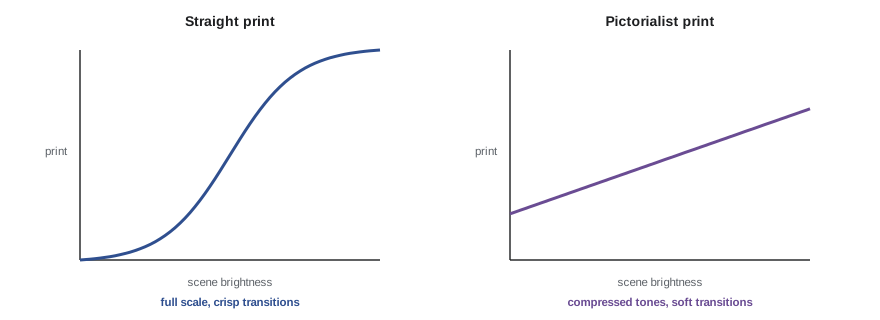
- Analyze: softness and compressed tones create mood rather than detail; the figure blends into nature, suggesting reverie or harmony.
- Contextualize: around 1905 pictorialists sought acceptance as artists by evoking symbolist painting and emphasizing hand-made prints.
- Interpret: the photograph presents photography as poetic and expressive, prioritizing feeling over information.
Answer: The analysis links formal choices such as soft focus and compressed tones to pictorialism's goal of artistic recognition.
Practice: a pictorialist experiment
Try making two versions of the same subject: one in a pictorialist manner and one straight. For the pictorialist version, choose a quiet, evocative subject such as a figure by a window, fog over water or trees at dusk. Use soft light, a soft-focus filter or a lens defocused slightly, and compress the tones during editing by lifting the blacks and lowering the whites; consider printing on a matte, textured paper or trying a cyanotype or gum print if your program has the facilities. For the straight version, photograph the same subject with sharp focus, a full tonal range and minimal editing.
Display the two prints side by side and ask viewers what each version communicates. Pictorialist softness often reads as memory, dream or emotion, while straight sharpness reads as information and presence. Neither is more truthful; each is a set of conventions. Understanding why early photographers fought so hard over these choices helps you make them deliberately in your own work, rather than relying on the default look of a camera or app filter.
Common mistakes
MistakeThinking pictorialists lacked technical skill
InsteadPictorialists were often highly skilled printers who chose soft focus and hand processes deliberately
MistakeBelieving soft focus was accidental
InsteadSoft focus was an intentional aesthetic linked to tonalist painting and ideas about vision
MistakeTreating pictorialism as only a British movement
InsteadIt was international, with major centers in Britain, continental Europe, the United States and Canada
MistakeSaying Stieglitz always opposed pictorialism
InsteadStieglitz championed pictorialism for years before turning to straight photography
MistakeForgetting the role of women
InsteadWomen such as Cameron, Käsebier, Brigman and Keene were central to pictorialism
Summary and key terms
- Gelatin dry plates and the Kodak made photography fast and popular in the 1870s and 1880s.
- Pictorialists sought artistic status through soft focus, mood and hand-made prints.
- Emerson's naturalism argued for selective focus based on vision, then he renounced his own views.
- Platinum, gum bichromate, bromoil and carbon prints gave pictorialists control and visible craft.
- The Linked Ring, the Photo-Secession, Camera Work and gallery 291 organized the movement.
- Women had unusual opportunities in pictorialism, though critics often framed their work narrowly.
- Pictorialism declined after 1917 but laid foundations for photography as art.
- Pictorialism
- An international movement, about 1885 to 1915, treating photography as a fine art through mood, soft focus and hand-made prints
- Gelatin dry plate
- A factory-made glass plate with a gelatin silver emulsion that could be stored before and after exposure
- Photo-Secession
- The group founded by Alfred Stieglitz in New York in 1902 to promote photography as art
- Camera Work
- Stieglitz's quarterly journal published from 1903 to 1917
- Gum bichromate
- A pigment printing process allowing brushwork and layered color
- Platinum print
- A print made with platinum salts giving delicate, permanent tones
- Bromoil
- A process in which a bleached silver print is inked by hand
- Linked Ring
- The British secession group founded in 1892 that held annual artistic salons
- Naturalistic photography
- Emerson's approach based on how the eye sees, with selective sharpness
- Salon
- An exhibition selected by a jury for artistic merit
Practice problems
Work each problem on paper first, then reveal the answer to check.
What two advantages did gelatin dry plates have over wet collodion?
Show answer
They could be stored and developed later, and they were much faster.
In the lesson's example, about how many stops faster was a dry plate than wet collodion?
Show answer
About 6 stops.
What did the Kodak slogan promise?
Show answer
"You press the button, we do the rest", photography without expertise.
What did the Brownie cost in 1900?
Show answer
One US dollar.
What problem did pictorialism try to solve?
Show answer
How photography could be accepted as art when anyone could take a photograph.
What did Emerson's Naturalistic Photography argue?
Show answer
Photographs should reflect how the eye sees, with the subject sharp and surroundings slightly soft.
Why did pictorialists favor gum bichromate and bromoil?
Show answer
These processes allowed hand manipulation and showed the artist's control.
When and where was the Photo-Secession founded?
Show answer
In New York in 1902 by Alfred Stieglitz.
Which photographer's work filled the final issue of Camera Work?
Show answer
Paul Strand.
Name a Canadian club important to pictorialism.
Show answer
The Toronto Camera Club, founded in 1888.
Lesson quiz · 5 questions
Score 60% or more to complete this lesson.
Create a free account to save your progress, take quizzes and earn a certificate.