
VIS-210 · Lesson 9 of 12 · 30 min
Theory I: index, reproduction and the photographic image
What kind of image is a photograph? From 1839, people sensed that photographs were different from drawings and paintings, but it took more than a century for critics to develop clear ways of explaining the difference. This lesson introduces some of the most influential ideas in photographic theory: Charles Sanders Peirce's index, André Bazin's ontology of the photographic image, Walter Benjamin's aura and mechanical reproduction, Roland Barthes's semiotics, studium and punctum, and Susan Sontag's critique of photography's place in modern life. You do not need to accept these theories to benefit from them. Each offers a set of questions that will sharpen how you read and make photographs. Quotations here are brief; read the original texts for the full arguments.
Signs: icon, index and symbol
The American philosopher Charles Sanders Peirce, writing in the late nineteenth century, classified signs by how they relate to what they represent. An icon resembles its object, as a drawing of a tree resembles a tree. A symbol relates to its object by convention, as the word "tree" or a traffic sign does. An index has a physical or causal connection to its object, as smoke indicates fire, a footprint indicates a foot, or a weathervane indicates the wind.
A photograph is both iconic and indexical. It usually resembles its subject, which makes it an icon, but it was also produced by light physically reflected from the subject onto a sensitive surface, which makes it an index. Peirce himself noted that photographs are effectively forced by nature to correspond point by point to their objects. Later theorists made indexicality the key to photography's special authority: we believe photographs because they are traces of what was in front of the camera.
| Type | Relation to object | Everyday example | Photographic aspect |
|---|---|---|---|
| Icon | resemblance | a map, a portrait drawing | a photograph looks like its subject |
| Index | physical or causal connection | smoke and fire, a footprint | light from the subject made the image |
| Symbol | convention | a word, a national flag | captions, logos and learned codes in the image |
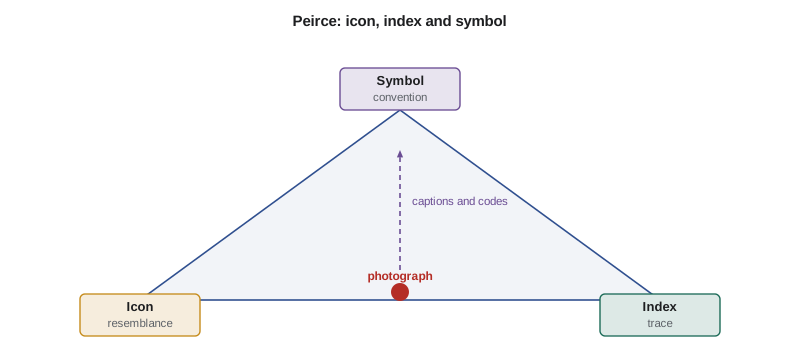
Digital imaging complicates the index. A digital sensor still records light from a scene, but the data are processed by software, sometimes heavily, and generative AI can produce photorealistic images with no camera or scene at all. Lesson 11 returns to this question; for now, notice that the belief in photographic evidence depends on the index, and that technologies which weaken the index challenge that belief.
Bazin and the ontology of the photograph
The French film critic André Bazin, in his essay "The Ontology of the Photographic Image" (1945), argued that photography satisfied a deep human desire, older than art, to preserve life against death, a desire he traced to Egyptian mummification. Because a photograph is made by a mechanical process without the creative intervention of a human hand, Bazin argued, we accept it as the re-presentation of the object itself, not just a likeness. He wrote that the photograph has the irrational power to carry away our faith. Bazin's ideas influenced film theory, especially his preference for long takes and deep focus that preserved the continuity of real space and time.
Benjamin, reproduction and aura
The German critic Walter Benjamin wrote two essays that shaped photography theory. In "Little History of Photography" (1931) he discussed early portraits, the work of David Octavius Hill and Eugène Atget, and introduced the idea of the "optical unconscious": the camera reveals details of movement and form that the eye cannot see, as slow motion and enlargement do.
In "The Work of Art in the Age of Its Technological Reproducibility", written in the mid-1930s and often translated as "mechanical reproduction", Benjamin argued that a traditional artwork possesses an "aura", a sense of uniqueness, authenticity and presence tied to its existence in one place and its history. Photography and film, which produce many identical copies, detach artworks from tradition and destroy aura. Benjamin saw this as a loss but also an opportunity: reproduction made art accessible to the masses and could serve political ends. He warned that fascism aestheticized politics, turning mass rallies into spectacles, and urged instead the politicization of art. His essay is still central to debates about reproduction, from posters to digital files and NFTs.
Worked problem
Thinking about aura and reproduction in numbers
A painting exists as one original. A famous photograph has a few vintage prints made by the photographer, later prints made by an estate, millions of reproductions in books and magazines, and perhaps hundreds of millions of digital views. Suppose 10 vintage prints and an estimated 500 million digital views exist. What fraction of all encounters with the image involve a vintage print? What would Benjamin say about where the photograph's meaning lives?
Show solution
- Fraction of encounters with vintage prints, counting each print as one encounter for simplicity: \( 10 \div 500{,}000{,}000 = 2 \times 10^{-8} \).
- That is two in a hundred million, so almost everyone meets the image as a reproduction.
- Benjamin would argue that the photograph's meaning lives mainly in its reproductions and circulation, not in a unique original with an aura.
Answer: About \( 2 \times 10^{-8} \); yet the art market still prizes vintage prints, showing that aura has been partly restored by collecting, signatures and scarcity.
Barthes and the rhetoric of the image
Roland Barthes, the French semiotician, wrote about photography throughout his career. In "The Photographic Message" (1961) and "Rhetoric of the Image" (1964), he analyzed press and advertising photographs as systems of signs. A photograph has a denoted, literal message (what is shown) and connoted, cultural meanings (what it suggests). In a famous analysis of a pasta advertisement, Barthes showed how a string bag, tomatoes, peppers and the colors red, green and white connoted "Italianicity" and freshness.
Barthes also described how text controls images. Anchorage occurs when a caption fixes one meaning among many possible readings, directing the viewer. Relay occurs when text and image complement each other in a sequence, as in comics or film dialogue. Captions are therefore not neutral labels; they are powerful tools of meaning.
Worked problem
A semiotic reading of a described advertisement
A described advertisement shows a steaming mug on a wooden table by a frosted window, a knitted scarf draped over a chair and soft morning light. The caption reads "Home, wherever you are." Identify the denotation, three connotations and the role of the caption.
Show solution
- Denotation: a mug of hot drink, a wooden table, a frosted window, a scarf, morning light.
- Connotations: warmth against cold (steam and frost), comfort and handmade tradition (knitted scarf and wood), calm and new beginnings (soft morning light).
- The caption anchors the image, directing viewers to read the scene as "home" and associating the product with belonging, even for travelers.
Answer: The image denotes simple objects but connotes warmth, tradition and belonging, and the caption anchors these connotations to the product.
Camera Lucida: studium and punctum
Barthes's last book, Camera Lucida (1980), written after his mother's death, is personal and meditative. He distinguished two ways photographs affect us. The studium is our general, cultural interest in a photograph: we understand its subject, history and intentions, and we may find it informative or well made. The punctum is a detail that "pricks" or wounds a particular viewer unexpectedly, often something the photographer did not intend, such as a pair of strapped shoes, a hand or a necklace. The punctum is personal; what pierces one viewer may leave another unmoved.
In the second part of the book, Barthes describes searching through photographs of his mother and finding one of her as a child in a winter garden that captured her essence for him. He deliberately does not reproduce it, saying it would mean nothing to readers. He concludes that the essence, or noeme, of photography is "that-has-been": the photograph certifies that its subject was really there, in front of the lens, at a past moment. Photography therefore always contains death, the knowledge that the moment is gone and that the person will die or has died.
Worked problem
Structured analysis using studium and punctum
A described 1920s studio portrait shows a family of four in formal clothes in front of a painted backdrop. The youngest child holds a small wooden toy horse and looks away, slightly blurred. Write a structured reading in three steps.
Show solution
- Studium: the photograph informs us about 1920s studio conventions, middle-class aspirations, formal dress and family structure.
- Punctum candidate: for one viewer, the blurred child and the toy horse pierce the formal surface, suggesting a life that resisted the pose and a moment the studio could not fully control.
- That-has-been: knowing that this child grew old and is almost certainly no longer alive gives the image poignancy that is specifically photographic.
Answer: The reading distinguishes shared cultural interest, a personal piercing detail and the photograph's testimony to a vanished moment.
Sontag on photography
The American writer Susan Sontag's essays, collected in On Photography (1977), offered a critical view of photography's role in modern consumer society. She argued that photographing is a way of appropriating the thing photographed, that photographs turn the world into a collection of images, and that the camera encourages a voyeuristic, acquisitive relationship to experience, as when tourists photograph sights instead of experiencing them. She wrote that photographs of suffering can shock but that repeated exposure dulls our response, and that images without understanding cannot produce ethical or political action.
In Regarding the Pain of Others (2003), Sontag revised some of these ideas. She acknowledged that photographs of war and atrocity can haunt us and serve as reminders, and that compassion fatigue is not inevitable, while still insisting that photographs need narratives and context to help us understand.
Other voices
Many other theorists have shaped photographic thinking. The Czech-born philosopher Vilém Flusser, in Toward a Philosophy of Photography (1983), described the camera as an apparatus whose program shapes what photographers can do; photographers play within possibilities designed by engineers and manufacturers, a provocative idea in an age of algorithmic cameras. Allan Sekula's essay "On the Invention of Photographic Meaning" (1975) argued that a photograph has no fixed meaning outside the discourses and institutions that frame it. John Berger, in Ways of Seeing (1972) and later essays, explored how photographs and advertising shape vision and how the meaning of an image changes when it is reproduced and placed beside other images or words.
In the United States, photography theory entered art schools and universities strongly in the 1970s and 1980s through translations of Benjamin and Barthes and through journals such as October, founded in 1976. Critics including Rosalind Krauss, Douglas Crimp and Abigail Solomon-Godeau applied these ideas to contemporary art and the history of photography, questioning modernist claims about originality, authorship and the photograph's purity. The next lesson follows these debates into postmodernism.
Using theory in practice
Theory becomes useful when it changes how you work. Thinking about the index can make you more careful about manipulation and disclosure. Thinking about anchorage can make you write captions more thoughtfully. Thinking about studium and punctum can help you sequence a portfolio so that personal, unexpected details have room to work. Thinking about Sontag's critique can make you question why you photograph certain subjects, especially people in distress. Thinking about Benjamin can make you consider how your images will circulate and be reproduced, and what is gained and lost when they are.
Common mistakes
MistakeSaying a photograph is only an index
InsteadPhotographs are also iconic and acquire symbolic meanings through captions and culture
MistakeTreating the punctum as whatever the photographer emphasized
InsteadThe punctum is a personal detail that pierces a particular viewer, often unintended
MistakeThinking captions merely describe images
InsteadCaptions anchor meaning and can redirect how an image is read
MistakeAssuming Benjamin simply mourned the loss of aura
InsteadHe also saw reproduction as democratizing and politically useful
MistakeTaking Sontag's 1977 views as her final position
InsteadIn 2003 she revised her views on images of suffering
Summary and key terms
- Peirce's categories show that photographs are both iconic and indexical, with symbolic layers.
- Bazin argued that photography satisfies a desire to preserve reality and earns belief through mechanical recording.
- Benjamin described the loss of aura through reproduction and the camera's optical unconscious.
- Barthes analyzed denotation, connotation, anchorage and relay in press and advertising images.
- Camera Lucida introduced studium, punctum and the noeme "that-has-been".
- Sontag criticized photography's acquisitive, desensitizing role and later revised her views.
- Flusser, Sekula, Berger and McLuhan extended theory to apparatus, institutions, reproduction and media.
- Index
- A sign with a physical or causal connection to its object
- Icon
- A sign that resembles its object
- Symbol
- A sign whose meaning is set by convention
- Aura
- Benjamin's term for the unique presence and authenticity of an original artwork
- Optical unconscious
- Benjamin's idea that the camera reveals what the eye cannot see
- Denotation
- The literal content of an image
- Connotation
- The cultural meanings an image suggests
- Anchorage
- Barthes's term for text fixing one meaning of an image
- Studium
- General cultural interest in a photograph
- Punctum
- A detail in a photograph that pierces a particular viewer
Practice problems
Work each problem on paper first, then reveal the answer to check.
What makes a photograph indexical?
Show answer
It was produced by light physically reflected from the subject.
Give an example of a symbol in a photograph.
Show answer
A caption, a logo, a flag or another learned convention.
What desire did Bazin say photography satisfies?
Show answer
The desire to preserve reality against time and death.
What is aura in Benjamin's theory?
Show answer
The unique presence and authenticity of an original artwork.
What is the optical unconscious?
Show answer
What the camera reveals that the eye cannot see, such as details of movement.
Define anchorage.
Show answer
Text fixing one meaning among the possible readings of an image.
What is the difference between studium and punctum?
Show answer
Studium is general cultural interest; punctum is a personal piercing detail.
What does Barthes say is the essence of photography?
Show answer
"That-has-been": the subject was really there at a past moment.
What did Sontag argue about repeated exposure to images of suffering in 1977?
Show answer
It can dull our response and does not by itself produce understanding.
What did McLuhan's "the medium is the message" suggest for photographers?
Show answer
The form and medium of an image shape its meaning as much as its content.
Lesson quiz · 5 questions
Score 60% or more to complete this lesson.
Create a free account to save your progress, take quizzes and earn a certificate.