
ACCT-101 · Lesson 2 of 12 · 31 min
The accounting equation and business transactions
Every accounting system rests on one simple equation. A business has resources, called assets, and every asset was provided by someone: either by creditors, who expect to be repaid, or by owners, who have a residual claim on whatever is left. So at every moment, assets equal liabilities plus equity. This lesson defines each element, shows how ordinary business transactions change the equation while keeping it in balance, and introduces revenues, expenses and dividends as the parts of equity that change through operations. By the end you will be able to analyse a month of transactions for a small business and produce a simple balance sheet from the result.
Assets
An asset is a resource controlled by the business as a result of past events, from which future economic benefits are expected. In plain terms, assets are things the business owns or controls that will help it earn money or that can be turned into cash. Cash is the most obvious asset. Accounts receivable are amounts customers owe for goods or services already provided. Inventory is goods held for sale. Prepaid expenses, such as insurance paid in advance, are assets because the business has paid for benefits it has not yet used. Equipment, vehicles, buildings and land are long-lived assets used in operations. Intangible assets such as patents, trademarks and software licences have no physical form but still provide future benefits.
Note what is not an asset. A loyal customer base, a talented team or a good reputation may be valuable, but they are not controlled through a past transaction and cannot be measured reliably, so they do not appear on the balance sheet unless they were purchased as part of buying another business. This is one reason a company's market value often differs from the total equity on its balance sheet.
Liabilities
A liability is a present obligation of the business to transfer economic resources as a result of past events. Accounts payable are amounts owed to suppliers for goods or services bought on credit. Wages payable are amounts earned by employees but not yet paid. Notes payable and loans payable are formal borrowings, usually with interest. Unearned revenue, sometimes called deferred revenue or contract liabilities, arises when a customer pays in advance: the business owes the customer goods or services, or a refund. Sales taxes collected from customers and not yet sent to the government are also liabilities, as lesson 8 explains.
Equity
Equity is the owners' residual interest in the assets after deducting liabilities. For a corporation, equity has two main parts. Share capital (often called common shares) records what shareholders paid the corporation for its shares. Retained earnings record the profits the corporation has earned over its life, less the dividends it has paid to shareholders. For a sole proprietorship, equity is a single owner's capital account, increased by the owner's investments and the business's profits and decreased by losses and by the owner's withdrawals, called drawings.
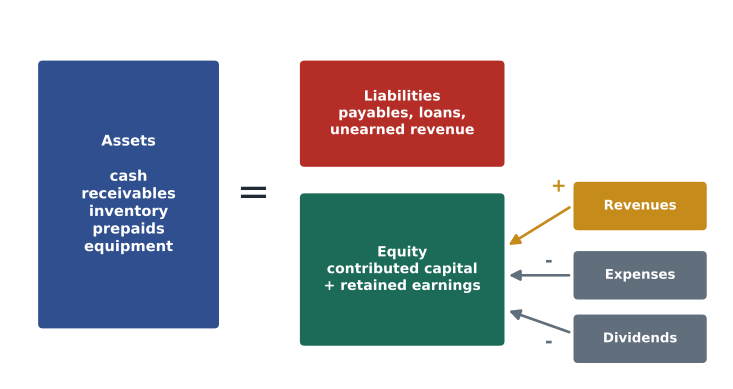
Retained earnings change through operations, and it helps to break the change into parts. Revenues are increases in equity from delivering goods or services to customers: sales revenue, service revenue, rent revenue, interest revenue. Expenses are decreases in equity from the costs of earning revenue: wages, rent, utilities, advertising, the cost of goods sold, depreciation. Dividends are distributions of profits to owners; they reduce retained earnings but are not expenses, because they are not a cost of earning revenue. Putting it together gives the expanded accounting equation.
Here 'share capital' plus 'revenues minus expenses minus dividends' (accumulated over the business's life, starting from opening retained earnings) is total equity. When revenues exceed expenses for a period, the result is net income, also called profit; when expenses exceed revenues, the result is a net loss.
What counts as a transaction
An accounting transaction is an event that changes the financial position of the business and can be measured reliably in money. Buying supplies, selling a bicycle, paying wages and borrowing from a bank are transactions. Signing a contract to buy equipment next month, receiving a purchase order from a customer, or hiring an employee who starts next week are not yet transactions, because nothing has been exchanged; they may be important, and some must be disclosed, but they do not change the equation today. Each transaction is supported by a source document such as an invoice, receipt, bank statement, contract or payroll record, which provides evidence of what happened and the amount.
Every transaction affects at least two items in the equation. If one asset increases, either another asset decreases, a liability or equity increases, or both. This dual effect is the foundation of double-entry bookkeeping in lesson 3. Before learning debits and credits, it is useful to analyse transactions directly in the equation, writing a plus or minus under each element.
Analysing a month of transactions
Birchwood Bikes Inc. is a small corporation that sells and repairs bicycles in Guelph, Ontario. Its owner, Maya Okafor, incorporated the business on 1 May. The transactions for May are below. To keep the focus on the equation, sales taxes are ignored until lesson 8.
| # | Date | Transaction |
|---|---|---|
| 1 | 1 May | Maya invests $40,000 cash in the business in exchange for shares. |
| 2 | 2 May | The business borrows $20,000 from the bank, signing a three-year note payable. |
| 3 | 3 May | Buys repair equipment for $18,000 cash. |
| 4 | 5 May | Pays $3,600 cash for a 12-month insurance policy starting 1 May. |
| 5 | 8 May | Buys $1,500 of repair supplies on account (on credit). |
| 6 | 15 May | Performs repair services for customers and receives $4,200 cash. |
| 7 | 20 May | Performs repair services for a cycling club on account, $2,800. |
| 8 | 25 May | Pays $1,000 of the amount owed for supplies. |
| 9 | 28 May | Collects $1,800 from the cycling club. |
| 10 | 31 May | Pays shop rent of $2,000 and wages of $3,100 for May. |
| 11 | 31 May | Receives the May utility bill of $350, to be paid in June. |
| 12 | 31 May | Pays a dividend of $500 to Maya as shareholder. |
Work through them one at a time. Transaction 1 increases cash (an asset) by $40,000 and share capital (equity) by $40,000. Transaction 2 increases cash by $20,000 and notes payable (a liability) by $20,000. Transaction 3 exchanges one asset for another: equipment rises by $18,000 and cash falls by $18,000, with no change in the totals. Transaction 4 is similar: prepaid insurance, an asset, rises by $3,600 and cash falls by $3,600. The insurance is not an expense yet, because the benefit covers the next 12 months; lesson 5 shows how one month is moved to expense at month end.
Transaction 5 increases supplies (an asset) and accounts payable (a liability) by $1,500. Transaction 6 increases cash and service revenue by $4,200; revenue increases equity because the business has earned it by doing the work. Transaction 7 also earns $2,800 of revenue, but the customer has not paid, so the asset that increases is accounts receivable. Transaction 8 decreases cash and accounts payable by $1,000. Transaction 9 exchanges one asset for another: cash up $1,800, accounts receivable down $1,800. Collecting a receivable is not revenue; the revenue was recorded when the work was done in transaction 7.
Transaction 10 decreases cash by $5,100 and records rent expense of $2,000 and wages expense of $3,100, each reducing equity. Transaction 11 records an expense even though no cash has been paid: the shop used the electricity in May, so utilities expense increases by $350 and accounts payable (or utilities payable) increases by $350. Transaction 12 reduces cash and retained earnings by $500. The dividend is not an expense; it is a distribution of profits.
# Transaction analysis for Birchwood Bikes, May (illustrative)
cols = ["Cash", "A/R", "Supplies", "Prepaid", "Equipment",
        "A/P", "Note", "ShareCap", "Revenue", "Expenses", "Dividends"]
tx = [
    (1,  {"Cash": 40000, "ShareCap": 40000}),
    (2,  {"Cash": 20000, "Note": 20000}),
    (3,  {"Cash": -18000, "Equipment": 18000}),
    (4,  {"Cash": -3600, "Prepaid": 3600}),
    (5,  {"Supplies": 1500, "A/P": 1500}),
    (6,  {"Cash": 4200, "Revenue": 4200}),
    (7,  {"A/R": 2800, "Revenue": 2800}),
    (8,  {"Cash": -1000, "A/P": -1000}),
    (9,  {"Cash": 1800, "A/R": -1800}),
    (10, {"Cash": -5100, "Expenses": 5100}),
    (11, {"A/P": 350, "Expenses": 350}),
    (12, {"Cash": -500, "Dividends": 500}),
]
bal = dict.fromkeys(cols, 0)
for n, eff in tx:
    for k, v in eff.items():
        bal[k] += v
    assets = sum(bal[c] for c in cols[:5])
    claims = (bal["A/P"] + bal["Note"] + bal["ShareCap"]
              + bal["Revenue"] - bal["Expenses"] - bal["Dividends"])
    assert assets == claims, n
for c in cols:
    print(f"{c:<10}{bal[c]:>9,}")
assets = sum(bal[c] for c in cols[:5])
print(f"Total assets {assets:,}; liabilities + equity {claims:,}")Cash 37,800 A/R 1,000 Supplies 1,500 Prepaid 3,600 Equipment 18,000 A/P 850 Note 20,000 ShareCap 40,000 Revenue 7,000 Expenses 5,450 Dividends 500 Total assets 61,900; liabilities + equity 61,900
The program applies each transaction and checks after every one that assets still equal liabilities plus equity. At the end of May, total assets are $61,900, and the claims on them are the same: $20,850 of liabilities and $41,050 of equity. If any transaction had been entered with only one side, the check would fail at that line, which is exactly how accountants locate many errors.
From the equation to the statements
The ending balances produce simple financial statements. Revenue for May was $4,200 + $2,800 = $7,000, and expenses were $2,000 + $3,100 + $350 = $5,450, so net income was $1,550. Retained earnings started at zero, increased by net income of $1,550 and decreased by the $500 dividend, ending at $1,050. The balance sheet then lists the assets, the liabilities, and equity made up of share capital and retained earnings.
| Birchwood Bikes Inc. | Amount |
|---|---|
| Service revenue | $7,000 |
| Wages expense | (3,100) |
| Rent expense | (2,000) |
| Utilities expense | (350) |
| Net income for May | $1,550 |
| Assets | Liabilities and equity | ||
|---|---|---|---|
| Cash | $37,800 | Accounts payable | $850 |
| Accounts receivable | 1,000 | Note payable | 20,000 |
| Supplies | 1,500 | Share capital | 40,000 |
| Prepaid insurance | 3,600 | Retained earnings | 1,050 |
| Equipment | 18,000 | ||
| Total assets | $61,900 | Total liabilities and equity | $61,900 |
It is worth tying the statements back to the analysis. Cash is 40,000 + 20,000 − 18,000 − 3,600 + 4,200 − 1,000 + 1,800 − 5,100 − 500 = $37,800, matching the program. Accounts payable is 1,500 − 1,000 + 350 = $850. Total liabilities are therefore $20,850 and total equity is $40,000 + $1,050 = $41,050, giving $61,900, the same as total assets. Recomputing a key figure two different ways is a habit worth building; it catches slips that a single calculation hides.
Errors the equation cannot catch
The equation guarantees that every transaction is recorded with equal effects on both sides, but it cannot guarantee that the right accounts were used or that the amounts are correct. If the $2,000 rent payment were recorded as a purchase of equipment, the equation would still balance, but assets would be overstated by $2,000 and expenses understated by $2,000, so net income would look $2,000 better than it really was. If a $4,200 sale were recorded as $2,400 on both sides, the equation would balance but revenue and cash would both be wrong. Lesson 4 discusses errors that a trial balance does and does not reveal, and lesson 10 covers internal controls that reduce them.
Worked problem
Classifying items
Classify each item as an asset, liability, equity, revenue or expense: (a) unpaid wages owed to staff at month end; (b) a customer deposit received for a bicycle to be delivered next month; (c) bicycle parts held for sale; (d) interest earned on a bank account; (e) the cost of a newspaper advertisement that ran this month.
Show solution
- (a) Wages payable is a liability: a present obligation to pay employees.
- (b) The deposit creates unearned revenue, a liability: the business owes the customer a bicycle or a refund.
- (c) Parts held for sale are inventory, an asset.
- (d) Interest earned is revenue (often called interest income).
- (e) Advertising that has already run is an expense of this month.
Answer: Liability, liability, asset, revenue, expense.
Worked problem
Finding a missing amount
At 31 December a business has total assets of $185,000 and liabilities of $72,000. Share capital is $60,000. During the year, net income was $31,000 and dividends were $9,000. What was retained earnings at 1 January?
Show solution
- Total equity at year end = assets − liabilities = 185,000 − 72,000 = $113,000.
- Ending retained earnings = total equity − share capital = 113,000 − 60,000 = $53,000.
- Ending retained earnings = opening retained earnings + net income − dividends, so 53,000 = opening + 31,000 − 9,000.
- Opening retained earnings = 53,000 − 22,000 = $31,000.
Answer: Retained earnings at 1 January were $31,000.
Worked problem
Effects on the equation
For each transaction, state the effect on total assets, total liabilities and total equity: (a) buy a delivery van for $30,000, paying $6,000 cash and signing a note for the rest; (b) pay $800 owed to a supplier; (c) receive $1,500 cash from a customer for work to be done next month; (d) record $400 of interest owed on a loan but not yet paid.
Show solution
- (a) Van +30,000, cash −6,000: assets +24,000; note payable +24,000: liabilities +24,000; equity unchanged.
- (b) Cash −800 and accounts payable −800: assets −800, liabilities −800, equity unchanged.
- (c) Cash +1,500 and unearned revenue +1,500: assets +1,500, liabilities +1,500, equity unchanged until the work is done.
- (d) Interest expense +400 reduces equity by 400; interest payable +400 increases liabilities; assets unchanged.
Answer: Every transaction keeps assets equal to liabilities plus equity, even when only one side changes internally.
Common mistakes
MistakeRecording a customer's cash payment on an existing receivable as revenue.
InsteadThe revenue was recorded when the work was done; collecting the receivable just exchanges one asset (receivable) for another (cash).
MistakeTreating dividends or owner withdrawals as expenses.
InsteadDividends and drawings are distributions to owners; they reduce equity but are not costs of earning revenue and do not appear on the income statement.
MistakeRecording a prepaid insurance policy as an expense when it is paid.
InsteadA payment for future benefits is an asset (prepaid expense); it becomes an expense as time passes.
MistakeRecording a signed purchase agreement for next month as a transaction now.
InsteadNothing has been exchanged yet, so the equation is unchanged; record the purchase when the goods are received or ownership passes.
MistakeAssuming a balanced equation means the records are correct.
InsteadAn entry can balance and still use the wrong accounts or the wrong amount; balance is necessary but not sufficient.
Summary and key terms
- Assets = liabilities + equity at every moment; every transaction affects at least two items.
- Assets are resources controlled from past events that are expected to provide future benefits.
- Liabilities are present obligations to transfer resources; unearned revenue is a liability.
- Equity for a corporation is share capital plus retained earnings; a proprietorship has an owner's capital account and drawings.
- Revenues increase equity, expenses decrease it, and dividends reduce retained earnings without being expenses.
- Collecting a receivable or paying a payable is not revenue or expense.
- A balanced equation does not prove the accounts or amounts are correct.
- Asset
- A resource controlled by the entity as a result of past events, from which future economic benefits are expected.
- Liability
- A present obligation to transfer economic resources as a result of past events.
- Equity
- The residual interest in assets after deducting liabilities.
- Revenue
- An increase in equity from delivering goods or services to customers.
- Expense
- A decrease in equity from the costs of earning revenue.
- Dividend
- A distribution of profits from a corporation to its shareholders.
- Retained earnings
- Accumulated net income less accumulated dividends since the corporation began.
- Accounts receivable
- Amounts owed to the business by customers for goods or services already provided.
- Accounts payable
- Amounts the business owes to suppliers for goods or services bought on credit.
- Unearned revenue
- Cash received from customers before the goods or services are provided; a liability.
Practice problems
Work each problem on paper first, then reveal the answer to check.
Total assets are $90,000 and equity is $55,000. What are total liabilities?
Show answer
$35,000.
A business buys supplies for $600 on account. What happens to assets, liabilities and equity?
Show answer
Assets +600 (supplies); liabilities +600 (accounts payable); equity unchanged.
A business performs $2,500 of services on account. Effect?
Show answer
Assets +2,500 (accounts receivable); equity +2,500 (revenue).
The business collects $2,500 from the customer in the previous question. Effect?
Show answer
Cash +2,500, accounts receivable −2,500; totals unchanged.
Why is a dividend not an expense?
Show answer
It is a distribution of profit to owners, not a cost of earning revenue.
Revenue is $48,000, expenses are $39,500 and dividends are $5,000. Opening retained earnings were $12,000. Find ending retained earnings.
Show answer
12,000 + 8,500 − 5,000 = $15,500.
Is a signed employment contract for a new manager starting next month a transaction?
Show answer
No; no exchange has occurred and nothing is owed yet.
A customer pays $900 in advance for a bike tune-up package. Which liability increases?
Show answer
Unearned revenue.
Give an example of an error that keeps the equation in balance.
Show answer
Recording rent paid as equipment, or recording $540 as $450 on both sides.
Extend the Python program by adding a transaction: on 31 May the business pays $350 to the utility company. Which balances change?
Show answer
Cash −350 and A/P −350; totals still balance.
Lesson quiz · 5 questions
Score 60% or more to complete this lesson.
Create a free account to save your progress, take quizzes and earn a certificate.