
BUS-110 · Lesson 3 of 12 · 32 min
Payroll: from gross to net pay
Payroll is the business calculation that most people meet first: the cheque or deposit that arrives every pay period. For an employer, payroll is also one of the largest costs and one of the most regulated. Amounts must be withheld correctly, sent to the government on time and reported at year end, and mistakes bring penalties and interest. This lesson works through the arithmetic of a pay period, from the hours or salary that make up gross pay to the deductions that leave net pay, and then looks at what the employer pays on top.
Payroll rules in Canada come from three sources: federal law for the Canada Pension Plan (CPP), Employment Insurance (EI) and federal income tax; provincial law for provincial income tax, minimum wage, overtime and vacation pay (Quebec also runs its own pension plan, QPP, and parental insurance plan, QPIP); and the employment contract. The figures in this lesson are the 2026 rates at the time of writing (October 2026). They change every January, and sometimes mid-year, so always check the current Canada Revenue Agency (CRA) payroll tables before running a real payroll.
Gross pay
Gross pay is what an employee earns before anything is taken off. It is calculated in one of several ways, depending on how the employee is paid.
| Pay basis | How gross pay is calculated | Example |
|---|---|---|
| Annual salary | Salary ÷ number of pay periods in the year | $62,400 ÷ 26 = $2,400 every two weeks |
| Hourly wage | Regular hours × rate, plus overtime hours × overtime rate | 40 h × $22.50 = $900 |
| Piecework | Units produced × rate per unit | 1,250 units × $0.84 = $1,050 |
| Commission | Sales × commission rate, sometimes with a base salary or draw | $40,000 × 3 % = $1,200 |
| Combination | Base salary plus commission or bonus | $1,500 + 2 % of $60,000 = $2,700 |
The number of pay periods matters. Weekly pay gives 52 periods a year, biweekly (every two weeks) gives 26, semi-monthly (twice a month) gives 24 and monthly gives 12. Biweekly and semi-monthly are easy to confuse: a biweekly payroll occasionally has 27 pay dates in a calendar year, while semi-monthly always has exactly 24. To convert an hourly wage to an annual equivalent, a common assumption is 2,080 hours (40 hours × 52 weeks).
Worked problem
Converting between pay bases
An employee earns $58,500 a year. What is her gross pay on a weekly, biweekly, semi-monthly and monthly schedule? What is the equivalent hourly rate, assuming 37.5 hours a week?
Show solution
- Weekly: $58,500 ÷ 52 = $1,125.00.
- Biweekly: $58,500 ÷ 26 = $2,250.00.
- Semi-monthly: $58,500 ÷ 24 = $2,437.50.
- Monthly: $58,500 ÷ 12 = $4,875.00.
- Hours a year = 37.5 × 52 = 1,950; hourly rate = $58,500 ÷ 1,950 = $30.00.
Answer: Her gross pay is $1,125.00 weekly, $2,250.00 biweekly, $2,437.50 semi-monthly or $4,875.00 monthly, equivalent to $30.00 an hour.
Overtime
In Canada, overtime rules are set by each province and territory, and by the Canada Labour Code for federally regulated workplaces such as banks, airlines and telecommunications. The usual overtime rate is one and a half times the regular rate, but the threshold differs. Ontario requires overtime after 44 hours in a week. Alberta and British Columbia use both a daily threshold (8 hours) and a weekly one (44 hours in Alberta, 40 in British Columbia), and BC pays double time after 12 hours in a day. The federal Labour Code uses 8 hours a day and 40 a week. Many managers and some professionals are exempt. Always apply the rules of the province where the employee works.
Worked problem
Overtime pay
A warehouse worker in Ontario earns $22.50 an hour and works 48 hours in one week. Ontario requires overtime at 1.5 times the regular rate after 44 hours. What is his gross pay for the week?
Show solution
- Regular hours = 44; regular pay = 44 × $22.50 = $990.00.
- Overtime hours = 48 − 44 = 4; overtime rate = 1.5 × $22.50 = $33.75.
- Overtime pay = 4 × $33.75 = $135.00.
- Gross pay = $990.00 + $135.00 = $1,125.00.
Answer: His gross pay is $1,125.00. If the same week were worked in a province with a 40-hour threshold, the overtime would be 8 hours and gross pay would be $1,170.00, so the province matters.
Statutory deductions
Canadian employers must withhold three statutory deductions from most employees' pay: CPP contributions, EI premiums and income tax (federal and provincial combined). In Quebec, QPP replaces CPP, a lower EI rate applies and QPIP premiums are added, and Quebec provincial income tax is calculated under Revenu Québec rules.
| Deduction (2026) | Employee rate | Applies to | Annual employee maximum |
|---|---|---|---|
| CPP (base and first additional) | 5.95 % | Earnings between $3,500 and $74,600 (the YMPE) | $4,230.45 |
| CPP2 (second additional) | 4 % | Earnings between $74,600 and $85,000 | $416.00 |
| EI premium (outside Quebec) | 1.63 % | Insurable earnings up to $68,900 | $1,123.07 |
| Federal income tax | 14 % to 33 % | Taxable income, after credits | No maximum |
| Provincial income tax | Varies by province | Taxable income, after credits | No maximum |
The CPP basic exemption of $3,500 is spread evenly over the year's pay periods. For a biweekly payroll, the exemption per period is $3,500 ÷ 26 = $134.62, so CPP for a period is 5.95 % of (gross pay − $134.62). Once an employee's contributions reach the annual maximum, deductions stop for the rest of the year; the same applies to EI. Higher earners therefore see their take-home pay rise late in the year.
Income tax withholding
Federal and provincial income tax are progressive: each rate applies only to the slice of income within its bracket. For 2026, the federal rates are 14 % on taxable income up to $58,523, 20.5 % up to $117,045, 26 % up to $181,440, 29 % up to $258,482 and 33 % above that. The federal basic personal amount of $16,452 produces a non-refundable credit worth 14 % of that amount. Each province adds its own brackets and credits; Ontario, for example, starts at 5.05 % on taxable income up to about $53,891, with a basic personal amount of about $12,989, and adds the Ontario Health Premium, which is $750 a year for taxable income between $48,600 and $72,000.
Real payroll software uses the CRA's formulas, which also give credits for CPP and EI contributions and the Canada employment amount. A useful approximation is the annualization method: multiply the period's gross by the number of periods, work out the year's tax using the brackets, subtract the basic credits and divide back by the number of periods. Because it leaves out some credits, the approximation slightly overstates the tax.
Worked problem
A complete pay period
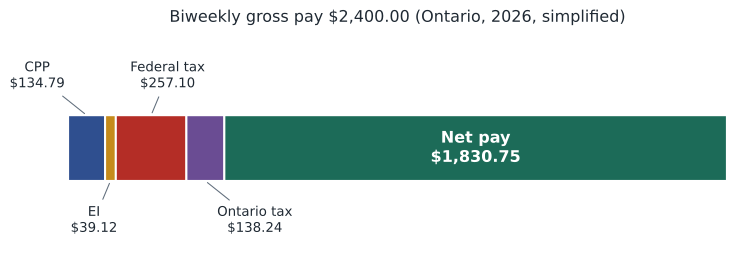
Priya works in Ontario and earns a salary of $62,400 a year, paid biweekly. She has no other deductions. Using the simplified annualization method and 2026 rates, find her CPP, EI, federal tax, Ontario tax and net pay for one period.
Show solution
- Gross pay = $62,400 ÷ 26 = $2,400.00.
- CPP = 5.95 % × ($2,400.00 − $134.62) = 0.0595 × $2,265.38 = $134.79.
- EI = 1.63 % × $2,400.00 = $39.12.
- Federal tax on $62,400: 14 % × $58,523 = $8,193.22, plus 20.5 % × ($62,400 − $58,523) = $794.79, total $8,988.01. Subtract the basic credit 14 % × $16,452 = $2,303.28, leaving $6,684.73 a year, or $6,684.73 ÷ 26 = $257.10 a period.
- Ontario tax: 5.05 % × $53,891 = $2,721.50, plus 9.15 % × ($62,400 − $53,891) = $778.57, total $3,500.07. Subtract the basic credit 5.05 % × $12,989 = $655.94 and add the $750 health premium, giving $3,594.13 a year, or $138.24 a period.
- Net pay = $2,400.00 − $134.79 − $39.12 − $257.10 − $138.24 = $1,830.75.
Answer: Priya takes home about $1,830.75 each pay period, about 76 % of her gross pay. The CRA payroll calculator would give slightly lower tax, because it also credits her CPP and EI contributions and the Canada employment amount.
# Simplified biweekly payroll, 2026 rates (illustration only)
def brackets(income, table):
    tax, lower = 0.0, 0.0
    for upper, rate in table:
        if income > lower:
            tax += (min(income, upper) - lower) * rate
        lower = upper
    return tax

gross, periods = 2400.00, 26
annual = gross * periods
# Canada (Ontario)
cpp = round((gross - 3500 / periods) * 0.0595, 2)
ei = round(gross * 0.0163, 2)
fed = brackets(annual, [(58523, .14), (117045, .205), (181440, .26), (258482, .29), (1e12, .33)]) - .14 * 16452
on = brackets(annual, [(53891, .0505), (1e12, .0915)]) - .0505 * 12989 + 750
ca = [cpp, ei, round(fed / periods, 2), round(on / periods, 2)]
print("Canada (ON):", ca, "net", round(gross - sum(ca), 2))
# United States (Pennsylvania)
fit = brackets(annual - 16100, [(12400, .10), (50400, .12), (105700, .22), (1e12, .24)])
us = [round(gross * .062, 2), round(gross * .0145, 2), round(fit / periods, 2), round(gross * .0307, 2)]
print("US (PA):", us, "net", round(gross - sum(us), 2))Canada (ON): [134.79, 39.12, 257.1, 138.24] net 1830.75 US (PA): [148.8, 34.8, 204.15, 73.68] net 1938.57
Other deductions
Beyond the statutory deductions, an employee's pay may carry voluntary or contractual deductions. Some reduce taxable income, because they are taken before tax is calculated; others are taken after tax.
| Deduction | Before or after tax | Notes |
|---|---|---|
| Registered pension plan (RPP) contributions | Before tax | Reduces income subject to tax, not CPP or EI |
| Group RRSP contributions | Before tax if the employer arranges it | Lets the employee get the tax saving on each cheque |
| Union dues | Before tax | Deductible from income |
| Health and dental premiums | Usually after tax | Employer-paid premiums for some benefits are a taxable benefit |
| Charitable donations | After tax | Claimed as a credit on the tax return |
| Garnishments | After tax | Required by a court order or government demand |
Worked problem
A pre-tax deduction
Suppose Priya also contributes 5 % of her gross pay to a registered pension plan. How much does that reduce her federal and Ontario tax each period, and what does the contribution really cost her?
Show solution
- Contribution = 5 % × $2,400 = $120.00 a period, or $3,120 a year.
- Her taxable income falls from $62,400 to $59,280. All $3,120 comes out of the 20.5 % federal bracket, because $59,280 is still above $58,523, so the federal saving is 20.5 % × $3,120 = $639.60 a year.
- In Ontario, all $3,120 comes out of the 9.15 % bracket, saving $285.48 a year. The health premium stays at $750.
- Total annual tax saving = $925.08, or $35.58 a period.
- Real cost of the contribution = $120.00 − $35.58 = $84.42 a period.
Answer: A $120 pension contribution reduces her take-home pay by only about $84, because the government in effect pays the rest through lower tax.
The employer's cost
The cost of an employee is more than gross pay. Canadian employers match the employee's CPP contributions dollar for dollar (and CPP2), pay EI premiums at 1.4 times the employee's premium, and in most provinces pay workers' compensation premiums. Some provinces add an employer health tax on large payrolls, such as Ontario's Employer Health Tax, BC's Employer Health Tax and Quebec's Health Services Fund contribution. On top of these come vacation pay (at least 4 % of wages in most provinces for employees with under five years' service), statutory holiday pay and any benefits.
Worked problem
The employer's payroll cost
For Priya's biweekly pay of $2,400, what does her employer pay in CPP and EI, and what is the total cost of the period before benefits?
Show solution
- Employer CPP = employee CPP = $134.79.
- Employer EI = 1.4 × $39.12 = $54.77.
- Total cost = $2,400.00 + $134.79 + $54.77 = $2,589.56.
- As a percentage of gross: $189.56 ÷ $2,400 ≈ 7.9 %.
Answer: The employer pays about $2,589.56 for the period before vacation pay, workers' compensation and benefits. A common budgeting rule of thumb is that the full cost of an employee runs 15 % to 30 % above salary.
Remitting and reporting
Withheld amounts are held in trust for the government. Employers send CPP, EI and income tax deductions, together with their own CPP and EI contributions, to the CRA, usually by the 15th of the following month for regular remitters (larger employers remit more often). At year end the employer issues each employee a T4 slip showing employment income and deductions, and files a T4 summary. Failing to remit on time leads to penalties, and directors can be held personally liable for unremitted source deductions.
Common mistakes
MistakeCalculating overtime on total hours rather than only the hours above the threshold.
InsteadPay the regular rate for regular hours and the overtime rate only for hours over the limit.
MistakeApplying the CPP rate to the full gross pay.
InsteadSubtract the per-period share of the $3,500 basic exemption first.
MistakeApplying the top tax rate to all income.
InsteadEach rate applies only to the income within its bracket.
MistakeTreating gross pay as the cost of an employee.
InsteadAdd employer payroll taxes, insurance, vacation pay and benefits.
MistakeAssuming a pre-tax contribution reduces take-home pay by its full amount.
InsteadTake-home pay falls by the contribution minus the tax saved.
Summary and key terms
- Gross pay is earnings before deductions; net pay is what the employee receives.
- Count pay periods carefully: 52, 26, 24 or 12 a year.
- Overtime rules depend on where the employee works.
- CPP, EI and income tax are the main Canadian statutory deductions.
- Income tax is progressive, applied bracket by bracket.
- Pre-tax deductions cost less than their face value.
- Employers pay their own payroll taxes on top of gross pay.
- Gross pay
- Earnings before any deductions.
- Net pay
- Gross pay minus all deductions; take-home pay.
- Pay period
- The interval covered by one pay cheque or deposit.
- Overtime
- Hours worked beyond the legal threshold, paid at a premium rate.
- Statutory deduction
- A deduction required by law.
- Marginal tax rate
- The rate applied to the next dollar of income.
- Annualization
- Converting a period amount to a yearly figure to apply annual brackets.
- Pre-tax deduction
- A deduction taken before income tax is calculated.
- Remittance
- Payment of withheld amounts to the government.
- Employer contribution
- A payroll tax or premium paid by the employer on top of wages.
Practice problems
Work each problem on paper first, then reveal the answer to check.
An employee earns $49,400 a year paid semi-monthly. What is the gross pay per period?
Show answer
$2,058.33.
An hourly worker earns $19.80 and works 46 hours in a week with a 40-hour threshold. What is gross pay?
Show answer
$970.20.
A salesperson earns $1,200 a month plus 2.5 % commission on sales of $72,000. What is gross pay?
Show answer
$3,000.
What is the CPP deduction on weekly gross pay of $1,000? (Exemption per week = $3,500 ÷ 52.)
Show answer
0.0595 × ($1,000 − $67.31) = $55.49.
What is the EI premium on biweekly gross pay of $1,850?
Show answer
$30.16.
Using the 2026 federal brackets, what is federal tax on taxable income of $70,000 before credits?
Show answer
$8,193.22 + 20.5 % × $11,477 = $10,546.01.
A worker in a 30 % combined bracket puts $200 into a pre-tax plan. How much does take-home pay fall?
Show answer
$140.
What does an employer pay in EI on an employee premium of $25.00?
Show answer
$35.00.
Why might take-home pay rise in November for a high earner?
Show answer
Some contributions stop once their annual maximum or wage base is reached.
How many pay dates are there in a semi-monthly payroll?
Show answer
24 a year.
Lesson quiz · 5 questions
Score 60% or more to complete this lesson.
Create a free account to save your progress, take quizzes and earn a certificate.