
BUS-110 · Lesson 6 of 12 · 41 min
Simple interest and short-term financing
Interest is the price of money over time. A business that borrows to buy inventory pays interest; a business that leaves cash on deposit earns it. For short periods, typically less than a year, interest is usually calculated as simple interest, where the interest is a fixed percentage of the original amount for each unit of time and is not added to the balance to earn more interest. Simple interest governs lines of credit, short-term loans, promissory notes, treasury bills, late-payment charges and many everyday financial contracts. It is also the foundation for compound interest in the next lesson.
The simple interest formula
Here I is the interest in dollars, P the principal (the amount borrowed or invested), r the annual interest rate as a decimal, and t the time in years. Because rates are almost always quoted per year, time must be expressed in years too: 9 months is 9/12 = 0.75 years, and 146 days is 146/365 years.
Worked problem
Basic simple interest
A business borrows $12,000 at 6.5 % simple interest for 146 days. How much interest does it pay?
Show solution
- t = 146 ÷ 365 = 0.4 years.
- I = $12,000 × 0.065 × 0.4 = $312.00.
Answer: The interest is $312.00.
The formula can be rearranged to find any one of the four quantities when the other three are known.
Worked problem
Finding the rate
A supplier lends a customer $4,000 and is repaid $4,120 after 120 days. What simple interest rate did the supplier charge?
Show solution
- Interest I = $4,120 − $4,000 = $120.
- t = 120 ÷ 365 = 0.328767 years.
- r = I ÷ (Pt) = $120 ÷ ($4,000 × 0.328767) = 0.09125, or 9.125 %.
Answer: The rate was 9.125 % a year.
Counting days
When a loan runs between two dates, the time is the exact number of days between them. By convention the start date is counted and the end date is not (or, equivalently, count the end date and not the start). Subtracting dates in a spreadsheet does this automatically: in most spreadsheets =DATE(2026,8,9)−DATE(2026,3,15) gives 147. By hand, count the days left in the first month, add the full months, and add the days in the last month.
| Month | Days | Month | Days |
|---|---|---|---|
| January | 31 | July | 31 |
| February | 28 (29 in a leap year) | August | 31 |
| March | 31 | September | 30 |
| April | 30 | October | 31 |
| May | 31 | November | 30 |
| June | 30 | December | 31 |
Worked problem
Days between two dates
How many days of interest are charged on a loan taken out on March 15, 2026 and repaid on August 9, 2026?
Show solution
- March: 31 − 15 = 16 days remaining (March 16 to 31). Leaving out the start date means the end date is counted instead.
- April 30 + May 31 + June 30 + July 31 = 122 days.
- August: 9 days, including August 9. Total = 16 + 122 + 9 = 147.
- Check with a spreadsheet: =DATE(2026,8,9)−DATE(2026,3,15) = 147.
Answer: Interest is charged for 147 days.
In Canada, interest on loans and deposits is normally calculated on the actual number of days divided by 365, even in a leap year. The federal Interest Act also requires that when a rate is stated for a period shorter than a year, such as a daily or monthly rate, the contract must disclose the equivalent annual rate; otherwise the lender may be limited to 5 % a year.
Worked problem
The effect of the day count
A Canadian bank and a lender using a 360-day year each lend $12,000 at 6.5 % for 146 days. How much more does the 360-day lender collect?
Show solution
- Exact interest (365-day year): $12,000 × 0.065 × 146 ÷ 365 = $312.00.
- 360-day year: $12,000 × 0.065 × 146 ÷ 360 = $316.33.
- Difference = $4.33, which is 1.4 % more interest (365 ÷ 360 = 1.0139).
Answer: Dividing by 360 instead of 365 raises the interest by about 1.4 %, here $4.33. The effective rate is 6.5 % × 365 ÷ 360 = 6.59 %.
Maturity value and present value
The maturity value (or future value) of a simple interest loan or investment is the principal plus the interest. Turning the formula around gives the present value: the amount that must be invested today at a given rate to grow to a stated amount by a future date.
Worked problem
Maturity value
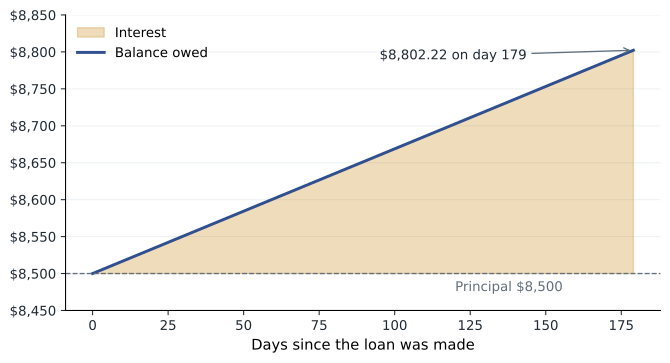
A company borrows $8,500 on April 4, 2026 at 7.25 % simple interest, repaying principal and interest on September 30, 2026. What is the maturity value?
Show solution
- Days: April 4 to September 30 = 179 days.
- I = $8,500 × 0.0725 × 179 ÷ 365 = $302.22.
- S = $8,500 + $302.22 = $8,802.22.
Answer: The company repays $8,802.22.
Worked problem
Present value
A customer will pay $15,000 in 200 days. If money can earn 5 % simple interest, what is that payment worth today?
Show solution
- P = S ÷ (1 + rt) = $15,000 ÷ (1 + 0.05 × 200 ÷ 365).
- 1 + 0.05 × 0.547945 = 1.027397.
- P = $15,000 ÷ 1.027397 = $14,600.00.
Answer: The future payment is worth $14,600.00 today. Present value is the basis for comparing amounts due at different dates.
Equivalent payments and the focal date
Money due at different times cannot simply be added. To compare or combine payments, move each one to a common date, called the focal date, using \( S = P(1 + rt) \) to move money forward in time and \( P = S/(1 + rt) \) to move it back. The payments are equivalent when their values at the focal date are equal. This is how lenders and borrowers reschedule debts.
Worked problem
Rescheduling two payments
A small business owes a supplier $2,000 that was due 60 days ago and $3,000 due in 90 days. They agree to replace both with one payment today, using a rate of 6 % simple interest. What single payment settles both debts?
Show solution
- The overdue $2,000 is moved forward 60 days: $2,000 × (1 + 0.06 × 60 ÷ 365) = $2,019.73.
- The $3,000 due in 90 days is moved back: $3,000 ÷ (1 + 0.06 × 90 ÷ 365) = $2,956.26.
- Single payment today = $2,019.73 + $2,956.26 = $4,975.99.
Answer: A payment of $4,975.99 today settles both debts. It is less than the $5,000 face total because the discount for paying the later debt early outweighs the interest added to the late one.
Lines of credit and changing balances
An operating line of credit lets a business borrow up to a limit and repay whenever it likes, paying interest only on the balance used. The rate is usually floating, set as the bank's prime rate plus a margin, and interest is calculated daily and charged monthly. When the balance or the rate changes during a month, split the month into periods, calculate the interest for each period, and add them.
Worked problem
Interest on a line of credit
A business has a line of credit at a floating rate of 7.2 %. On June 1 the balance is $18,000. It draws $7,500 on June 12, the bank cuts the rate to 6.95 % on June 15, and it repays $10,000 on June 20. What interest is charged for June (30 days)?
Show solution
- June 1 to 11: 11 days at $18,000 and 7.2 %: $18,000 × 0.072 × 11 ÷ 365 = $39.06.
- June 12 to 14: 3 days at $25,500 and 7.2 %: $15.09.
- June 15 to 19: 5 days at $25,500 and 6.95 %: $24.28.
- June 20 to 30: 11 days at $15,500 and 6.95 %: $32.47.
- Total = 11 + 3 + 5 + 11 = 30 days; interest = $39.06 + $15.09 + $24.28 + $32.47 = $110.90.
Answer: The June interest charge is $110.90.
Promissory notes
A promissory note is a written promise by one party (the maker) to pay a stated sum to another (the payee) on a stated date or on demand. Businesses use notes to formalize overdue accounts, to finance large purchases from suppliers and to document loans between related companies. An interest-bearing note states a face value and a rate; its maturity value is found with \( S = P(1 + rt) \). Because a note is a written, signed obligation, the payee can sell it to a bank or finance company before maturity. The buyer pays the present value of the maturity value at its own required rate, so the price falls when interest rates rise and rises when they fall, a first glimpse of how bond prices behave.
Worked problem
Selling a note before maturity
A furniture maker accepts a 120-day note for $9,000 at 8 % from a customer. Forty-five days later it sells the note to a finance company that wants a return of 10 %. What does the finance company pay?
Show solution
- Maturity value = $9,000 × (1 + 0.08 × 120 ÷ 365) = $9,236.71.
- Days remaining = 120 − 45 = 75.
- Price = $9,236.71 ÷ (1 + 0.10 × 75 ÷ 365) = $9,236.71 ÷ 1.020548 = $9,050.74.
Answer: The finance company pays $9,050.74. The furniture maker receives its cash early and has earned $50.74 of interest for the 45 days it held the note.
Treasury bills and other discounted instruments
Government of Canada treasury bills (T-bills) are short-term debts with terms of up to one year. They pay no interest directly. Instead, they are sold at a discount to their face value and repaid at face value at maturity, and the difference is the investor's return. Canadian T-bill yields are quoted as simple annual rates on a 365-day basis, calculated on the price paid.
Worked problem
Yield on a T-bill
An investor buys a 182-day Government of Canada T-bill with face value $100,000 for $98,050. What is the yield?
Show solution
- Return in dollars = $100,000 − $98,050 = $1,950.
- Yield = $1,950 ÷ $98,050 × 365 ÷ 182 = 0.0399, or about 3.99 %.
Answer: The T-bill yields about 3.99 % a year.
The high cost of short-term consumer credit
Simple interest makes it easy to compare the cost of short-term borrowing. A credit card at 20.99 % charges about $31 a month on a balance of $1,800 (\( 1{,}800 \times 0.2099 \times 30/365 \approx 31.05 \)). A fee that looks small relative to a short loan can mean a very high annual rate.
Payday loans are a striking example. Under federal rules in force since January 1, 2025, the cost of a payday loan is capped at $14 for every $100 borrowed. A $14 fee on a 14-day loan of $100 is equivalent to a simple annual rate of \( 0.14 \times 365/14 = 3.65 \), or 365 %. The Criminal Code's criminal interest rate was also lowered to 35 % APR from the same date, with payday loans regulated by the provinces as an exception. These are the rules at the time of writing (October 2026).
# Simple interest helpers and a line-of-credit month
from datetime import date

def days(a, b): return (b - a).days
def interest(P, r, d, basis=365): return P * r * d / basis

d = days(date(2026, 4, 4), date(2026, 9, 30))
print(d, "days; maturity value", round(8500 + interest(8500, 0.0725, d), 2))
print("365 vs 360:", round(interest(12000, .065, 146), 2), round(interest(12000, .065, 146, 360), 2))
pieces = [(18000, .072, 11), (25500, .072, 3), (25500, .0695, 5), (15500, .0695, 11)]
print("June interest", round(sum(round(interest(*p), 2) for p in pieces), 2))
print("PV of 15,000 in 200 days at 5%:", round(15000 / (1 + .05 * 200 / 365), 2))179 days; maturity value 8802.22 365 vs 360: 312.0 316.33 June interest 110.9 PV of 15,000 in 200 days at 5%: 14600.0
Common mistakes
MistakeUsing a number of days or months as t without converting to years.
InsteadDivide days by 365 (or 360 where that convention applies) and months by 12.
MistakeCounting both the start and end dates.
InsteadCount one of them, not both; date subtraction does this for you.
MistakeAdding amounts due at different dates.
InsteadMove each amount to a common focal date first.
MistakeUsing the old balance after a draw or repayment on a line of credit.
InsteadSplit the month at every change in balance or rate.
MistakeJudging a short-term loan by its fee alone.
InsteadConvert the fee to an annual rate to compare.
Summary and key terms
- Simple interest: I = Prt, with t in years.
- Maturity value S = P(1 + rt); present value P = S ÷ (1 + rt).
- Count exact days; the start date counts and the end date does not.
- Canadian practice uses actual days over 365.
- Payments at different dates are compared at a focal date.
- Line-of-credit interest is calculated for each period of constant balance and rate.
- T-bills are sold at a discount; their yield is calculated on the price paid.
- Principal
- The amount borrowed or invested.
- Simple interest
- Interest calculated only on the original principal.
- Maturity value
- Principal plus interest at the end of the term.
- Present value
- The amount today that is equivalent to a future amount.
- Focal date
- The common date to which payments are moved for comparison.
- Line of credit
- A borrowing arrangement up to a limit, with interest on the balance used.
- Prime rate
- A bank's benchmark rate for variable-rate loans.
- Treasury bill
- A short-term government debt sold at a discount to face value.
- Day count
- The rule for counting days and the length of the year in interest calculations.
- Equivalent payments
- Payments with equal values at a focal date.
Practice problems
Work each problem on paper first, then reveal the answer to check.
What is the simple interest on $5,000 at 4.8 % for 9 months?
Show answer
$180.
How many days from February 10 to May 22, 2026?
Show answer
101.
$7,300 is borrowed at 8 % for 75 days. What is the interest?
Show answer
$120.
What principal earns $90 in 180 days at 5 %?
Show answer
About $3,650.
What is the maturity value of $2,400 at 6 % for 10 months?
Show answer
$2,520.
What is the present value of $10,500 due in one year at 5 %?
Show answer
$10,000.
A $50,000 T-bill maturing in 91 days is bought for $49,550. What is the yield on a 365-day basis?
Show answer
About 3.64 %.
Interest of $54 is charged on $3,000 for 73 days. What is the rate?
Show answer
9 %.
A fee of $20 is charged to delay a $1,000 payment by 30 days. What simple annual rate is that?
Show answer
About 24.3 %.
$1,000 is due in 120 days. At 6 %, what is its value 30 days from now?
Show answer
About $985.42.
Lesson quiz · 5 questions
Score 60% or more to complete this lesson.
Create a free account to save your progress, take quizzes and earn a certificate.