
BUS-120 · Lesson 1 of 12 · 35 min
Communication at work
Every job is partly a communication job. An accountant explains a variance to a manager who is not an accountant. A site supervisor writes an incident report that an insurer, a regulator and a lawyer may all read. A software developer describes a bug so clearly that a colleague in another time zone can fix it overnight. A customer service agent turns an angry message into a loyal customer. Surveys of employers ask which skills they most want in new hires, and written and spoken communication are near the top every time, ahead of many technical skills. This is not because technical skill matters less. Technical work only creates value when other people understand it, trust it and act on it.
This course treats business communication as a practical craft. You will learn to analyze an audience, plan and draft clear documents, write emails and messages that get answered, deliver good and bad news, persuade, write reports and proposals, design accessible visuals, present, run meetings, apply for jobs and stay on the right side of the law and ethics. Each lesson ends with a short portfolio task, and lesson 12 brings them together into a capstone portfolio. This first lesson sets out the ideas that the rest of the course builds on: what communication is, why it fails, which channel to choose and how communication flows through an organization.
What makes business communication different
Business communication is purposeful. A personal letter may simply share news, but almost every workplace message exists to get something done: to inform a decision, request an action, record an agreement, build a relationship or protect the organization. It is also audience-centred. The reader is usually busy, often interrupted and rarely obliged to read to the end, so the writer carries the burden of making the message easy to use. Finally, business communication is consequential and permanent. Emails are discoverable in lawsuits, chat messages are archived, a careless social media post can become news, and a contract clause can cost or save millions. These features lead to the habits this course will keep returning to: put the purpose first, write for the reader, be concise and accurate, and assume your words will be read by someone you did not intend.
| Feature | What it means | Practical habit |
|---|---|---|
| Purposeful | Each message should achieve a specific result | Write down the one action or decision you want before you start |
| Audience-centred | The reader decides whether the message works | Answer the questions the reader will ask, in the order they will ask them |
| Concise | Readers skim and are interrupted | Lead with the main point; cut words that do no work |
| Accurate | Errors cost money and credibility | Check every name, number, date and link before sending |
| Permanent | Messages are stored, forwarded and discoverable | Write as if your manager, the client and a judge will read it |
| Collaborative | Most documents involve several people | Use shared drafts, clear version names and review comments |
A model of the communication process
Communication scholars have drawn many models, but a simple transactional model is enough for practical work. A sender has an idea and encodes it into words, numbers, images, tone of voice or body language. The message travels through a channel, such as an email, a meeting, a phone call, a report or a slide. The receiver decodes it, interpreting it through their own knowledge, expectations, culture and mood, and then responds with feedback. Throughout the process, noise interferes. Noise can be physical (a bad connection or a noisy room), semantic (jargon or ambiguous words), psychological (stress, distrust or a bad first impression) or cultural (different expectations about directness, hierarchy or time).
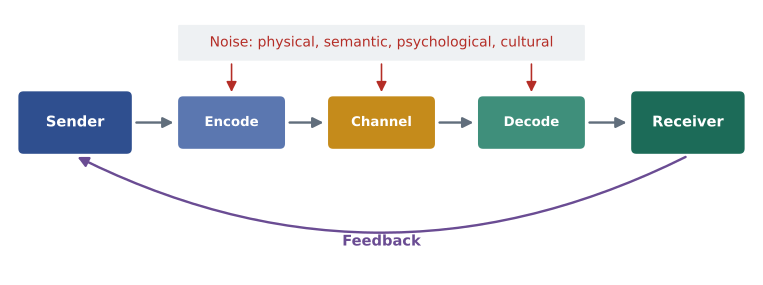
The key lesson of the model is that meaning is not transferred; it is constructed by the receiver. You may write a perfectly accurate sentence, but if the reader does not share your vocabulary or assumptions, they will build a different meaning from it. That is why feedback matters so much. Good communicators look for evidence that the message was understood as intended: a reply that restates the request, a question in a meeting, a completed task, a dashboard showing that customers clicked the right link.
Worked problem
Diagnosing a failed message
A project manager sent this email to a team of eight: "Please make sure the deck is updated by EOD with the latest figures from finance." The next morning, three different versions of the slide deck existed, two used last month's figures and one team member in Vancouver had worked until 9 p.m. Pacific time while the manager, in Toronto, meant 5 p.m. Eastern. Use the communication model to diagnose what went wrong.
Show solution
- Sender and encoding: the manager assumed everyone knew which deck, which figures and whose end of day was meant. The message was encoded with private context.
- Semantic noise: "EOD" is ambiguous across time zones, and "latest figures" could mean the preliminary or final numbers.
- Channel: an email to eight people with no named owner invited everyone to act and no one to coordinate.
- Feedback: no one was asked to confirm, so the misunderstanding only surfaced the next morning.
- A better message: "Priya, please update slides 4 to 7 of Q3-Board-v2 with the final September figures that finance sent on Monday (attached). Please send it to me by 3 p.m. Eastern (noon Pacific) on Thursday. Everyone else: no action needed."
Answer: The failure came from encoding with private assumptions, ambiguous terms, a channel with no owner and no feedback loop. Naming one owner, one file, one source and one time zone fixes all four.
Why communication fails
Most workplace communication failures fall into a small number of patterns. Recognizing them is the first step to avoiding them.
- Unclear purpose. The writer did not decide what they wanted, so the reader cannot tell either. Long messages that end with "Thoughts?" often have this problem.
- Wrong audience assumptions. The writer assumed knowledge the reader does not have, or over-explained to an expert.
- Buried main point. The request or decision is in paragraph four, after the background. Busy readers stop before they reach it.
- Wrong channel. Bad news delivered by text message, a complex negotiation by email, or a quick question scheduled as a one-hour meeting.
- Tone mismatch. A curt message read as anger, or an overly casual note to a senior client.
- Information overload. Too many messages, too long, sent to too many people, so important ones are missed.
- No feedback loop. The sender assumes understanding instead of checking for it.
The cost of these failures is real. Unclear instructions cause rework, misread emails damage relationships, and slow decisions delay projects. One way to make that cost visible is to estimate the time a team spends reading and writing messages.
Worked problem
The cost of a long email
A manager sends a weekly update email of 900 words to 40 employees. Assume an average reading speed of 240 words per minute for workplace prose and an average loaded labour cost of $55 an hour per employee. A rewrite that leads with the three decisions and links to details cuts the email to 300 words. How much reading time and cost does the rewrite save per year (50 weeks)?
Show solution
- Original reading time per person = 900 ÷ 240 = 3.75 minutes.
- Rewritten reading time per person = 300 ÷ 240 = 1.25 minutes.
- Time saved per person per week = 2.5 minutes; for 40 people that is 100 minutes, or about 1.67 hours.
- Annual time saved = 1.67 hours × 50 weeks ≈ 83 hours.
- Annual cost saved = 83.3 hours × $55 ≈ $4,580.
Answer: The shorter email saves about 83 hours of reading a year, worth roughly $4,600 in labour, before counting the benefit of readers actually finding the decisions.
Choosing a channel
Channels differ in richness: how many cues they carry and how quickly feedback arrives. A face-to-face conversation is the richest channel, with words, tone, facial expression, gesture and instant feedback. A video call is close behind. A phone call loses the visual cues. Instant messages and emails carry only text (plus emoji and formatting), and feedback may be slow. Formal reports and letters are the leanest but the most permanent and the easiest to review. Media richness theory suggests matching the channel to the task: rich channels for ambiguous, emotional or complex messages, and lean channels for routine, factual messages that need a record.
| Channel | Richness | Speed of feedback | Permanence | Best for |
|---|---|---|---|---|
| In-person conversation | Very high | Immediate | Low unless minuted | Sensitive news, negotiation, coaching, relationship building |
| Video call | High | Immediate | Low; can be recorded | Remote discussion, interviews, team check-ins |
| Phone call | Medium | Immediate | Low | Quick clarification, urgent issues, personal follow-up |
| Instant message or chat | Low to medium | Fast | Medium; archived | Quick questions, coordination, informal updates |
| Low | Hours to days | High | Requests, confirmations, records, external contacts | |
| Memo or report | Low | Slow | Very high | Policies, analysis, decisions that need review |
| Social media post | Low | Fast and public | Very high | Announcements, brand building, customer engagement |
Two practical rules help. First, escalate richness when things get difficult: if an email thread has gone back and forth three times without agreement, or if emotion is rising, switch to a call. Second, follow up rich conversations with a lean record: after an important call, send a short email summarizing what was agreed, who will do what and by when. That combination gives you the nuance of a conversation and the reliability of a written record.
Worked problem
Choosing channels for one situation
A team leader must tell a staff member that their request for a schedule change has been declined, explain the reason, offer an alternative and make sure there is a record. Which channel or combination of channels fits best?
Show solution
- The message is negative and personal, so a lean channel alone (an email or chat message) risks seeming cold and invites misreading.
- A rich channel lets the leader show empathy, hear the staff member's concerns and discuss the alternative.
- Because scheduling decisions may matter later, a written record is also needed.
- Plan: a short private conversation (in person or by video), followed the same day by a brief email that restates the decision, the reason and the alternative offered.
Answer: Use a rich channel for the conversation and a lean channel for the record. Neither alone serves both needs.
Communication in organizations
Information moves through an organization in several directions. Downward communication flows from managers to staff: goals, instructions, policies and feedback. Upward communication flows from staff to managers: reports, ideas, concerns and requests. Horizontal or lateral communication connects peers and departments, and is where much coordination happens. External communication connects the organization with customers, suppliers, investors, regulators and the public. Each direction has typical problems. Downward messages can be distorted as they pass through layers of management. Upward messages can be filtered because people hesitate to share bad news. Lateral messages can be slowed by silos and competing priorities.
Alongside the formal channels shown on the organization chart, every workplace has an informal network, often called the grapevine. The grapevine is fast and often surprisingly accurate, but it also spreads rumours, especially when official information is missing. Leaders who communicate early and honestly during change leave less room for rumours. Psychological safety, the shared belief that it is safe to speak up, ask questions and admit mistakes, is strongly linked to how well teams share upward and lateral information. Teams with high psychological safety report problems sooner and learn faster.
| Direction | Typical messages | Common problem | Remedy |
|---|---|---|---|
| Downward | Goals, instructions, policies, feedback | Distortion through layers; too little context | Explain the why; check understanding; use several channels |
| Upward | Reports, ideas, concerns, requests | Bad news filtered out | Ask open questions; reward candour; hold skip-level meetings |
| Horizontal | Coordination, problem solving, handoffs | Silos, duplicated work | Shared tools, cross-team meetings, clear owners |
| External | Sales, service, investor and regulatory reports | Inconsistent messages | Approved key messages, style guides, spokespersons |
| Informal | Rumours, social news, unofficial advice | Misinformation when official news is late | Communicate early and openly during change |
Communicating in hybrid and remote workplaces
Many organizations now work in hybrid patterns, with some people in the office and others at home or in other cities. Hybrid work makes written communication more important, because more coordination happens asynchronously in email, chat, shared documents and project tools. It also makes it easier for remote colleagues to be left out of hallway conversations. Effective hybrid teams agree on norms: which channel to use for what, expected response times, core hours for meetings, how to record decisions and how to include remote participants fairly in meetings.
Worked problem
Writing a team communication charter
A hybrid team of nine people in Halifax, Toronto and Calgary keeps missing messages. Draft five norms for a one-page team communication charter.
Show solution
- Channels: chat for quick questions and coordination; email for external contacts and anything that needs a record; the project tool for tasks and deadlines; video calls for discussion and decisions.
- Response times: chat within four working hours; email within one working day; urgent issues by phone.
- Time zones: core meeting hours are 11 a.m. to 3 p.m. Eastern, which is noon to 4 p.m. in Halifax and 9 a.m. to 1 p.m. in Calgary, and every deadline names a time zone.
- Decisions: every decision is recorded in the team's decision log within 24 hours, with the owner and date.
- Meetings: every meeting has an agenda sent a day ahead; if one person is remote, everyone joins from their own device so all participants are equal.
Answer: A short, specific charter turns vague good intentions into shared habits and reduces missed messages.
The professional communicator's mindset
The rest of this course will give you many techniques, but they rest on a few attitudes. Respect the reader's time and intelligence. Be honest, even when the news is unwelcome. Take responsibility for being understood rather than blaming the reader. Seek feedback and revise. Be aware that people differ in culture, language, ability and experience, and adapt rather than assume. Finally, remember that every message also builds or erodes your reputation. People judge competence partly by communication: a clear, well-organized email signals a clear, well-organized mind.
Portfolio task for lesson 1: collect three workplace messages you have received recently (with confidential details removed). For each, identify the purpose, the intended audience and the channel, and note one way it could have been clearer. Keep your notes; you will revise one of these messages in lesson 4.
Common mistakes
MistakeAssuming that a clear sentence will be understood as intended.
InsteadRemember that the receiver constructs meaning; check understanding through feedback.
MistakeUsing whatever channel is most convenient for you.
InsteadChoose the channel that fits the message: rich for complex or emotional topics, lean for routine records.
MistakeStarting with background and ending with the request.
InsteadLead with the purpose or main point, then give supporting detail.
MistakeSending a message to many people with no named owner.
InsteadName who should act, what they should do and by when.
MistakeWriting "by end of day" across time zones.
InsteadGive a specific time with a time zone, such as 3 p.m. Eastern.
MistakeTreating informal channels as private.
InsteadAssume chat messages and emails may be forwarded, archived or produced in legal proceedings.
Summary and key terms
- Business communication is purposeful, audience-centred, concise, accurate and permanent.
- In the transactional model, the sender encodes, the receiver decodes and both are affected by noise; meaning is built by the receiver.
- Common failures include unclear purpose, buried main points, wrong channel, tone mismatch, overload and no feedback.
- Match channel richness to the message: rich channels for complex or sensitive topics, lean channels for routine information and records.
- Information flows downward, upward, horizontally, externally and through the informal grapevine.
- Hybrid teams need explicit norms for channels, response times, time zones and decision records.
- Encoding
- Turning an idea into words, images or other signals.
- Decoding
- Interpreting a message to build meaning from it.
- Channel
- The medium through which a message travels, such as email or a meeting.
- Noise
- Anything that interferes with accurate communication.
- Feedback
- The receiver's response, which shows how the message was understood.
- Media richness
- The capacity of a channel to carry cues and allow rapid feedback.
- Grapevine
- The informal network through which information and rumours spread.
- Psychological safety
- The shared belief that it is safe to speak up, ask questions and admit mistakes.
- Asynchronous communication
- Communication in which people do not respond at the same time, such as email.
- Communication charter
- A team agreement on how, when and through which channels members communicate.
Practice problems
Work each problem on paper first, then reveal the answer to check.
Name the four kinds of noise and give an example of each.
Show answer
Physical (a poor video connection), semantic (jargon such as "EOD"), psychological (distrust after a conflict) and cultural (different expectations about directness).
Why is feedback essential in the transactional model?
Show answer
Because the receiver builds the meaning; feedback shows whether that meaning matches the sender's intent.
Which channel would you choose to tell a client that a delivery will be two weeks late?
Show answer
A phone or video call to explain and discuss options, followed by an email confirming the new date and any remedies.
A 600-word email goes to 25 people who read at 240 words per minute. How many person-minutes of reading does it take?
Show answer
600 ÷ 240 = 2.5 minutes per person; 2.5 × 25 = 62.5 person-minutes.
What is the grapevine, and when is it most active?
Show answer
The informal information network; it is most active when official information is missing, especially during change.
Give two reasons upward communication fails.
Show answer
People filter bad news to avoid blame, and managers may not ask or may react badly to problems.
Rewrite "Can someone look at this ASAP?" to be clearer.
Show answer
For example: "Sam, please review the attached contract clause 7 by 2 p.m. Eastern today and tell me whether legal sign-off is needed."
What is media richness theory's main recommendation?
Show answer
Match channel richness to the ambiguity and sensitivity of the message.
List three norms a hybrid team might agree on.
Show answer
Which channel to use for what, expected response times, and how decisions are recorded (also core hours and meeting practices).
Why does business communication need to assume permanence?
Show answer
Messages are archived, forwarded and may be produced in legal proceedings, so careless words can have lasting consequences.
Lesson quiz · 5 questions
Score 60% or more to complete this lesson.
Create a free account to save your progress, take quizzes and earn a certificate.