
BUS-120 · Lesson 6 of 12 · 29 min
Persuasive messages and proposals
Much of working life involves persuading people: convincing a manager to fund a project, a colleague to help, a customer to buy, a client to accept a proposal, a committee to change a policy. Persuasion in business is not manipulation. It is the honest work of showing people why an action is in their interest and making it easy for them to act. This lesson covers the foundations of persuasion, the AIDA pattern for persuasive messages, internal requests, sales messages and the structure of business proposals, including how to build and present a budget.
Foundations of persuasion
Aristotle identified three modes of persuasion more than 2,300 years ago, and they still describe how business arguments work. Ethos is credibility: the reader must trust the writer's competence, honesty and goodwill. Logos is logic and evidence: facts, figures, examples, comparisons and reasoning. Pathos is emotion and values: connecting the request to what the reader cares about, such as security, pride, fairness or the well-being of customers and staff. Strong business persuasion uses all three, with logos usually in the lead and ethos and pathos supporting it.
| Mode | Built by | Example in a request for new safety equipment |
|---|---|---|
| Ethos (credibility) | Expertise, track record, honesty about limits, credible sources | As the shift supervisor for six years, I have reviewed every incident report since 2022. |
| Logos (logic) | Data, cost comparisons, examples, clear reasoning | Hand injuries cost us $84,000 in lost time last year; cut-resistant gloves for 60 workers cost $7,200 a year. |
| Pathos (emotion and values) | Stories, shared values, the human impact | No one on this team should go home with stitches because we saved a few dollars on gloves. |
Research on influence, popularized by the psychologist Robert Cialdini, identifies principles that make people more likely to say yes: reciprocity (we return favours), commitment and consistency (we act in line with what we have already said), social proof (we follow what similar people do), authority (we defer to credible experts), liking (we say yes to people we like and who are like us), scarcity (we value what is limited) and unity (we favour people we see as part of our group). These principles are powerful, which is why they must be used honestly. Fake scarcity ("Only 2 left!" when there are hundreds) or fabricated testimonials are not only unethical but, in many cases, illegal.
The AIDA pattern
The AIDA pattern organizes persuasive messages in four steps: gain the reader's Attention, build Interest, create Desire and prompt Action. In practice, interest and desire often merge into one section that explains the benefits and supplies evidence. The pattern works for sales letters, fundraising appeals, internal requests to an uninterested reader and even cover letters (lesson 11).
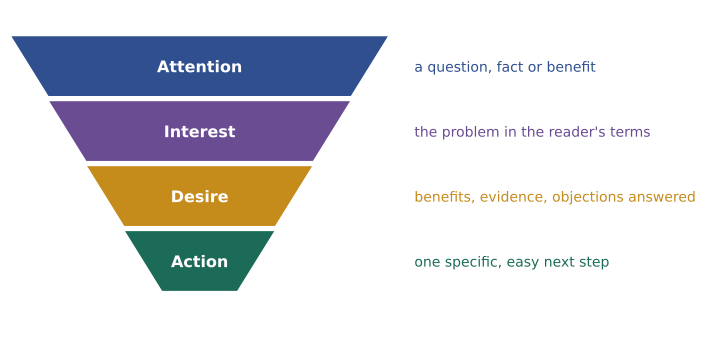
| Stage | Goal | Techniques |
|---|---|---|
| Attention | Make the reader want to keep reading | A relevant question, a striking fact, a benefit, a problem the reader recognizes |
| Interest | Show that the message is relevant | Describe the problem or opportunity in the reader's terms |
| Desire | Convince with benefits and evidence | Benefits rather than features, data, testimonials, guarantees, answers to objections |
| Action | Make the next step clear and easy | A specific action, a deadline or incentive, a link, a phone number |
Worked problem
An AIDA sales email, annotated
A Halifax company sells an app that lets restaurants take orders at the table by QR code. Write and annotate a short sales email to independent restaurant owners.
Show solution
- Attention (subject and opening): subject "Turn tables 15 minutes faster this summer"; opening "What would an extra table turn every Friday night be worth to you?"
- Interest: "On busy nights, guests wait to order, wait for the bill and wait to pay. Every minute of waiting is a minute the next party stands at the door."
- Desire (benefits and evidence): "With TableTap, guests scan a code, order and pay from their phones. Restaurants in our pilot cut average table time from 82 to 67 minutes, and average bills rose 9 % because guests reordered drinks without waiting. Setup takes one afternoon, and there is no hardware to buy."
- Answer an objection: "Worried about losing the personal touch? Your servers spend less time on payment and more time on hospitality."
- Action: "Book a 15-minute demo before June 30 and get your first three months free: [link], or call Maya at 902-555-0188."
Answer: Each stage moves the reader one step: a question about value, a problem they recognize, benefits backed by pilot data, an objection answered and one specific, time-limited action.
Benefits, features and evidence
Features describe what a product or proposal is; benefits describe what it does for the reader. "256-bit encryption" is a feature; "your customers' card details are protected to banking standards" is a benefit. Lead with benefits and support them with features as evidence. Then strengthen the case with evidence the reader will trust: specific numbers rather than vague claims, independent sources, case studies, testimonials from real customers, demonstrations, free trials and guarantees. Anticipate objections and answer them before the reader raises them; addressing the strongest counterargument openly also builds ethos.
Persuasive requests inside the organization
Internal persuasion often goes upward (to a manager or committee) or sideways (to a colleague in another department who owes you nothing). For upward requests, managers want to know the problem, the proposed solution, the cost, the benefits, the risks and how the request supports the organization's goals. Present your case as a business case, quantify where you can and offer options. For lateral requests, emphasize shared goals and what the colleague gains, keep the request small and specific, and make it easy to say yes.
Worked problem
Building a business case with payback
A customer service manager wants to buy a knowledge-base tool for $24,000 in setup costs plus $6,000 a year. She estimates it will cut average call time from 9.0 to 7.5 minutes across 60,000 calls a year, with agent time costing $36 an hour. Calculate the annual savings and the payback period, and draft the key sentence of the request.
Show solution
- Time saved per call = 9.0 − 7.5 = 1.5 minutes.
- Annual time saved = 1.5 × 60,000 = 90,000 minutes = 1,500 hours.
- Gross annual savings = 1,500 × $36 = $54,000.
- Net annual savings = $54,000 − $6,000 subscription = $48,000.
- Payback period = $24,000 ÷ $48,000 = 0.5 years, or about 6 months.
- Key sentence: "For a one-time cost of $24,000, the knowledge base would save about 1,500 agent hours, or $48,000 a year after fees, paying for itself in about six months."
Answer: Net savings of $48,000 a year give a payback of about six months. Leading with the payback in one sentence answers the decision-maker's main question immediately.
Business proposals
A proposal offers to solve a problem or meet a need, usually in exchange for money. Proposals may be solicited, written in response to a request for proposals (RFP), or unsolicited, offered on the writer's own initiative. They may be internal (asking your organization to fund a project) or external (offering services to a client). Solicited proposals must follow the RFP's instructions exactly: required sections, page limits, formats, deadlines and evaluation criteria. Many public-sector RFPs score proposals on a points system, so a proposal that ignores a required section can be disqualified regardless of its quality.
In Canada, federal government opportunities are posted on CanadaBuys, and provinces and municipalities run their own procurement portals; trade agreements such as the Canadian Free Trade Agreement set rules for open, fair tendering above set thresholds.
| Section | Content |
|---|---|
| Introduction or executive summary | The problem, your proposed solution and the main benefits, in a page or less |
| Background and need | Evidence that you understand the client's situation and problem |
| Proposed solution and approach | What you will do, how and why it will work |
| Deliverables and schedule | What the client will receive and when, often as a timeline or Gantt chart |
| Staffing and qualifications | Who will do the work and why they are qualified; past projects |
| Budget | Itemized costs, payment terms and assumptions |
| Evaluation and risks | How success will be measured; risks and how you will manage them |
| Conclusion and authorization | A summary of benefits and how to accept the proposal |
Worked problem
A proposal budget table
A small consulting firm is proposing a staff survey and report for a hospital. The work involves 40 hours of a senior consultant at $165 an hour, 80 hours of an analyst at $95 an hour, survey software licences of $1,200, and printing and travel of $850. The firm adds a 10 % contingency on labour only. Applicable sales tax of 13 % applies to the whole fee. Build the budget.
Show solution
- Senior consultant: 40 × $165 = $6,600.
- Analyst: 80 × $95 = $7,600.
- Labour subtotal = $6,600 + $7,600 = $14,200; contingency = 0.10 × $14,200 = $1,420.
- Expenses = $1,200 + $850 = $2,050.
- Subtotal before tax = $14,200 + $1,420 + $2,050 = $17,670.
- Tax = 0.13 × $17,670 = $2,297.10; total = $19,967.10.
Answer: The proposed price is $17,670 before tax and $19,967.10 with tax. Presenting it as a table with each line, rate and assumption shown builds trust.
| Item | Quantity | Rate | Amount |
|---|---|---|---|
| Senior consultant | 40 hours | $165/hour | $6,600.00 |
| Analyst | 80 hours | $95/hour | $7,600.00 |
| Contingency (10 % of labour) | $1,420.00 | ||
| Survey software licences | $1,200.00 | ||
| Printing and travel | $850.00 | ||
| Subtotal | $17,670.00 | ||
| Sales tax (13 %) | $2,297.10 | ||
| Total | $19,967.10 |
Persuading a resistant or sceptical reader
When the reader is likely to resist, open with common ground rather than the request: a goal you share, a problem you both recognize or a fact the reader already accepts. Then present the evidence, deal openly with the strongest objection and only then make the request, scaled so that saying yes feels safe. A small first step, such as a three-month pilot, a trial with one team or a review date, lowers the perceived risk and draws on the commitment and consistency principle. Offer options where you can, because people resist being cornered more than they resist change itself. Finally, respect the reader's right to say no: persuasion that leaves a decision-maker feeling manipulated wins one argument and loses the relationship. If the answer is no, ask what evidence would change it, and come back with that evidence later.
Honesty and the law in persuasive messages
Persuasive messages must be truthful. In Canada, the Competition Act prohibits false or misleading representations to the public, including misleading prices and drip pricing (advertising a price that cannot be obtained because of mandatory extra fees), and amendments in 2024 added rules on unsubstantiated environmental claims (greenwashing). The Competition Bureau can seek penalties, and the Act also allows private parties to seek orders in some cases. Commercial electronic messages are also subject to Canada's anti-spam legislation, CASL (lesson 12).
Beyond the law, persuasion depends on trust. Exaggerated claims may win one sale but lose the customer. A useful test is whether you would be comfortable if the reader later learned everything you knew when you wrote the message.
Portfolio task for lesson 6: write a one-page persuasive request to a decision-maker in an organization you know, asking for a resource (equipment, training, a process change). Use the AIDA pattern, include at least one calculation (savings, payback or cost per person) and answer one likely objection.
Common mistakes
MistakeListing features and assuming the reader will see the benefits.
InsteadTranslate each feature into a benefit for the reader, then use the feature as evidence.
MistakeUsing vague claims such as "significant savings".
InsteadQuantify: "about $48,000 a year, paying back in six months".
MistakeIgnoring the reader's likely objections.
InsteadAnticipate the strongest objection and answer it in the message.
MistakeEnding a persuasive message without a clear action.
InsteadClose with one specific, easy action and a reason to act now.
MistakeIgnoring an RFP's required format.
InsteadFollow every instruction on sections, page limits, format and deadline.
MistakeUsing fake urgency or invented testimonials.
InsteadUse only true scarcity, real testimonials and claims you can substantiate.
Summary and key terms
- Persuasion combines ethos (credibility), logos (logic and evidence) and pathos (emotion and values).
- Influence principles such as reciprocity and social proof are powerful and must be used honestly.
- AIDA: attention, interest, desire, action.
- Lead with benefits, support them with features and evidence, and answer objections.
- Internal requests should be framed as business cases with costs, benefits and payback.
- Proposals may be solicited or unsolicited; solicited proposals must follow the RFP exactly.
- Budgets should be itemized, with rates, assumptions, contingency and tax shown.
- Ethos
- Persuasion through the credibility of the writer.
- Logos
- Persuasion through logic and evidence.
- Pathos
- Persuasion through emotion and values.
- AIDA
- A persuasive pattern: attention, interest, desire, action.
- Benefit
- What a product or proposal does for the reader.
- Feature
- A characteristic of a product or proposal.
- Social proof
- The tendency to follow what similar people do.
- Request for proposals (RFP)
- A document in which an organization invites proposals for a defined need.
- Payback period
- The time needed for savings or income to recover an initial cost.
- Contingency
- An amount added to a budget to cover uncertain costs.
Practice problems
Work each problem on paper first, then reveal the answer to check.
Turn this feature into a benefit: "The laptop weighs 1.1 kg."
Show answer
"You can carry it all day without noticing it."
Which mode of persuasion is a cost comparison?
Show answer
Logos.
Write an attention-getting opening for a message promoting a staff wellness program.
Show answer
For example, "What if you could leave work with more energy than you came in with?"
A $15,000 system saves $5,000 a year net. What is the payback period?
Show answer
3 years.
Labour of 50 hours at $120 plus a 15 % contingency on labour comes to what?
Show answer
$6,000 + $900 = $6,900.
Name four sections of a typical proposal.
Show answer
Executive summary, background and need, proposed solution, schedule, staffing, budget, evaluation (any four).
What is the difference between a solicited and an unsolicited proposal?
Show answer
A solicited proposal responds to a request such as an RFP; an unsolicited proposal is offered on the writer's own initiative.
Why should you answer objections in a persuasive message?
Show answer
It removes reasons to say no before the reader raises them and builds credibility.
Give an example of unethical use of scarcity.
Show answer
Claiming "only 2 left" when there are hundreds in stock.
What does the action step of AIDA need?
Show answer
A specific, easy action, often with a deadline or incentive and a clear way to respond.
Lesson quiz · 5 questions
Score 60% or more to complete this lesson.
Create a free account to save your progress, take quizzes and earn a certificate.