
BUS-120 · Lesson 11 of 12 · 35 min
Employment communication
The job search is a persuasive communication project with you as the product. Every document and conversation, from the résumé to the thank-you note, is a chance to show an employer that you understand their needs and can meet them. Employment communication also runs the other way: employers write job postings, interview questions, offer letters and rejection messages, all of which are governed by human rights and employment law. This lesson covers both sides: preparing résumés and cover letters that get past screening software and impress people, interviewing well, following up and negotiating, and the legal rules on what employers may ask and must disclose in Canada and the United States.
How hiring works
Most employers screen applicants in stages. Many large employers use an applicant tracking system (ATS) to collect applications and help recruiters search and rank them by keywords and qualifications. A recruiter or hiring manager then scans the shortlisted résumés, often for well under a minute each on the first pass. Promising candidates move to a phone or video screen, then one or more interviews, sometimes with a skills test or work sample, and finally reference checks and an offer. Because so many people apply for each posting, each stage eliminates most candidates.
Worked problem
Reading the hiring funnel
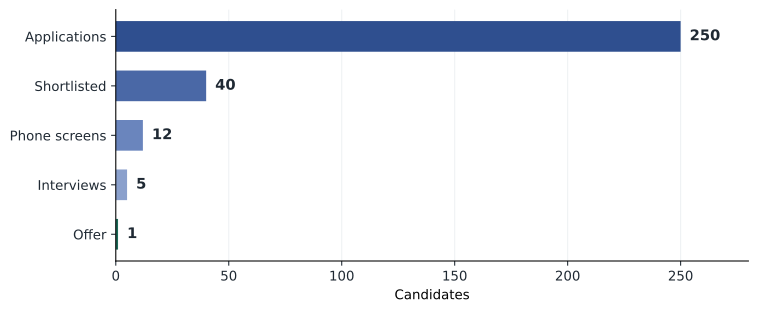
A posting attracted 250 applications. Forty were shortlisted after ATS and recruiter screening, 12 had phone screens, 5 were interviewed and 1 received an offer. Calculate the conversion rate at each stage and the overall odds for a typical applicant.
Show solution
- Application to shortlist = 40 ÷ 250 = 16 %.
- Shortlist to phone screen = 12 ÷ 40 = 30 %.
- Phone screen to interview = 5 ÷ 12 ≈ 42 %.
- Interview to offer = 1 ÷ 5 = 20 %.
- Overall = 1 ÷ 250 = 0.4 %.
Answer: The first screen is the steepest: 84 % of applicants never reach a person's shortlist. A tailored résumé that clearly matches the posting is the biggest single lever a candidate controls.
Résumés
A résumé is a concise, targeted marketing document, usually one or two pages, that summarizes your qualifications for a specific job. The most common format is reverse chronological: your most recent experience first. A functional or skills-based format, which groups experience by skill, can help career changers but is viewed with suspicion by some recruiters; a combination format, with a skills summary followed by a chronological history, is a practical compromise.
| Section | Content | Tips |
|---|---|---|
| Contact information | Name, city and province or state, phone, email, LinkedIn or portfolio link | A professional email address; no full street address needed |
| Summary or profile | Two or three lines connecting your strengths to the job | Tailor to each posting; avoid clichés such as "hard-working team player" |
| Skills | Technical skills, software, languages, certifications | Use the exact terms in the posting where they are true |
| Experience | Job title, employer, location, dates, achievement bullets | Start bullets with action verbs; quantify results |
| Education | Credential, institution, year; relevant courses or honours | Put education first if it is your strongest qualification |
| Optional | Volunteer work, projects, awards, professional memberships | Include when relevant to the job |
The heart of a strong résumé is its achievement bullets. Each bullet should begin with a strong action verb (led, reduced, built, negotiated, trained) and describe a result, ideally quantified. One useful formula is challenge, action, result (CAR): what problem you faced, what you did and what happened. Compare "Responsible for social media accounts" with "Grew Instagram followers from 2,100 to 9,800 in 10 months by launching a weekly customer-story series".
Worked problem
Rewriting résumé bullets
Rewrite these three duties-based bullets from a retail supervisor's résumé as achievement bullets: (a) "Responsible for scheduling staff"; (b) "Handled customer complaints"; (c) "Did inventory counts".
Show solution
- (a) "Built weekly schedules for 18 staff, cutting overtime hours by 22 % while maintaining coverage during peak periods."
- (b) "Resolved an average of 15 customer complaints a week; raised the store's satisfaction score from 3.9 to 4.5 out of 5 in one year."
- (c) "Led quarterly inventory counts of 4,000 products; introduced a scanner-based count that reduced count time from 14 to 8 hours."
- Check: each bullet starts with an action verb, shows scale and gives a measurable result. Percentage cut in count time = (14 − 8) ÷ 14 ≈ 43 %, which could also be stated.
Answer: Achievement bullets show what you accomplished and how well, not just what you were assigned to do.
To get past an ATS and a quick human scan, tailor each résumé to the posting. Mirror the posting's key terms where they truthfully apply (if the posting says "accounts payable", do not write only "vendor payments"). Use standard section headings and a simple layout without text boxes, tables or graphics, which some systems read poorly. Save in the format requested, usually Word or PDF. And never exaggerate or invent: credentials and past employers are easy to check, and misrepresentation is a common reason for withdrawn offers and dismissals.
Cover letters
A cover letter (or cover email) introduces your résumé and makes the case for why you fit this job at this organization. Not every employer reads them, but many do, and a well-targeted letter can distinguish you, especially for smaller employers or when you are changing careers. A cover letter follows the AIDA pattern from lesson 6. The opening names the position and grabs attention with your strongest qualification or a connection to the organization. The body builds interest and desire with one or two specific achievements that match the employer's needs. The close requests an interview and makes it easy to contact you. Keep it to one page, address it to a named person if possible and never send a generic letter that could go to any employer.
Worked problem
Annotating a cover letter opening
Compare two openings for a junior marketing analyst position at a Winnipeg outdoor equipment retailer. (A) "I am writing to apply for the position I saw advertised on your website. I believe I would be a great fit." (B) "As a lifelong canoeist who analyzed 40,000 customer reviews for my capstone project at Red River College, I was excited to see your posting for a junior marketing analyst."
Show solution
- A: generic; it does not name the position or the employer and makes a claim ("great fit") without evidence.
- B: names the position; connects personally to the employer's products; offers a specific, quantified achievement relevant to marketing analysis; signals enthusiasm.
- B also sets up the body: the next paragraph can explain what the review analysis found and how similar analysis could help the retailer.
Answer: Opening B attracts attention with relevance and evidence; opening A could have been sent to any employer.
Interviews
Interviews take many forms: phone or video screens, one-on-one interviews, panel interviews, group interviews and technical or case interviews. Most employers now use behavioural questions, which ask how you handled real situations in the past ("Tell me about a time you dealt with a difficult customer"), on the principle that past behaviour predicts future behaviour. Prepare for these with the STAR method: describe the situation, the task you faced, the action you took and the result. Prepare five to eight STAR stories that show the skills in the posting, and practise telling each in about two minutes.
Worked problem
A STAR answer
Answer the question: "Tell me about a time you had to meet a tight deadline."
Show solution
- Situation: "In my co-op term at a property management firm, our largest client asked for a full tenant survey report four days before their board meeting, two weeks earlier than planned."
- Task: "I was responsible for cleaning and analyzing the survey data from 620 tenants and drafting the charts."
- Action: "I set up a schedule with my manager, automated the data cleaning with a spreadsheet macro instead of doing it by hand, and drafted the charts while she wrote the narrative, checking in with her twice a day."
- Result: "We delivered the report a day early. The client approved the recommended maintenance budget, and the macro is now used for all of the firm's surveys."
Answer: The answer is specific, focuses on the candidate's own actions and ends with a measurable result and a lasting benefit.
Research the employer before the interview: its products, customers, recent news and the role's challenges. Prepare two or three thoughtful questions to ask ("What would success look like in the first six months?"). For video interviews, test your technology, choose a quiet, well-lit spot and look at the camera. After the interview, send a short thank-you email within 24 hours that thanks the interviewer, reinforces one point from the conversation and confirms your interest.
Negotiating an offer
When an offer arrives, thank the employer and ask for it in writing, along with time to consider it. Research the market rate for the role from salary surveys and posted ranges. Negotiate on the whole package, not just salary: vacation, flexible work, signing bonus, start date, training budget and job title can all be discussed. Make a specific, reasoned request based on market data and the value you bring, and keep the tone collaborative.
Worked problem
Evaluating a counter-offer
You receive an offer of $58,000 with three weeks of vacation. Posted ranges for similar roles in your city run from $56,000 to $66,000. You ask for $63,000. The employer counters with $61,000 plus a $2,000 signing bonus. What is the percentage increase in base salary, and what is the first-year value of the counter-offer compared with the original?
Show solution
- Base salary increase = ($61,000 − $58,000) ÷ $58,000 ≈ 5.2 %.
- First-year cash value of the counter = $61,000 + $2,000 = $63,000, the same as your request.
- Increase in first-year cash = $63,000 − $58,000 = $5,000, or about 8.6 %.
- Long-term view: the signing bonus is paid once, while the base salary affects future raises, which are often calculated as a percentage of base.
Answer: The counter raises base salary 5.2 % and first-year cash 8.6 %. Whether to accept depends on how you value the one-time bonus against a higher base for future raises.
The law on hiring communication
In Canada, hiring is governed by human rights legislation. Each province and territory has a human rights code (for example, Ontario's Human Rights Code and British Columbia's Human Rights Code), and the Canadian Human Rights Act covers federally regulated employers. These laws prohibit discrimination on protected grounds, which vary by jurisdiction but typically include race, colour, ancestry, place of origin, ethnic origin, citizenship, creed or religion, sex (including pregnancy), sexual orientation, gender identity and expression, age, marital and family status, and disability. Employers should not ask questions in job applications or interviews that directly or indirectly reveal these grounds, such as age, marital status, plans to have children, religious practices or place of birth, unless a legitimate job requirement applies. Questions about the ability to perform the essential duties of a job are allowed, and employers have a duty to accommodate disabilities to the point of undue hardship. Ontario added new job posting rules from January 1, 2026, for employers with 25 or more employees: publicly advertised postings must include the expected pay or a pay range (no wider than $50,000, for jobs paying $200,000 or less), disclose whether artificial intelligence is used to screen, assess or select applicants, state whether the job is an existing vacancy and not require Canadian experience, and employers must tell interviewed candidates whether a hiring decision has been made within 45 days of their last interview. Pay transparency laws also apply in British Columbia and Prince Edward Island, among others.
| Avoid asking | Lawful alternative focused on the job |
|---|---|
| How old are you? When did you graduate from high school? | Are you of legal age to work in this jurisdiction? (Where age is a legal requirement for the role.) |
| Where were you born? Is English your first language? | Are you legally entitled to work here? The role requires fluent written French and English; describe your experience writing in each. |
| Are you married? Do you have or plan to have children? | This role requires travel two weeks a month. Are you able to meet that requirement? |
| Do you have any disabilities? How many sick days did you take last year? | Can you perform the essential duties of this role, with or without accommodation? (After describing the duties.) |
| What religion do you practise? Which holidays do you observe? | The role requires some weekend shifts. Are you available for them? (Accommodation will be discussed if needed.) |
Candidates who are asked an improper question have several options: answer it if they are comfortable, redirect to the underlying job requirement ("If you are asking whether I can travel, yes, I can meet that requirement") or politely decline. A pattern of such questions may be grounds for a human rights or discrimination complaint.
Portfolio task for lesson 11: find a real job posting that interests you. Write a tailored one-page résumé with at least five quantified achievement bullets, a one-page cover letter using the AIDA pattern and three STAR stories that match the posting's requirements.
Common mistakes
MistakeListing duties ("Responsible for…") instead of achievements.
InsteadStart each bullet with an action verb and show a measurable result.
MistakeSending the same résumé to every posting.
InsteadTailor the summary, skills and bullets to each posting's key terms.
MistakeUsing text boxes, tables and graphics in a résumé.
InsteadUse a simple, single-column layout with standard headings that an ATS can read.
MistakeAnswering behavioural questions with generalities.
InsteadUse the STAR method with a specific situation and a measurable result.
MistakeAccepting or rejecting an offer on the spot.
InsteadThank the employer, ask for the offer in writing and take time to evaluate the whole package.
MistakeAsking interview questions about age, family or religion.
InsteadAsk only about the ability to meet genuine job requirements.
Summary and key terms
- Hiring is a funnel; the first screen, often by ATS and recruiter scan, eliminates most applicants.
- Résumés should be targeted, with achievement bullets that start with action verbs and quantify results.
- Cover letters follow AIDA and should be specific to the employer and role.
- Prepare for behavioural interviews with STAR stories, research the employer and send a thank-you within 24 hours.
- Negotiate on the whole package with market data, and weigh one-time bonuses against base salary.
- Provincial and territorial human rights codes and the Canadian Human Rights Act prohibit discriminatory questions; Ontario requires pay ranges and AI disclosure in public job postings from 2026.
- Applicant tracking system (ATS)
- Software that collects, searches and ranks job applications.
- Reverse chronological résumé
- A résumé listing the most recent experience first.
- Achievement bullet
- A résumé bullet that describes an action and its measurable result.
- Cover letter
- A letter that introduces a résumé and argues for the candidate's fit.
- Behavioural question
- An interview question about how the candidate handled a past situation.
- STAR method
- A structure for answers: situation, task, action, result.
- Protected ground
- A characteristic, such as age or religion, on which discrimination is prohibited.
- Duty to accommodate
- The legal obligation to adjust work or hiring to meet a protected need, short of undue hardship.
- Pay transparency
- Laws requiring employers to disclose pay ranges in job postings.
- Conditional offer
- A job offer that depends on conditions such as reference or background checks.
Practice problems
Work each problem on paper first, then reveal the answer to check.
Rewrite: "Responsible for training new hires."
Show answer
For example, "Trained 24 new hires in 2025, cutting average time to full productivity from six to four weeks."
Of 180 applicants, 27 are shortlisted. What is the shortlist rate?
Show answer
15 %.
What does STAR stand for?
Show answer
Situation, task, action, result.
Why should a résumé avoid text boxes and tables?
Show answer
Some applicant tracking systems read them poorly, so content may be lost.
An offer rises from $52,000 to $55,120. What is the percentage increase?
Show answer
6 %.
Name two items besides salary that can be negotiated.
Show answer
Vacation, flexible work, signing bonus, start date, training budget, title (any two).
Rewrite "Do you have young children?" as a lawful question.
Show answer
"This role requires occasional evening work. Are you able to meet that requirement?"
What must public job postings in Ontario include from January 1, 2026, for employers with 25 or more employees?
Show answer
The expected pay or a pay range, a disclosure of any AI used in screening, whether the job is an existing vacancy, and no Canadian experience requirement.
When should you send a thank-you note after an interview?
Show answer
Within 24 hours.
How can a candidate respond to an improper question?
Show answer
Answer if comfortable, redirect to the job requirement, or politely decline.
Lesson quiz · 5 questions
Score 60% or more to complete this lesson.
Create a free account to save your progress, take quizzes and earn a certificate.