
CHEM-103 · Lesson 12 of 12 · 30 min
Case studies and course project
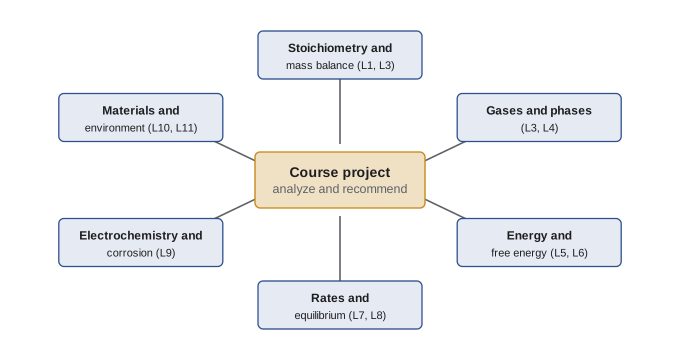
Real engineering problems do not arrive labelled by lesson. A parking garage that is crumbling after fifteen years involves diffusion, equilibrium, electrochemistry and materials chemistry at once; a water treatment plant needs stoichiometry, solubility and kinetics; choosing between hydrogen and batteries for trucks involves thermochemistry, free energy and electrochemistry. This final lesson works through three such case studies in depth, showing how the tools of the course combine, and then sets out a course project in which you carry out a similar analysis of a system of your choice.
How to approach a chemistry-based engineering problem
Each case study below follows the same pattern, which is worth adopting as a habit:
- Identify the chemistry. Write the balanced reactions involved, including side reactions that cause problems.
- Decide what controls the outcome: how much (stoichiometry and mass balance), whether it can happen (ΔG and equilibrium), how fast (kinetics or transport), and what energy is involved.
- Gather data from reliable sources: tables of properties, codes and standards, manufacturer data or measurements, and note their uncertainty.
- Calculate, starting with simple estimates and refining only where the decision depends on it.
- Check against experience: compare with measured values, typical ranges or another method.
- Recommend, stating the assumptions and the trade-offs among cost, durability, safety and environmental impact.
Case study 1: corrosion of a parking structure
A municipality owns a fifteen-year-old reinforced concrete parking garage in a city that uses large quantities of de-icing salt. Cars carry salty slush onto the decks every winter. Inspectors find rust stains, cracks parallel to the reinforcing bars and patches where the concrete cover has spalled off, exposing corroded steel. The municipality wants to know why, and what the designers of its next garage should do differently.
The chemistry links several lessons. Fresh concrete's pore solution has a pH near 13 because of calcium hydroxide from cement hydration (Lesson 10), and at that pH a thin passive oxide film protects the steel (Lesson 9). Chloride ions from the salt dissolve in water on the deck and diffuse slowly into the concrete through its pore network. When the chloride concentration at the depth of the steel exceeds a threshold, roughly 0.05 % of the concrete's mass (about 0.4 % of the cement's), the passive film breaks down locally and corrosion begins. The steel becomes an anode, Fe → Fe²⁺ + 2e⁻, while nearby steel serves as the cathode for O₂ + 2H₂O + 4e⁻ → 4OH⁻. The rust that forms occupies two to six times the volume of the iron it replaces, and the expansion cracks the concrete, which lets in more salt, water and oxygen and accelerates the damage.
The time to corrosion initiation is controlled by diffusion. For a constant surface concentration C_s, Fick's second law gives the chloride concentration at depth x after time t as:
where D is the apparent chloride diffusion coefficient of the concrete and erf is the error function, a standard function in Python's math module. Setting C equal to the threshold and solving for t gives the initiation time for any cover depth and concrete quality.
import math

Cs, Ct = 0.50, 0.05     # surface and threshold chloride, percent by mass of concrete
target = 1 - Ct / Cs    # erf(z) must reach this value at the bar depth

lo, hi = 0.0, 3.0       # solve erf(z) = target by bisection
for _ in range(60):
    mid = (lo + hi) / 2
    if math.erf(mid) < target:
        lo = mid
    else:
        hi = mid
z = (lo + hi) / 2
print(f"erf(z) = {target:.2f} at z = {z:.4f}")

year = 365.25 * 24 * 3600
mixes = [("w/c 0.50", 2.0e-12), ("w/c 0.40", 1.0e-12), ("w/c 0.40 + slag", 0.3e-12)]
for name, D in mixes:
    times = []
    for cover in [0.040, 0.050, 0.060]:          # concrete cover to the bar, m
        t = (cover / (2 * z)) ** 2 / D / year    # years until chloride at bar reaches threshold
        times.append(f"{t:6.1f}")
print(f"{name:16s} D = {D:.1e} m2/s 40/50/60 mm cover: " + " ".join(times) + " years")erf(z) = 0.90 at z = 1.1631 w/c 0.50 D = 2.0e-12 m2/s 40/50/60 mm cover: 4.7 7.3 10.5 years w/c 0.40 D = 1.0e-12 m2/s 40/50/60 mm cover: 9.4 14.6 21.1 years w/c 0.40 + slag D = 3.0e-13 m2/s 40/50/60 mm cover: 31.2 48.8 70.3 years
Because the time grows with the square of the cover and inversely with D, both matter enormously. A garage built with 40 mm of cover and ordinary concrete (w/c 0.50) begins corroding within about five years, consistent with the damage the inspectors found once several more years of corrosion are added for cracking to appear. Lowering the water-to-cement ratio to 0.40 roughly doubles the time; adding slag or fly ash, whose additional hydration products refine the pore structure, cuts D by a further factor of three or more; and adding 20 mm of cover more than doubles the time again.
These results explain the requirements of CSA A23.1 for concrete exposed to chlorides (class C-1): a maximum water-to-cementing materials ratio of 0.40, a minimum strength of 35 MPa, air entrainment for freeze–thaw resistance and 60 mm of cover. CSA S413, the standard for parking structures, adds waterproofing membranes or sealers on the decks, drainage slopes so that salty water does not pond, and, in severe cases, corrosion-resistant reinforcement.
Options for the new garage, in rising cost, include a low-permeability mix with slag or fly ash; increased cover; penetrating sealers or a traffic membrane renewed every ten to fifteen years; epoxy-coated, galvanized or stainless steel reinforcement; glass-fibre-reinforced polymer bars, which cannot rust; and impressed-current cathodic protection (Lesson 9). For the existing garage, repairs involve removing chloride-contaminated concrete around corroded bars, cleaning or replacing the steel, patching, and applying a membrane; galvanic zinc anodes embedded in the patches prevent new corrosion from starting at their edges.
The case also shows the limits of a simple model. Real surface concentrations build up over the first years; D decreases as concrete matures; cracks provide shortcuts; and corrosion rates depend on moisture and temperature. Engineers use more refined service-life models, calibrated with cores taken from existing structures, but the simple model captures the essential dependence on cover and concrete quality.
Case study 2: chemical demand at a water treatment plant
A conventional water treatment plant serving a town of 120 000 people treats 50 ML (50 000 m³) of river water per day. Jar tests show that an alum dose of 30 mg/L gives the best coagulation; the chlorine demand of the filtered water is 1.0 mg/L, and the plant wants a residual of 1.5 mg/L leaving the clearwell. The operators need daily chemical quantities, sludge production and the effect on alkalinity.
Alum is aluminium sulphate, commonly sold as Al₂(SO₄)₃·14H₂O (594.4 g/mol). It reacts with the water's natural bicarbonate alkalinity to form aluminium hydroxide flocs:
Worked problem
Daily quantities
Find the daily alum use, the aluminium hydroxide sludge produced, the alkalinity consumed and the chlorine needed.
Show solution
- Since 1 mg/L equals 1 g/m³, alum per day = 30 g/m³ × 50 000 m³ = 1500 kg.
- Al(OH)₃ formed: 2 × 78.00 g per 594.4 g of alum, so 1500 × 156.0/594.4 = 394 kg/day of dry hydroxide, plus the river solids it captures.
- Alkalinity: 6 HCO₃⁻ per alum is equivalent to 3 CaCO₃ (300.3 g), so each mg/L of alum consumes 300.3/594.4 = 0.51 mg/L of alkalinity as CaCO₃; 30 mg/L consumes about 15 mg/L.
- Chlorine: dose = demand + residual = 2.5 mg/L, so 2.5 × 50 000 = 125 kg/day.
Answer: About 1.5 t of alum, 125 kg of chlorine and roughly 0.4 t of dry hydroxide sludge per day, plus the captured silt. If the river's alkalinity were below about 30 mg/L as CaCO₃, the alum would push the pH too low for good floc formation (Lesson 8), and the plant would need to add lime or soda ash. The CO₂ released also lowers the pH, which helps keep chlorine in its more effective HOCl form (Lesson 11) but makes the water more corrosive to pipes, so many plants adjust the pH upward before the water enters the distribution system.
Kinetics enters at the other end of the plant: chlorine decays in the mains (Lesson 7), so the residual must be high enough at the plant to survive to the farthest customer, but not so high that it forms excessive disinfection by-products, such as trihalomethanes, by reacting with natural organic matter. Operators balance these by removing organic matter with enhanced coagulation, moving the chlorination point, or switching to chloramine for the distribution system. The sludge, mostly aluminium hydroxide and silt, must be thickened, dewatered and disposed of, a significant cost in its own right.
Case study 3: hydrogen or batteries for heavy trucks
A freight company wants to replace diesel trucks on a regional route and is choosing between hydrogen fuel-cell trucks and battery-electric trucks, both charged from the same low-carbon electricity grid. The chemistry of energy conversion sets the comparison.
For hydrogen, electricity first splits water in an electrolyzer. The minimum electrical energy is ΔG, 237 kJ per mole of H₂ (1.23 V per cell, Lessons 6 and 9), but the full energy content is ΔH, 286 kJ/mol, and real electrolyzers operate at about 1.8 to 2.0 V per cell because of electrode overpotentials and resistance. One kilogram of H₂ (496 mol) has a higher heating value of 141.8 MJ, or 39.4 kWh, and electrolyzers use about 53 kWh per kilogram, about 74 % efficient on that basis. The hydrogen must then be compressed to 35 to 70 MPa or liquefied, using another 3 to 12 kWh/kg, transported and dispensed. In the truck, a fuel cell converts it back to electricity at about 50 % of the lower heating value (33.3 kWh/kg), delivering about 16.7 kWh per kilogram to the motors.
Worked problem
Comparing well-to-wheel efficiency
Using about 53 kWh/kg for electrolysis, 5 kWh/kg for compression and 16.7 kWh of fuel-cell output per kilogram, compare the electricity reaching the motor with that of a battery truck whose charging and battery round trip is about 88 % efficient.
Show solution
- Hydrogen: 16.7/(53 + 5) = 0.29, so about 29 % of the grid electricity reaches the motor.
- Battery: about 88 %, from charger losses of a few percent and the battery's high round-trip efficiency, because lithium-ion cells convert energy with low overpotentials (Lesson 9).
- Ratio: 0.88/0.29 = 3.0.
Answer: A hydrogen truck needs about three times as much electricity per kilometre as a battery truck. Hydrogen's advantages are fast refuelling, lower vehicle weight for long ranges and independence from grid capacity at the depot; batteries win on energy efficiency and cost of fuel. The choice depends on route length, payload, electricity price and infrastructure, and many analysts expect batteries for regional routes and hydrogen or other fuels for some long-haul and remote applications. If the hydrogen came from steam methane reforming without carbon capture, its emissions, at least 5.5 kg of CO₂ per kilogram from the chemistry alone (Lesson 11), would erase much of the benefit over diesel.
Safety chemistry also differs. Hydrogen has very wide flammability limits in air (4 to 75 %), very low ignition energy and burns with an almost invisible flame, but it is light and disperses quickly upward; facilities need ventilation, leak detection and flame detectors. Lithium-ion batteries can undergo thermal runaway (Lesson 7) if damaged, overcharged or overheated, releasing flammable and toxic gases; battery management systems, cell spacing, cooling and fire protection address that risk. Neither is inherently safe or unsafe; each needs the right engineering.
Course project
The course project asks you to analyze a real engineering system in which chemistry governs performance, cost, safety or environmental impact, and to recommend an improvement. Suitable topics include:
- The fuel and emissions of a heating plant, generator or vehicle fleet, with options to reduce CO₂, NOₓ or SO₂.
- The durability of a concrete or steel structure in an aggressive environment, with a corrosion-control strategy.
- The chemical demand, sludge and by-products of a water or wastewater treatment process.
- A battery, fuel cell or hydrogen system for a specific application.
- The material choice for a component exposed to heat, chemicals, sunlight or seawater.
- The process chemistry and carbon footprint of a product, such as cement, steel, aluminium or fertilizer.
Your report, about ten pages, should:
- Describe the system and the question to be answered.
- Write the balanced reactions and identify the governing principles (stoichiometry, gas behaviour, thermochemistry, equilibrium, kinetics, electrochemistry or materials chemistry).
- Carry out at least three quantitative calculations, such as a mass balance, an energy or emissions estimate, an equilibrium or rate calculation, or a corrosion or service-life estimate, with a short Python script for at least one of them.
- Compare at least two alternatives on technical performance, cost, safety and environmental impact.
- Check your numbers against published values or a second method, and state the main assumptions and uncertainties.
- Make a clear recommendation and identify the codes, standards or regulations that apply.
Looking back and ahead
This course began with counting atoms and ends with designing garages, water plants and truck fleets. The common thread is that chemistry is quantitative: the same balanced equation that tells a student how much CO₂ a gram of propane makes tells an engineer how much limestone a scrubber needs, and the same free energy that predicts whether a reaction can happen sets the voltage of a fuel cell. Later courses build on these foundations: thermodynamics and heat transfer extend Lessons 4 to 6; materials science extends Lessons 2 and 10; environmental engineering extends Lessons 7, 8 and 11; and electrical and chemical engineering courses extend Lesson 9. In practice, the chemistry you have learned will appear whenever you specify a material, choose a fuel, protect a structure or treat water, and the habit of writing the reaction and doing the arithmetic will serve you throughout your career.
Common mistakes
MistakeAnalyzing only one aspect of a problem, such as cost.
InsteadConsider performance, durability, safety and environmental impact together.
MistakeTreating a simple model's output as exact.
InsteadUse simple models to find what matters, and state their assumptions.
MistakeComparing energy options by vehicle efficiency alone.
InsteadFollow the energy from its source to the wheels, including production and storage losses.
MistakeForgetting side reactions and by-products.
InsteadAccount for sludge, CO₂ from scrubbing and disinfection by-products.
MistakeSkipping the check against real data.
InsteadCompare with measurements, typical ranges or a second method before recommending.
Summary and key terms
- Real problems combine stoichiometry, thermodynamics, kinetics, electrochemistry and materials.
- Chloride diffusion controls corrosion initiation in concrete; time grows with cover squared and falls with D.
- Low w/c, supplementary materials, cover and membranes extend the life of salt-exposed structures.
- Water treatment chemical quantities follow from dose × flow; alum consumes alkalinity and makes sludge.
- Hydrogen trucks need about three times the electricity of battery trucks per kilometre.
- The course project applies at least three quantitative analyses to a real system.
- Write the reaction, do the arithmetic, check it and state the trade-offs.
- Chloride threshold
- The chloride concentration at which steel in concrete loses its passivity.
- Diffusion coefficient
- A measure of how fast a substance migrates through a material.
- Error function
- The function erf(z) appearing in solutions of the diffusion equation.
- Corrosion initiation
- The time when conditions at the steel first allow corrosion to begin.
- Jar test
- A bench-scale test to find the best coagulant dose for a water.
- Chlorine demand
- Chlorine consumed by reactions in water before a residual remains.
- Disinfection by-products
- Compounds formed when disinfectants react with organic matter.
- Well-to-wheel efficiency
- The fraction of source energy that reaches a vehicle's wheels.
- Overpotential
- Extra voltage beyond the thermodynamic value needed to drive an electrode reaction.
- Service-life model
- A model predicting how long a structure performs before major repair.
Practice problems
Work each problem on paper first, then reveal the answer to check.
Using the code output, what initiation time does w/c 0.40 concrete with 60 mm cover give?
Show answer
About 21 years.
By what factor does doubling the cover change the initiation time?
Show answer
Four, since t is proportional to x².
If D is halved, how does the initiation time change?
Show answer
It doubles.
Why does rust crack concrete?
Show answer
Rust occupies several times the volume of the steel, creating expansive pressure.
Name two ways to protect rebar in a new garage other than better concrete.
Show answer
For example, more cover, a waterproofing membrane, coated or stainless bars, FRP bars or cathodic protection.
A plant treats 20 000 m³/day with 25 mg/L of alum. Find the daily alum use.
Show answer
25 × 20 000 g = 500 kg.
How much alkalinity as CaCO₃ does that dose consume?
Show answer
25 × 0.51 ≈ 12.6 mg/L.
Find the chlorine dose for a demand of 0.8 mg/L and a target residual of 1.2 mg/L.
Show answer
2.0 mg/L.
If electrolysis used 50 kWh/kg and compression 4 kWh/kg, what fraction of electricity would reach the motor of a fuel-cell truck delivering 16.7 kWh/kg?
Show answer
16.7/54 = 31 %.
List three governing principles you would apply to analyze a coal-to-gas conversion of a boiler.
Show answer
For example, combustion stoichiometry, emission factors from carbon content, and SO₂ and NOₓ formation chemistry.
Lesson quiz · 5 questions
Score 60% or more to complete this lesson.
Create a free account to save your progress, take quizzes and earn a certificate.