
CHEM-103 · Lesson 6 of 12 · 32 min
Entropy, free energy and spontaneity
Lesson 5 measured the heat a reaction releases or absorbs. But heat alone does not tell you whether a reaction will happen. Most spontaneous reactions are exothermic, like burning fuel or rusting iron, yet ice melts on its own at room temperature while absorbing heat, salts such as ammonium nitrate dissolve while cooling the water (the basis of instant cold packs), and limestone, stable for millions of years in the ground, decomposes in a kiln at 900 °C. Something besides energy decides the direction of change. That something is entropy, and combining it with enthalpy gives the Gibbs free energy, the single quantity that predicts whether a process can occur, how far it will go, and how much useful work it can deliver. This lesson develops these ideas and applies them to lime kilns, ammonia synthesis, metal smelting, power plants and fuel cells.
Spontaneous processes
A spontaneous process is one that, once started, proceeds on its own without continuous outside help. Heat flows from hot to cold; gas expands to fill a container; sugar dissolves in coffee; iron rusts in moist air. The reverse processes never happen by themselves: you have to supply work, as a refrigerator does to move heat from cold to hot, or as an electrolysis cell does to turn rust back into iron.
Spontaneous does not mean fast. Diamond is thermodynamically unstable with respect to graphite at room conditions, but the conversion is immeasurably slow; a mixture of hydrogen and oxygen can sit for years until a spark sets it off. Thermodynamics, this lesson, tells you which direction a process can go and how far; kinetics, Lesson 7, tells you how fast it will go. An engineer needs both.
Entropy
Entropy, S, measures how many microscopic arrangements of a system's particles and energy are consistent with what we observe. The Austrian physicist Ludwig Boltzmann expressed it as S = k ln W, where W is the number of arrangements and k is Boltzmann's constant. A gas spread through a whole container has vastly more possible arrangements than the same gas squeezed into one corner, so spontaneous expansion is overwhelmingly probable. In practical terms, entropy increases when:
- A solid melts or a liquid evaporates (gases have far higher entropy than liquids, and liquids than solids).
- A reaction produces more moles of gas than it consumes.
- A solid or liquid dissolves, mixing two substances.
- The temperature rises, spreading energy over more levels.
- Molecules become larger and more complex.
Entropy is a state property with units of J/K (or J/(mol·K) for molar values). Unlike enthalpy, absolute entropies can be measured, because a perfect crystal at absolute zero has zero entropy (the third law of thermodynamics). Tables list standard molar entropies S° at 25 °C and 1 bar, and the entropy change of a reaction is found the same way as its enthalpy change: products minus reactants.
| Substance | S° (J/(mol·K)) | Substance | S° (J/(mol·K)) |
|---|---|---|---|
| C (diamond) | 2.4 | H₂O (l) | 70.0 |
| C (graphite) | 5.7 | H₂O (g) | 188.8 |
| Fe (s) | 27.3 | O₂ (g) | 205.2 |
| CaO (s) | 38.1 | N₂ (g) | 191.6 |
| CaCO₃ (s) | 92.9 | CO₂ (g) | 213.8 |
| NH₃ (g) | 192.8 | CH₄ (g) | 186.3 |
Worked problem
Entropy change of limestone calcination
Find ΔS° for CaCO₃(s) → CaO(s) + CO₂(g).
Show solution
- Products: 38.1 + 213.8 = 251.9 J/K.
- Reactants: 92.9 J/K.
- ΔS° = 251.9 − 92.9 = +159.0 J/K.
Answer: ΔS° ≈ +159 J/K per mole, large and positive because the reaction releases a mole of gas from a solid. The same reasoning predicts that N₂ + 3H₂ → 2NH₃, which turns four moles of gas into two, has a large negative entropy change (−198.7 J/K).
The second law of thermodynamics
The second law states that in any spontaneous process, the total entropy of the universe (system plus surroundings) increases:
A system's own entropy can decrease, as when water freezes or a living cell builds proteins, but only if the surroundings gain more. Heat released by the system to surroundings at temperature T raises their entropy by ΔS_surr = −ΔH_sys/T. The lower the temperature, the bigger the effect of a given amount of heat, which is why exothermic reactions are favoured at low temperatures.
Worked problem
Why water freezes below 0 °C
For freezing water, ΔH = −6.01 kJ/mol and ΔS = −22.0 J/(mol·K). Find ΔS_univ at −10 °C and at +10 °C.
Show solution
- At 263 K: ΔS_surr = 6010/263 = +22.9 J/K; ΔS_univ = −22.0 + 22.9 = +0.9 J/K > 0, so freezing is spontaneous.
- At 283 K: ΔS_surr = 6010/283 = +21.2 J/K; ΔS_univ = −22.0 + 21.2 = −0.8 J/K < 0, so freezing is not spontaneous; ice melts instead.
- At 273 K the two terms balance: ΔS_univ = 0, the condition for equilibrium between ice and water.
Answer: Freezing is spontaneous below 0 °C and melting above it. The melting point is simply the temperature at which ΔH/T for the surroundings exactly matches the system's entropy change.
Gibbs free energy
Keeping track of the surroundings is awkward. For processes at constant temperature and pressure, the usual case in chemistry and engineering, the American physicist J. Willard Gibbs combined the system's enthalpy and entropy into one quantity, the Gibbs free energy:
Multiplying the second-law condition by −T shows that ΔG = −TΔS_univ. So:
- ΔG < 0: the process is spontaneous.
- ΔG > 0: the process is not spontaneous; its reverse is.
- ΔG = 0: the system is at equilibrium.
The signs of ΔH and ΔS give four cases. If ΔH < 0 and ΔS > 0, as in combustion of most fuels, the reaction is spontaneous at all temperatures. If ΔH > 0 and ΔS < 0, it is never spontaneous. When both have the same sign, temperature decides: reactions with ΔH > 0 and ΔS > 0 (melting, evaporation, calcination) become spontaneous above T = ΔH/ΔS, and reactions with ΔH < 0 and ΔS < 0 (freezing, ammonia synthesis) are spontaneous only below it.
import math

R = 8.314   # J/(mol K)
reactions = {                       # (standard enthalpy J, standard entropy J/K)
    "CaCO3 -> CaO + CO2": (178.3e3, 158.9),
    "N2 + 3H2 -> 2NH3": (-92.2e3, -198.7),
}
for name, (dH, dS) in reactions.items():
    print(name)
    if dH * dS > 0:                 # same sign: spontaneity switches at T = dH/dS
        Tx = dH / dS
        print(f"  Crossover temperature {Tx:.0f} K ({Tx - 273.15:.0f} C)")
    for T in [298.15, 500.0, 700.0, 900.0, 1200.0]:
        dG = dH - T * dS
        K = math.exp(-dG / (R * T))
print(f" T = {T:6.1f} K: dG = {dG / 1000:7.1f} kJ, K = {K:9.3g}")CaCO3 -> CaO + CO2 Crossover temperature 1122 K (849 C) T = 298.1 K: dG = 130.9 kJ, K = 1.15e-23 T = 500.0 K: dG = 98.8 kJ, K = 4.71e-11 T = 700.0 K: dG = 67.1 kJ, K = 9.89e-06 T = 900.0 K: dG = 35.3 kJ, K = 0.00895 T = 1200.0 K: dG = -12.4 kJ, K = 3.46 N2 + 3H2 -> 2NH3 Crossover temperature 464 K (191 C) T = 298.1 K: dG = -33.0 kJ, K = 5.95e+05 T = 500.0 K: dG = 7.2 kJ, K = 0.179 T = 700.0 K: dG = 46.9 kJ, K = 0.000317 T = 900.0 K: dG = 86.6 kJ, K = 9.37e-06 T = 1200.0 K: dG = 146.2 kJ, K = 4.31e-07
The output shows the two classic engineering cases. Calcination of limestone becomes spontaneous (ΔG° < 0) above about 850 °C, which is why lime and cement kilns run at 900 °C and above. Ammonia synthesis is spontaneous at room temperature, but there it is far too slow; at the 400 to 500 °C needed for a useful rate (Lesson 7), ΔG° is positive and the equilibrium yield is small. The Haber–Bosch process resolves this conflict with very high pressure, which shifts the equilibrium toward ammonia (Lesson 8), and an iron catalyst.
Free energy and the equilibrium constant
ΔG° is the free energy change when reactants and products are all in their standard states (1 bar for gases, 1 M for solutes). Under any other conditions, ΔG = ΔG° + RT ln Q, where Q is the reaction quotient of Lesson 8. At equilibrium ΔG = 0 and Q = K, which gives one of the most useful relations in chemistry:
A negative ΔG° means K > 1 (products favoured); a positive ΔG° means K < 1. Because of the exponential, modest changes in ΔG° produce enormous changes in K: at 25 °C, each 5.7 kJ/mol shifts K by a factor of ten. The code above uses this relation. For calcination, K is simply the equilibrium pressure of CO₂ in bar. At 900 K it is only 0.009 bar, and the reaction stalls once that much CO₂ surrounds the stone; at 1200 K it reaches 3.5 bar, and the stone decomposes even in a kiln full of its own CO₂.
Metal extraction: the Ellingham diagram
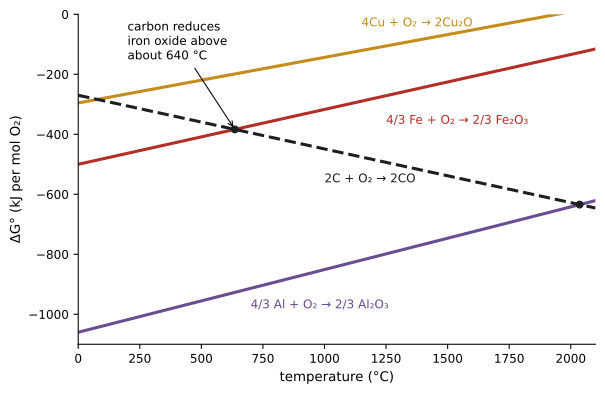
Most metals occur in nature as oxides or other compounds, and making the metal means removing the oxygen. Plotting ΔG° against temperature for forming each oxide, per mole of O₂, gives an Ellingham diagram. Because forming a solid oxide from a metal and oxygen gas consumes gas, ΔS is negative and the lines slope upward: oxides become less stable as temperature rises. The line for 2C + O₂ → 2CO slopes downward, because one mole of gas becomes two. Wherever the carbon line lies below a metal's line, carbon (as carbon monoxide) can strip oxygen from that metal's oxide.
Worked problem
Can carbon smelt iron and aluminium?
Approximate lines (kJ per mol O₂, T in K): 2C + O₂ → 2CO: ΔG° = −221 − 0.179T. 4/3 Fe + O₂ → 2/3 Fe₂O₃: ΔG° = −550 + 0.183T. 4/3 Al + O₂ → 2/3 Al₂O₃: ΔG° = −1117 + 0.209T. Find where the carbon line crosses each metal line.
Show solution
- Iron: −221 − 0.179T = −550 + 0.183T gives T = 329/0.362 = 909 K, about 636 °C.
- Aluminium: −221 − 0.179T = −1117 + 0.209T gives T = 896/0.388 = 2309 K, about 2040 °C.
Answer: Carbon can reduce iron oxide above roughly 640 °C, and blast furnaces, running at 1,500 °C and more, do so on a huge scale. Reducing alumina with carbon would need well over 2,000 °C, impractical and costly, so aluminium is instead made by electrolysis, using electrical work to drive a reaction with positive ΔG (Lesson 9). The diagram also explains why aluminium powder reduces iron oxide violently in the thermite reaction used to weld rails.
Free energy as maximum useful work
ΔG has a second meaning: for a process at constant temperature and pressure, −ΔG is the maximum non-expansion work, such as electrical work, the process can deliver. The rest of the energy, TΔS, must leave as heat. This sets hard limits on energy technology.
A fuel cell converts chemical free energy directly into electricity. For the hydrogen fuel cell, H₂ + ½O₂ → H₂O(l), ΔH° = −285.8 kJ/mol and ΔG° = −237.1 kJ/mol. The maximum efficiency, ΔG/ΔH, is 83 %, and the corresponding cell voltage is E = −ΔG/(nF) = 237 100/(2 × 96 485) = 1.23 V, a connection Lesson 9 develops. Real fuel cells reach 50 to 60 %.
A heat engine, by contrast, first turns chemical energy into heat and then converts part of the heat to work. The second law limits it to the Carnot efficiency, 1 − T_cold/T_hot, with temperatures in kelvin.
Worked problem
Power plant versus fuel cell
A steam power plant receives steam at 565 °C and rejects heat to a condenser at 35 °C. Compare its maximum efficiency with that of a hydrogen fuel cell.
Show solution
- Carnot efficiency: 1 − 308/838 = 0.632, or 63 %.
- Real steam plants reach about 38 to 45 % because of friction, heat losses and finite temperature differences; combined-cycle gas plants reach about 60 %.
- The fuel cell limit, 83 %, does not depend on a temperature difference.
Answer: The heat engine is limited to 63 % in principle and about 40 % in practice. The fuel cell avoids the Carnot limit, although its real efficiency is lowered by electrode losses. Whatever the device, at least TΔS of the energy must appear as heat.
Coupled reactions and life
A reaction with positive ΔG can be driven by coupling it to one with a larger negative ΔG, so the total is negative. Smelting couples the unfavourable decomposition of iron oxide to the favourable oxidation of carbon. Living cells couple the synthesis of proteins and DNA to the breakdown of ATP. Electrolysis and charging a battery couple an unfavourable reaction to electrical work supplied from outside. In every case the second law is satisfied overall: the entropy of the universe still increases.
Common mistakes
MistakeAssuming exothermic reactions are always spontaneous.
InsteadSpontaneity depends on ΔG = ΔH − TΔS, not ΔH alone.
MistakeAssuming a spontaneous reaction is fast.
InsteadThermodynamics gives direction; kinetics gives rate.
MistakeMixing kJ and J in ΔH − TΔS.
InsteadEntropies are tabulated in J/K; convert before combining with ΔH in kJ.
MistakeUsing °C in ΔG = ΔH − TΔS or in −RT ln K.
InsteadUse kelvin.
MistakeBelieving a well-designed engine can convert all heat to work.
InsteadThe Carnot efficiency, 1 − T_c/T_h, is the upper limit for any heat engine.
Summary and key terms
- Spontaneous processes proceed on their own; spontaneity says nothing about rate.
- Entropy counts microscopic arrangements; it rises with gas formation, mixing, melting and temperature.
- The second law: the entropy of the universe increases in any spontaneous process.
- ΔG = ΔH − TΔS; negative ΔG means spontaneous at constant T and P.
- When ΔH and ΔS share a sign, spontaneity switches at T = ΔH/ΔS.
- ΔG° = −RT ln K links thermodynamics to equilibrium.
- −ΔG is the maximum useful work; heat engines are further limited by the Carnot efficiency.
- Spontaneous process
- A process that proceeds without continuous outside intervention.
- Entropy
- A measure of the number of microscopic arrangements of a system.
- Second law of thermodynamics
- The entropy of the universe increases in any spontaneous process.
- Third law of thermodynamics
- A perfect crystal at absolute zero has zero entropy.
- Gibbs free energy
- G = H − TS; its change predicts spontaneity at constant T and P.
- Standard free energy change
- ΔG° for reactants and products in their standard states.
- Crossover temperature
- T = ΔH/ΔS, where ΔG changes sign.
- Ellingham diagram
- A plot of ΔG° of oxide formation against temperature.
- Carnot efficiency
- The maximum efficiency of a heat engine, 1 − T_c/T_h.
- Coupled reactions
- Reactions linked so a favourable one drives an unfavourable one.
Practice problems
Work each problem on paper first, then reveal the answer to check.
Predict the sign of ΔS for 2H₂(g) + O₂(g) → 2H₂O(l).
Show answer
Negative: three moles of gas become liquid.
Using the table, find ΔS° for C(graphite) + O₂ → CO₂.
Show answer
213.8 − 5.7 − 205.2 = +2.9 J/K.
A reaction has ΔH = −50 kJ and ΔS = −100 J/K. Above what temperature is it non-spontaneous?
Show answer
T = 50 000/100 = 500 K.
Find ΔG at 298 K for a reaction with ΔH = +30 kJ and ΔS = +120 J/K.
Show answer
30 − 298 × 0.120 = −5.8 kJ; spontaneous.
Find K at 298 K if ΔG° = −11.4 kJ.
Show answer
K = exp(11 400/(8.314 × 298)) = exp(4.60) ≈ 100.
Why does dissolving ammonium nitrate, an endothermic process, happen on its own?
Show answer
The large entropy increase from mixing makes TΔS exceed ΔH, so ΔG < 0.
Using the code output, what is the equilibrium CO₂ pressure over limestone at 900 K?
Show answer
About 0.009 bar.
Why can carbon not economically smelt aluminium?
Show answer
The carbon line crosses the aluminium line only above about 2,000 °C.
Find the Carnot efficiency of an engine working between 800 K and 300 K.
Show answer
1 − 300/800 = 62.5 %.
What is the maximum electrical work from 1 mol of H₂ in a fuel cell at 25 °C?
Show answer
237 kJ.
Lesson quiz · 5 questions
Score 60% or more to complete this lesson.
Create a free account to save your progress, take quizzes and earn a certificate.