
CHEM-103 · Lesson 4 of 12 · 34 min
Liquids, solutions and phase behaviour
Lesson 3 treated gases, whose molecules are far apart and nearly independent. Liquids and solids are condensed phases: their molecules are held close together by the intermolecular forces of Lesson 2. Most engineering processes involve a change between these phases or a mixture of substances in one of them: water boils in a power-plant boiler and condenses in a cooling tower, moisture condenses inside walls and on cold pipes, road salt melts ice, reverse osmosis turns seawater into drinking water, and oxygen dissolved in a river keeps fish alive. This lesson covers vapour pressure and boiling, the Clausius–Clapeyron equation, humidity and dew point, phase diagrams, solutions and their concentration units, the colligative properties (vapour pressure lowering, freezing point depression, boiling point elevation and osmotic pressure), and the solubility of gases described by Henry's law.
Vapour pressure and boiling
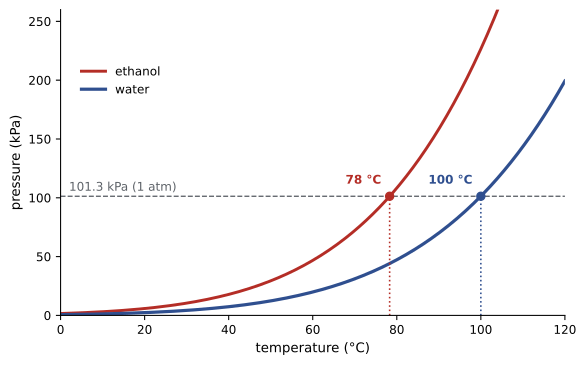
In a liquid, molecules have a range of energies. The fastest ones near the surface escape into the gas phase; in a closed container, some return, and soon the rates of evaporation and condensation balance. The pressure of the vapour at that balance is the liquid's vapour pressure. It depends only on the substance and the temperature, not on how much liquid there is, and it rises steeply with temperature because more molecules have enough energy to escape. Liquids with weak intermolecular forces, such as gasoline components or acetone, have high vapour pressures and evaporate readily; they are called volatile. Water, held together by hydrogen bonds, has a fairly low vapour pressure at room temperature.
A liquid boils when its vapour pressure equals the surrounding pressure: bubbles of vapour can then form inside the liquid and grow. At 101.3 kPa water boils at 100 °C, its normal boiling point. At lower pressure, as on a mountain or in a vacuum evaporator, it boils at a lower temperature; at higher pressure, as in a pressure cooker, an autoclave or a power-plant boiler, at a higher one.
| Temperature (°C) | Vapour pressure of water (kPa) |
|---|---|
| 0 | 0.611 |
| 10 | 1.23 |
| 20 | 2.34 |
| 30 | 4.25 |
| 50 | 12.35 |
| 80 | 47.4 |
| 100 | 101.3 |
| 120 | 198.5 |
| 180 | 1003 |
The Clausius–Clapeyron equation
The vapour pressure curve follows from the energy needed to vaporize the liquid, its molar enthalpy of vaporization ΔH_vap (40.7 kJ/mol for water at its boiling point). Treating the vapour as an ideal gas and ΔH_vap as constant gives the Clausius–Clapeyron equation:
with temperatures in kelvin and R = 8.314 J/(mol·K). It lets you find the vapour pressure at one temperature from another, or the boiling point at a given pressure.
Worked problem
Boiling water in Calgary and in a pressure cooker
Calgary, at about 1,050 m elevation, has a typical air pressure of 89 kPa. A pressure cooker operates at 200 kPa absolute. Estimate the boiling point of water in each case.
Show solution
- R/ΔH_vap = 8.314/40 700 = 2.04 × 10⁻⁴ K⁻¹; T₁ = 373.15 K at P₁ = 101.3 kPa.
- Calgary: 1/T₂ = 1/373.15 − 2.04 × 10⁻⁴ × ln(89/101.3) = 0.002 680 + 0.000 026 = 0.002 706 K⁻¹, so T₂ = 369.5 K = 96.3 °C.
- Pressure cooker: 1/T₂ = 0.002 680 − 2.04 × 10⁻⁴ × ln(200/101.3) = 0.002 680 − 0.000 139 = 0.002 541 K⁻¹, so T₂ = 393.6 K = 120.4 °C.
Answer: About 96 °C in Calgary and 120 °C in the pressure cooker (steam tables give 120.2 °C). Food cooks more slowly at altitude, and sterilizers run under pressure to reach 121 °C. The same physics sets the temperature in every boiler: a drum at 10 MPa boils water at about 311 °C.
Humidity and dew point
Air always contains some water vapour. Its partial pressure (Lesson 3) cannot exceed the vapour pressure of water at the air's temperature; air at that limit is saturated. The relative humidity is the ratio of the actual partial pressure of water vapour to the saturation value:
If moist air is cooled, its water vapour partial pressure stays the same while the saturation pressure falls. At the dew point, the two are equal and water begins to condense. This is why cold-water pipes and windows "sweat", why fog forms on clear nights, why compressed-air systems need dryers and drains, and why building scientists worry about moisture condensing inside walls, where it rots wood, corrodes fasteners and grows mould.
Worked problem
Condensation on a cold-water pipe
Indoor air is at 22 °C and 50 % relative humidity (P_sat at 22 °C = 2.64 kPa). Will water condense on an uninsulated pipe carrying water at 8 °C?
Show solution
- Partial pressure of water vapour: P = 0.50 × 2.64 = 1.32 kPa.
- From steam tables, water has a vapour pressure of 1.32 kPa at about 11 °C, so the dew point is about 11 °C.
- The pipe surface, near 8 °C, is below the dew point.
Answer: Yes; water will condense on the pipe and drip. Insulating the pipe with a continuous vapour-tight jacket keeps its outer surface above the dew point. The same calculation, done layer by layer through a wall, decides where the vapour barrier goes in a Canadian house.
Phase diagrams
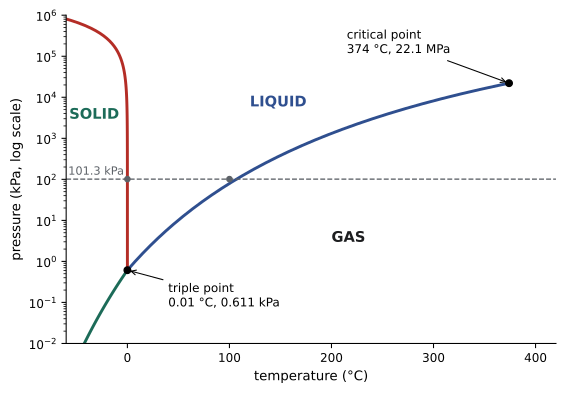
A phase diagram maps which phase of a substance is stable at each combination of temperature and pressure. Lines separate the solid, liquid and gas regions; along each line two phases coexist. The liquid–gas line is the vapour pressure curve. It ends at the critical point, beyond which liquid and gas can no longer be told apart and the substance is a supercritical fluid. The three lines meet at the triple point, the single temperature and pressure where all three phases coexist.
- Water: triple point 0.01 °C and 0.611 kPa; critical point 374 °C and 22.1 MPa. Unusually, its solid–liquid line slopes backward, because ice is less dense than liquid water (Lesson 2): pressure favours the denser liquid, so it slightly lowers the melting point.
- Carbon dioxide: triple point −56.6 °C and 518 kPa; critical point 31.0 °C and 7.38 MPa. Because its triple point lies above atmospheric pressure, solid CO₂ (dry ice) does not melt at 1 atm but sublimes directly to gas at −78.5 °C. Liquid CO₂ exists only under pressure, as in fire extinguishers and pipelines for carbon capture.
Supercritical fluids combine a gas's ability to penetrate porous solids with a liquid's ability to dissolve things. Supercritical CO₂ decaffeinates coffee and extracts oils without toxic solvent residues, and supercritical water and CO₂ are the working fluids of advanced power cycles that are more efficient than conventional steam plants.
Solutions and concentration
A solution is a uniform mixture of a solute dissolved in a solvent. Lesson 1 introduced molarity (mol/L), the most common unit in the laboratory. Other units suit other purposes:
- Molality, m = moles of solute per kilogram of solvent, does not change with temperature (volumes do), so it is used for colligative properties.
- Mole fraction, x = moles of a component / total moles, is used for vapour pressure and gas mixtures.
- Mass percent and parts per million (ppm, mg/kg, or about mg/L for dilute water solutions) are used in water treatment, environmental limits and alloy compositions.
Whether a substance dissolves depends on the intermolecular forces of Lesson 2 ("like dissolves like") and on temperature. Most solids dissolve better in hot water; most gases dissolve less, as the next sections show. A solution holding the maximum dissolved amount is saturated; cooling it, or evaporating solvent, makes the excess crystallize. This is how salt is refined, how scale forms in kettles and heat exchangers when hard water is heated (Lesson 8), and how sugar is purified.
Vapour pressure lowering and Raoult's law
A dissolved non-volatile solute takes up part of the liquid surface and lowers the solvent's tendency to escape. For ideal solutions, Raoult's law gives the solvent's vapour pressure as its mole fraction times the pure solvent's vapour pressure:
For a mixture of two volatile liquids, each contributes its own term, and the vapour is richer in the more volatile component. That difference is the basis of distillation, which separates crude oil into gasoline, kerosene and diesel fractions, purifies ethanol, and recovers solvents for reuse.
Freezing point depression and boiling point elevation
Because a solute lowers the vapour pressure, a solution boils at a higher temperature and freezes at a lower temperature than the pure solvent. For dilute solutions the changes are proportional to the molality of dissolved particles:
For water, K_f = 1.86 K·kg/mol and K_b = 0.512 K·kg/mol. The van 't Hoff factor i counts the particles each formula unit produces: about 1 for sugar or glycol, 2 for NaCl (Na⁺ and Cl⁻), 3 for CaCl₂. These properties depend only on the number of dissolved particles, not their identity, and are called colligative properties.
Worked problem
Road salt
Estimate the freezing point of brine containing 10 % NaCl by mass.
Show solution
- Take 1 kg of brine: 100 g NaCl in 900 g water.
- Moles of NaCl: 100/58.44 = 1.71 mol; molality m = 1.71/0.900 = 1.90 mol/kg.
- ΔT_f = 2 × 1.86 × 1.90 = 7.1 K, so the brine freezes at about −7 °C.
Answer: About −7 °C (measured: −6.6 °C, because the ions do not act fully independently at this concentration). As salt melts ice, the brine dilutes and its freezing point rises; below about −10 °C, rock salt works too slowly to be useful, and highway crews switch to calcium or magnesium chloride (CaCl₂ brine can stay liquid to about −50 °C) or to sand. The chlorides cost far more than their purchase price in corroded vehicles, reinforced concrete and bridges (Lesson 9).
Engine coolant uses the same effect in both directions: a 50/50 mixture of ethylene glycol and water freezes near −37 °C and, under the radiator cap's pressure, boils well above 120 °C. At such high concentrations the simple formula is only a rough guide, and engineers use measured data.
Osmosis and reverse osmosis
If a solution and pure solvent are separated by a semipermeable membrane, which passes solvent molecules but not solute, solvent flows into the solution. This flow, osmosis, stops when the solution side is pressurized by the osmotic pressure:
with M the molarity. Osmotic pressures are large. Applying more than the osmotic pressure to the solution side reverses the flow and pushes nearly pure water out through the membrane: reverse osmosis, the leading technology for desalination and for making ultrapure water for boilers and semiconductor plants.
Worked problem
Desalinating seawater
Seawater is roughly equivalent to 0.60 M NaCl. Estimate its osmotic pressure at 25 °C.
Show solution
- π = iMRT with R = 8.314 L·kPa/(mol·K).
- π = 2 × 0.60 × 8.314 × 298 = 2970 kPa ≈ 3.0 MPa.
Answer: About 3 MPa (measured: about 2.7 MPa). Because the remaining brine becomes saltier as fresh water is removed, reverse osmosis plants operate at 5.5 to 8 MPa, and pumping energy, about 3 kWh per cubic metre of fresh water with energy recovery, is their main operating cost.
Gases in liquids: Henry's law
The amount of a gas that dissolves in a liquid is proportional to the partial pressure of that gas above it:
where k_H is Henry's law constant, which depends on the gas, the solvent and the temperature. For oxygen in water at 25 °C, k_H ≈ 1.3 × 10⁻³ mol/(L·atm).
Worked problem
Dissolved oxygen in a river
Estimate the saturated concentration of dissolved oxygen in water at 25 °C in contact with air (oxygen partial pressure 0.21 atm).
Show solution
- C = 1.3 × 10⁻³ × 0.21 = 2.7 × 10⁻⁴ mol/L.
- Mass concentration: 2.7 × 10⁻⁴ × 32.0 g/mol = 8.7 × 10⁻³ g/L = 8.7 mg/L.
Answer: About 8.7 mg/L (measured: 8.3 mg/L). Many fish need at least 5 to 6 mg/L. Because gases dissolve less in warm water, hot effluent from power plants and industry ("thermal pollution") and summer heat can starve rivers of oxygen, especially where decaying organic waste is also consuming it.
Henry's law has many other consequences. Carbonated drinks are bottled under CO₂ pressure and fizz when opened. Divers breathing compressed air dissolve extra nitrogen in their blood and must ascend slowly to avoid decompression sickness. Boiler feedwater is heated and stripped in a deaerator to drive out dissolved oxygen and CO₂, which would otherwise corrode the boiler tubes.
Lesson 5 quantifies the heat involved in warming, melting and boiling, and Lesson 8 returns to dissolved substances through acid–base and solubility equilibria.
Common mistakes
MistakeThinking a liquid boils at a fixed temperature.
InsteadIt boils where its vapour pressure equals the surrounding pressure.
MistakeUsing °C in the Clausius–Clapeyron equation.
InsteadUse kelvin for all temperatures.
MistakeForgetting the van 't Hoff factor for salts.
InsteadNaCl gives about 2 particles per formula unit, CaCl₂ about 3.
MistakeUsing molarity for freezing point depression.
InsteadUse molality, moles per kilogram of solvent.
MistakeAssuming gases dissolve better in hot water, as most solids do.
InsteadGas solubility falls as temperature rises.
Summary and key terms
- Vapour pressure depends only on substance and temperature and rises steeply with temperature.
- A liquid boils when its vapour pressure equals the surrounding pressure.
- Clausius–Clapeyron relates vapour pressures at two temperatures through ΔH_vap.
- Relative humidity compares water vapour partial pressure with saturation; condensation starts at the dew point.
- Phase diagrams show stable phases, the triple point and the critical point.
- Colligative properties depend on the number of dissolved particles: ΔT_f = iK_f m, π = iMRT.
- Henry's law: dissolved gas is proportional to its partial pressure, and falls with temperature.
- Vapour pressure
- The pressure of a vapour in equilibrium with its liquid.
- Normal boiling point
- The temperature at which vapour pressure equals 101.3 kPa.
- Relative humidity
- Actual water vapour pressure divided by its saturation value.
- Dew point
- The temperature at which moist air becomes saturated on cooling.
- Critical point
- The end of the liquid–gas line, above which the fluid is supercritical.
- Triple point
- The temperature and pressure at which solid, liquid and gas coexist.
- Molality
- Moles of solute per kilogram of solvent.
- Colligative property
- A property depending only on the number of dissolved particles.
- Osmotic pressure
- The pressure needed to stop solvent flowing through a membrane into a solution.
- Henry's law
- Dissolved gas concentration is proportional to its partial pressure.
Practice problems
Work each problem on paper first, then reveal the answer to check.
Using the table, at what temperature does water boil under a pressure of 47.4 kPa?
Show answer
80 °C.
Water's vapour pressure is 3.17 kPa at 25 °C. Estimate it at 35 °C with ΔH_vap = 43.9 kJ/mol (its value near room temperature).
Show answer
ln(P₂/3.17) = 5280 × (1/298.15 − 1/308.15) = 0.575, so P₂ ≈ 5.6 kPa (tables: 5.63 kPa).
Air at 30 °C has a water vapour partial pressure of 2.34 kPa. Find its relative humidity and dew point.
Show answer
2.34/4.25 = 55 %; dew point 20 °C.
Why does dry ice not melt at atmospheric pressure?
Show answer
Its triple-point pressure (518 kPa) is above 1 atm, so at 1 atm it sublimes directly.
Find the molality of 62 g of ethylene glycol (M = 62.07 g/mol) in 500 g of water.
Show answer
1.00/0.500 = 2.0 mol/kg.
Estimate the freezing point of that solution.
Show answer
−1.86 × 2.0 = −3.7 °C.
Which lowers the freezing point more per mole, NaCl or CaCl₂?
Show answer
CaCl₂, which gives three ions instead of two.
Estimate the osmotic pressure of 0.10 M sucrose at 25 °C.
Show answer
0.10 × 8.314 × 298 = 248 kPa.
Why must reverse osmosis plants exceed the seawater osmotic pressure substantially?
Show answer
The brine concentrates as water is removed, and flux through the membrane needs a pressure margin.
Why does a lake hold less dissolved oxygen in August than in January?
Show answer
Gas solubility (Henry's constant) falls as temperature rises.
Lesson quiz · 5 questions
Score 60% or more to complete this lesson.
Create a free account to save your progress, take quizzes and earn a certificate.