
CINE-420 · Lesson 11 of 12 · 26 min
Health, safety and sustainability of a camera career
Camera work is physically and mentally demanding. Crew lift heavy cases, carry cameras on their shoulders, stand for 12 hours or more, work nights and outdoors in every kind of weather, and live with the uncertainty of freelance income. A long career depends on protecting the body and mind as carefully as the camera package. Many experienced camera crew can name colleagues who left the industry because of back injuries, hearing problems, exhaustion or burnout. This lesson looks at the main health and safety risks of a camera career and the habits, rights and supports that help crew stay healthy for decades. It points to other courses for detail: CINE-340 for set safety and fatigue, HSE-107 for manual handling and HSE-108 and HSE-109 for harassment and psychological health.
Fatigue and long hours
Long days and short turnarounds are the most serious health and safety problem for camera crews. Fatigue slows reactions, impairs judgement and causes mistakes with heavy equipment, and the drive home after a long day is one of the highest-risk moments in the job. Research on sleep has found that being awake for about 17 hours can impair performance about as much as a blood alcohol level of 0.05 %. Agreements set turnaround rules, but crew also need personal strategies.
- Protect sleep: plan your evening routine so most of the turnaround is available for sleep.
- Do not drive drowsy: use production transport or lodging where available, share rides, or rest before driving after very long days.
- Speak up: tell your department head or the AD if a schedule is unsafe, and use the union and production safety channels.
- Watch colleagues: fatigue is easier to see in others than in yourself.
Worked problem
Sleep opportunity in a turnaround
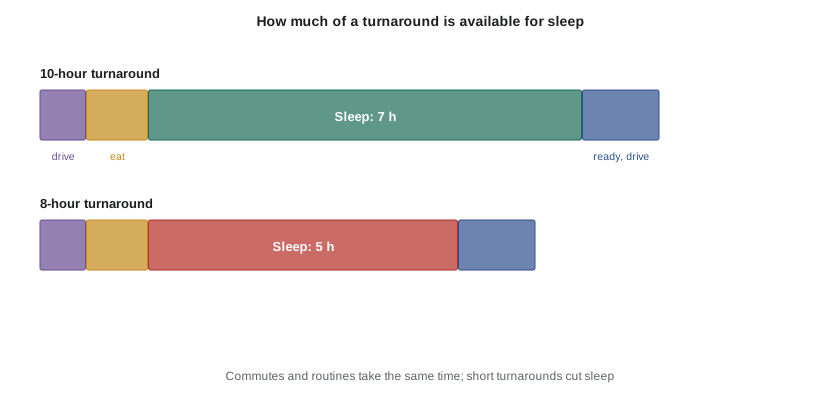
A 2nd AC wraps at 21:30 after camera wrap. The drive home takes 45 minutes, eating and winding down take 1 hour, and getting ready and driving back take 1 hour 15 minutes. Call is 7:30. How much time is left for sleep?
Show solution
- Turnaround: from 21:30 to 7:30 = 10 hours.
- Non-sleep time: 0.75 + 1 + 1.25 = 3 hours.
- Sleep opportunity: 10 − 3 = 7 hours.
Answer: About 7 hours of sleep opportunity, and less in practice because few people fall asleep instantly. With an 8-hour turnaround, the same routine leaves only 5 hours, which is why short turnarounds are dangerous.
Lifting, carrying and posture
Camera departments move heavy cases, cameras and accessories many times a day. Back, shoulder and knee injuries are common and can end careers.
- Use carts, dollies and wheeled cases instead of carrying, and ask for help with heavy or awkward loads.
- Lift with good technique: plan the lift, get close, keep the load near the body and avoid twisting.
- Pack cases so the heaviest items are low and the case can be handled safely.
- Handheld and shoulder operators should use support vests, rests between takes and rigs balanced for the body; many operators train their core and back strength.
- Stand on anti-fatigue mats or move regularly during long periods at the monitor or focus station.
HSE-107 covers manual handling and ergonomics in detail, including the NIOSH lifting equation.
Worked problem
Load on a handheld operator
A handheld camera build weighs 11 kg (about 24 lb). An operator holds it on the shoulder for takes totalling 90 minutes over a day, in takes of about 3 minutes each. How many lifts onto the shoulder does that involve, and what can reduce the strain?
Show solution
- Number of takes: 90 ÷ 3 = 30 takes.
- Each take usually involves lifting the camera onto the shoulder and taking it off, so about 30 lifts plus rehearsals.
Answer: About 30 or more lifts of an 11 kg camera, plus sustained loading on the shoulder and spine. Assistants can take the camera between takes, use a rest stand or easy rig support, and reduce the build weight by removing unneeded accessories.
Hearing, eyes and the environment
- Hearing: generators, special effects, gunfire effects, aircraft and loud music on music video sets can damage hearing. Use hearing protection and keep radio earpieces at sensible volumes.
- Eyes: long hours at monitors cause eye strain; take short breaks and adjust monitor brightness. Protect eyes from dust, debris, lasers and bright sources, and never look into high-power lights.
- Heat and cold: dress in layers, drink water, use shade and warming tents, and know the signs of heat illness and cold stress.
- Sun: use sunscreen, hats and shade on exterior days.
- Chemicals and smoke: atmospheric smoke and haze effects, fuels and cleaning solvents need ventilation and safety data sheets; ask the special effects team about products used.
Mental health and wellbeing
Freelance camera work can strain mental health: irregular income, long separations from family and friends, pressure to be perfect, harassment or bullying on some sets and periods without work. Signs that someone is struggling include withdrawal, irritability, exhaustion, increased use of alcohol or drugs and talk of hopelessness. Talking to someone you trust is a good first step. Many unions and productions offer confidential assistance programs, and industry charities support crew in financial or personal crisis. HSE-109 covers psychological health and safety in more detail.
If you or someone you work with is thinking about suicide, call or text 9-8-8, the Suicide Crisis Helpline, at any time in Canada. In an emergency, call 9-1-1.
Your safety rights in Canada
Provincial and federal occupational health and safety laws give workers three core rights: the right to know about hazards, the right to participate in health and safety, for example through joint committees or representatives, and the right to refuse work they believe is dangerous, without reprisal. Productions must provide training, safety meetings and incident reporting, and must report serious injuries to the provincial regulator. Union agreements and industry guidelines, such as Ontario's film and television safety guidelines and Actsafe's resources in British Columbia, add protections. Workers' compensation covers employees injured at work.
Sustainability: a long career and a lighter footprint
Sustainability in a camera career has two meanings. The first is personal: a career that lasts. That means managing money for slow periods, keeping skills current as cameras change, protecting health and relationships and planning for later career stages, such as moving into operating, DP work, teaching, rental house roles or specialties. The second is environmental: productions use large amounts of fuel, batteries, single-use plastics and travel. Camera departments can help by using rechargeable batteries and recycling spent ones, reducing single-use items, sharing transport, supporting battery power stations instead of diesel generators where possible and following the production's sustainability plan. Many productions now track emissions and have sustainability coordinators.
Night work and irregular schedules
Night shoots and split days, which start in the afternoon and run into the night, disturb the body's internal clock. Crew who switch between day and night work often sleep poorly and are at higher risk of mistakes and accidents. Keep sleep times as regular as possible during a night run, use blackout curtains and earplugs, limit caffeine late in the shift and eat light meals. Plan the drive home carefully after night work, when the body's natural sleep pressure is highest in the early morning hours.
Substance use
Long hours, stress and set culture can encourage the use of alcohol, cannabis or other substances to cope. Impairment on set endangers everyone, especially around heavy equipment, vehicles and heights, and productions have policies on drugs and alcohol. If you are worried about your own or a colleague's use, talk to someone you trust or use an assistance program. Many unions offer confidential support.
Building healthy routines
Small habits make a long career possible. Carry water and healthy food, stretch before lifting and at breaks, wear supportive footwear, keep a change of clothes for weather and protect days off for rest, family and activities outside film. Schedule regular health checks, including hearing and eye tests. Experienced crew often say that the people who last are those who treat their bodies like part of the camera package: maintained, protected and never pushed beyond their limits for long.
Weather and outdoor work in practice
Camera departments spend long hours outdoors, often standing still beside the camera rather than moving. In cold weather, layers, insulated boots, hand warmers and warm-up breaks protect against frostbite and hypothermia, and batteries and cameras need protection too. In heat, shade, water, cooling towels and rest breaks prevent heat exhaustion and heat stroke, which can be fatal. Know the signs: shivering, confusion and numb skin in the cold; heavy sweating, dizziness, nausea, confusion and hot dry skin in the heat. Report symptoms early and look after colleagues, especially those new to the conditions.
Planning for later career stages
Physical demands change with age. Many camera crew plan transitions, for example from handheld-heavy operating to remote heads, from assisting to DIT or data roles, or into teaching, rental house work or consulting. Building skills and relationships for the next stage while still working in the current one makes transitions smoother. Long careers also depend on money planning, covered in Lesson 10, so that health problems do not force difficult choices.
Respect and safety for everyone
Some crew face additional risks on set, including harassment based on gender, race, sexual orientation, disability or age. Productions must prevent and respond to harassment, and colleagues can help by speaking up, supporting people who report problems and refusing to join in jokes or behaviour that demeans others. Camera departments work in tight teams for long hours, so the culture each department head sets matters. HSE-108 covers reporting and investigation in detail.
Hearing protection in practice
Hearing damage builds slowly and is permanent. Keep foam or moulded earplugs in your kit, wear them near generators, pyrotechnics, gunfire effects, helicopters and loud playback, and take them out to hear safety calls when needed. Many crew use radio earpieces for hours each day, so keep volumes as low as practical and give your ears quiet time after work.
Taking time off
Freelancers often feel they cannot turn down work, but regular rest prevents burnout and injury. Plan time off between long productions, protect important family events and treat holidays as part of the work plan rather than lost income. Crew who rest well usually work better and longer.
Common mistakes
MistakeDriving home exhausted after a long day
InsteadUse transport or lodging, share rides or rest before driving
MistakeCarrying heavy cases instead of using carts
InsteadUse carts and wheeled cases and ask for help with heavy loads
MistakeSkipping hearing protection near generators and effects
InsteadWear hearing protection and keep earpieces at sensible volumes
MistakeKeeping quiet about an unsafe schedule
InsteadRaise concerns with the department head, AD, union or safety representative
MistakeTreating burnout as a personal weakness
InsteadRecognize the signs, talk to someone and use assistance programs
Summary and key terms
- Fatigue from long days and short turnarounds is the most serious health and safety risk for camera crews.
- Commutes and personal routines leave much less sleep than the turnaround suggests.
- Lifting, carrying and handheld operating cause injuries; use equipment, technique and help.
- Hearing, eyes, heat, cold, sun and chemicals need protection on set.
- Freelance life can strain mental health; talk to someone and use assistance programs and crisis lines.
- Canadian and US workers have legal safety rights, including protection from reprisal for raising concerns.
- A sustainable career means managing money, skills and health and reducing the production's environmental footprint.
- Fatigue
- Tiredness that reduces alertness, reaction time and judgement
- Turnaround
- The rest period between wrap and the next call
- Sleep opportunity
- The time actually available for sleep within a rest period
- Ergonomics
- Designing work to fit the body and reduce injury
- Easy rig
- A vest and arm system that carries some of a handheld camera's weight
- Right to refuse
- A worker's right to refuse work believed to be dangerous
- Reprisal
- Punishment for raising a safety concern, which the law prohibits
- Assistance program
- A confidential service offering counselling and support
- Burnout
- Exhaustion and detachment caused by prolonged work stress
- Sustainability coordinator
- A production role that plans and tracks environmental measures
Practice problems
Work each problem on paper first, then reveal the answer to check.
About how much sleep opportunity does a 10-hour turnaround give if commute and routine take 3 hours?
Show answer
About 7 hours
Why is the drive home a high-risk part of the day?
Show answer
Fatigue impairs driving after long days
Name two ways to reduce lifting injuries.
Show answer
Any two of carts, wheeled cases, help, good technique and well-packed cases
How many shoulder lifts might 90 minutes of 3-minute takes involve?
Show answer
About 30, plus rehearsals
Name two hazards to hearing on set.
Show answer
Any two of generators, effects, gunfire effects, aircraft and loud music
What are the three core safety rights in Canadian OHS laws?
Show answer
The right to know, the right to participate and the right to refuse dangerous work
What does US law protect workers from when they report safety concerns?
Show answer
Retaliation
Name two signs that a colleague may be struggling with mental health.
Show answer
Any two of withdrawal, irritability, exhaustion, increased alcohol or drug use and talk of hopelessness
Give two ways a camera department can reduce environmental impact.
Show answer
Any two of rechargeable batteries, recycling, less single-use plastic, shared transport and battery power stations
Which course covers manual handling in detail?
Show answer
HSE-107
Lesson quiz · 5 questions
Score 60% or more to complete this lesson.
Create a free account to save your progress, take quizzes and earn a certificate.