
CINE-420 · Lesson 12 of 12 · 28 min
Capstone: a career plan and first-year budget
This capstone brings the course together in a practical plan for the first year of a camera career. You will set goals, choose an entry route, estimate days worked and income, plan for union costs, equipment, insurance and taxes, and build a month-by-month cash-flow forecast that shows how payment delays and slow months affect your bank balance. The worked case follows a fictional camera assistant, Sam, through the planning process. All rates, fees and figures are illustrative and should be replaced with current figures from the agreements, unions, tax authorities and insurers that apply to you. The goal is not a perfect forecast, which no freelancer can make, but a plan that shows the risks and the actions that reduce them.
Step 1: goals and route
Start with clear goals for the year and the next few years.
- Role goal: for example, to work regularly as a 2nd AC and start day-playing as a 1st AC on smaller jobs.
- Union goal: for example, to complete a trainee program or permit days in Canada, or to reach the Local 600 roster in the US.
- Skills goal: specific cameras, wireless focus systems and data software to learn, and courses to take.
- Network goal: the number of DPs and 1st ACs to meet and the rental houses and events to visit.
- Financial goal: income needed, savings for slow periods and limits on equipment spending.
Write the goals down and review them every few months. Goals guide decisions, such as whether to take a low-paid job that builds union days or a better-paid corporate job that does not.
Step 2: estimate days and income
Estimate days worked conservatively, using information from mentors, unions and your own experience. Divide work into types, because each pays differently and counts differently toward union requirements.
| Type of work | Days | Average pay per day | Income |
|---|---|---|---|
| Union permit days as 2nd AC | 40 | 480 dollars | 19,200 dollars |
| Non-union commercials and music videos | 30 | 400 dollars | 12,000 dollars |
| Corporate and branded content | 25 | 350 dollars | 8,750 dollars |
| Kit rental on union and commercial jobs | 70 | 40 dollars | 2,800 dollars |
| Total | 42,750 dollars |
Step 3: costs of doing business
List the costs of working, from union fees to phones.
- Union costs: initiation fees, dues and working dues, or the costs of training courses needed to reach the roster.
- Equipment: a basic assistant's kit, such as tools, tape measures, slates, cleaning supplies and a cart, bought over time as work allows.
- Insurance: equipment and liability insurance, and health coverage if not provided by a union plan.
- Vehicle and travel: fuel, parking, maintenance and the business share of insurance.
- Phone, computer, software and website.
- Training and professional memberships.
- Accounting help at tax time.
Worked problem
Sam's first-year profit before income tax
Sam expects 42,750 dollars of income. Illustrative costs are: training and permit fees 600 dollars, kit purchases 2,500 dollars, insurance 500 dollars, vehicle business costs 3,000 dollars, phone and software 1,200 dollars and accounting 400 dollars. Estimate Sam's income after these costs.
Show solution
- Costs: 600 + 2,500 + 500 + 3,000 + 1,200 + 400 = 8,200 dollars.
- Income after costs: 42,750 − 8,200 = 34,550 dollars.
Answer: About 34,550 dollars before income tax. Some of these costs are deductible only against self-employment or rental income, so an accountant should review the plan.
Step 4: taxes and savings
Freelance income arrives in two streams: payroll wages with tax withheld, and contractor or rental payments without deductions. For the untaxed stream, set aside a fixed share, such as 30 %, in a separate account. Add an emergency fund target, such as three to six months of essential expenses, built up in busy months. Plan for union initiation fees or other large costs well before they are due.
Step 5: a month-by-month cash-flow forecast
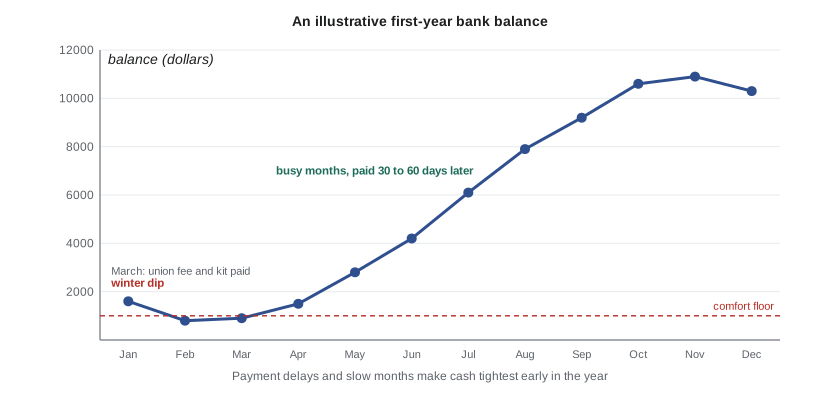
Profit over a year is not the same as cash in the bank. Freelance work is seasonal, and payment terms delay cash: payroll is often paid a week or two after the work week, while contractor invoices may be paid 30 to 60 days later. A cash-flow forecast lists expected receipts and payments month by month and tracks the bank balance.
Worked problem
The cost of slow payment
Sam invoices 4,000 dollars for a commercial shot in May on net 30 terms, and another 3,000 dollars for a corporate job in June on net 60 terms. In which months does the cash arrive, and what does that mean for June?
Show solution
- May invoice, net 30: cash arrives in June.
- June invoice, net 60: cash arrives in August.
- June's cash receipts include the May job's 4,000 dollars but not the June job's 3,000 dollars.
Answer: Sam does the work in May and June but receives 4,000 dollars in June and 3,000 dollars in August. If Sam's June bills depend on June's work, there will be a shortfall. A savings buffer, prompt invoicing and polite follow-up help smooth these gaps.
Worked problem
A simple three-month cash-flow check
Sam starts January with 3,000 dollars. Monthly living and business costs are 2,600 dollars. Receipts are expected to be 1,200 dollars in January, 1,800 dollars in February and 5,200 dollars in March, when a 2,500 dollar kit purchase is also planned. What is the balance at the end of each month?
Show solution
- January: 3,000 + 1,200 − 2,600 = 1,600 dollars.
- February: 1,600 + 1,800 − 2,600 = 800 dollars.
- March: 800 + 5,200 − 2,600 − 2,500 = 900 dollars.
Answer: The balance falls to 800 dollars in February, too low for comfort. Sam could delay the kit purchase until April, take extra corporate work in winter or build a larger buffer in the previous fall.
Step 6: risks and actions
Every plan should list the main risks and what you will do about them.
| Risk | Likelihood | Effect | Action |
|---|---|---|---|
| Slow production year in the region | Medium | Fewer days and lower income | Build savings; take corporate and commercial work; consider travel |
| Late payment on contractor jobs | High | Cash shortfalls | Invoice promptly; follow up; keep a buffer |
| Injury from lifting or fatigue | Medium | Lost work and health costs | Use carts and good technique; protect sleep; insurance |
| Equipment loss or theft | Low | Replacement cost | Insure gear; lock vehicles; never leave gear unattended |
| Health coverage lapse | Medium | Unexpected medical costs | Track plan hours or buy individual coverage |
| Burnout | Medium | Reduced performance and wellbeing | Plan breaks; keep relationships; use assistance programs |
Step 7: review and adjust
Review the plan every quarter. Compare actual days, income and costs with the forecast, and adjust. Celebrate progress toward goals, such as union milestones, new skills and new DPs who have hired you. Revise goals as you learn what kind of work and life suits you. Many camera careers take unexpected turns, into operating, documentary, specialty work, DIT and data, teaching or rental houses, and a good plan leaves room for those opportunities.
Your capstone task
Prepare a one-year plan for your own camera career, using the steps in this lesson.
- Goals for role, union status, skills, network and finances.
- An estimate of days worked by type of work, with average daily pay and income.
- A list of costs, with estimated annual amounts.
- A tax and savings plan, including the share set aside from untaxed income and an emergency fund target.
- A month-by-month cash-flow forecast with expected receipts based on payment terms.
- A risk register with at least five risks and actions.
- A review schedule.
Use current figures from your union or the union you plan to join, your tax authority and your insurers, and ask a mentor to review your plan.
Example: Sam's goals after one year
After a year, Sam reviews the plan. Sam worked 92 days instead of the planned 95, earned slightly less than forecast but kept costs lower by delaying a cart purchase. Sam met two new DPs, learned a new wireless focus system and moved closer to union membership. The biggest surprise was cash flow: two invoices were paid more than 60 days late, and the emergency fund covered the gap. For the second year, Sam sets goals to day-play as a 1st AC on commercials, finish union requirements, raise the emergency fund to four months of expenses and invoice on the last day of every job.
Getting feedback on your plan
Share your plan with a mentor, a union representative or an experienced colleague. Ask whether your days, rates and costs are realistic for your market and role, whether you have missed any costs and what risks they see. Experienced crew have lived through slow years, strikes and booms, and their advice can save you from expensive mistakes.
Turning the plan into weekly habits
A plan works only if it becomes part of everyday routines. Each week, Sam updates the income and invoice log, moves the tax share of untaxed payments into savings, sends follow-up messages to three contacts and spends an hour learning a new piece of equipment or software. Each month, Sam compares the bank balance with the forecast and adjusts spending or work plans. These habits take little time but keep the plan alive and prevent surprises at tax time.
Measuring progress beyond money
Income matters, but a camera career is also measured by skills learned, relationships built, safety and wellbeing. Add non-financial measures to your review, such as new camera systems learned, DPs and 1st ACs who rehired you, days worked in your target role, rest days protected and health checks completed. These measures show whether the career is moving in the direction you want, even in a year when income is lower than hoped.
A sample timeline for the year
- January to February: update résumé and website, visit rental houses, contact DPs and 1st ACs, take a safety or equipment course and keep spending low in the quiet season.
- March to April: start booking spring commercials and series, pay planned union or training costs and buy essential kit once cash allows.
- May to October: work as many good days as possible, invoice promptly, move tax shares into savings and build the emergency fund.
- November to December: review the year, organize records for taxes, update goals and plan the next year's purchases and training.
A final word
No plan survives a freelance year unchanged. The value of planning is that it makes risks visible, prepares you for slow periods and keeps you focused on the goals that matter. Revisit the plan often, stay curious and keep learning, and your camera career will grow on your own terms.
Common mistakes
MistakeTreating annual profit as cash in the bank
InsteadForecast cash month by month, including payment delays
MistakeAssuming every month will be busy
InsteadPlan for seasonal slow periods and build a buffer
MistakeBuying gear in the leanest month
InsteadTime large purchases for when cash is strong
MistakeLeaving taxes until filing time
InsteadSet aside a fixed share of untaxed income as it arrives
MistakeWriting a plan and never reviewing it
InsteadReview quarterly and adjust to actual days, income and goals
Summary and key terms
- A first-year plan starts with goals for role, union status, skills, network and finances.
- Estimate days and income conservatively, divided by type of work.
- List the costs of doing business, including union fees, kit, insurance, vehicle and accounting.
- Set aside money for taxes on untaxed income and build an emergency fund.
- Cash-flow forecasts show how payment terms and slow months affect the bank balance.
- A risk register links the main risks to practical actions.
- Review the plan quarterly and leave room for unexpected opportunities.
- Cash-flow forecast
- A month-by-month estimate of money coming in and going out
- Receipts
- Money received, such as wages and invoice payments
- Buffer
- Savings held to cover gaps between costs and receipts
- Payment terms
- The time allowed for an invoice to be paid, such as net 30
- Risk register
- A table of risks, their likelihood and effect and planned actions
- Seasonality
- Regular changes in work levels during the year
- Profit
- Income minus the costs of earning it
- Emergency fund
- Savings to cover several months of essential expenses
- Milestone
- A significant step toward a goal, such as union membership
- Quarterly review
- A check of progress against the plan every three months
Practice problems
Work each problem on paper first, then reveal the answer to check.
Why is annual profit different from cash in the bank?
Show answer
Payment delays and seasonal work change when money arrives
An invoice for work in June has net 60 terms. When does cash arrive?
Show answer
In August
Sam starts at 3,000 dollars, receives 1,200 and spends 2,600 in January. What is the balance?
Show answer
1,600 dollars
Name three costs of doing business for a camera assistant.
Show answer
Any three of union fees, kit, insurance, vehicle costs, phone and software, training and accounting
What share of untaxed income might a freelancer set aside for taxes?
Show answer
A fixed share such as 25 to 35 %, set with an accountant's advice
Give two actions for the risk of a slow production year.
Show answer
Any two of savings, corporate or commercial work and travel to other markets
Why time large purchases carefully?
Show answer
Buying in a lean month can leave too little cash for living costs
How often should the plan be reviewed?
Show answer
Every quarter
What is a risk register?
Show answer
A table of risks, their likelihood and effect and planned actions
Why ask a mentor to review the plan?
Show answer
Mentors know realistic days, rates and risks in the local market
Lesson quiz · 5 questions
Score 60% or more to complete this lesson.
Create a free account to save your progress, take quizzes and earn a certificate.