
CINE-420 · Lesson 6 of 12 · 26 min
Unions and guilds for camera crews in Canada
Most professional film and television production in North America is covered by union and guild agreements. For camera crews, union membership can mean higher minimum rates, health and retirement benefits, limits on hours, safety protections and access to larger productions. It also brings obligations: initiation fees, dues, rules on working for non-signatory productions and the need to build qualifying days before joining. Union structures differ between Canada and the US and between regions within each country. This lesson explains how camera unions are organized, how people join, what membership provides and costs, and how professional societies differ from unions. Union rules, fees and requirements change; always check the current rules with the local you plan to join.
Unions, guilds and agreements: the basics
A union or guild represents workers in collective bargaining with employers. In film and television, unions negotiate agreements with producers' associations, studios or individual production companies. An agreement sets minimum rates, overtime, rest periods, benefits contributions, safety rules and procedures for complaints. Productions that sign an agreement are called signatories. Workers in the union's jurisdiction and classifications are usually hired under the agreement's terms. Union rates are minimums; experienced crew may negotiate higher rates, called overscale.
Camera unions in Canada
Labour relations in Canada are mostly regulated by the provinces, so union representation differs across the country.
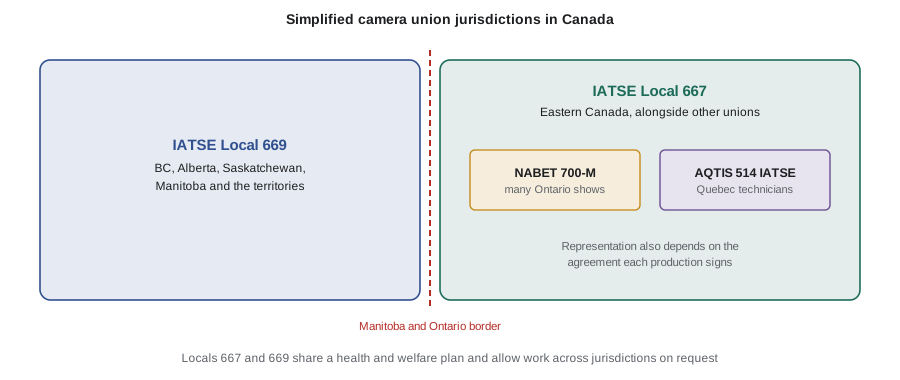
- IATSE Local 669, the International Cinematographers Guild in Western Canada, represents camera crews in British Columbia, Alberta, Saskatchewan, Manitoba and the three territories.
- IATSE Local 667, its sister local, represents camera crews in Eastern Canada, east of the Manitoba and Ontario border.
- AQTIS 514 IATSE represents many film and television technicians in Quebec, including camera crew, after the Quebec technicians' association joined IATSE.
- NABET 700-M Unifor represents film and television technicians, including camera crew, on many productions in Ontario.
- Other IATSE locals represent grips, electricians and other crafts in each region, and some represent several crafts together.
Locals 667 and 669 share a national health and welfare plan and take part in the Canadian Entertainment Industry Retirement Plan. Members of both locals can work in each other's jurisdictions under the host local's agreement when productions request it. Agreements are negotiated with producers' associations, such as the Canadian Media Producers Association, and with studios and individual productions, and different agreements, including low-budget agreements, apply to different budget levels.
Joining a camera union in Canada
Each local sets its own membership process. Common steps include the following.
- Working as a permittee: non-members may be hired on union productions as permittees when members are not available, building days and experience.
- Trainee programs: locals such as ICG 669 run camera trainee programs that place trainees on several productions, typically a series, a television movie and a feature, to learn camera systems and protocols.
- Applying for membership after meeting the local's requirements, which may include days worked in a classification, training courses, safety courses and references from members.
- Paying an initiation fee and ongoing dues.
Requirements and fees vary by local and change over time, so check the local's current membership pages before planning.
What membership provides
- Minimum rates and overtime rules set by agreements.
- Health and dental coverage and retirement contributions, funded by employers per hour or as a percentage of pay.
- Limits on hours, rest periods and turnaround, with penalties when they are broken.
- Grievance procedures if the employer breaks the agreement.
- Safety rules, training and support after incidents.
- Access to larger productions, which often hire only union crew in key positions.
- Training, events and a professional community.
Membership also brings obligations: following the union's rules, paying dues and, in many unions, not working on non-signatory productions in the union's jurisdiction without permission.
Worked problem
Budgeting for union initiation and dues
A 2nd AC plans to join a camera local with an illustrative initiation fee of 3,000 dollars, annual dues of 600 dollars and working dues of 2 % of union earnings. In the first year they expect 35,000 dollars of union earnings. What is the first-year cost?
Show solution
- Working dues: 0.02 × 35,000 = 700 dollars.
- Total: 3,000 + 600 + 700 = 4,300 dollars.
Answer: About 4,300 dollars, or about 12 % of first-year union earnings. Some locals allow initiation fees to be paid in instalments. These figures are illustrative; check the local's current fees.
Worked problem
Building qualifying days
A camera assistant works 4 permit days a month on union productions and 8 days a month on non-union productions in the same classification. A local's illustrative requirement is 60 union days in the classification. How long until they qualify?
Show solution
- Only union days count toward this requirement: 60 ÷ 4 = 15 months.
- If they can move half their non-union work to union productions as a permittee, union days rise to 8 a month: 60 ÷ 8 = 7.5 months.
Answer: About 15 months at the current pattern, or about 7.5 months if they shift more work to union productions. Check the local's actual requirements.
Professional societies
Professional societies are different from unions. They do not bargain contracts; they promote craft, education and community.
- The Canadian Society of Cinematographers (CSC) and the American Society of Cinematographers (ASC) are societies for cinematographers; the ASC admits members by invitation and its post-nominal letters signal peer recognition.
- The Society of Camera Operators (SOC) supports camera operators and runs awards and education.
- Other groups support women, Black, Indigenous and other underrepresented people in camera departments, and offer mentorship and networking.
Membership in a society can help with learning and networking but does not replace union membership where productions require it.
Union politics and participation
Unions are member organizations. Members elect officers, vote on agreements and bylaws and can serve on committees for safety, training, diversity and contract negotiations. Participation gives crew a voice in the terms they work under and is a good way to meet experienced members. Agreements are ratified by member votes, and debates over issues such as hours, rest periods, artificial intelligence and low-budget terms can be lively. Crew who understand their agreements are better able to spot mistakes in their pay and to support colleagues.
Working non-union and moving into the union
Many camera careers begin on non-union productions, which provide experience, credits and days that may count toward union requirements. Once a person joins a union, its rules may limit work on non-signatory productions in its jurisdiction, so the timing of joining matters. Some people join as soon as they qualify to access higher rates and benefits; others wait until they have enough union work available to replace their non-union income. Talk to the union and to working members before deciding, and ask how the local handles work outside its jurisdiction, such as commercials, corporate work or productions in other regions.
Grievances and disputes
When an employer breaks an agreement, for example by not paying overtime or meal penalties, the union can file a grievance. Most agreements set short time limits for raising grievances, so crew should report problems promptly and keep their own records of hours, meals and rest periods. Grievance procedures usually start with discussion between the union and the production and can end in binding arbitration. Non-union crew have fewer protections and must rely on employment standards or wage laws and, in some cases, small claims courts.
Benefits in practice
Union benefits are earned through hours worked under agreements, not through membership alone. Employers send contributions to the plans for each hour or as a share of wages, and the plans track each member's hours. Crew who work only a little union time in a year may not reach the hours needed to keep health coverage, and retirement credits build slowly over many years. Members should check their plan statements regularly, keep their own records of union hours and ask the plan office about banks of hours, self-payment options during slow periods and how to combine credits from work in different regions.
Equity, diversity and inclusion in camera unions
Camera departments have historically been among the least diverse parts of film production, with few women and people from racialized and Indigenous communities in senior roles. Unions, societies and producers now run programs to change that, such as trainee programs with targeted intakes, mentorship, funded training and anti-harassment initiatives. Crew who join these programs gain contacts and experience, and all members share responsibility for making departments welcoming. Hiring decisions in camera departments are personal, which means each department head's choices shape who gets a start.
Questions to ask a union before joining
- What are the membership requirements for my classification, and how are days documented?
- What are the initiation fee, annual or quarterly dues and working dues, and can fees be paid in instalments?
- What rules apply to working on non-signatory productions after I join?
- What health and retirement plans apply, and how many hours are needed to qualify?
- What training, safety courses and mentorship does the union offer?
- How does the availability list work, and how do members find work?
Comparing union and non-union work
Union and non-union productions differ in more than pay. Union productions usually offer higher minimum rates, benefits contributions, limits on hours and turnaround penalties, grievance procedures and established safety training. Non-union productions may offer more flexible roles, faster advancement into senior positions and opportunities to work with new directors, but often with lower pay, fewer protections and no benefits contributions. Many crew members work both during the early part of their careers, within the rules of their union once they join.
| Feature | Union production | Non-union production |
|---|---|---|
| Minimum rates | Set by the agreement | Negotiated job by job |
| Overtime and penalties | Defined in the agreement | Employment standards or wage law minimums only |
| Health and retirement | Employer contributions to plans | Usually none |
| Disputes | Grievance and arbitration | Employment standards complaint or court |
| Advancement | Classifications and rosters | Often faster but less structured |
Status of the Artist and provincial rules
Some Canadian jurisdictions have laws that recognize collective bargaining for self-employed artists and certain production workers, such as the federal Status of the Artist Act and Quebec's laws on the professional status of artists and technicians. These laws help explain why union structures and agreements differ across the country, especially in Quebec. Camera crew moving between provinces should ask the local union how its agreements apply there, because jurisdiction, classifications and rates can all change at a provincial border.
Common mistakes
MistakeAssuming union rules are the same everywhere
InsteadJurisdictions, agreements and requirements differ by country, region and local
MistakeTreating a professional society as a union
InsteadSocieties promote craft and community but do not bargain contracts
MistakeBudgeting only for the initiation fee
InsteadInclude annual or quarterly dues and working dues based on earnings
MistakeCounting undocumented days toward membership
InsteadKeep employment verification letters and pay records for every day
MistakeAssuming right-to-work means no union terms apply
InsteadAgreements still set rates and conditions on signatory productions
Summary and key terms
- Unions and guilds negotiate agreements that set minimum rates, hours, benefits and safety rules on signatory productions.
- Canada's camera unions are regional, including Locals 669 and 667, AQTIS 514 IATSE and NABET 700-M Unifor.
- In the US, IATSE Local 600 represents camera crews nationally under agreements with the AMPTP and others.
- Joining usually requires documented days, training and fees, with permittee and trainee routes in Canada and roster paths in the US.
- Membership provides benefits and protections and brings obligations such as dues and work rules.
- Professional societies such as the CSC, ASC and SOC promote craft but do not bargain.
- Union rules, fees and requirements change, so always check the current rules with the local.
- Signatory
- A production that has signed a union agreement
- Collective agreement
- A contract between a union and employers setting minimum terms
- Overscale
- Pay above the union minimum rate
- Permittee
- A non-member allowed to work on a union production, building days and experience
- Industry Experience Roster
- A US list of people eligible to be hired in each classification on signatory productions
- Initiation fee
- A one-time fee paid when joining a union
- Working dues
- Dues calculated as a percentage of earnings under union agreements
- Right-to-work law
- A US state law preventing agreements from requiring union membership
- Jurisdiction
- The geographic area and type of work a union covers
- Professional society
- An organization that promotes craft and community without bargaining contracts
Practice problems
Work each problem on paper first, then reveal the answer to check.
What is a signatory production?
Show answer
A production that has signed a union agreement
Name the camera locals for Western and Eastern Canada.
Show answer
IATSE Local 669 in the West and Local 667 in the East
Which local represents camera crews across the US?
Show answer
IATSE Local 600, the International Cinematographers Guild
What are the two Local 600 roster paths?
Show answer
30 signatory days in one year, or 100 days of any work in three years, in one classification
What is overscale?
Show answer
Pay above the union minimum
How is a professional society different from a union?
Show answer
It promotes craft and community but does not bargain contracts
Name three things union membership can provide.
Show answer
Any three of minimum rates, benefits, hour limits, grievance procedures, safety rules and access to larger productions
Why keep employment verification letters?
Show answer
To document days for union membership or roster eligibility
What do working dues depend on?
Show answer
A percentage of earnings under union agreements
What does a right-to-work law prevent?
Show answer
Agreements requiring union membership as a condition of employment
Lesson quiz · 5 questions
Score 60% or more to complete this lesson.
Create a free account to save your progress, take quizzes and earn a certificate.