
CINE-499 · Lesson 11 of 12 · 30 min
Deliverables, festivals and screening strategy
A finished film needs an audience. For most capstone shorts, that means a class screening, festivals, perhaps an online release and, for the DP, a reel. Each route needs the right files and the right timing. Festivals are especially strict: many have premiere requirements, and an early online upload can make a film ineligible for the festivals you care about most. This lesson covers the deliverables a short film needs, the basics of the Digital Cinema Package (DCP), festival strategy and budgets in Canada and the United States, online release and building your reel and portfolio from the film. Festival rules, fees and deadlines change every year, so the figures here are examples; always read each festival's current rules.
The deliverables list for a short film
Agree the deliverables list with the producer before the grade, so the master is made in the right formats. A typical capstone list looks like this.
| Deliverable | Purpose | Notes |
|---|---|---|
| Graded master file | Archive and source for all other files | High-quality codec, full resolution, no compression artefacts |
| Screening file | Class and festival screenings that accept files | Often ProRes or H.264 at high bitrate, with stereo audio |
| DCP | Cinema projection at festivals | JPEG 2000 picture, PCM audio, encrypted only if needed |
| Online screener | Festival submission platforms | H.264 or H.265, password protected, with burned-in or separate subtitles |
| Subtitles and captions | Accessibility and other languages | SRT or other timed-text formats; English captions at minimum |
| Stereo and 5.1 mixes, stems | Screening and future versions | Stems allow a new mix later |
| Stills and poster | Festival programs and press | High-resolution production stills and key art |
| Press kit | Festival programmers and press | Synopsis, credits, biographies, director's statement, technical specifications |
| Clearance and release documents | Distribution and E&O | Clearance log, releases, music licences (Lesson 5) |
Keep the graded master in at least two places. Every other file can be made again from it; the master cannot.
The Digital Cinema Package
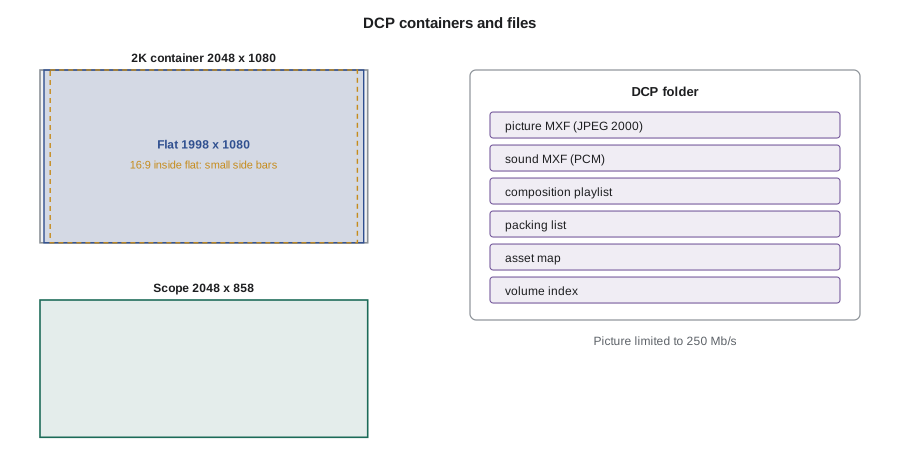
Cinemas and many festivals project from a DCP, a standardized set of files defined by the Digital Cinema Initiatives (DCI) specification and SMPTE standards. A DCP contains the picture as JPEG 2000 image files, the sound as uncompressed PCM audio, and XML files that describe the composition and packing. The picture is usually encoded in the DCI colour space (XYZ) at 2K (2048 × 1080) or 4K (4096 × 2160) container resolution, at 24 frames per second for most shorts.
- The JPEG 2000 picture bitrate is limited to 250 Mb/s in the DCI specification; many DCPs use lower rates.
- Flat (1.85:1) and scope (2.39:1) are the standard projection containers; a 16:9 film is placed inside the flat container with small side bars.
- Subtitles can be included as separate files or burned into the image.
- Most festival DCPs are unencrypted; encryption needs keys (KDMs) for each projector.
- Always test a DCP on a real projection system or a reliable DCP player before sending it.
Worked problem
The size of a DCP
A 9-minute short is encoded as a DCP with an average picture bitrate of 200 Mb/s and 6 channels of 24-bit, 48 kHz audio. About how large is the DCP?
Show solution
- Picture: 200 Mb/s × 540 s = 108,000 Mb = 13,500 MB ≈ 13.5 GB.
- Audio: 6 × 24 × 48,000 = 6.9 Mb/s; × 540 s ≈ 3,730 Mb ≈ 0.47 GB.
- Total ≈ 13.5 + 0.47 ≈ 14 GB.
Answer: About 14 GB. Even at the maximum 250 Mb/s, the picture would be about 17 GB, so a 32 GB drive or a download link is enough.
Festival strategy
Festivals are where short films find audiences, programmers, press and future collaborators. A strategy decides which festivals to target, in what order, and when the film can go online.
- Premiere status: many major festivals want a world, international, national or regional premiere, so the order of submissions matters.
- Tiers: a few large, highly competitive festivals, then strong genre, regional and student festivals, then smaller local ones.
- Fit: target festivals that programme films like yours, such as documentary, genre, LGBTQ+, regional or student-focused festivals.
- Qualifying festivals: some festivals' short film awards qualify winners for major awards such as the Academy Awards or the Canadian Screen Awards; check each award's current rules.
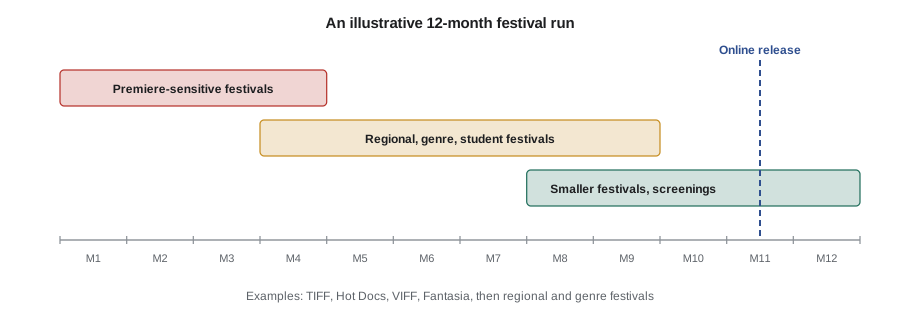
- Timing: plan a 12- to 18-month run, starting with the festivals that require premieres.
- Budget: submissions cost money, so set a limit and stick to it.
In Canada, major festivals for shorts include TIFF (Toronto), Hot Docs (Toronto, documentary), VIFF (Vancouver), the Festival du nouveau cinéma and Fantasia (Montréal, genre), the Atlantic International Film Festival, Calgary and Edmonton festivals, and many regional, student and community festivals. TIFF's short film rules for 2026, for example, required a world, international or North American premiere, with a Canadian premiere considered at the festival's discretion, and limited shorts to 40 minutes. Canadian broadcasters and festivals also run short film competitions and markets. Check each festival's rules each year.
Worked problem
A festival submission budget
A team plans 3 top-tier submissions at an average of 70 dollars, 8 mid-tier at 40 dollars and 10 smaller festivals at 20 dollars. They also plan one DCP at 300 dollars and shipping or delivery costs of 100 dollars. What is the festival budget, and how could it be reduced?
Show solution
- Top tier: 3 × 70 = 210 dollars.
- Mid tier: 8 × 40 = 320 dollars.
- Smaller: 10 × 20 = 200 dollars.
- Submissions total: 210 + 320 + 200 = 730 dollars.
- Add DCP and delivery: 730 + 300 + 100 = 1,130 dollars.
- To reduce: use early deadlines (often cheaper), ask about student fee waivers and choose festivals more selectively.
Answer: About 1,130 dollars. Early deadlines, student waivers and a more targeted list could cut it by several hundred dollars.
Worked problem
Early deadline savings
A festival charges 55 dollars at the early deadline, 75 at the regular deadline and 95 at the late deadline. If the team submits to 6 festivals with similar fees, how much do early deadlines save compared with late ones?
Show solution
- Early: 6 × 55 = 330 dollars.
- Late: 6 × 95 = 570 dollars.
- Savings: 570 − 330 = 240 dollars.
Answer: About 240 dollars, which is why finishing the film early in the festival calendar helps.
Submitting well
Programmers watch thousands of shorts. Make it easy for them.
- Submit a finished film, not a work in progress, unless a festival asks for one.
- Use a high-quality, password-protected screener with correct aspect ratio and sound.
- Write a short, clear synopsis and a logline.
- Include accurate running time, completion date, premiere status and country of production.
- Provide subtitles for any dialogue not in English (or French, for some Canadian festivals).
- Keep a spreadsheet of submissions: festival, deadline, fee, date submitted, result.
Online release
Online release puts the film in front of anyone, but it can end the festival run. Many teams wait until the main festival run is over, then release on a video platform or a curated short film site. Some festivals and platforms allow private, password-protected screeners without affecting premiere status; check the rules.
- Decide the online date as part of the festival strategy.
- Check that every music licence and clearance covers online release.
- Add captions and accurate metadata.
- Share the release with everyone who worked on the film.
Your reel and portfolio
The capstone is also raw material for your career. CINE-420 covered reels and portfolios; here, plan what you will take from the film.
- Select the strongest 60 to 90 seconds that show your visual thinking: lighting, composition, movement and colour.
- Get the director's and producer's agreement on the excerpt and on when it can go online, so it does not affect festival premieres.
- Export frame grabs at full resolution for your website and social media.
- Write a short case study: the visual concept, a key challenge, how you solved it and the result.
- Credit the director and key collaborators clearly.
Worked problem
Reel length and pacing
A DP wants a 75-second reel excerpt from the capstone with shots averaging 3.5 seconds each. How many shots will it contain, and why does that matter?
Show solution
- Shots = 75 ÷ 3.5 ≈ 21 shots.
Answer: About 21 shots. Choosing 21 strong, varied shots means leaving out many good ones, so pick shots that show range and control rather than repeating similar frames.
The class screening
Most programs end with a public or class screening. Attend the technical check in the venue, confirm the file or DCP plays correctly with the right aspect ratio and sound, and watch the film with an audience. Note their reactions; they will feed into your reflection.
Handling acceptances and rejections
Rejections are normal. Even strong short films are rejected by most of the festivals they enter, because programmers have far more good films than slots. Do not take rejections personally, and do not change the film after every one. When a film is accepted, read the acceptance letter carefully: it lists deadlines for the screening copy, stills, credits, a press kit and sometimes a DCP or particular file format. Meet every deadline, confirm who from the team will attend and ask whether the festival offers travel support, accommodation or passes for filmmakers. At the screening, attend the technical check if possible, introduce yourself to programmers and other filmmakers and take part in the question and answer session. Many careers grow from relationships formed at festivals.
- Expect more rejections than acceptances, and keep submitting to the plan.
- Read acceptance letters carefully and meet every deadline.
- Attend technical checks and screenings when you can.
- Follow up with programmers and filmmakers you meet.
Keeping festival records
A simple spreadsheet keeps the festival run under control. Record each festival's name, category, deadline, fee, premiere requirement, date submitted, notification date and result. Add the delivery requirements for any acceptance and the date each item was sent. This record also helps the producer and director plan the online release and report to anyone who supported the film.
Screening copies and quality checks
Before any file leaves the team, watch it from start to finish. Check that the aspect ratio is correct, the credits are complete and spelled correctly, the sound is in sync on every reel, subtitles appear at the right times and the last frames are not cut off. Label every file with the title, version, date, format and audio configuration, so programmers and projectionists know exactly what they have.
Common mistakes
MistakeThe DCP can be made from any file at any time.
InsteadMake the DCP from the graded master and test it on a real projection system before sending.
MistakeUpload the film online immediately to get views.
InsteadAn early online release can break premiere rules for major festivals; plan the online date.
MistakeFestival fees are the same at every deadline.
InsteadEarly deadlines are often cheaper; plan the finish date to meet them.
MistakeA DCP picture can use any bitrate.
InsteadThe DCI specification limits JPEG 2000 picture to 250 Mb/s.
MistakeThe DP's reel can use the film whenever the DP wants.
InsteadAgree the excerpt and timing with the director and producer so it does not affect premieres.
Summary and key terms
- Agree the deliverables list before the grade and keep the graded master in at least two places.
- A DCP packages JPEG 2000 picture, PCM sound and XML files in a flat or scope container.
- DCI limits picture bitrate to 250 Mb/s; a 9-minute DCP is usually under 20 GB.
- Festival strategy considers premiere status, tiers, fit, qualifying awards, timing and budget.
- Canadian and US festivals have different premiere rules; read each year's rules.
- Plan the online release to avoid breaking premiere requirements.
- Build a reel excerpt and case study from the film, with the team's agreement.
- Deliverables list
- The agreed set of files and documents for a finished film.
- Graded master
- The highest-quality finished file, the source for all other versions.
- DCP
- Digital Cinema Package: the standard file package for cinema projection.
- Flat container
- The 1.85:1 DCP projection format.
- Scope container
- The 2.39:1 DCP projection format.
- KDM
- Key delivery message: the key that unlocks an encrypted DCP on a specific projector.
- Premiere status
- Whether a festival screening is a world, international, national or regional first showing.
- Qualifying festival
- A festival whose award qualifies a film for a major award.
- Screener
- A private copy of a film for programmers or reviewers.
- Press kit
- Synopsis, credits, biographies, statements, stills and technical information for festivals and press.
Practice problems
Work each problem on paper first, then reveal the answer to check.
Name five typical capstone deliverables.
Show answer
Any five of graded master, screening file, DCP, online screener, subtitles, mixes and stems, stills and poster, press kit, clearance documents.
What picture codec does a DCP use?
Show answer
JPEG 2000.
What is the DCI maximum picture bitrate?
Show answer
250 Mb/s.
A 6-minute DCP at 150 Mb/s average: about how large is the picture?
Show answer
150 × 360 = 54,000 Mb ≈ 6.75 GB.
Why does premiere status matter?
Show answer
Many major festivals require a world, international or national premiere.
5 submissions at 40 dollars and 10 at 25 dollars: what is the total?
Show answer
200 + 250 = 450 dollars.
How can festival costs be reduced?
Show answer
Early deadlines, student fee waivers and selective targeting.
When should a short usually go online?
Show answer
After the main festival run, as planned in the strategy.
How many shots in a 60-second reel at 3 seconds per shot?
Show answer
20.
What should a reel case study include?
Show answer
The visual concept, a key challenge, the solution and the result.
Lesson quiz · 5 questions
Score 60% or more to complete this lesson.
Create a free account to save your progress, take quizzes and earn a certificate.