
CINE-499 · Lesson 12 of 12 · 30 min
Reflection, critique and professional next steps
The capstone ends with looking back. A written reflection, a critique session and a plan for what comes next turn one film into lasting learning. Reflection is not a list of excuses or a celebration of everything that went right. It is an honest, evidence-based assessment of your work against the rubric, with specific lessons you will carry into your next job. This lesson shows how to write a strong reflection, how to give and receive critique, how to measure your own growth across the program, and how to take the next steps toward a career as a cinematographer, building on CINE-420.
Why reflection matters
Professionals reflect constantly, even if they do not call it that. A DP who watches their finished film and asks "what would I do differently?" improves faster than one who moves straight to the next job. Reflection also helps you talk about your work in interviews and on your website: employers want to know how you think and solve problems, not only what your reel looks like.
- It turns experience into lessons you can reuse.
- It shows assessors the thinking behind your decisions.
- It gives you stories for interviews and case studies.
- It helps you see patterns in your strengths and weaknesses across projects.
The structure of a capstone reflection
Most reflections follow a simple structure. Keep each section specific and tied to evidence from the film, the prep package, the test report and the production log.
- Context: the film, your role, the team and the visual concept in a short paragraph.
- Goals: what you set out to achieve and learn.
- What worked: two or three successes, each with evidence (a frame, a log entry, a test result).
- What did not work: two or three problems, each with evidence and an honest analysis of causes.
- Decisions under pressure: one or two key decisions from the log, with reasons and outcomes.
- Assessment against the rubric: a self-score for each criterion with a short justification.
- Lessons and next steps: what you will do differently and what you want to learn next.
A good reflection uses the first person, names specific shots and days, and avoids blaming others. When something went wrong because of another person, focus on what you could have done to prevent or manage it.
Worked problem
Turning a vague statement into evidence
A draft reflection says "the lighting in scene 5 didn't look as good as I wanted." Rewrite it using evidence from the production log and test report.
Show solution
- Identify the specific problem: the log for day 3 notes that the bedside lamp read 2 stops hotter than planned in the close-up.
- Identify the cause: the test report measured the lamp with a different bulb from the one used on the day.
- State the impact: the colourist had to add a window to bring the lamp down, which flattened the falloff on the wall.
- State the lesson: test the actual practicals that will be used and carry spare matching bulbs.
Answer: "In scene 5, the bedside lamp read about 2 stops hotter than planned in the close-up (day 3 log). The test used a different bulb from the one on set. The grade had to pull it down with a window, which flattened the wall falloff. Next time I will test the exact practicals and carry matching spares."
Self-assessment against the rubric
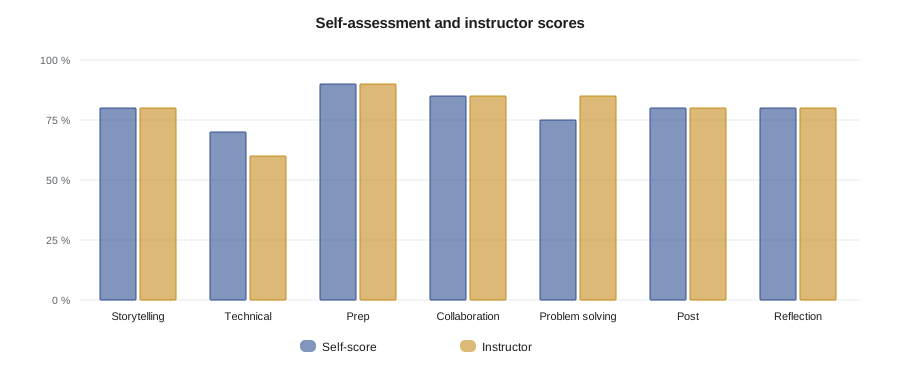
Score yourself honestly against each rubric criterion before the instructor does. Comparing your scores with theirs is one of the most useful parts of the capstone.
| Criterion | Weight | Self-score | Evidence |
|---|---|---|---|
| Visual storytelling | 25 % | 80 % | Progression from tight to wide held through the cut |
| Technical control | 20 % | 70 % | Two soft takes; exposure consistent except scene 5 |
| Prep package | 15 % | 90 % | Complete overheads and plots; schedule used daily |
| Collaboration and leadership | 15 % | 85 % | Director feedback; crew retained for pick-ups |
| Problem solving | 10 % | 75 % | Rain day moved to cover set; triage on day 4 logged |
| Post and delivery | 10 % | 80 % | Grade supervised; DCP tested |
| Reflection | 5 % | 80 % | Specific, evidence-based |
Worked problem
Comparing self-scores and instructor scores
Using the weights above, the student's self-scores give an overall 79.75 %. The instructor's scores are the same except technical control at 60 % instead of 70 % and problem solving at 85 % instead of 75 %. What is the instructor's overall score, and what does the difference suggest?
Show solution
- Change from technical control: 0.20 × (60 − 70) = −2.0 points.
- Change from problem solving: 0.10 × (85 − 75) = +1.0 point.
- Instructor overall = 79.75 − 2.0 + 1.0 = 78.75 %.
Answer: About 79 %. The student overrated technical control and underrated problem solving; focus practice on focus and exposure discipline, and keep logging decisions, which assessors valued.
Giving and receiving critique
Critique sessions, where the class watches and discusses each film, are standard in film programs and in professional life (screenings, reviews with producers, colourist sessions). Good critique is specific, kind and useful.
- Describe before judging: say what you saw and felt ("the handheld in the argument made me feel trapped").
- Connect comments to the film's intentions: ask what the team was aiming for.
- Be specific: name the scene, shot or moment.
- Offer suggestions as questions or options, not orders.
- Balance strengths and areas to improve.
- When receiving critique, listen first, take notes, ask clarifying questions and avoid defending every choice.
- Thank people for their feedback, then decide later which points to act on.
A widely used structure is to share what worked, ask questions about what was unclear and offer one or two suggestions. Many programs use their own critique protocol; follow it.
Measuring growth across the program
Look back across the whole program, not just the capstone. Compare your first exercises with the capstone images.
- Exposure and lighting: are your images more controlled and intentional?
- Composition and movement: do your choices follow from the story?
- Colour: do you build looks in camera and finish them confidently in the grade?
- Collaboration: do you lead a crew calmly and communicate clearly?
- Process: do you prepare, test, log and deliver reliably?
Write down three strengths you can now describe with evidence, and three areas you will work on in the next year.
Worked problem
A simple growth comparison
A student rates their skills on a 1 to 5 scale at the start of the program and after the capstone: lighting 2 to 4, composition 3 to 4, colour 1 to 3, collaboration 2 to 4, process 2 to 5. Which skill improved most, and which is now weakest?
Show solution
- Changes: lighting +2, composition +1, colour +2, collaboration +2, process +3.
- Largest improvement: process (+3).
- Lowest current score: colour (3).
Answer: Process improved most, and colour is now the weakest skill. A plan for the next year might include grading practice or assisting a colourist.
Professional next steps
CINE-420 covered how camera crews find work, union and guild routes, rates, contracts and freelance business. Use the capstone as a launching point.
- Update your reel with the capstone excerpt once the team agrees and festival timing allows.
- Write a short case study for your website using your reflection.
- Contact people you worked with and keep in touch; most work comes through people who have seen you work.
- Look for camera trainee, camera assistant, lighting or grip positions on professional sets to learn from experienced crews.
- Consider joining professional bodies for emerging cinematographers, such as the Canadian Society of Cinematographers or the American Society of Cinematographers' programs and events, and local film co-ops or collectives.
- Set a learning goal for the next year, such as working on three more shorts, assisting a DP on a feature or learning a new tool.
In Canada, emerging camera people often move from student work into trainee and permittee positions with IATSE Local 667 (Eastern Canada) or Local 669 (Western Canada), AQTIS 514 IATSE in Quebec or NABET 700-M Unifor, depending on the region; requirements and training programs vary, so contact the local directly. Film co-ops, CSC events and regional festivals are good places to meet working DPs.
Keeping a learning habit
The best cinematographers keep learning throughout their careers. Watch films with the sound off to study images, photograph light every day with a phone, test new equipment when you can, ask experienced crew questions and keep a notebook of ideas, references and lessons. Reflection is not only for the end of a course; it is a habit that will make every future film better.
Worked problem
Planning the next year
A graduate wants to shoot 3 more shorts and assist on at least 10 professional shoot days in the next year. If each short takes about 5 shoot days plus 4 days of prep and post involvement, how many working days does the plan need?
Show solution
- Shorts: 3 × (5 + 4) = 27 days.
- Professional assisting: 10 days.
- Total: 27 + 10 = 37 days.
Answer: About 37 days, a realistic plan alongside other work, and a useful target for tracking progress.
Writing a director's or cinematographer's statement
Festivals and websites often ask for a short statement about the film. A cinematographer's statement explains the visual approach in plain language: the idea behind the images, one or two choices that express it and what you hope the audience feels. Keep it to about 150 to 250 words. Avoid technical lists of equipment unless the reader is technical; say why the images look the way they do. Draft it from your look book and reflection, then ask the director to read it so your statements agree.
- Open with the film's central visual idea.
- Give one or two concrete examples of choices that express it.
- End with what you hope the audience experiences.
- Check that it matches the director's statement.
Celebrating and closing the project
Finish the capstone properly. Thank everyone who worked on the film, including cast, crew, locations, suppliers and funders, by name. Share the finished film privately with the team, return any borrowed items, close out the budget with receipts and file all documents in the production book. Closing a project well leaves good relationships behind, and those relationships often bring the next job.
Common mistakes
MistakeA reflection should mostly explain what went wrong because of others.
InsteadFocus on your own decisions and what you could have done differently, with evidence.
MistakeVague statements are enough in a reflection.
InsteadName specific scenes, days and evidence from logs and tests.
MistakeReceiving critique means defending every choice.
InsteadListen, take notes, ask questions and decide later what to act on.
MistakeSelf-assessment is pointless because the instructor grades anyway.
InsteadComparing your scores with the instructor's shows where your judgement of your own work needs calibrating.
MistakeLearning ends with the capstone.
InsteadKeep a habit of reflection, testing and study throughout your career.
Summary and key terms
- Reflection turns experience into reusable lessons and shows assessors your thinking.
- Structure the reflection: context, goals, successes, problems, decisions, rubric self-assessment and next steps.
- Use evidence from the production log, test report and finished film.
- Self-scores compared with instructor scores reveal blind spots.
- Good critique is specific, kind, connected to intentions and balanced.
- Measure growth across the program and set three strengths and three goals.
- Use the capstone to update your reel, write a case study and take the next career step.
- Reflection
- An evidence-based assessment of your own work and learning.
- Self-assessment
- Scoring your own work against the rubric before the instructor does.
- Critique
- A structured discussion of a work's strengths and areas to improve.
- Evidence
- Specific material, such as log entries, frames or test results, that supports a claim.
- Case study
- A short write-up of a project's concept, challenge, solution and result.
- Growth comparison
- A comparison of skills at the start and end of a program.
- Permittee
- A non-member allowed to work on a union production under a permit, often a step toward membership.
- Trainee
- An entry-level crew position for learning on professional sets.
- Learning goal
- A specific, measurable target for developing a skill.
- Critique protocol
- An agreed structure for giving and receiving feedback.
Practice problems
Work each problem on paper first, then reveal the answer to check.
List the sections of a capstone reflection.
Show answer
Context, goals, what worked, what did not, decisions under pressure, rubric self-assessment, lessons and next steps.
Rewrite "the colour looked off" with evidence.
Show answer
Name the scene, the measured or logged problem, the cause, the impact and the lesson.
A criterion weighted 20 % is self-scored 70 % and instructor-scored 60 %. What is the difference in points?
Show answer
2 points.
Name three habits of good critique.
Show answer
Any three of describing first, connecting to intentions, being specific, offering options, balancing strengths and improvements.
How should you receive critique?
Show answer
Listen, take notes, ask clarifying questions, thank people and decide later what to act on.
Skills rise from 2 to 4, 1 to 3 and 3 to 4. Which improved least?
Show answer
The one from 3 to 4.
Name three professional next steps after the capstone.
Show answer
Any three of updating the reel, writing a case study, keeping in touch with collaborators, seeking trainee or assistant work, joining professional bodies, setting learning goals.
Two shorts of 5 shoot days and 3 prep days each plus 8 assisting days: how many days?
Show answer
2 × 8 + 8 = 24 days.
Why compare first exercises with capstone images?
Show answer
To see growth in control, intention, colour, collaboration and process.
What daily habit helps a DP study light?
Show answer
Photographing light every day, such as with a phone.
Lesson quiz · 5 questions
Score 60% or more to complete this lesson.
Create a free account to save your progress, take quizzes and earn a certificate.