
CON-240 · Lesson 3 of 12 · 32 min
Structural forces and members
Once you know what loads a structure must carry, the next question is how its members carry them. Every member in a building, whether a cable, a column, a beam or a wall, resists load through internal forces. There are only a few kinds of internal force: tension, compression, bending, shear and torsion. Learning to recognize them in real members, and to sketch the forces acting on a piece of structure, is the core skill of structures literacy.
This lesson introduces equilibrium, free-body diagrams, the basic internal forces, stress and strain, and the way different materials respond. It uses simple arithmetic only. The aim is not to design members but to understand why they are shaped and connected the way they are, and why changing them on site can be dangerous.
Forces and equilibrium
A force has size, direction and a point of application. In structures we usually describe forces by their components: vertical and horizontal. A structure that is standing still, which is what we want from buildings, is in equilibrium. That means three things must be true for any part of it in a two-dimensional view.
- The sum of all vertical forces is zero: upward forces balance downward forces.
- The sum of all horizontal forces is zero: forces to the left balance forces to the right.
- The sum of all moments about any point is zero: the turning effects balance.
A moment is the turning effect of a force about a point, equal to the force multiplied by its perpendicular distance from the point. A 1 kN force acting 2 m from a point produces a moment of 2 kN·m. Moments explain why a long cantilever is harder to hold up than a short one, and why a crane outrigger must be farther from the crane's centre as the lift gets heavier or longer.
Worked problem
Balancing a seesaw
A 3.0 m plank pivots at its centre. A 60 kg person sits 1.2 m from the pivot. Where must a 90 kg person sit on the other side to balance it?
Show solution
- Moments must balance: 60 × 1.2 = 90 × d (the factor g cancels).
- d = 72 ÷ 90 = 0.8 m from the pivot.
- The heavier person sits closer, because moment is force times distance.
Answer: 0.8 m from the pivot.
Free-body diagrams
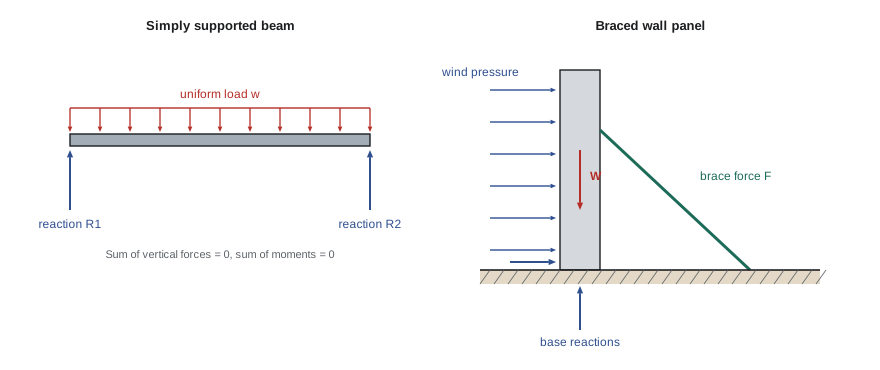
A free-body diagram (FBD) is a sketch of one part of a structure, cut free from everything around it, with every force that acts on it drawn as an arrow. Engineers use FBDs to work out unknown forces. Constructors can use simple FBDs to reason about temporary works: what holds up a shore, what keeps a wall brace from sliding, or what forces act on an outrigger pad.
To draw an FBD, isolate the object, draw its outline, add the known loads (weights, applied forces) and then add the reactions where it touches supports. Supports are modelled by what they resist: a roller resists only a force perpendicular to its surface; a pin resists vertical and horizontal forces but not rotation; a fixed support resists forces and rotation.
Worked problem
Reactions on a beam with a point load
A simply supported beam spans 6.0 m. A 30 kN point load acts 2.0 m from the left support. What are the support reactions?
Show solution
- Take moments about the left support: R_right × 6.0 = 30 × 2.0, so R_right = 10 kN.
- Vertical equilibrium: R_left + R_right = 30, so R_left = 20 kN.
- The support nearer the load carries more of it.
Answer: Left reaction 20 kN, right reaction 10 kN.
The basic internal forces
When a member carries load, it develops internal forces that hold its parts together.
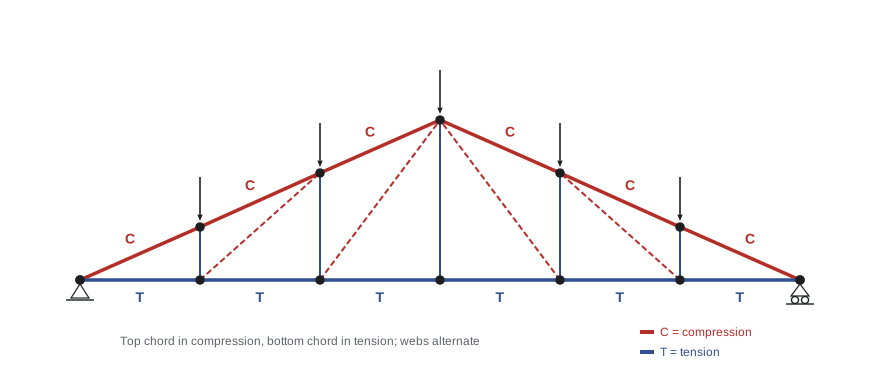
- Tension: the member is pulled and tends to stretch. Cables, hangers, the bottom chord of a truss and steel tie rods work in tension. Tension members can be slender because they cannot buckle.
- Compression: the member is pushed and tends to shorten. Columns, struts, shores and the top chord of a truss work in compression. Slender compression members can buckle sideways at loads far below the material's crushing strength.
- Bending: the member is loaded across its length and curves. One face is stretched (tension) and the other squeezed (compression). Beams, slabs and lintels work mainly in bending.
- Shear: one part of the member tends to slide past the next. Shear is high near the supports of beams and around columns in flat slabs, where it can cause punching shear failure.
- Torsion: the member is twisted, as in a spandrel beam carrying a slab on one side or a balcony cantilever.
Stress and strain
Stress is internal force divided by the area that carries it. It tells you how hard the material is working. Strain is the change in length divided by the original length. For most structural materials, stress and strain are proportional up to a limit; the ratio is the modulus of elasticity (E).
In SI units stress is measured in megapascals (MPa), where 1 MPa = 1 N/mm². Typical values: structural steel yields at about 350 MPa (CSA G40.21 350W) and has E ≈ 200,000 MPa; normal concrete is specified at 25 to 50 MPa in compression, has a tensile strength only about a tenth of that and E ≈ 25,000 to 30,000 MPa; reinforcing bars yield at 400 MPa (CSA G30.18 Grade 400).
Worked problem
Stress in a steel hanger rod
A 20 mm diameter steel rod hangs a 40 kN load. What is the stress in the rod?
Show solution
- Area: π × 20² ÷ 4 = 314 mm².
- Stress: 40,000 N ÷ 314 mm² ≈ 127 MPa.
- That is well below a 350 MPa yield stress, but connections and threads reduce capacity, so the engineer's rated capacity governs.
Answer: About 127 MPa.
Worked problem
Shortening of a column under load
A steel column 4.0 m long carries a stress of 140 MPa. With E = 200,000 MPa, how much does it shorten?
Show solution
- Strain = 140 ÷ 200,000 = 0.0007.
- Shortening = 0.0007 × 4,000 mm = 2.8 mm.
- Over 20 storeys, elastic shortening adds up, which is one reason tall buildings need column shortening allowances.
Answer: About 2.8 mm.
How materials behave
Materials differ in strength, stiffness and how they fail, and that drives how structures are designed and built.
| Material | Strong in | Weak in | Failure behaviour | Construction implication |
|---|---|---|---|---|
| Steel | Tension and compression | Fire (loses strength when hot), corrosion | Ductile: yields and bends before breaking | Slender members need bracing against buckling; fireproofing and coatings matter |
| Concrete | Compression | Tension (cracks easily) | Brittle in tension; reinforcing makes it ductile | Rebar placement, cover and curing control strength; young concrete is weak |
| Wood and mass timber | Along the grain | Across the grain, moisture, fire in small sections | Can split or crush; char protects large sections | Keep dry during construction; connections govern |
| Masonry | Compression | Tension and out-of-plane bending | Brittle; unreinforced walls topple | Brace walls until supported; grout and reinforcement placement matter |
Ductility is a structure's ability to deform a lot before it fails, giving warning. Ductile behaviour is designed in deliberately, through steel reinforcing in concrete, through steel connections that yield before they fracture and through seismic detailing. A brittle failure, such as a shear failure in a beam with missing stirrups or a punching failure in a flat slab, can happen suddenly without warning. This is why seemingly small site errors in reinforcing detail can matter so much.
Common structural members
Each common member type works mainly in one or two ways.
- Columns and posts: compression, with some bending from eccentric loads or frames.
- Beams, girders, joists and lintels: bending and shear.
- Slabs and decks: bending in one or two directions, and shear around columns.
- Walls: compression from gravity loads, in-plane shear from lateral loads (shear walls) and out-of-plane bending from wind or soil.
- Trusses: members in pure tension or compression, connected at joints, carrying bending of the whole truss efficiently.
- Braces: tension or compression, depending on load direction.
- Cables and hangers: tension only.
- Arches and domes: mainly compression, pushing outward at their supports.
Worked problem
Forces in a simple two-member frame
A sign weighing 4 kN hangs from the end of a horizontal strut, held by a tie rod at 30° to the strut. Find the tie force and strut force.
Show solution
- At the joint, the tie's vertical component balances the sign: T sin 30° = 4 kN, so T = 4 ÷ 0.5 = 8 kN (tension).
- The tie's horizontal component is balanced by the strut: C = T cos 30° = 8 × 0.866 ≈ 6.9 kN (compression).
- Shallow ties carry much more than the load they support.
Answer: Tie about 8 kN in tension; strut about 6.9 kN in compression.
The last example has a practical lesson for rigging and temporary bracing: the flatter the angle of a sling, tie or brace, the higher the force in it for the same load. That is why rigging tables limit sling angles and why braces are usually set at 45° to 60° rather than lying almost flat.
Connections
Members are only as good as their connections. Loads must pass from one member to the next through bolts, welds, nails, screws, bearing plates, anchors or concrete reinforcing that laps or develops into the next element. Many structural failures, during construction and in service, are connection failures: a missing bolt, a short weld, a hanger rod with a changed detail, a bar lap that was too short or an anchor set in weak concrete.
Constructors control connection quality directly. Bolting and welding must follow approved shop drawings and inspection requirements. Anchors must be installed to the manufacturer's instructions, often with special inspection. Reinforcing laps, hooks and development lengths must match the drawings. Lesson 12 returns to the Hyatt Regency walkway collapse of 1981, in which a change to a hanger connection doubled the load on a critical detail.
For constructors, the practical value of these ideas is in reading situations quickly: seeing which member of a temporary frame is in compression and might buckle, which tie is carrying tension and must not be removed, and where a load will travel when a support is taken away.
Common mistakes
MistakeAssuming a compression member is as strong as its material.
InsteadSlender compression members buckle at loads far below crushing strength; bracing and length matter.
MistakeThinking concrete carries tension.
InsteadConcrete cracks under small tension; reinforcing steel carries the tension in beams and slabs.
MistakeSetting braces or slings at very flat angles.
InsteadForce in a brace or sling rises sharply as its angle flattens; keep within the designed angles.
MistakeTreating connections as minor details.
InsteadLoads pass through connections, and many failures start there; install and inspect them to the approved details.
MistakeIgnoring the difference between ductile and brittle failure.
InsteadMissing stirrups, short laps or weak anchors can cause sudden failures without warning.
Summary and key terms
- A structure at rest is in equilibrium: forces and moments balance in every direction.
- A free-body diagram isolates a part of a structure and shows every force acting on it.
- The internal forces are tension, compression, bending, shear and torsion.
- Stress is force divided by area; strain is change in length divided by length; their ratio is the modulus of elasticity.
- Steel is strong and ductile; concrete is strong in compression and weak in tension; wood is strong along the grain; masonry is strong in compression.
- Slender compression members can buckle, and flat braces and slings carry high forces.
- Connections carry loads between members and are a frequent source of failures.
- Equilibrium
- The state in which all forces and moments on a body balance.
- Moment
- The turning effect of a force, equal to force times perpendicular distance.
- Free-body diagram (FBD)
- A sketch of an isolated part of a structure showing all forces acting on it.
- Reaction
- A force provided by a support to keep a structure in equilibrium.
- Tension
- An internal force that stretches a member.
- Compression
- An internal force that shortens a member.
- Shear
- An internal force that tends to make one part slide past another.
- Stress
- Internal force per unit area.
- Modulus of elasticity (E)
- The ratio of stress to strain for a material in its elastic range.
- Ductility
- The ability to deform significantly before failure.
Practice problems
Work each problem on paper first, then reveal the answer to check.
What three conditions define equilibrium in two dimensions?
Show answer
Sum of vertical forces, sum of horizontal forces and sum of moments all equal zero.
A 12 kN force acts 1.5 m from a point. What is its moment?
Show answer
18 kN·m.
A beam spans 5 m with a 20 kN load at mid-span. What are the reactions?
Show answer
10 kN at each support.
A beam spans 8 m with a 24 kN load 2 m from the left support. Find the right reaction.
Show answer
24 × 2 ÷ 8 = 6 kN.
Which internal force can cause sudden buckling?
Show answer
Compression in a slender member.
A 400 mm × 400 mm concrete column carries 2,000 kN. What is the average stress?
Show answer
2,000,000 N ÷ 160,000 mm² = 12.5 MPa.
Why are reinforcing bars placed near the bottom of a simply supported beam?
Show answer
The bottom is in tension under bending, and concrete is weak in tension.
What happens to the force in a brace as its angle becomes flatter?
Show answer
It increases, because a smaller component of the force acts in the useful direction.
Which members of a truss are typically in tension under gravity load?
Show answer
The bottom chord and some web members.
Why is ductility desirable?
Show answer
A ductile structure deforms visibly and gives warning before it fails.
Lesson quiz · 5 questions
Score 60% or more to complete this lesson.
Create a free account to save your progress, take quizzes and earn a certificate.