
CON-325 · Lesson 12 of 12 · 29 min
Capstone: equipment management and a site logistics plan for an invented project
This final lesson brings the course together. It starts with the last piece of the logistics puzzle, the management of construction equipment as a business asset: what equipment costs, when to own and when to rent, how to keep it productive, maintained and safe, and how the shift to cleaner equipment is changing the choices. It then assembles the complete site logistics plan for Larkspur Commons, phase by phase, prices it, and sets out how Dana Whitfield's team will review, communicate, monitor and update it from the first day of excavation to the last day of landscaping. The plan is the superintendent's main tool for running the site, and the capstone shows what a complete one looks like.
CON-250 introduced earthmoving equipment, its productivity and the basics of equipment cost; this lesson looks at equipment from the general contractor's side, where most of the equipment on a building site is rented or brought by subcontractors and the contractor's own fleet is small. Lesson 1 introduced the logistics plan, and lessons 2 to 11 developed each of its parts.
What equipment costs
The cost of a piece of equipment has two parts. Ownership costs are incurred whether the machine works or not: depreciation, the loss of value over time; the cost of the money tied up in it, called interest or the cost of capital, whether borrowed or the company's own; insurance; licence or registration fees and taxes; and storage. Operating costs are incurred only when the machine works: fuel or electricity, lubricants, filters, repairs and wear parts such as tires or tracks. The operator's wages are a third cost, often tracked separately because the same operator may run different machines.
Equipment cost per hour is the sum of ownership and operating costs divided by the hours the machine works. The ownership part depends heavily on utilization: a machine that works 1,500 hours a year spreads its ownership cost over three times as many hours as one that works 500. That is why the decision to own or rent depends less on the price of the machine than on how much the company will use it.
Thornbury Builders owns a small fleet: two telehandlers, several forklifts, a skid steer, light towers, small generators and many small tools. Larger and specialized equipment, such as the tower crane, the hoist, mobile cranes, concrete pumps and excavators, is rented or brought by subcontractors. The equipment manager asked whether Thornbury should buy a third telehandler for Larkspur Commons and its other projects, or rent one.
# Own or rent? Hourly cost of a telehandler for Larkspur Commons (illustrative figures, Canadian dollars)
price, salvage, life_years = 210_000, 70_000, 8      # purchase price, resale at end of life, years kept
hours_per_year = 1_300                               # expected operating hours across Thornbury's projects
interest = 0.065                                     # cost of capital
ins_tax_storage = 0.025                              # insurance, licence fees and yard storage, share of price per year
fuel_lph, fuel_price = 7.5, 1.85                     # litres per hour, dollars per litre of diesel
repair_factor = 0.55                                 # lifetime repairs as a share of (price - salvage)

depreciation = (price - salvage) / life_years
avg_investment = (price + salvage) / 2               # average money tied up over the machine's life
ownership_year = depreciation + interest * avg_investment + ins_tax_storage * price
own_h = ownership_year / hours_per_year
operate_h = fuel_lph * fuel_price + repair_factor * (price - salvage) / (life_years * hours_per_year)
print(f"Ownership cost  {own_h:6.2f} $/h   (depreciation, interest, insurance, storage)")
print(f"Operating cost  {operate_h:6.2f} $/h   (fuel and repairs; operator not included)")
print(f"Total           {own_h + operate_h:6.2f} $/h")

rent_month, site_hours = 6_900, 140      # monthly rental (delivered, maintained) and hours worked per month on site
rent_h = rent_month / site_hours + fuel_lph * fuel_price
print(f"Renting only when needed: {rent_h:6.2f} $/h at {site_hours} h a month")
# The owned machine's ownership cost runs all year, whether it works or sits in the yard
for yearly in (400, 800, 1_300):
    cost = ownership_year / yearly + operate_h
    print(f"Owned, {yearly:5,d} h/year across all projects: {cost:6.2f} $/h  -> {'own' if cost < rent_h else 'rent'}")
breakeven = ownership_year / (rent_h - operate_h)
print(f"Break-even utilization: about {breakeven:,.0f} operating hours a year")Ownership cost 24.50 $/h (depreciation, interest, insurance, storage) Operating cost 21.28 $/h (fuel and repairs; operator not included) Total 45.78 $/h Renting only when needed: 63.16 $/h at 140 h a month Owned, 400 h/year across all projects: 100.90 $/h -> rent Owned, 800 h/year across all projects: 61.09 $/h -> own Owned, 1,300 h/year across all projects: 45.78 $/h -> own Break-even utilization: about 760 operating hours a year
The calculation shows the classic pattern. At high utilization across the company's projects, owning is cheaper per hour than renting; at low utilization, the ownership costs keep running while the machine sits in the yard, and renting wins. The break-even is a little under 800 operating hours a year. Thornbury's two existing telehandlers average about 1,100 hours a year, but a third would mainly cover peaks, so its utilization would probably be low; the equipment manager recommended renting for Larkspur Commons and reviewing the decision after a year of utilization data. The figures are illustrative; real decisions use the company's own costs, rental quotes, tax treatment and the resale market.
Other factors also enter the decision. Owning gives control over availability, which matters when rental fleets are tight in a construction boom, and over the condition of the machine. Renting gives access to newer, cleaner and specialized equipment, moves maintenance to the rental company and keeps capital free for other uses. Many contractors use a mix: owning the machines they use constantly and renting the rest. Leases and rent-to-own arrangements sit between the two.
Keeping equipment productive
Equipment earns its cost only while it works. On a building site, much equipment time is lost to waiting: a telehandler idling while a delivery is late, a crane waiting for a load to be rigged, a pump waiting for concrete trucks. The logistics plan, the delivery schedule and the crane and hoist bookings exist largely to keep equipment and crews working together.
Telematics, the data reported by sensors and GPS units on modern machines, show where each machine is, how many hours it ran, how long it idled, how much fuel it used and when it needs service. The international standard ISO 15143-3 defines a common format for this data, so a contractor can collect data from different manufacturers in one system. Typical uses on Larkspur Commons include the following.
- Utilization reports that show which machines are underused and could be returned to the rental company early.
- Idle-time reports: an engine idling burns fuel, wears the machine and adds noise and exhaust, and many machines idle for a large share of their running hours.
- Service reminders based on actual hours, and fault codes reported before a breakdown.
- Geofences that alert the equipment manager if a machine leaves the site after hours, which helps deter theft (lesson 3).
Simple practices also matter: returning rented equipment as soon as it is no longer needed, because rental charges run until the machine is picked up; checking rental invoices against the days the machine was actually on site; sharing equipment between trades instead of each trade renting its own; and planning the work so that machines move as little as possible.
Maintenance, inspection and operators
Equipment that is not maintained breaks down at the worst time and can injure people. A maintenance program includes daily pre-use inspections by the operator, using the manufacturer's checklist; scheduled servicing at set hours; periodic inspections by qualified people, such as the annual inspection and certification of cranes and hoists; repairs by qualified mechanics; and records for each machine. Defective equipment is tagged out of service until it is repaired.
In British Columbia, WorkSafeBC's regulation requires mobile equipment, cranes and hoists to be inspected and maintained according to the manufacturer's instructions and the applicable standards, and requires operators to be trained and competent; tower and mobile crane operators must hold certification recognized by WorkSafeBC, and lift truck operators are trained to standards such as CSA B335. Rental equipment arrives with the rental company's inspection and maintenance records, but the contractor remains responsible for the pre-use checks and for using the machine safely.
On Larkspur Commons, every machine on site, owned, rented or brought by a subcontractor, is listed on the equipment register kept by Omar Haddad, with its inspection records, its operators' qualifications and its daily pre-use checklist. Subcontractors must submit their equipment and operator records before bringing a machine to site, and the superintendent can remove any machine that is not in safe condition. HSE-218 and HSE-219 covered the safety rules for mobile equipment and cranes in detail.
Cleaner and quieter equipment
Construction equipment is a significant source of diesel exhaust, greenhouse gas emissions and noise on urban sites. In Canada, federal regulations for off-road diesel engines are aligned with the US EPA Tier 4 standards, so new machines are much cleaner than older ones, and some owners, cities and provinces now ask for low-emission or zero-emission equipment on their projects. British Columbia's climate policies and the City of Kelowna's climate plans encourage electrification, and electricity in British Columbia comes mostly from hydroelectric generation, which makes electric equipment especially low in emissions there.
Electric options are now common for some equipment and emerging for others. Tower cranes and hoists have always been electric. Battery-electric mini excavators, compact loaders, scissor lifts, boom lifts and forklifts are widely available, and battery-electric telehandlers and larger excavators are entering rental fleets. Electric equipment is quieter, which helps with neighbours and night work (lesson 10), and has no exhaust, which helps indoors and in enclosed areas. Its limits are purchase price, charging time and the need for enough temporary power on site (lesson 9), so electrification has to be planned with the temporary service. CON-430 covered the wider picture of low-carbon construction.
On Larkspur Commons, Thornbury specified battery-electric scissor lifts and boom lifts for interior and envelope work, electric forklifts in the enclosed podium levels, and a battery-electric mini excavator for landscaping near the neighbours. The temporary service estimate in lesson 9 included charging loads for them.
The complete logistics plan for Larkspur Commons
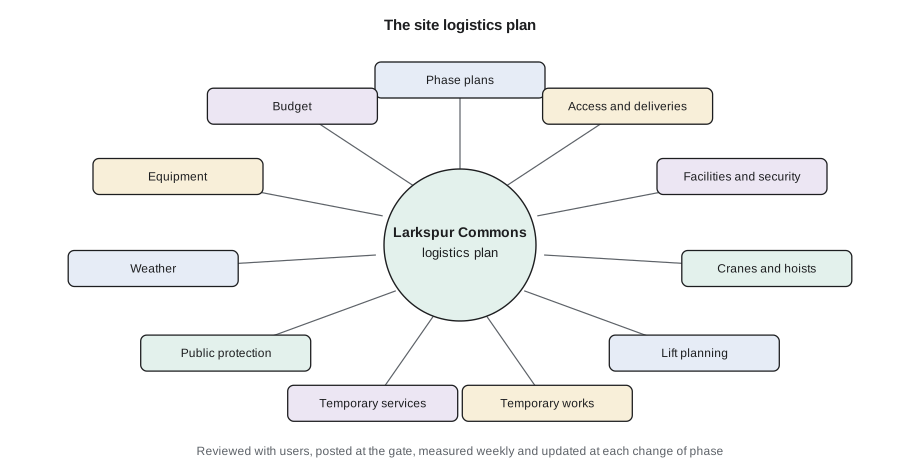
Over the course, Dana's team built the logistics plan in pieces. The complete plan pulls them together into a package of phase drawings, schedules, registers and procedures that everyone on site can use. It is a living document, not a one-time submission.
| Plan element | Content on Larkspur Commons | Lesson |
|---|---|---|
| Phase site plans | Excavation, podium, wood frame and finishing phases, each showing fences, gates, crane, hoist, laydown, trailers, services and routes | 1 |
| Access and deliveries | Lane gate and truck route, unloading bay, delivery booking calendar, street use permit calendar, pedestrian detours | 2 |
| Site facilities and security | Trailer compound, washrooms, first aid, muster points, waste and recycling area, security patrols and cameras | 3 |
| Tower crane | Position at gridlines 6 and D, coverage and capacity check, zoning limits, oversail agreements, erection and dismantling plans | 4 |
| Other lifting equipment | Assist crane set-up with mats, hoist on the south face with booking system, loading platforms, concrete pump locations | 5 |
| Lift planning | Lift classification, critical lift plans, pre-lift meetings, wind limits | 6 |
| Temporary works | Register, coordinator, designs, permits to load and strike, reshoring sequence | 7 and 8 |
| Temporary services | Power service and distribution, water and backflow, fire safety plan, standpipe, temporary heat and enclosure | 9 |
| Public protection | Hoarding, covered way, falling-object controls, dust, noise and vibration controls, monitoring, neighbour agreements, community contact | 10 |
| Weather | Seasonal sequencing, cold-weather concreting, snow plan, storm checklist, lightning alerts, heat and smoke triggers | 11 |
| Equipment | Equipment register, own or rent decisions, telematics, maintenance and operator records, electric equipment | 12 |
| Budget | Time-related logistics costs by month, tracked against actual costs | 12 |
Pricing the plan
Logistics costs sit in the general conditions or general requirements of the estimate, and many of them depend on time: the crane rents by the month, the trailers, security and temporary services run as long as the job runs, and the hoist runs from when it is installed until the permanent elevators can take over. Pricing them by month against the schedule shows the total, the cash flow and, importantly, what a delay costs.
# Logistics budget for Larkspur Commons: time-related site costs by month (illustrative, Canadian dollars)
items = {  # name: (first month, last month, monthly cost, one-time cost)
    "Tower crane, rental and operator":   (4, 12, 58_000, 140_000),   # one-time: foundation, erection, dismantling
    "Personnel and material hoist":       (9, 17, 16_000, 45_000),
    "Hoarding, fencing and covered way":  (1, 18, 2_500, 96_000),
    "Site offices, washrooms, utilities": (1, 20, 14_000, 25_000),
    "Temporary power and lighting":       (1, 19, 6_500, 60_000),
    "Security and cameras":               (1, 20, 7_000, 8_000),
    "Traffic control and flag persons":   (1, 12, 9_000, 0),
    "Telehandler and forklift":           (3, 18, 8_500, 0),
    "Waste removal and street cleaning":  (1, 20, 9_500, 0),
    "Temporary heat and winter protection": (9, 12, 34_000, 20_000),
}
total, by_month = 0, [0] * 21
for name, (a, b, monthly, once) in items.items():
    cost = monthly * (b - a + 1) + once
    total += cost
    for m in range(a, b + 1):
        by_month[m] += monthly
    by_month[a] += once
    print(f"{name:<38} months {a:2d}-{b:2d}  {cost:>10,.0f}")
print(f"{'Total logistics budget':<38} {'':12}{total:>10,.0f}")
peak = max(range(1, 21), key=lambda m: by_month[m])
print(f"Highest month: month {peak} at {by_month[peak]:,.0f}")
# What does a six-week (1.5-month) delay in the wood frame cost? Everything running in month 10 runs longer.
slip = 1.5 * sum(monthly for a, b, monthly, once in items.values() if a <= 10 <= b)
print(f"Six-week slip during the frame adds about {slip:,.0f} in time-related site costs")Tower crane, rental and operator months 4-12 662,000 Personnel and material hoist months 9-17 189,000 Hoarding, fencing and covered way months 1-18 141,000 Site offices, washrooms, utilities months 1-20 305,000 Temporary power and lighting months 1-19 183,500 Security and cameras months 1-20 148,000 Traffic control and flag persons months 1-12 108,000 Telehandler and forklift months 3-18 136,000 Waste removal and street cleaning months 1-20 190,000 Temporary heat and winter protection months 9-12 156,000 Total logistics budget 2,218,500 Highest month: month 4 at 255,000 Six-week slip during the frame adds about 247,500 in time-related site costs
The logistics budget is a large number for a mid-rise building, and the tower crane is its largest single item. The monthly costs peak in month 4, when the crane's one-time foundation and erection costs land on top of the other site costs. The last line is the one Dana watches most closely: a six-week slip during the wood frame adds roughly a quarter of a million dollars in time-related site costs, before counting any extra labour, which is why keeping the frame on schedule justifies spending on loading platforms, extra hoist shifts and weather protection. All figures are illustrative.
Reviewing and communicating the plan
A plan that only the superintendent understands is not much of a plan. Before excavation, the Larkspur Commons plan was reviewed by the people who would use it or be affected by it.
- The project manager and the estimator, to confirm that the plan matched the budget and the schedule.
- The safety coordinator and the joint health and safety committee, for hazards, access, muster points and first aid.
- The crane supplier, the shoring and temporary works engineer and the geotechnical engineer, for the crane, temporary works and monitoring.
- The major subcontractors, especially concrete, framing, mechanical, electrical and drywall, for their laydown, deliveries, hoisting and timing.
- The city's permit, transportation and fire departments, for street use, hoarding, the covered way and fire access.
- The neighbours, through the pre-start meeting and the agreements (lesson 10).
Once approved, the plan is communicated in ways people will actually use: the current phase plan posted at the gate, in the site office and in the lunchroom; a short version in the site orientation for every new worker; the delivery and crane booking rules sent to every subcontractor and supplier; and changes announced at the morning coordination meeting and in the weekly subcontractor meeting (CON-305).
Monitoring and updating the plan
The plan changes as the site changes. Dana's team updates the phase plan at each change of phase and whenever something significant moves, such as a laydown area, a gate or a walkway. The weekly site meeting reviews a short set of logistics measures, because what is measured gets managed.
- Deliveries: share of deliveries arriving in their booked slot, trucks waiting in the street, deliveries refused.
- Crane and hoist: hours booked, hours used, hours lost to wind or breakdowns, picks waiting.
- Public protection: complaints received and closed, monitoring readings against triggers, inspection findings at the perimeter.
- Safety: incidents and near misses related to logistics, such as struck-by events at the gate or dropped objects.
- Cost: logistics costs to date against the monthly budget.
At the end of the job, the team records what worked and what did not: the actual crane and hoist utilization, the real winter costs, the delivery problems, the complaints and how they were resolved. Those lessons learned feed the next project's logistics plan, which is how a contractor's logistics planning improves from job to job.
Capstone exercise
To practise, apply the course to an invented project of your own: a five-storey wood-frame building of 60 homes over a concrete parking level, on a corner lot of about 40 m by 35 m in the downtown of a mid-sized city, with a busy street on the south side, a quiet residential street on the west side, a lane on the north side and a two-storey heritage building on the east side about 3 m from the property line. Prepare a site logistics plan that includes the items below.
- Phase site plans for excavation, the concrete level, the wood frame and finishes.
- The gate, truck route, unloading area and delivery rules, with the permits you would need.
- A crane choice, either a tower crane or mobile cranes, with a position, a coverage check for the heaviest and farthest picks, and the agreements you would need with the neighbours.
- A list of temporary works and who would design and inspect each.
- A temporary services summary, including the power service size and the fire safety measures before lumber arrives.
- Public protection: hoarding, overhead protection, and the vibration and condition monitoring you would require for the heritage building.
- A seasonal plan, assuming excavation starts in April.
- A month-by-month logistics budget with the cost of a one-month delay.
Compare your plan with the Larkspur Commons plan: the corner lot gives two street frontages but also two sets of pedestrians to protect, the heritage building next door calls for tighter vibration limits and more careful monitoring, and the smaller site leaves less room for laydown, which pushes toward just-in-time deliveries and prefabrication. There is no single right answer; a good plan makes the trade-offs explicit and shows how the risks will be controlled.
Common mistakes
MistakeDeciding to buy equipment because the hourly cost at full utilization looks low.
InsteadBase the decision on realistic utilization across all projects, and compare with renting only when needed.
MistakeKeeping rented equipment on site after it is no longer needed.
InsteadTrack utilization and return rentals promptly; check rental invoices against days on site.
MistakeLetting subcontractors bring equipment without records.
InsteadRequire equipment inspection and operator qualification records before any machine comes to site.
MistakeOrdering electric equipment without checking the temporary power supply.
InsteadInclude charging loads in the temporary service estimate and plan charging locations.
MistakeTreating the logistics plan as a one-time permit submission.
InsteadReview it with users and affected parties, post the current phase, and update it at each change.
MistakePricing logistics as a lump sum without linking it to the schedule.
InsteadPrice time-related costs by month so the cost of delay is visible.
Summary and key terms
- Equipment cost combines ownership costs, which run whether the machine works or not, and operating costs, which run only when it works.
- The own-or-rent decision depends mainly on utilization; low utilization favours renting.
- Telematics, prompt return of rentals and good scheduling keep equipment productive and reduce idling.
- Maintenance, pre-use inspections, periodic inspections and qualified operators keep equipment safe; the contractor remains responsible for rented and subcontractor equipment on its site.
- Electric equipment reduces exhaust and noise but must be planned with the temporary power supply.
- The complete logistics plan combines phase plans, access, facilities, cranes, lifting, temporary works, services, public protection, weather, equipment and budget.
- Time-related logistics costs priced by month show the cash flow and the cost of delay.
- The plan is reviewed with its users, communicated in usable forms, measured weekly, updated as the site changes and improved with lessons learned.
- Ownership cost
- Equipment costs incurred whether or not the machine works, such as depreciation, interest, insurance and storage.
- Operating cost
- Equipment costs incurred only when the machine works, such as fuel, lubricants and repairs.
- Utilization
- The share of available time, or the number of hours a year, that a machine actually works.
- Break-even utilization
- The utilization at which owning and renting a machine cost the same per working hour.
- Telematics
- Data on location, hours, idling, fuel and faults reported automatically by sensors on a machine.
- Equipment register
- A list of all equipment on site with its inspection records and operator qualifications.
- General conditions
- The contractor's site-wide, mostly time-related costs, such as supervision, cranes, temporary facilities and services.
- Lessons learned
- A record of what worked and what did not on a project, used to improve the next one.
Practice problems
Work each problem on paper first, then reveal the answer to check.
Why does utilization matter more than purchase price in the own-or-rent decision?
Show answer
Ownership costs run whether or not the machine works; low utilization spreads them over few hours and makes each hour expensive.
What was the break-even utilization for the telehandler, and what did the equipment manager recommend?
Show answer
About 760 operating hours a year; renting for Larkspur Commons, because a third machine would mainly cover peaks and be lightly used.
Name three uses of telematics on Larkspur Commons.
Show answer
Any three of: utilization reports, idle-time reports, service reminders and fault codes, geofences against theft.
Who is responsible for the pre-use checks on a rented telehandler?
Show answer
The contractor using it, even though the rental company maintains it.
Why does electric equipment need to be planned with the temporary service?
Show answer
Charging adds electrical demand, so the service must be sized and charging locations planned.
Which item is the largest in the Larkspur Commons logistics budget?
Show answer
The tower crane, including its rental, operator, foundation, erection and dismantling.
What does a six-week slip during the frame add in time-related site costs?
Show answer
About 247,500 dollars in the illustrative budget.
Name four logistics measures reviewed at the weekly meeting.
Show answer
Any four of: deliveries in their slots, trucks waiting, crane and hoist use and lost hours, complaints, monitoring readings, logistics incidents, cost against budget.
Lesson quiz · 5 questions
Score 60% or more to complete this lesson.
Create a free account to save your progress, take quizzes and earn a certificate.