
CON-350 · Lesson 2 of 12 · 26 min
Risk identification and the risk register
A risk that nobody has named cannot be managed. It sits in the project until it turns into an issue, usually at the worst possible moment and without any money set aside to deal with it. Risk identification is therefore the foundation of everything else in this course. It is also the step most often done badly: a quick brainstorm at bid time, a list copied from the last job, and a register that is never opened again. This lesson shows how to identify risks systematically, how to describe them so they can be analysed and managed, and how to build a risk register that the team will actually use.
Throughout this course we follow one invented project, the Kingfisher Wharf Community Centre. The City of Larkspur, also invented, is building a $48 million community centre with a 25-metre pool, gymnasium, library branch and underground parking on a former industrial waterfront site. Tallgrass Builders, an invented general contractor, has won the job under a stipulated price contract after a design-bid-build tender. The site has a history of fill, the water table is high, the pool hall is a complex mechanical space and the city wants the building open for a summer festival two years away. It is a good project on which to practise risk management because almost every category from lesson 1 shows up.
Sources of information
Good identification draws on several sources rather than one meeting. Each source catches risks the others miss.
| Source | What it reveals | Kingfisher Wharf example |
|---|---|---|
| Contract documents | Onerous clauses, unclear scope, allowances, liquidated damages, notice periods | Liquidated damages of $8,000 per day tied to the festival date |
| Drawings and specifications | Design gaps, coordination issues, novel systems | Pool dehumidification system specified by performance only |
| Site investigation reports | Ground conditions, groundwater, contamination | Boreholes show fill to 4 metres and a perched water table |
| Schedule | Tight logic, long-lead items, weather-sensitive work, critical path | Excavation and shoring planned for the spring thaw |
| Estimate | Low-confidence quantities and rates, allowances, plugs | Shoring priced from a single subcontractor quote |
| Lessons-learned records | Problems on similar past projects | Previous pool project had tile delamination and a corrosion claim |
| Market intelligence | Escalation, labour supply, supplier capacity | Electrical gear lead times above a year |
| Stakeholders | Neighbours, regulators, users, utilities | Rowing club needs waterfront access maintained during construction |
Site visits deserve special mention. Walking the site with the drawings in hand, looking at neighbouring buildings, access routes, overhead lines, drainage and signs of past use, often reveals more than any report. Many of the risks that later become claims, such as a utility pole in the path of a crane or a neighbour's foundation sitting on the property line, are visible on the first visit to anyone who looks.
Identification techniques
No single technique finds every risk, so most teams combine several.
| Technique | How it works | Strengths and limits |
|---|---|---|
| Structured workshop | Facilitated session with estimators, schedulers, superintendents, designers and key trades, working through categories | Draws on many viewpoints; can be dominated by senior voices |
| Checklists and prompt lists | Standard list of risk categories and common risks reviewed item by item | Fast and thorough on known risks; misses unusual ones |
| Interviews | One-on-one conversations with experienced people | Candid views; time-consuming |
| Assumption analysis | List every assumption behind the estimate and schedule, then ask what if each is wrong | Finds hidden risks; needs discipline |
| Schedule review | Walk the critical and near-critical paths and long-lead items | Catches time risks; needs a good schedule |
| Pre-mortem | Imagine the project has failed and ask why | Overcomes optimism; can feel negative |
| Constructability review | Builders review the design for buildability and sequence | Catches design and method risks early |
The pre-mortem, a technique popularized by the psychologist Gary Klein, is particularly useful against the optimism bias discussed in lesson 1. The facilitator asks the team to imagine that it is a year after completion and the project has been a disaster, then gives everyone a few minutes to write down the reasons. Because the failure is presented as a given, people feel free to raise concerns they would otherwise keep to themselves. At Kingfisher Wharf a pre-mortem might surface the fear that the pool will fail its first water test, that the festival opening will be missed and the city will be embarrassed, or that the shoring subcontractor will go bankrupt mid-job.
Describing a risk well
A vague risk cannot be analysed. 'Ground conditions' is a topic, not a risk. A useful technique is to describe each risk in three parts, sometimes called a risk metalanguage: a cause, an uncertain event and an effect on objectives.
| Weak description | Better description (cause, event, effect) |
|---|---|
| Ground conditions | Because the site was filled with industrial debris, excavation may encounter buried concrete and contaminated soil, which would add cost for removal and disposal and delay the parking level by up to six weeks |
| Weather | Because excavation is scheduled during the spring thaw, heavy rain may flood the excavation and soften the subgrade, which would stop work and require dewatering and subgrade replacement |
| Pool equipment | Because the dehumidification units are custom built overseas, delivery may slip past the scheduled date, which would delay pool hall enclosure and finishes and threaten the opening |
| Subcontractor problems | Because the shoring subcontractor is small and has several large jobs at once, it may fail financially during the work, which would require replacement at higher cost and delay excavation |
The three-part description makes the next steps easier. The cause points to mitigation, since removing or weakening the cause lowers the probability. The event is what the team watches for. The effect tells the analyst what to estimate: cost, time, safety, quality or reputation. It also stops the register from mixing causes and effects, a common fault in which 'delay' appears as a risk when it is really the effect of many different risks.
The risk register
The risk register is the central record of identified risks and what is being done about them. It can be a spreadsheet, a database or a module of project management software, but it needs the same core fields.
| Field | Purpose |
|---|---|
| ID and title | Unique reference and short name |
| Description (cause, event, effect) | Precise statement of the risk |
| Category | Supports reporting and identification checks |
| Owner | The one person responsible for managing the risk |
| Probability and impact scores | Qualitative assessment (lesson 3) |
| Cost and time ranges | Minimum, most likely and maximum for quantitative analysis |
| Contract allocation | Who carries it under the contract: owner, contractor, subcontractor, shared, insured |
| Response and actions | What will be done, by whom, by when |
| Residual scores | Expected scores after the response |
| Trigger or early warning | The sign that the risk is about to occur |
| Status and dates | Open, closed, occurred; date raised and last reviewed |
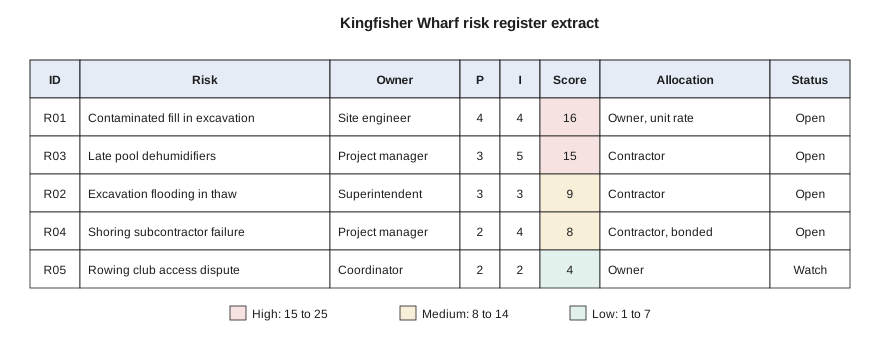
Ownership is the field most often neglected. A risk owned by 'the project team' is owned by nobody. Each risk should have one named person who tracks it, carries out or delegates the response, and reports on it. The owner need not be senior; a site engineer can own the dewatering risk, while the project manager owns the liquidated damages exposure.
The contract allocation field is particularly important for contractors. A risk the owner carries under the contract still matters to the contractor, because the contractor must give notice when it occurs and must document its cost to be paid (CON-220 lessons 8 and 9). But it is managed differently from a risk the contractor carries at its own expense. Some contractors keep two registers: one for risks the contractor carries and one for owner risks that create claims or change orders.
Worked problem
Building the first draft of a register
At the Kingfisher Wharf start-up workshop the team lists twelve candidate risks. Four are found to be known costs (the winter heating allowance, a fixed tipping fee, the scheduled pool fill and a city permit fee). Two are duplicates. One is an issue that has already happened (a late survey). How many risks go into the register, and what happens to the others?
Show solution
- Start with 12 candidates.
- Remove 4 known costs, which go into the estimate: 8 left.
- Merge 2 duplicates into existing entries: 6 left.
- Move 1 issue to the issues log: 5 left.
Answer: Five risks go into the register; four items are priced directly, two duplicates are merged and one is managed as an issue.
Keeping the register alive
A register is useful only if it is updated. Common practice is to review the top risks at every project meeting, the whole register monthly, and the register as a whole at major milestones such as design completion, start of excavation, enclosure and commissioning. New risks appear as the project moves forward, and old ones close when the work that carried them is finished. A register that never changes is a sign that nobody is looking at it.
# A minimal risk register in Python (illustrative Kingfisher Wharf data)
from dataclasses import dataclass

@dataclass
class Risk:
    rid: str
    title: str
    owner: str
    prob: int      # 1 (rare) to 5 (almost certain)
    impact: int    # 1 (minor) to 5 (severe)
    allocation: str
    status: str = "open"

    @property
    def score(self):
        return self.prob * self.impact

register = [
    Risk("R01", "Contaminated fill in excavation", "Site engineer", 4, 4, "Owner (contaminated soil clause)"),
    Risk("R02", "Excavation flooding in spring thaw", "Superintendent", 3, 3, "Contractor"),
    Risk("R03", "Late delivery of pool dehumidifiers", "Project manager", 3, 5, "Contractor"),
    Risk("R04", "Shoring subcontractor insolvency", "Project manager", 2, 4, "Contractor (bonded sub)"),
    Risk("R05", "Rowing club access dispute", "Project coordinator", 2, 2, "Owner"),
]
for r in sorted(register, key=lambda r: -r.score):
    band = "high" if r.score >= 15 else "medium" if r.score >= 8 else "low"
    print(f"{r.rid} {r.title:<38} {r.owner:<18} score {r.score:>2} ({band})  {r.allocation}")
print("Contractor-carried risks:", sum(1 for r in register if r.allocation.startswith("Contractor")))R01 Contaminated fill in excavation Site engineer score 16 (high) Owner (contaminated soil clause) R03 Late delivery of pool dehumidifiers Project manager score 15 (high) Contractor R02 Excavation flooding in spring thaw Superintendent score 9 (medium) Contractor R04 Shoring subcontractor insolvency Project manager score 8 (medium) Contractor (bonded sub) R05 Rowing club access dispute Project coordinator score 4 (low) Owner Contractor-carried risks: 3
A spreadsheet does the same job, but writing the register as structured data shows why consistent fields matter: once every risk has a probability, an impact, an owner and an allocation, the team can sort, filter and report automatically. Lesson 3 explains the scoring scales behind the numbers, and lesson 12 shows how the register feeds a monthly dashboard.
Owner and contractor registers
On well-run projects the owner and contractor share at least part of their registers. The owner knows things about the site, the users and the approvals that the contractor cannot; the contractor knows about methods, trades and the market. Some public owners now require a joint risk workshop at the start of every major project and a shared register for risks that both parties can influence. Collaborative delivery methods (CON-340 lessons 6 and 8) go further, with a single project register managed by the whole team. Even under a traditional stipulated price contract, sharing information about risks that the owner carries, such as contamination or permits, helps both sides prepare.
There are limits. A contractor will not want to share its view of its own pricing risks or the weaknesses of its subcontractors, and an owner may hold back information it fears will invite claims. Contract clauses about the reliance that can be placed on site information, discussed in lesson 6, affect how much is shared and what each party can claim if the information turns out to be wrong.
Common mistakes
MistakeListing topics such as 'weather' or 'design' as risks.
InsteadDescribe each risk as a cause, an uncertain event and an effect on objectives.
MistakeAssigning risks to 'the team' or a department.
InsteadGive every risk one named owner.
MistakeRecording effects such as 'delay' as separate risks.
InsteadRecord the underlying events; delay is an effect of many of them.
MistakeBuilding the register once at bid time and never reviewing it.
InsteadReview top risks at every project meeting and the full register monthly and at milestones.
MistakeIgnoring owner-carried risks in the contractor's register.
InsteadTrack them too, because notice and documentation are needed to recover their cost.
Summary and key terms
- Identification uses contract documents, drawings, site reports, the schedule, the estimate, lessons learned, market intelligence, stakeholders and site visits.
- Workshops, checklists, interviews, assumption analysis, schedule reviews, pre-mortems and constructability reviews each catch different risks.
- A good risk description states a cause, an uncertain event and an effect on objectives.
- The risk register records each risk with an owner, scores, ranges, contract allocation, responses, triggers and status.
- Every risk needs one named owner.
- The register must be reviewed regularly; new risks appear and old ones close as work proceeds.
- Owners and contractors benefit from sharing information on risks both can influence, within commercial limits.
- Risk identification
- The process of finding and describing risks.
- Risk register
- The central record of identified risks, their assessment, owners and responses.
- Risk owner
- The one person accountable for managing a particular risk.
- Pre-mortem
- An identification technique that imagines the project has failed and asks why.
- Assumption analysis
- Listing the assumptions behind a plan and testing what happens if each is wrong.
- Risk metalanguage
- A structured way of describing a risk as cause, event and effect.
- Trigger
- An early warning sign that a risk is about to occur.
- Residual risk
- The risk that remains after a response is applied.
- Constructability review
- A review of the design by builders to find problems with building it.
- Prompt list
- A list of risk categories used to guide identification.
Practice problems
Work each problem on paper first, then reveal the answer to check.
Rewrite 'weather' as a three-part risk for a roofing package scheduled in November.
Show answer
Because roofing is scheduled in November, snow and freezing rain may stop work for several days, which would delay enclosure and interior finishes.
Why is a pre-mortem useful against optimism bias?
Show answer
It presents failure as given, so people feel free to raise concerns.
Name four fields of a risk register.
Show answer
Any four of: ID, description, category, owner, scores, ranges, allocation, response, residual scores, trigger, status.
Why should 'delay' not usually appear as a risk?
Show answer
It is an effect of many underlying risks; the events causing it should be recorded instead.
Ten candidate risks include three known costs and one issue. How many enter the register if there are no duplicates?
Show answer
Six.
Who should own a risk?
Show answer
One named person able to track and act on it.
Why should contractors track owner-carried risks?
Show answer
To give notice and document costs so they can be recovered.
What does the cause in a risk description point to?
Show answer
Possible mitigation.
When should the full register be reviewed?
Show answer
Monthly and at major milestones, with top risks reviewed at every project meeting.
Give one reason an owner and contractor might not share their full registers.
Show answer
Commercial sensitivity, such as a contractor's pricing risks or an owner's fear of inviting claims.
Lesson quiz · 5 questions
Score 60% or more to complete this lesson.
Create a free account to save your progress, take quizzes and earn a certificate.