
CON-350 · Lesson 8 of 12 · 26 min
Construction insurance II: liability, professional, pollution and wrap-ups
Property insurance pays to repair the work. Liability insurance pays when someone else is hurt or their property is damaged and a project party is legally responsible. On a construction site the potential for third-party claims is large: members of the public walk past the hoarding, neighbouring buildings can be undermined or flooded, vehicles move in and out, and the finished building will be used by thousands of people for decades. This lesson covers the liability side of a construction insurance program, together with professional, pollution and cyber coverage and wrap-up programs that insure everyone on a project under one policy. As with lesson 7, the actual policy wording always governs.
Commercial general liability
Commercial general liability (CGL) insurance is the foundation of a contractor's liability program. It covers the insured's legal liability for bodily injury and property damage to third parties caused by an occurrence, together with the cost of defending claims. It also covers personal and advertising injury, and, subject to its terms, liability the insured assumes under insured contracts such as many indemnities given in construction contracts (lesson 5).
| Feature | What it means |
|---|---|
| Occurrence basis | The policy in force when the injury or damage happens responds, even if the claim comes years later |
| Per occurrence limit | The most paid for one occurrence |
| General aggregate | The most paid in the policy period for all occurrences other than completed operations; often per project by endorsement |
| Products-completed operations | Coverage for injury or damage after the work is finished, usually with its own aggregate |
| Defence costs | Usually paid in addition to the limits in North American CGL forms |
| Contractual liability | Covers liability assumed under insured contracts, within policy terms |
| Additional insured | Another party, such as the owner, added to the policy for claims arising from the named insured's work |
Completed operations coverage is particularly important for contractors, because many claims arise after handover: a balcony railing fails, a roof leak damages a tenant's stock, or a ceiling falls. Owners commonly require contractors to keep completed operations coverage in force for a number of years after completion, often matching the limitation period for claims. A contractor that lets its coverage lapse after retiring may still be sued.
CGL policies have important exclusions for construction. The 'your work' exclusion generally removes coverage for damage to the insured's own completed work arising out of it, with an exception in many forms for work performed by subcontractors. Professional services exclusions remove design liability, which is why design-builders need professional liability insurance. Pollution exclusions remove most environmental claims, which is why pollution liability is bought separately. Residential construction has seen insurers add further exclusions in some markets, so contractors should read their policies closely.
Umbrella and excess layers
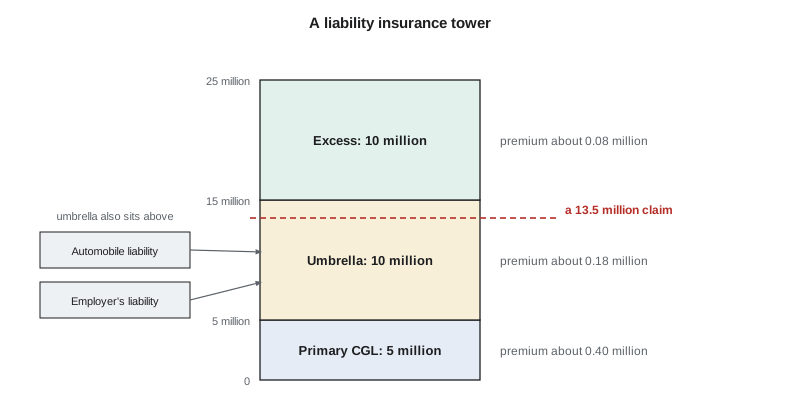
A single CGL policy rarely provides enough limit for a large project. Contractors and owners build a tower of insurance: a primary CGL layer, an umbrella policy that sits above the CGL, automobile and employer's liability policies and may broaden coverage, and excess layers that follow the form of the layers below.
Worked problem
How a large claim moves through the tower
A crane on the Kingfisher Wharf site collapses onto a neighbouring property, causing $13.5 million of property damage and injury claims for which Tallgrass is liable. The tower is primary CGL $5 million, umbrella $10 million and excess $10 million. How is the claim paid?
Show solution
- Primary CGL pays its full $5 million limit.
- Remaining: 13.5 − 5.0 = $8.5 million.
- Umbrella pays $8.5 million, within its $10 million limit.
- Excess layer is not reached.
Answer: The primary pays $5 million and the umbrella $8.5 million. Without the umbrella, Tallgrass would face $8.5 million itself, enough to bankrupt most contractors of its size.
Market conditions for umbrella and excess layers have been harder than for primary layers, because of large court awards, sometimes called social inflation, and the cost of claims rising faster than general inflation. Broker reports in 2026 expected US umbrella and excess rates for contractors to keep rising, by around 5 to 15 % in many programs, while primary general liability was closer to flat. Owners setting insurance requirements should ask brokers what limits are actually available at a reasonable price before demanding very high limits from every subcontractor.
Workers' compensation and automobile
In Canada, workers' compensation is a provincial no-fault system run by boards such as the WSIB in Ontario and WorkSafeBC. Employers pay premiums to the board, and in return workers generally cannot sue their employer for workplace injuries. Contractors must be registered and in good standing, and general contractors usually require clearance certificates from subcontractors, because in several provinces a principal can be liable for a subcontractor's unpaid premiums. Experience rating adjusts premiums for an employer's injury record (HSE-401 and CON-330 lesson 3). Automobile liability is required by provincial law, and contracts typically require higher limits than the statutory minimum.
Workers' compensation and automobile liability usually fall outside the CGL, but the umbrella often sits over automobile and employer's liability as well, which is why its limit is chosen with all three exposures in mind.
Professional liability
Professional liability, also called errors and omissions insurance, covers claims arising from negligent professional services: design errors, faulty specifications, incorrect calculations. Architects and engineers carry it as a matter of course, and many provincial and state regulators or owners require it. It is written on a claims-made basis, which means the policy in force when the claim is made, not when the error was committed, responds, provided the error occurred after the policy's retroactive date.
| Feature | Occurrence (CGL) | Claims-made (professional) |
|---|---|---|
| Which policy responds? | The one in force when the injury or damage occurred | The one in force when the claim is first made |
| Retroactive date | Not applicable | Errors before this date are not covered |
| After retirement or closing | Old policies still respond to old occurrences | Need an extended reporting period (tail) or run-off cover |
| Defence costs | Usually in addition to limits | Often inside the limit, eroding it |
Contractors need professional coverage when they take on design, for example as design-builders, when they provide delegated design such as engineered shoring or precast connections, or when they offer preconstruction services under construction management contracts (CON-340). Contractor's professional liability policies are designed for this. Owners on large projects increasingly buy project-specific professional liability that covers the whole design team for the duration of the project plus a reporting period, so that limits are not shared with each designer's other work. Owner's protective professional indemnity is another product that pays the owner when a designer's own policy is exhausted.
Pollution liability
Most CGL policies exclude pollution claims, but construction can cause pollution: disturbed contaminated soil, fuel spills, mould growth, silt-laden runoff, asbestos released during renovation. Contractor's pollution liability insurance covers third-party bodily injury, property damage and clean-up costs arising from pollution conditions caused by the contractor's operations. Owners of contaminated sites like Kingfisher Wharf may also buy pollution legal liability insurance, which covers pre-existing contamination discovered later. HSE-251 covers spill response and environmental protection from the safety side.
Mould is worth singling out. Water entering a building during construction, especially in wood-frame or interior finishes, can lead to mould claims after occupancy. Many CGL policies exclude mould, and some pollution policies cover it. Contractors working on residential and health care projects should confirm where mould sits in their program.
Cyber and other coverages
Construction firms have become targets for ransomware and payment fraud, ranking among the most attacked industries in recent years (CON-260 lesson 11). Cyber insurance covers costs such as incident response, data recovery, business interruption, notification and liability for privacy breaches. A common construction loss is invoice fraud, where criminals impersonate a supplier and redirect a payment; whether this is covered depends on social engineering or funds transfer fraud extensions, often in a crime policy rather than the cyber policy. Other coverages in a contractor's program include contractor's equipment, installation floaters for material in transit, and directors and officers liability.
Wrap-up programs
Under a traditional program each party buys its own insurance and the owner relies on certificates. Under a wrap-up, one party buys a single policy covering all contractors and subcontractors on the project. An owner-controlled insurance program (OCIP) is bought by the owner; a contractor-controlled insurance program (CCIP) is bought by the general contractor.
In Canada, project-specific wrap-up liability policies covering the owner, contractor, subcontractors and consultants for third-party liability arising from the project are common on larger projects, and CCDC 41 allows the owner to provide wrap-up liability insurance in place of the contractor's CGL for the project. Because workers' compensation is a provincial board system, Canadian wrap-ups generally cover liability only.
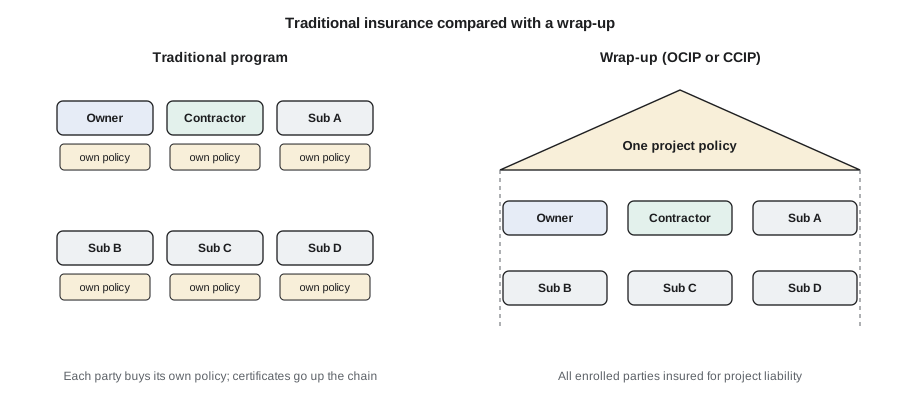
Wrap-ups offer several advantages: no gaps or disputes between policies, consistent limits for everyone, a single claims handler, a coordinated safety program, and lower total cost through bulk purchasing. They also have drawbacks: administration costs, the need to sign up and track every subcontractor, possible coverage gaps for off-site work, and questions about completed operations coverage after the project ends. They are usually worthwhile only above a certain project size.
# Comparing a traditional program with a wrap-up (illustrative)
contract = 48_000_000
# traditional: each party's liability cost embedded in prices, as % of their contract value
trad_rate = 0.0145              # average GL and umbrella cost built into all bids
traditional = contract * trad_rate
# wrap-up: owner buys one policy and credits are deducted from bids
wrap_premium = contract * 0.0085
admin = 65_000                  # broker, sign-up and safety administration
deductible_losses = 90_000      # expected retained losses under the wrap-up
wrap_total = wrap_premium + admin + deductible_losses
print(f"Traditional cost in bids: {traditional:,.0f}")
print(f"Wrap-up total cost:       {wrap_total:,.0f}")
print(f"Saving: {traditional - wrap_total:,.0f} ({(traditional - wrap_total) / contract:.2%} of contract)")Traditional cost in bids: 696,000 Wrap-up total cost: 563,000 Saving: 133,000 (0.28% of contract)
In the illustration the wrap-up saves about $133,000, roughly 0.3 % of the contract value. Real savings depend on whether subcontractors actually remove their insurance costs from their bids, which owners check through bid forms that ask for insurance costs separately, and on the loss experience of the project.
Certificates and additional insured status
Owners and contractors usually verify coverage through certificates of insurance. A certificate is a summary issued by the broker; it does not change the policy and generally gives the certificate holder no rights. What protects the owner is the endorsement on the policy itself naming it as an additional insured, together with any waiver of subrogation and notice of cancellation endorsements. Good practice is to require copies of the endorsements, not just certificates, and to track expiry dates through the project.
| Document | What it does | What to check |
|---|---|---|
| Certificate of insurance | Summarizes coverage for information | Insurer, policy numbers, limits, dates, named insured |
| Additional insured endorsement | Adds the owner or contractor to the policy for specified claims | Whether it covers completed operations; primary and non-contributory wording |
| Waiver of subrogation endorsement | Stops the insurer pursuing the named party | Matches the contract requirement |
| Cancellation notice endorsement | Requires the insurer or broker to give notice before cancelling | The notice period, often 30 days |
Common mistakes
MistakeRelying on a certificate of insurance as proof of additional insured status.
InsteadObtain the actual endorsement and check it covers completed operations.
MistakeLetting completed operations coverage lapse after handover.
InsteadKeep it in force for the period the contract and limitation law require.
MistakeAssuming the CGL covers design errors in design-build.
InsteadBuy contractor's or project-specific professional liability; CGL excludes professional services.
MistakeAssuming pollution and mould are covered by the CGL.
InsteadCheck the exclusions and buy contractor's pollution liability where needed.
MistakeSetting very high limits for every subcontractor regardless of trade.
InsteadTier limits by trade risk and check what the market will provide.
Summary and key terms
- CGL covers third-party bodily injury and property damage on an occurrence basis, including completed operations and insured contracts.
- Umbrella and excess layers build a tower of limits; umbrella and excess pricing has been harder than primary.
- Workers' compensation is a provincial board system in Canada and a state insurance system in the United States.
- Professional liability is claims-made, with retroactive dates and tail coverage; contractors need it when they design.
- Pollution and mould are usually excluded from CGL and covered by pollution policies.
- Cyber and crime policies address ransomware and payment fraud, a growing construction risk.
- Wrap-ups (OCIP or CCIP) insure everyone under one policy; they save cost and avoid gaps but need administration.
- Endorsements, not certificates, create additional insured rights.
- Commercial general liability
- Insurance for third-party bodily injury and property damage caused by the insured's operations.
- Occurrence basis
- Coverage triggered by when the injury or damage happens.
- Claims-made basis
- Coverage triggered by when the claim is first made.
- Completed operations
- Coverage for injury or damage arising after the work is finished.
- Umbrella policy
- A policy above primary liability policies that adds limit and may broaden coverage.
- Retroactive date
- The date before which errors are not covered under a claims-made policy.
- Extended reporting period
- A period after a claims-made policy ends during which claims can still be reported.
- Pollution liability
- Insurance for injury, damage and clean-up costs from pollution conditions.
- Wrap-up
- A single project insurance program covering all participants (OCIP or CCIP).
- Certificate of insurance
- A summary of coverage issued by a broker that does not change the policy.
Practice problems
Work each problem on paper first, then reveal the answer to check.
A $9 million liability claim hits a tower of $5 million primary and $10 million umbrella. How is it paid?
Show answer
Primary $5 million, umbrella $4 million.
What is the difference between occurrence and claims-made coverage?
Show answer
Occurrence responds to when injury or damage occurs; claims-made to when the claim is made.
Why must contractors keep completed operations coverage after handover?
Show answer
Many claims arise after completion and may be brought years later.
Why does a design-builder need professional liability insurance?
Show answer
CGL policies exclude professional services such as design.
What is a retroactive date?
Show answer
Errors committed before it are not covered by a claims-made policy.
Name two pollution exposures on construction sites.
Show answer
Any two of: disturbed contaminated soil, fuel spills, silt runoff, asbestos, mould.
What is the difference between an OCIP and a CCIP?
Show answer
An OCIP is bought by the owner; a CCIP by the general contractor.
Why does a certificate of insurance not protect the owner by itself?
Show answer
It only summarizes coverage; the additional insured endorsement creates rights.
Give two advantages and two drawbacks of a wrap-up.
Show answer
Advantages: no gaps, consistent limits, lower cost, coordinated safety. Drawbacks: administration, tracking enrolled firms, off-site gaps, completed operations questions.
Which policy often covers payment redirection fraud?
Show answer
A crime policy with social engineering or funds transfer fraud cover, or a cyber extension.
Lesson quiz · 5 questions
Score 60% or more to complete this lesson.
Create a free account to save your progress, take quizzes and earn a certificate.