
CRE-201 · Lesson 6 of 12 · 25 min
Text, professional and community platforms
Not every creator works in video. Writers, analysts, commentators, professionals and community builders thrive on platforms where text, images and conversation matter most: LinkedIn, X, Threads, Bluesky, Reddit, Pinterest, Substack Notes, Tumblr and Discord-style communities. These platforms rank content differently from short-form video feeds, rewarding conversation, expertise, relevance to communities, and in some cases giving users unusual control over their feeds. This lesson examines LinkedIn, X, Bluesky and decentralized platforms, Reddit and voting-based ranking, Pinterest as a visual discovery engine, community platforms, the role of links and external traffic, and strategies for text-based creators.
LinkedIn is the leading professional network, where creators share expertise, career stories, industry analysis and business insights. Its feed ranks posts by predicted relevance and engagement, and LinkedIn has said it aims to show posts that share knowledge and advice from people with relevant expertise, while reducing distribution for engagement bait, such as polls used only to farm reactions, and low-quality viral content. Signals include dwell time, how long people spend reading a post; meaningful comments, especially from people in the creator's network or industry; reshares; and relationships between members. Formats include text posts, documents or carousels presented as swipeable PDFs, images, short and long videos, newsletters and articles, and live events. LinkedIn audiences are professional, so tone, accuracy and credibility matter; personal stories work best when they offer lessons or insight.
X
X, formerly Twitter, combines a "For You" recommendation feed with a "Following" feed. In 2023, the company published parts of its recommendation source code, describing a pipeline that retrieves candidates from followed accounts and from similar users and topics, ranks them with a neural network predicting engagement actions such as likes, replies, reposts and clicks, and filters them for diversity and safety. Since then, X has changed its systems repeatedly, including giving more visibility to paid subscribers and testing changes to how links and long posts are treated. Many creators and publishers have reported reduced reach for posts containing external links, though X's practices have shifted over time. X remains important for news, politics, technology, sports and real-time conversation, but its audience and policies have changed significantly since 2022, and many users and organizations have moved to alternatives.
Bluesky and decentralized platforms
Bluesky, opened to the public in 2024, is built on an open protocol, the AT Protocol, that separates the network from the feeds and moderation tools people use. Its most distinctive feature for creators is custom feeds: anyone can build a feed algorithm, for example a feed of science posts, art, local news or posts from a community, and users choose which feeds to follow. This means distribution depends partly on whether a creator's posts appear in popular custom feeds, often through keywords, hashtags or community membership. Mastodon and other fediverse services use mostly chronological feeds and decentralized servers with their own moderation rules, offering less algorithmic reach but more control and community. Threads, as Lesson 5 described, connects to the fediverse. These platforms offer creators portability, the ability to move followers between services in some cases, and less dependence on a single company's algorithm.
| Platform | Feed approach | Creator considerations |
|---|---|---|
| Ranked by relevance, expertise and engagement | Professional tone, dwell time, comments | |
| X | For You recommendations plus Following | Real-time topics, changing policies |
| Threads | Ranked recommendations plus following feed | Conversation, linked to Instagram |
| Bluesky | User-chosen custom feeds plus following | Appear in relevant custom feeds |
| Mastodon | Mostly chronological, decentralized | Community norms, hashtags, server choice |
Reddit and voting-based ranking
Reddit is organized into communities called subreddits, each with its own moderators, rules and culture. Posts are ranked by votes from community members: upvotes raise posts, downvotes lower them, and ranking formulas such as "hot" combine vote score with age, so that newer posts with rapidly growing votes rise while older posts fall. Users can also sort by new, top and rising. Reddit's home feed recommends posts from joined and suggested communities. For creators, Reddit can bring large, engaged audiences, but its communities are often hostile to self-promotion; many subreddits limit or ban promotional links and expect members to participate genuinely before sharing their own work. Reddit content also appears prominently in search engines, and Reddit licenses its data to AI companies, giving its posts long-term visibility.
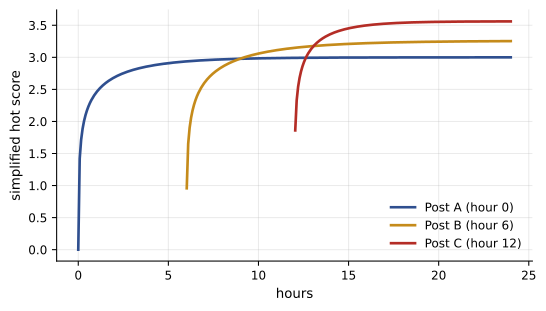
This simplified form of Reddit's historical "hot" formula, published when Reddit's code was open source, shows two key ideas: votes count logarithmically, so the first ten votes matter as much as the next ninety, and newer posts receive a time bonus, so freshness competes with popularity. Reddit's current ranking is more complex, but the principles remain useful.
Worked problem
Why early votes matter on Reddit
Using the simplified hot formula, how much does a post's score change when its net votes rise from 10 to 100, compared with from 100 to 1,000? How does this compare with the time bonus for a post made 12.5 hours later?
Show solution
- From 10 to 100 net votes: log₁₀ 100 − log₁₀ 10 = 2 − 1 = 1 point.
- From 100 to 1,000 net votes: 3 − 2 = 1 point, the same increase for ten times more votes.
- Time bonus: 12.5 hours = 45,000 seconds, worth 1 point.
- A post made 12.5 hours later with 10 votes scores the same as an earlier post with 100 votes.
Answer: Each tenfold increase in votes adds one point, and a 12.5-hour newer post earns one point; early votes and freshness matter greatly.
Pinterest functions more like a visual search and discovery engine than a social network. People use it to plan and find ideas: recipes, home decor, fashion, weddings, crafts, travel and products. Pins can remain discoverable for months or years, much longer than posts on most social platforms. Pinterest's systems use visual understanding of images, text in titles and descriptions, board names, and engagement such as saves and clicks to match pins with searches and home feed interests. Keywords therefore matter greatly: clear, descriptive titles and descriptions using the terms people search for help pins appear. Pinterest also drives significant traffic to external websites, making it valuable for bloggers, online shops and creators with products, and its shopping features link pins directly to products.
Community platforms and owned spaces
Discord servers, Facebook groups, Patreon communities, Circle, Geneva, Substack chats and similar spaces offer creators places where members gather around shared interests. These are generally not algorithmic in the same way as public feeds: members see what is posted in channels they join, and the creator or moderators shape the experience. They offer deeper relationships, direct communication and opportunities for paid memberships, but they depend on members choosing to participate. Community management, moderation and safety are significant responsibilities (CRE-301). Newsletters and email lists, discussed in CRE-120 and Lesson 12, are the most direct owned channels, delivering content to subscribers without algorithmic filtering, though email providers apply their own filtering.
Links and external traffic
Many creators want to send audiences to websites, shops, newsletters or other platforms. Social platforms often have incentives to keep users on their own services, and some have been reported to reduce the distribution of posts with external links, or to place links in less prominent positions. Practices vary and change: LinkedIn, X and Facebook have all faced reports of link penalties at times, while Pinterest and Reddit actively support links in many contexts. Creators adapt by providing value within the post itself and offering the link as an optional next step, using platform features such as link stickers in Stories, link-in-bio tools, comments, or native newsletters and articles. Measuring actual clicks and conversions, not just reach, reveals whether a platform is truly sending traffic.
Strategies for text-based creators
Text-based creators succeed by combining strong writing (CRE-120) with an understanding of each platform's ranking. Effective approaches include writing a clear, compelling first line or two that earns the "see more" tap; providing specific, original insight rather than generic advice; formatting for readability with short paragraphs and lists; replying to comments to build conversation, which many platforms reward; posting consistently on topics that build recognized expertise; adapting posts to each platform's culture rather than copying them verbatim; and building a newsletter or website so that the audience is not wholly dependent on any one platform. Text platforms can also support video creators, as places to share insights, behind-the-scenes thoughts and links to longer work.
Writing for professional audiences
Professional platforms reward a particular kind of writing. Posts that share specific lessons from real experience, explain trends in an industry with evidence, offer practical frameworks, or start thoughtful debates tend to attract meaningful comments from relevant people. Vague motivational posts, exaggerated success stories and obvious engagement tactics are increasingly ignored or demoted. Credibility comes from a consistent focus, accurate information, clear sourcing, and a profile that shows relevant experience. Many professionals build audiences that lead to clients, jobs, speaking invitations and partnerships, making these platforms valuable even with modest follower counts.
Real-time platforms and news
Text-based platforms such as X, Threads and Bluesky are often where news breaks and real-time conversation happens, around sports, politics, entertainment and technology. Recommendation systems on these platforms weigh recency heavily, so timely posts can gain reach quickly, while older posts fade fast. This rewards creators who can react thoughtfully and quickly, but it also encourages haste and amplification of unverified claims. Creators who share news responsibly verify sources, correct mistakes openly and avoid sharing misleading content, protecting their credibility over time.
Communities as discovery engines
Communities, whether subreddits, Discord servers, Facebook groups or forums, are also discovery engines. Members recommend creators to each other, share links, and discuss content in depth. A creator who becomes a valued member of a community, contributing expertise and respecting its norms, can gain loyal followers who arrive with trust already established. This kind of discovery is slower than algorithmic virality but often produces stronger relationships.
Measuring text-based success
Text platforms offer analytics such as impressions, engagement rate, profile visits, follower growth and link clicks. As with video, comparing each post with your own typical results is more meaningful than comparing with others. For professionals and writers, outcomes beyond the platform, such as newsletter sign-ups, inquiries, job offers and sales, may matter more than impressions, and tracking them, for example with dedicated links, shows which platforms truly support goals.
Newsletters on platforms
Several platforms host newsletter-style content: LinkedIn newsletters notify subscribers when new editions are published; Substack combines email newsletters with a social network called Notes and in-app recommendations from other writers; and platforms such as Medium and Ghost support publishing with varying discovery features. Substack's recommendation network, in which writers recommend other publications to their subscribers, has become a significant growth channel for many writers. These hybrid tools combine some of the reach of social platforms with the direct relationship of email, though the platform still controls the in-app discovery layer.
Choosing among text platforms
Text-based creators rarely need every platform. A business consultant might focus on LinkedIn and a newsletter; a technology commentator on X, Bluesky or Threads plus a blog; a crafts creator on Pinterest and a website; a gaming community on Reddit and Discord. The right choice depends on where the intended audience gathers, the creator's writing style and goals, and the time available. Starting with one or two platforms and adding others once routines are established prevents spreading effort too thinly. Revisiting the choice periodically matters, because text platforms have changed rapidly, with audiences moving between services as policies, ownership and features change.
Common mistakes
MistakeUsing engagement-bait polls on LinkedIn.
InsteadShare genuine expertise and invite real discussion.
MistakePosting self-promotion in subreddits without participating.
InsteadFollow community rules and contribute first.
MistakeIgnoring keywords on Pinterest.
InsteadWrite descriptive titles and descriptions with search terms.
MistakeRelying on link posts for reach.
InsteadDeliver value in the post and offer links as a next step.
MistakeCopying the same text to every platform.
InsteadAdapt to each platform's culture and format.
Summary and key terms
- LinkedIn rewards expertise, dwell time and meaningful comments.
- X combines For You and Following feeds and has changed policies frequently.
- Bluesky offers user-chosen custom feeds on an open protocol; Mastodon is mostly chronological.
- Reddit ranks by community votes and freshness, and resists self-promotion.
- Pinterest is a visual search engine where pins last and drive external traffic.
- Community platforms and newsletters provide owned, less algorithmic spaces.
- Links may be deprioritized on some platforms; measure real traffic.
- Dwell time
- Time spent reading or viewing a post.
- For You feed
- Algorithmic recommendation feed.
- Following feed
- Feed of posts from followed accounts.
- AT Protocol
- Open protocol underlying Bluesky.
- Custom feed
- User-created feed algorithm on Bluesky.
- Fediverse
- Network of interoperable decentralized services.
- Subreddit
- Reddit community with its own rules.
- Hot ranking
- Ranking combining votes and recency.
- Pin
- Saved image or video linking to content on Pinterest.
- Link-in-bio
- Profile link to a page of a creator's links.
Practice problems
Work each problem on paper first, then reveal the answer to check.
What does LinkedIn say it favours?
Show answer
Knowledge and advice from relevant experts.
What did X publish in 2023?
Show answer
Parts of its recommendation source code.
What are Bluesky custom feeds?
Show answer
User-created feed algorithms people choose to follow.
How are Mastodon feeds mostly ordered?
Show answer
Chronologically.
What do upvotes and time do in Reddit's hot ranking?
Show answer
Votes raise posts logarithmically; newer posts get a bonus.
Points added by going from 1,000 to 10,000 net votes?
Show answer
One point.
Why is Pinterest like a search engine?
Show answer
People search for ideas and pins last for months or years.
Name two owned or community spaces.
Show answer
Discord, newsletters, Patreon, groups.
How can creators handle link penalties?
Show answer
Deliver value in-post and use link features or comments.
Name two text-creator strategies.
Show answer
Strong first lines, original insight, replies, consistency, adaptation.
Lesson quiz · 5 questions
Score 60% or more to complete this lesson.
Create a free account to save your progress, take quizzes and earn a certificate.