
CRE-211 · Lesson 5 of 12 · 25 min
Retention by design: openings, pacing and payoffs
Retention, the proportion of a video that viewers watch, is one of the clearest signals of whether a long-form video delivers on its promise. CRE-202 explained how to read retention curves and watch time in analytics; this lesson is about designing videos that hold attention in the first place. The goal is not to trap viewers with tricks, but to respect their time: every moment should give them a reason to stay, whether through information, story, emotion or entertainment. This lesson covers the first 30 seconds, managing expectations, open loops and questions, re-hooks and segment transitions, pacing for long-form, variety and pattern interrupts, placing sponsor segments, endings that lead to more viewing, and reviewing your own videos for retention.
The first 30 seconds
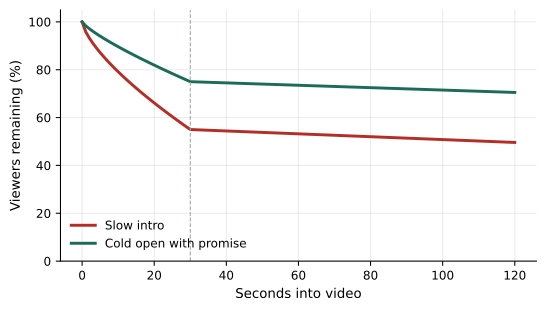
The opening of a long video does a different job from a short-form hook. The viewer has already clicked, so the opening must confirm they are in the right place and give them a reason to commit. Effective openings typically:
- Show or state the subject of the thumbnail and title immediately, so viewers know the promise will be kept.
- Establish the stakes: why this matters, what is uncertain, what could go wrong, or what the viewer will gain.
- Preview the payoff or the journey: a glimpse of the finished result, a dramatic moment from later, or a roadmap of what the video covers.
- Start the content quickly, without long greetings, channel intros, sponsor messages or requests to like and subscribe.
Many creators find that the most common retention problem is an opening that takes too long to get going. Cutting the first 20 seconds of throat-clearing often produces an immediate improvement. A cold open, beginning directly with a compelling moment or question, is a powerful technique for many formats.
Managing expectations
Viewers stay when they believe the video will continue to be worth their time. Clear signposting helps: telling viewers what the video covers, how it is organized, or roughly where the payoff will come ("by the end, we will know which grinder wins") sets expectations and gives a reason to stay. Chapters (Lesson 10) also tell viewers what is coming, and while some viewers use them to skip ahead, they improve satisfaction and help viewers find what they came for. Avoid promising more than the video delivers, or teasing a payoff that is then underwhelming, both of which damage trust.
Open loops and questions
An open loop is a question or unresolved situation that the viewer wants answered. Long-form videos use open loops at several scales: a central question that runs through the whole video, such as "will the cheap grinder hold up?", and smaller questions within segments, such as "but there was one problem we did not expect". Opening a new loop before closing the previous one keeps viewers moving forward. Open loops must be closed; viewers who discover that a teased answer never arrives feel cheated. The investigation and narrative structures from Lesson 4 are built around open loops naturally, while list and tutorial structures can add them by previewing the most interesting item or the most common mistake.
Re-hooks and transitions
Viewers tend to leave at transitions between segments, where one idea has been resolved and the next has not yet started. A re-hook is a moment at the start of a new segment that renews interest: a new question, a surprise, a change of stakes or a promise of something especially valuable. Transitions that simply say "next" give viewers an easy exit; transitions that create a reason to continue keep them. Examples include "That solved the noise problem, but it created a new one", "The first two tests were close. The third was not", and "Everything so far has been theory. Now let us see what happens on a real job." Visual and audio transitions, such as a change of location, music or shot style, can also signal a fresh start.
| Weak transition | Re-hook |
|---|---|
| Next, let's talk about battery life. | Battery life is where this phone surprised me most. |
| Moving on to step four. | Step four is where most people ruin the bread. |
| Now the second test. | The first test was a tie. The second one was not even close. |
| So that's the history. | That explains how it started, but not why it collapsed. |
Pacing for long-form
Pacing is the speed at which information and events unfold. Long-form pacing differs from short-form: viewers who have committed to a twenty-minute video tolerate, and often enjoy, moments of breathing room, atmosphere and detail, but they leave when the video repeats itself, explains the obvious or lingers without purpose. Good long-form pacing varies: quick sections that cover simple points briskly, slower sections that let important moments land, and changes of rhythm that keep attention fresh. Common pacing problems include repetition, saying the same thing several ways; over-explaining; long, unedited demonstrations; tangents that do not serve the promise; and sections where nothing changes visually for minutes. Tightening the edit, removing pauses, repetitions and weaker examples, is usually the most effective pacing fix (Lesson 8).
Variety and pattern interrupts
Attention fades when a video becomes predictable. Variety in content and presentation keeps it fresh: alternating between talking to camera, B-roll, demonstrations, graphics, interviews and screen recordings; changing camera angles and shot sizes; changing locations; using music to mark sections; and including humour, surprises or personal moments. A pattern interrupt is a deliberate break in the established rhythm, such as a sudden cut to a different scene, an unexpected sound, a visual gag or a direct question to the viewer. Used occasionally, they refresh attention; used constantly, they become noise. The goal is variety that serves the content, not distraction for its own sake.
Sponsor segments and retention
Sponsored segments, covered in Lesson 12, are a common point of viewer drop-off. Their placement and quality affect both retention and sponsor value. Common practices include placing the sponsor segment after the opening has established the promise, typically one to three minutes into the video, rather than before any content; keeping it concise, often 60 to 90 seconds; integrating it naturally with a transition that relates to the video's subject; making it honest and genuinely useful; and using a clear visual marker so viewers know when it starts and ends. Viewers who trust the creator often watch sponsor segments, especially when the product is relevant and the segment is entertaining. Some viewers skip them using chapters or third-party tools, which creators should accept rather than counter with tricks.
Worked problem
Estimating the cost of a slow opening
A creator publishes two similar 15-minute videos. In the first, with a 45-second introduction before the content, 58 % of viewers remain at the one-minute mark and average view duration is 5.4 minutes. In the second, with a cold open, 74 % remain at one minute and average view duration is 7.1 minutes. If each video gets 40,000 views, how much more watch time does the second video earn?
Show solution
- First video watch time: 40,000 × 5.4 = 216,000 minutes = 3,600 hours.
- Second video watch time: 40,000 × 7.1 = 284,000 minutes ≈ 4,733 hours.
- Difference: about 1,133 hours, or about 31 % more watch time.
- More watch time and satisfaction can also lead to more recommendations, so the real difference in views may be larger.
Answer: About 1,133 more hours of watch time, roughly 31 % more, from the cold open alone.
Endings that lead to more viewing
Viewers leave when a video signals that it is ending, so the end of a long video is both a retention risk and an opportunity. Deliver the payoff clearly, summarize briefly if useful, and end soon afterward. Rather than a generic "thanks for watching, see you next time", point to a specific next video that continues the viewer's interest, explained in a sentence: "If you are planning to build one yourself, the next video shows the mistakes that cost me two weekends." End screens (Lesson 10) then make it easy to click. Videos that send viewers to more videos on the channel increase session time and the channel's overall performance.
Reviewing your own videos for retention
Before publishing, watch the full edit as a viewer would, ideally after a break and on the devices your audience uses. Mark every moment where your attention drifts, where you would be tempted to skip ahead, or where something is unclear; these are the places viewers will leave. Ask someone unfamiliar with the subject to watch and note the same. After publishing, compare the retention curve with your predictions (CRE-202): dips at transitions, slow sections and sponsor segments reveal where to improve next time, while bumps show moments viewers rewatched or skipped to. Over many videos, these reviews teach the pacing instincts that make strong long-form creators.
Emotion and stakes
Information alone rarely holds attention for twenty minutes; emotion and stakes do. Stakes are what could be gained or lost: money, time, safety, reputation, a goal or simply the answer to a question the viewer cares about. Emotion comes from people: the creator's frustration when a test fails, an interviewee's memory of a difficult moment, the satisfaction of a finished project. Even technical videos benefit from human moments, such as admitting a mistake or showing genuine surprise. Make stakes clear early and raise them as the video progresses, so the payoff matters more.
Retention and different traffic sources
Viewers arriving from different sources behave differently. Search viewers often want a specific answer and may leave once they have it, so a tutorial with a lower average percentage viewed may still be highly satisfying; chapters help them find the answer quickly. Browse and suggested viewers chose the video out of curiosity and need the opening to deliver on that curiosity fast. Subscribers are more forgiving and often watch longer. When judging retention, compare videos of similar type and traffic mix rather than expecting every video to hold the same percentage (CRE-202).
Respecting the viewer
Retention techniques can be misused: endless teasing of a payoff that is delayed for no reason, fake cliffhangers, misleading "wait until the end" promises, or padding with filler to reach mid-roll advertisement thresholds. These may raise short-term watch time, but they frustrate viewers and erode trust, and recommendation systems increasingly measure satisfaction through surveys and long-term viewing behaviour (CRE-201). The most durable retention comes from videos that are genuinely worth watching from start to finish. A good question to ask of every retention technique is whether it makes the video better for the viewer, or merely longer.
Retention for different formats
Different formats hold attention in different ways. Tutorials hold viewers through usefulness and clear progress toward a result, so retention depends on clarity and efficiency. Stories and documentaries hold viewers through curiosity and emotion, so retention depends on stakes, character and unanswered questions. Entertainment and challenge videos hold viewers through escalation and personality. Conversations and podcasts hold viewers through chemistry, ideas and the feeling of companionship, and their audiences often accept lower percentages viewed of very long episodes while still watching for hours in total. Retention techniques should suit the format rather than being applied identically to every video.
Learning from the retention curve
After publishing, the retention curve shows exactly where viewers left, rewatched or skipped. Look for the initial drop in the first 30 seconds, steady declines during slow sections, sharp drops at transitions or sponsor segments, and spikes where viewers rewatched a moment or jumped ahead. Compare the curve with the outline: which segments held attention best, and why? Note lessons in a running document so that each new video benefits from the last.
Testing your opening
Before publishing, show the first minute to someone unfamiliar with the video and ask what they think the video will deliver and whether they want to keep watching. If their answer does not match the packaging's promise, or they hesitate, tighten the opening until it does.
Common mistakes
MistakeLong greetings and channel intros.
InsteadOpen with the subject and stakes immediately.
MistakeTransitions that offer an easy exit.
InsteadRe-hook each new segment.
MistakeOpen loops that are never closed.
InsteadResolve every question you raise.
MistakeConstant pattern interrupts.
InsteadUse variety that serves the content.
MistakeSponsor segments before any content.
InsteadPlace them after the promise is established.
Summary and key terms
- Long-form openings must confirm the promise and establish stakes quickly.
- Signposting and chapters manage expectations.
- Open loops at several scales keep viewers moving forward.
- Re-hooks at transitions prevent drop-off between segments.
- Long-form pacing varies and cuts repetition and tangents.
- Variety and occasional pattern interrupts refresh attention.
- Thoughtful sponsor placement and specific next-video endings protect retention.
- Retention
- Proportion of a video viewers watch.
- Cold open
- Starting directly with a compelling moment.
- Signposting
- Telling viewers what is coming.
- Open loop
- Unresolved question the viewer wants answered.
- Re-hook
- Renewed reason to watch at a segment's start.
- Pacing
- Speed at which information and events unfold.
- Pattern interrupt
- Deliberate break in the established rhythm.
- Sponsor segment
- Paid section promoting a product.
- Average view duration
- Mean time viewers spend watching.
- Session time
- Total viewing in a visit to the platform.
Practice problems
Work each problem on paper first, then reveal the answer to check.
What must a long-form opening do?
Show answer
Confirm the promise, set stakes and start quickly.
What is a cold open?
Show answer
Starting directly with a compelling moment or question.
How does signposting help?
Show answer
It sets expectations and gives a reason to stay.
What is an open loop?
Show answer
An unresolved question the viewer wants answered.
Rewrite "Next, the price."
Show answer
For example, "The price is where this gets complicated."
Name three pacing problems.
Show answer
Repetition, over-explaining, long demos, tangents, static visuals.
What is a pattern interrupt?
Show answer
A deliberate break in rhythm.
Where are sponsor segments usually placed?
Show answer
One to three minutes in, after the promise.
Watch time from 20,000 views at 6 minutes average?
Show answer
2,000 hours.
How should a video end?
Show answer
Payoff, brief close, specific next video.
Lesson quiz · 5 questions
Score 60% or more to complete this lesson.
Create a free account to save your progress, take quizzes and earn a certificate.