
CRE-220 · Lesson 1 of 12 · 25 min
Storytelling foundations for creators
People have told stories for as long as there have been people. Stories help us remember information, understand other people, make sense of events and decide what matters. For creators, storytelling is not an optional extra reserved for documentaries and vlogs: a product review, a tutorial, a commentary video, a podcast episode and even a fifteen-second short all work better when they are shaped as stories, with a person who wants something, an obstacle, a change and a reason to care. This course is about two closely connected skills: telling stories well and delivering them on camera with confidence and presence. This first lesson sets out why stories work, the core elements every story needs, how stories differ from information, the role of the storyteller, and the habits that help creators find and tell stories consistently.
Why stories work
Research in psychology and communication suggests several reasons why stories are powerful. Stories are easier to remember than lists of facts, because they connect information in a sequence of causes and effects that the mind can follow. Stories invite viewers to imagine themselves in someone else's situation, a process researchers sometimes call narrative transportation, which can make people more open to ideas and more emotionally engaged. Stories create anticipation: once viewers know that a person wants something and faces an obstacle, they want to know what happens next, which keeps them watching. And stories carry meaning: they show why something matters, not just that it exists. A tutorial that begins with "I ruined three batches of bread before I figured this out" holds attention differently from one that begins with "Here are five tips for bread".
This does not mean every piece of content must be a dramatic narrative. Many successful videos are mostly information. But even informational content benefits from story elements: a clear problem at the start, a sense of progress, a payoff and a person the viewer can relate to.
The core elements of a story
Stories in every culture and medium share a small set of elements:
- A character: someone the audience can follow, often the creator, a guest, a customer or even an object treated as a character, such as a restored car or a garden.
- A want or goal: what the character is trying to achieve, from learning a skill to solving a problem or winning a challenge.
- An obstacle or conflict: what stands in the way, which may be external (a broken tool, a deadline, a competitor) or internal (fear, doubt, inexperience).
- Stakes: what happens if the character succeeds or fails, which gives the audience a reason to care.
- Change: by the end, something is different, whether the situation, the character or the audience's understanding.
- Meaning: a point, lesson or feeling that the story leaves behind.
Remove any of these and the story weakens. Without a want, events feel random; without an obstacle, there is no tension; without stakes, viewers do not care; without change, the story feels pointless.
| Element | Question it answers | Creator example |
|---|---|---|
| Character | Who is this about? | A first-time gardener |
| Want | What do they want? | To grow tomatoes on a balcony |
| Obstacle | What stands in the way? | Wind, small pots, little sun |
| Stakes | Why does it matter? | Saving money and proving it can be done |
| Change | What is different at the end? | A harvest, and a method others can copy |
| Meaning | What should viewers take away? | Small spaces can still grow food |
Stories versus information
Information tells; stories show. "Backing up your files is important" is information. "Last spring my laptop died two days before a deadline, and I lost three weeks of client work" is the beginning of a story that makes the same point far more memorably. Information is organized by topic; stories are organized by time and cause. Information answers "what"; stories answer "what happened, and why does it matter?". Effective creators combine both: they use story to create interest and meaning and information to deliver value. A common pattern is to open with a short story that shows the problem, deliver the information as the solution, and close by returning to the story to show the result.
Worked problem
Turning a tip into a story
A creator wants to share a tip: use a timer to stop procrastinating. How could this information become a short story for a 60-second video?
Show solution
- Character and want: "I needed to finish my thesis chapter."
- Obstacle: "Every time I sat down, I ended up scrolling for an hour."
- Turning point: "My roommate dared me to work for just 25 minutes with a kitchen timer."
- Change: "I wrote more in those 25 minutes than in the whole previous week."
- Meaning and tip: "Here is how the timer method works, and why it beats willpower."
Answer: A character with a goal, an obstacle, a turning point and a result turn a simple tip into a story that leads naturally into the information.
The storyteller's role
Creators are usually both the storyteller and a character in their stories. This dual role brings opportunities and responsibilities. The storyteller decides what to include and leave out, in what order events are told, which details to emphasize and what the story means. These choices shape how viewers understand events and the people in them. Good storytellers are selective: they cut details that do not serve the story, however true or interesting. They are also honest: compressing time, simplifying and choosing a perspective are normal parts of storytelling, but inventing events, exaggerating struggles or misrepresenting other people damages trust when discovered, and some audiences and platforms treat fabricated "true" stories as deception. Lesson 7 returns to authenticity and honesty.
Point of view and voice
Every story is told from a point of view. First-person stories ("I") are intimate and common in vlogs and personal content. Second-person stories ("you") place the viewer in the story, popular in tutorials and short-form hooks: "You open the fridge and realize you forgot to defrost dinner." Third-person stories ("she", "they", "this company") suit documentaries, explainers and case studies. The choice affects how close viewers feel to the action. Voice, the personality that comes through in word choice, rhythm and attitude, makes the same story feel funny, serious, warm or sharp. CRE-110 covers brand voice; this course focuses on how voice comes through in spoken delivery (Lessons 4 to 6).
Emotion and specificity
Stories move people through emotion: curiosity, surprise, humour, tension, empathy, relief, joy. Emotion comes less from describing feelings ("I was really nervous") than from specific, concrete details that let viewers feel them for themselves ("My hands were shaking so much I dropped the microphone twice"). Specificity also makes stories credible and memorable: a named place, an exact time, a particular object, a line of dialogue. General statements fade quickly; specific details stick. When preparing a story, ask: what did I see, hear, say and do at the key moment? Those details are usually the heart of the story.
Stories at every length
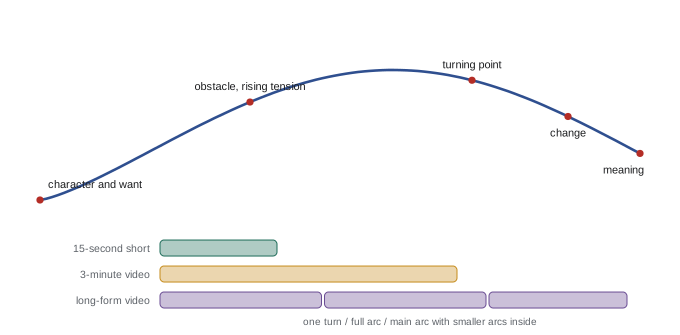
Stories can be told at any length. A fifteen-second short might contain a single turn: a situation, a twist and a reaction. A three-minute video might contain a full arc with a setup, a struggle and a resolution. A long-form video or podcast episode can weave several stories together, with a main story and smaller stories within it. The principles are the same; what changes is how much setup and detail the format allows. Shorter formats demand faster setup and clearer turns; longer formats allow richer characters, subplots and reflection. CRE-210 and CRE-211 cover structure for short and long video; this course concentrates on the storytelling and performance skills that apply across them.
Building a story habit
Creators who tell good stories consistently tend to collect them constantly. Useful habits include keeping a story bank, a note on your phone or in a document where you record moments, conversations, mistakes, surprises and observations as they happen, with the specific details that made them memorable; asking audience members, guests and customers for their stories; reviewing your week for moments of change, conflict or humour; and practising telling stories aloud to friends, which reveals what works before you film. Lesson 3 covers finding and shaping personal stories in more depth.
How this course is organized
The first three lessons build storytelling skills: foundations, narrative structures and personal stories. Lessons 4 to 8 focus on delivery: voice, speaking to camera, body language and energy, authenticity, and managing nerves. Lessons 9 to 11 cover unscripted and live delivery, interviewing guests and working with collaborators. Lesson 12 brings everything together with practice methods, feedback, inclusive presenting and a capstone in which you plan, perform and evaluate a story-driven video.
Stories across cultures and traditions
Storytelling traditions differ around the world, and knowing them broadens a creator's toolkit. Many Indigenous storytelling traditions in Canada and the United States emphasize relationships, place, cycles and teachings passed between generations, and some stories belong to particular communities or may only be told at certain times or by certain people, so creators should not retell them without permission. Oral traditions in West Africa, carried by griots, combine history, music and praise. East Asian narrative forms such as kishōtenketsu, a four-part structure of introduction, development, twist and reconciliation, build interest through contrast and surprise rather than conflict. Folk tales everywhere use repetition, patterns of three and memorable characters. Western screenwriting conventions dominate online video, but audiences enjoy stories that follow other shapes, and creators from many backgrounds bring their own traditions to their content.
Stories as a gift to the audience
A helpful way to think about storytelling is as a gift: you are offering the audience an experience, an insight or a feeling that they could not get elsewhere. This mindset shifts attention from "how do I look telling this?" to "what will this give the viewer?", which tends to improve both the choice of stories and the delivery. Ask, before telling any story, what the viewer will gain: a laugh, a warning, reassurance, a skill, a new way of seeing. Stories told purely to impress, such as long accounts of personal achievements, often feel self-centred; the same events told to show what the audience can learn from them feel generous.
Common storytelling myths
Several myths hold creators back. One is that you need extraordinary experiences; in fact, ordinary experiences told with insight are more relatable. Another is that stories must be long; many of the most effective stories are told in under a minute. A third is that storytelling is a talent you either have or lack; like any skill, it improves with practice, feedback and study. A fourth is that every video must be a dramatic story; often a small story element, such as a brief anecdote at the start, is enough to transform informational content.
A quick story checklist
Before filming any story, run through a short checklist. Who is the character, and what do they want? What stands in the way, and what is at stake? Where does the story start, and is that as close to the action as possible? What is the turning point, and have I slowed down there with a specific scene? What changed by the end, and what is the point for the viewer? Have I cut details that do not serve the story? Is everything honest? Answering these questions takes a few minutes and often turns an ordinary anecdote into a memorable story.
Stories and memory for viewers
Stories also help viewers remember your content long after watching. When viewers recall a video weeks later, they usually remember a story, an example or a striking detail rather than a list of points. Building each important idea around a short story or concrete example therefore makes your content more useful as well as more engaging, and makes it more likely that viewers will retell it to others, which is how much content spreads.
Common mistakes
MistakeListing information without a problem or a person.
InsteadFrame information with a character, a want and an obstacle.
MistakeDescribing emotions in general terms.
InsteadUse specific details that let viewers feel them.
MistakeIncluding every true detail.
InsteadSelect details that serve the story.
MistakeInventing or exaggerating events for effect.
InsteadCompress and simplify honestly, without fabrication.
MistakeEnding without a change or point.
InsteadShow what changed and what it means.
Summary and key terms
- Stories aid memory, create empathy and anticipation, and carry meaning.
- Core elements: character, want, obstacle, stakes, change and meaning.
- Stories show and are organized by time and cause; information tells.
- Storytellers select and order events and must stay honest.
- Point of view and voice shape how close viewers feel.
- Specific details create emotion and credibility.
- Stories work at every length; a story bank keeps them coming.
- Story
- Account of a character pursuing a goal through obstacles to a change.
- Character
- The person or subject the audience follows.
- Want
- The goal a character pursues.
- Obstacle
- What stands in the way of the goal.
- Stakes
- What depends on success or failure.
- Narrative transportation
- Being absorbed into a story's world.
- Point of view
- Perspective from which a story is told.
- Specificity
- Use of concrete, particular details.
- Arc
- The shape of change through a story.
- Story bank
- A collection of potential stories and details.
Practice problems
Work each problem on paper first, then reveal the answer to check.
Name three reasons stories work.
Show answer
Memory, empathy, anticipation, meaning.
List the six core story elements.
Show answer
Character, want, obstacle, stakes, change, meaning.
What happens to a story without stakes?
Show answer
Viewers do not care.
How are stories organized, compared with information?
Show answer
By time and cause rather than topic.
Give a common pattern combining story and information.
Show answer
Story shows the problem, information solves it, return to the story.
What is second-person storytelling?
Show answer
Placing the viewer in the story using "you".
How do you create emotion?
Show answer
Specific concrete details rather than general statements.
What is acceptable compression versus fabrication?
Show answer
Simplifying and ordering is fine; inventing events is not.
What can a 15-second short contain?
Show answer
A single turn: situation, twist, reaction.
What is a story bank?
Show answer
A running collection of moments and details.
Lesson quiz · 5 questions
Score 60% or more to complete this lesson.
Create a free account to save your progress, take quizzes and earn a certificate.